
Most people hang lights on a Christmas tree as an afterthought—stringing one set haphazardly, stepping back, and calling it done. The result? A flat, monotonous glow that fades into the background instead of commanding attention. But lighting a tree isn’t about illumination alone; it’s about sculpting space, guiding the eye, and building emotional resonance through light. The most compelling trees—the ones featured in design magazines, hotel lobbies, and award-winning holiday displays—share a quiet secret: they treat bulbs like brushstrokes. Small bulbs recede like fine detail work; medium bulbs anchor the midground; large bulbs pop forward like focal points. When layered intentionally, these sizes create optical depth, rhythmic contrast, and theatrical drama—transforming your tree from festive to unforgettable.
Why Bulb Size Matters More Than You Think
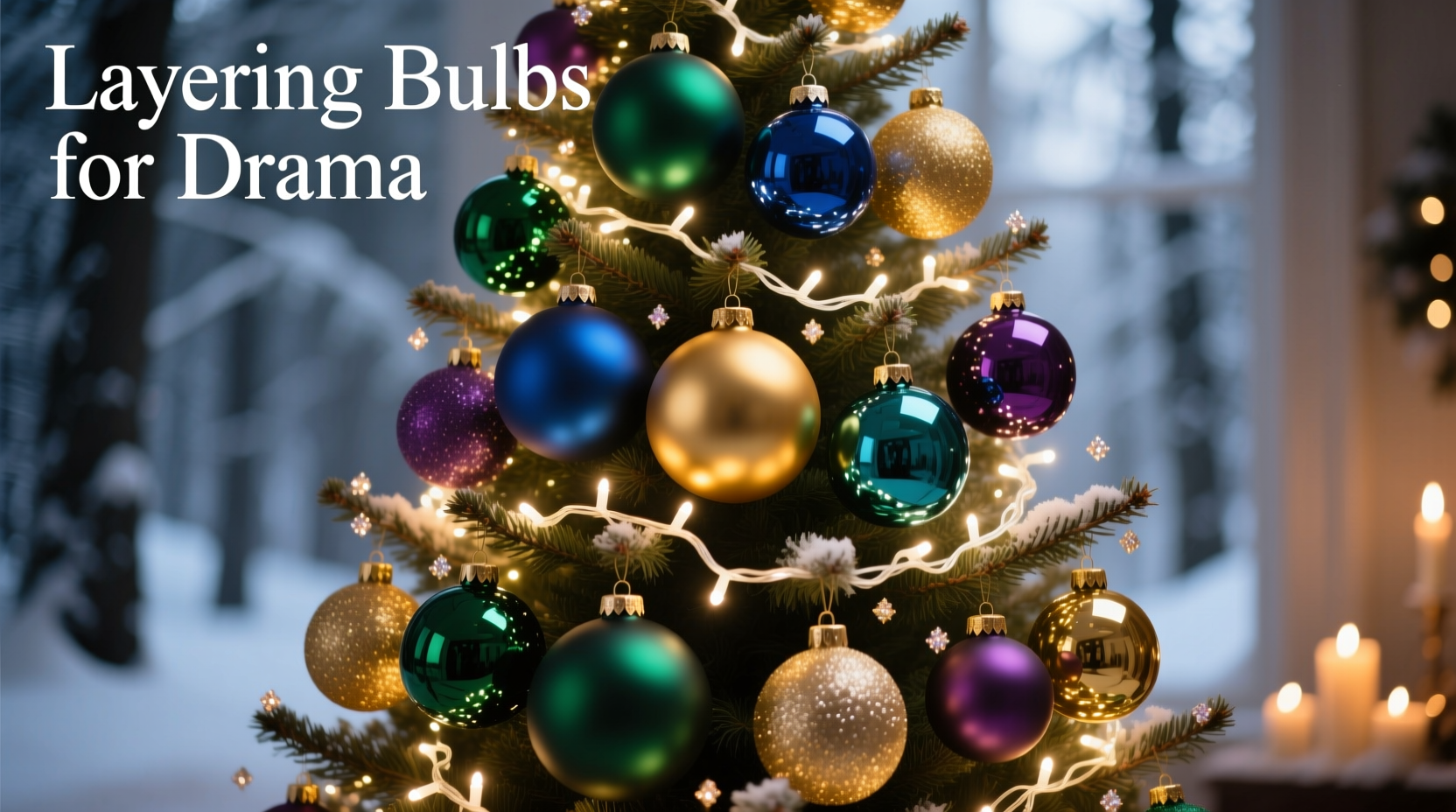
Human vision interprets scale and distance through relative size, texture, and contrast. On a densely branched evergreen, a 5mm micro-bulb appears delicate and distant—even when placed near the trunk—because its small surface area diffuses light softly and integrates with needle texture. A 12mm vintage-style bulb, by contrast, projects bold, defined halos and draws immediate focus. Without variation, the eye has no hierarchy to follow: everything competes equally, resulting in visual fatigue rather than delight. Designers at Balsam Hill and the Rockefeller Center Tree Team confirm this principle is foundational—not decorative flair, but spatial intelligence. As lighting consultant and former White House holiday decorator Marisol Vega explains:
“Size variation creates implied layers—like atmospheric perspective in painting. Tiny bulbs suggest ‘far away’ foliage; larger ones act like lanterns held close. That illusion of depth is what makes a tree feel alive, not lit.” — Marisol Vega, Holiday Lighting Designer & Author of The Lighted Tree
This isn’t theory. It’s perceptual science applied to tradition. And it begins not with color or twinkle mode—but with deliberate sizing.
The Three-Tier Layering System (and Why It Works)
Forget “more lights = better tree.” Effective layering uses three distinct bulb diameters, each assigned a precise structural role. This system works across all tree types—real firs, pines, spruces, and high-quality fakes—with consistent results.
- Base Layer (Micro-Bulbs, 2.5–4.5mm): These are your foundation. Not fairy lights in the traditional sense, but ultra-fine, warm-white LED bulbs with narrow beam angles. They’re tucked deep into the interior branches and inner third of outer limbs—not visible head-on, but glowing *through* the needles. Their purpose is ambient fill: eliminating shadows, softening density, and creating a gentle “backlight” effect that makes the tree appear voluminous and luminous from within.
- Mid-Layer (Standard Bulbs, 5–7mm): This is your workhorse layer—the majority of your lights (60–70%). These bulbs sit along the primary branch structure, spaced 4–6 inches apart, following the natural outward curve of each limb. They define shape, establish rhythm, and provide even, balanced brightness. Warm white or soft amber LEDs in this size deliver warmth without glare.
- Accent Layer (Statement Bulbs, 10–15mm): These are your punctuation marks—strategically placed, never random. Use them sparingly (no more than 15–20 per 6-foot tree) at key visual nodes: the apex, the lowest outward-reaching branch tips, and where major limbs intersect the trunk. Their larger surface area catches and reflects light dynamically, creating highlights that shift as viewers move—a subtle kinetic quality that reads as luxury and intention.
A Step-by-Step Installation Timeline
Layering isn’t intuitive—it requires sequencing. Follow this proven timeline for flawless execution:
- Prep (15 minutes): Unbox and test all lights. Separate by size and color temperature (stick to one Kelvin range—2200K–2700K—for cohesion). Measure your tree height and calculate needed lengths: allow 100 lights per vertical foot for micro + standard layers combined; add 15–20 statement bulbs separately.
- Interior Fill (25 minutes): With gloves on, gently part inner branches. Weave micro-bulb strings *along the trunk and inner branch crotches*, securing with twist-ties every 8 inches. Avoid wrapping tightly—let bulbs nestle naturally. Goal: invisible wiring, visible glow.
- Branch Framework (35 minutes): Starting at the bottom, spiral standard-bulb strings upward with 4-inch spacing between bulbs. Hold each bulb so its base faces inward—this directs light outward and prevents harsh glare toward viewers. Tuck loose wire behind branches.
- Strategic Accent Placement (15 minutes): Stand back every 5 minutes. Identify 3–5 “anchor points”: the topmost tip, two lower corners, and where the thickest limb meets the trunk. Clip one statement bulb at each point using mini clip-on hangers. Ensure they face slightly downward to cast gentle pools of light on lower branches.
- Final Refinement (10 minutes): Turn off room lights. Observe from multiple angles—front, side, diagonal. Adjust any micro-bulbs casting uneven shadows. Gently rotate 2–3 statement bulbs to catch ambient light differently. Add one final string of micro-bulbs vertically down the trunk if the base looks recessed.
Do’s and Don’ts: A Practical Comparison Table
| Action | Do | Don’t |
|---|---|---|
| Bulb Spacing | Micro-bulbs: cluster loosely in interior zones (no fixed spacing) Standard: 4–6 inches apart, following branch flow Statement: minimum 12 inches apart, always on structural nodes |
Space all bulbs evenly regardless of layer Place statement bulbs on thin, flexible tips (they’ll droop) |
| Color Consistency | Use identical color temperature across all layers (e.g., all 2400K warm white) Mix only if intentional—e.g., cool white micro-bulbs + warm white standards for icy depth |
Combine warm white standards with multicolor statement bulbs (creates visual chaos) Use different CRI ratings—low-CRI bulbs dull the effect of high-CRI layers |
| Wiring Management | Tuck wires behind thicker branches Use black zip ties for dark trees, green for firs Route all cords down the trunk interior before plugging |
Let wires dangle visibly between layers Wrap cords tightly around branch tips (damages needles and distorts shape) |
| Tree Type Adaptation | Dense firs: emphasize micro-bulbs to prevent “black holes” Open-branched spruces: increase statement bulb count by 30% for definition Fakes: use micro-bulbs only on inner frame wires, not plastic tips |
Apply same density to sparse and dense trees Ignore branch direction—bulbs facing sideways create confusing light patterns |
Real Example: The “Maple Street” Transformation
In December 2023, homeowner Lena R. in Portland, Oregon, struggled with her 7.5-foot Fraser fir. “It looked like a flashlight had been shoved into it,” she recalls. “All brightness, no breath.” She’d used 300 standard 5mm lights—uniform, unlayered, overwhelming. After consulting a local lighting artisan, she invested in three targeted sets: 200 micro-bulbs (3.5mm), 300 standard (6mm), and 18 matte-glass statement bulbs (12mm). She followed the step-by-step timeline over one quiet Sunday afternoon. The difference wasn’t just brighter—it was dimensional. Neighbors stopped mid-walk to ask, “How did you make it look *round*?” The micro-bulbs eliminated the hollow trunk shadow; the standards created elegant rhythm; the statement bulbs acted like tiny chandeliers at branch termini. Most telling? Her toddler pointed not at the lights, but *at the spaces between them*—the soft gradients and gentle transitions that signaled depth to his developing vision. That’s the hallmark of successful layering: it doesn’t shout “look at me!”—it invites slow, sustained looking.
Essential Tools & Supplies Checklist
- Micro-bulb string (3.5mm, warm white, 200–250 count)
- Standard-bulb string (6mm, warm white, 300–400 count)
- Statement-bulb set (12mm, matte-finish, 15–20 count)
- Black or green insulated twist-ties (50+)
- Mini clip-on hangers (for statement bulbs)
- Soft cotton gloves (to protect needles and bulbs)
- Stepladder with stable base (never stand on furniture)
- Dedicated outlet with surge protection (no daisy-chaining)
FAQ
Can I layer bulb sizes on a pre-lit tree?
Yes—but with precision. First, identify the existing bulb size (usually 5mm). Then add only micro-bulbs deep inside and statement bulbs at structural anchors. Never overlay a second full layer of standard bulbs—that causes overheating and wire clutter. Test the pre-lit string’s wattage capacity before adding extras.
What if I only have one set of lights? Can I still create depth?
You can approximate layering by varying *placement*, not size. Use half your string for tight interior weaving (micro effect), half for open, rhythmic spiraling (standard effect), and manually separate 5–7 bulbs to mount individually at key points (statement effect). It’s less precise, but honors the same spatial logic.
Do LED bulb sizes affect energy use or heat output?
No—modern LEDs draw negligible power regardless of size. A 12mm LED consumes the same 0.04 watts as a 3.5mm LED. Heat output is also functionally identical and safe for all tree types. Size affects only optical impact, not electrical load.
Conclusion
Layering bulb sizes isn’t a holiday hack—it’s a time-honored technique rooted in how we perceive space, light, and beauty. It asks you to see your tree not as a surface to cover, but as a three-dimensional sculpture to illuminate with intention. When micro-bulbs breathe warmth from within, standard bulbs trace the graceful architecture of each branch, and statement bulbs crown the composition with quiet confidence, something shifts. The tree stops being seasonal decor and becomes a presence—calm, generous, and deeply human. You don’t need rare bulbs or expensive gear. You need observation, patience, and the willingness to treat light as material—as worthy of thoughtful arrangement as ornaments or ribbons. This year, resist the urge to “just get it done.” Instead, take the time to build depth. Let your tree hold space—not just in your living room, but in memory. Because the most enduring holiday moments aren’t the loudest. They’re the ones that glow with quiet, layered intention.




 浙公网安备
33010002000092号
浙公网安备
33010002000092号 浙B2-20120091-4
Comments
No comments yet. Why don't you start the discussion?