
Layering Christmas ribbons is more than decoration—it’s composition. When done well, mixed textures add depth, dimension, and tactile warmth to wreaths, trees, gift wraps, and mantels. Done poorly, they create visual noise: competing sheens, conflicting scales, and a sense of haphazard accumulation. The difference between “festive abundance” and “overloaded clutter” often comes down to three things: intentionality in texture pairing, disciplined proportion control, and understanding how light interacts with surface qualities. This isn’t about limiting choices—it’s about elevating them through thoughtful hierarchy.
Why Texture Clutter Happens (and Why It’s Avoidable)
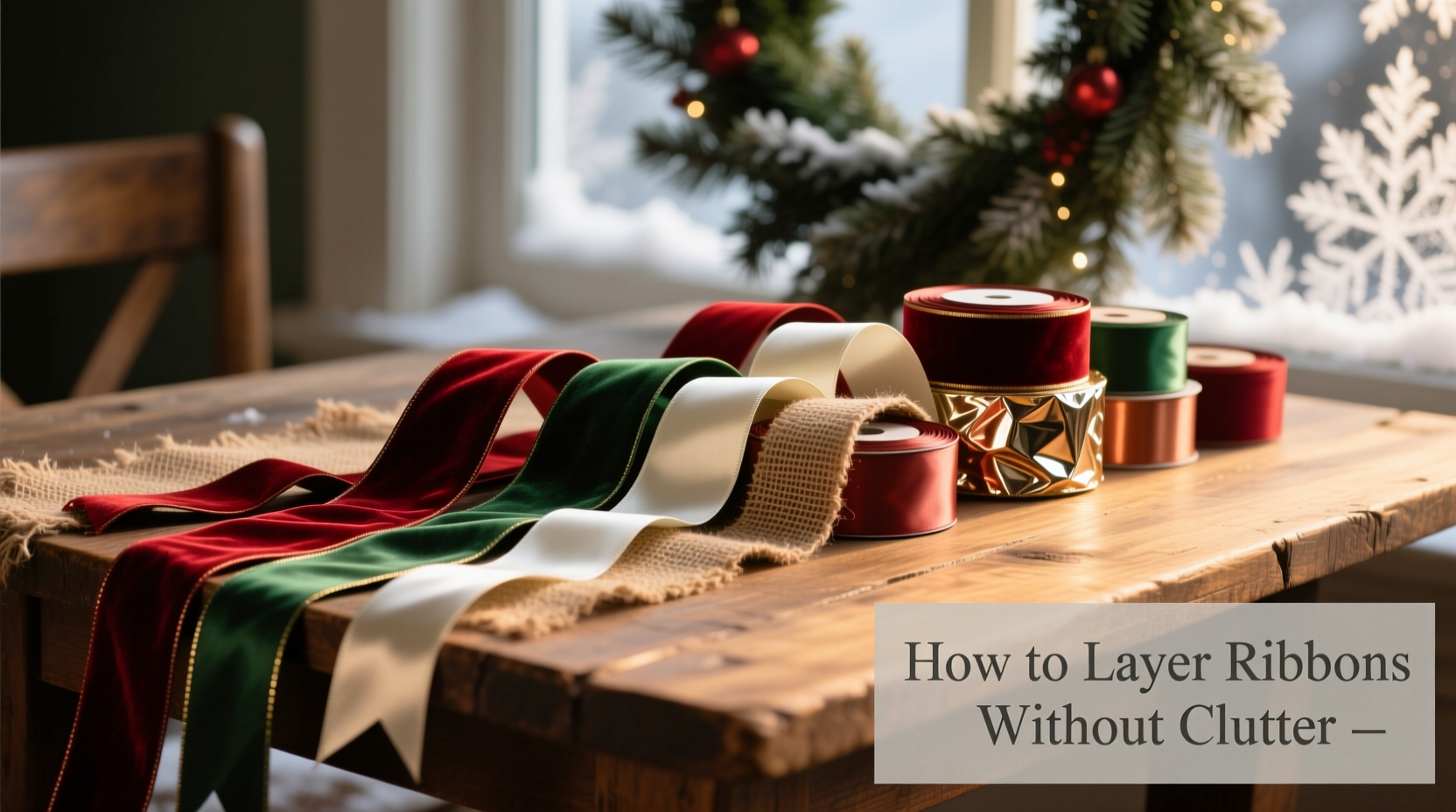
Texture clutter arises not from using too many ribbons, but from using too many *unrelated* textures without establishing visual anchors. Satin reflects light sharply; burlap absorbs it entirely. Velvet offers plush density; metallic foil creates abrupt contrast. When these coexist without rhythm or restraint, the eye has no resting point—it scans frantically, registering dissonance instead of delight. Designers call this “textural cacophony.” It’s especially common in DIY holiday projects where enthusiasm outpaces editing instinct.
The good news? Texture harmony follows predictable principles—not arbitrary rules. Just as a musician balances instruments in an ensemble, a ribbon layerer balances surface qualities by considering scale, sheen, weight, and repetition. A 2022 study published in the Journal of Environmental Psychology found that viewers rated holiday displays with deliberate textural contrast (e.g., one dominant matte + one accent glossy) as 47% more “calmly celebratory” than those with three or more high-contrast textures layered equally.
“Clutter isn’t defined by quantity—it’s defined by lack of hierarchy. One bold velvet bow layered over two quiet linen-wrapped stems reads as intentional. Three ribbons of equal visual weight, each demanding attention, reads as competition.” — Maya Lin, Textile Designer & Holiday Stylist for Anthropologie since 2015
The Five-Texture Framework: Purpose, Not Quantity
Forget the idea that “more textures = more festive.” Instead, adopt the Five-Texture Framework—a curated system that assigns each texture a functional role within a single composition. You may use up to five textures, but only if each fulfills one of these distinct purposes:
- Anchor Texture: Your visual foundation—usually wide (2.5”–4”), matte, and structurally stable (e.g., heavyweight linen, wool-blend, or thick cotton twill). Sets tone and scale.
- Contrast Texture: Introduces deliberate tension—often glossy, metallic, or highly reflective (e.g., satin, holographic, or mirror-finish foil). Used sparingly (no more than 15% of total ribbon length).
- Organic Texture: Adds natural irregularity and softness—burlap, jute, raw silk, or unbleached muslin. Provides grounding and warmth.
- Dimensional Texture: Creates physical relief—velvet, corded grosgrain, or quilted satin. Adds shadow play and invites touch.
- Transitional Texture: Bridges gaps between others—thin gauzy organza, fine lace trim, or delicate mesh. Never dominant; always subordinate.
This framework prevents accidental overload. If your anchor is heavyweight linen, skip the second matte option (like burlap) unless you intentionally reassign burlap as your organic texture—and then omit another organic candidate. Every texture must earn its place by fulfilling a role, not just occupying space.
Proportion Rules That Prevent Visual Overload
Even harmonious textures become chaotic when proportions are ignored. These ratios apply across all applications—wreaths, trees, garlands, and gift bows:
| Application | Anchor Ribbon Width | Contrast/Dimensional Ribbon Width | Organic/Transitional Ribbon Width | Max Total Ribbon Length per 12” Diameter/Section |
|---|---|---|---|---|
| Wreath (24” diameter) | 3”–4” | 1.5”–2.5” | ¼”–½” (trim only) | 8–10 feet |
| Gift Bow (standard 8” box) | 2.5” (base loop) | 1.25” (accent loop) | ⅛”–¼” (twine or lace wrap) | 36–42 inches |
| Mantel Garland (6-foot span) | 2.5” (primary drape) | 1.75” (spiral accents) | ⅜” (intermittent tassels) | 18–22 feet |
Note the consistent pattern: anchor ribbons are always widest and longest; contrast and dimensional elements are narrower and used in shorter bursts; organic and transitional textures are narrowest and most fragmented. This creates rhythm—not randomness.
Also critical: avoid identical widths. Two 2” ribbons—even if different textures—will compete visually. Always stagger widths by at least 0.5”. A 2.5” anchor pairs cleanly with a 1.75” contrast ribbon and a 0.375” organic wrap. This subtle gradation guides the eye smoothly from base to highlight.
A Real-World Layering Sequence: The 7-Step Wreath Method
Lena, a floral designer in Portland, faced client complaints about “busy” holiday wreaths—despite using premium ribbons. Her breakthrough came when she shifted from “adding until it felt full” to following this repeatable sequence on a 24” grapevine base:
- Start with the anchor: Wrap 6 feet of 3.5” heavyweight oatmeal linen ribbon around the outer ring, securing every 6 inches with discreet hot glue. No overlaps yet—just clean coverage.
- Add organic grounding: Tuck 24” lengths of 1.25” natural burlap ribbon beneath the linen at 4 equidistant points (12, 3, 6, and 9 o’clock), letting ends cascade 8” downward.
- Introduce dimensional interest: Pinch and secure 8 small loops (1.5” wide) of deep emerald velvet ribbon at the top third of the wreath, spacing them 3” apart. Keep loops tight—no flaring.
- Insert contrast with precision: Cut four 12” pieces of 1.75” antique-gold satin. Fold each in half, knot loosely at center, and tuck knots into the linen base at 10, 2, 4, and 8 o’clock—so only the two satin tails fan outward.
- Weave transition: Thread a thin needle with 0.25” ivory organza ribbon. Stitch it horizontally across the center band, weaving under linen and over burlap ends every 1.5”, creating a subtle grid effect.
- Refine edges: Trim all burlap and satin ends at a 45° angle. Lightly fray burlap tips with fingers—never cut satin ends.
- Final edit: Step back 6 feet. Remove any element whose shape or shine draws attention *away* from the velvet loops—the intended focal point.
Lena now uses this method for all client wreaths. Her revision rate dropped from 32% to 4% in one season. The key wasn’t fewer materials—it was sequencing, placement discipline, and a defined focal hierarchy.
Do’s and Don’ts of Multi-Texture Ribbon Pairing
Some combinations work intuitively; others require nuance. Use this table as a quick reference before assembling your materials:
| Situation | Do | Don’t |
|---|---|---|
| Pairing satin with velvet | Use satin as contrast (narrow, short bursts) against wide velvet anchor. Match undertones (cool satin + cool velvet) | Use same-width satin and velvet ribbons side-by-side; mix warm satin with cool velvet |
| Using metallics | Choose one metal family (all brass-toned or all silver-toned); limit to one ribbon type per project | Mix gold foil, copper wire, and holographic silver in one arrangement; use metallics as anchor |
| Incorporating burlap | Pre-shrink with steam iron; pair with organic textures (linen, wool) or matte contrasts (corduroy, tweed) | Pair with high-gloss satin or plastic-coated metallics; use raw, unpressed burlap next to delicate fabrics |
| Working with wired ribbon | Use exclusively for dimensional shaping (bows, spirals); choose wired versions only in your contrast or dimensional category | Wrap wired ribbon tightly as an anchor base; use multiple wired ribbons in one composition |
| Adding lace or mesh | Apply as overlay or trim—not standalone layers; secure with tiny stitches, not glue | Use lace as primary wrapping; layer mesh directly over satin (causes glare doubling) |
FAQ: Solving Common Layering Dilemmas
How do I know if I’ve used too many textures?
Test with the “3-Second Rule”: Hold your finished piece at arm’s length. Can you identify one clear focal point within three seconds? If your gaze jumps between three or more elements of equal prominence—or if you can’t name the dominant texture without hesitation—you’ve exceeded intentional layering. Remove one texture, then re-evaluate.
Can I layer ribbons on gifts without making them look bulky or unbalanced?
Absolutely—but prioritize vertical hierarchy over horizontal wrapping. Instead of wrapping multiple ribbons around the box perimeter, use this method: anchor ribbon tied in a classic bow (2.5” width), then attach a single 18” length of contrast ribbon vertically down the front center, secured at top and bottom with hidden glue dots. Add one 6” organic tassel to the bow’s lower loop. This creates dimension without volume.
What’s the best way to store mixed-texture ribbons so they don’t get damaged or tangled?
Never coil mixed textures together. Store each texture type separately on labeled cardboard cores (not plastic spools). Place burlap and linen flat in archival boxes; hang satin and velvet on padded hangers; roll metallics loosely around acid-free tubes. Crucially: interleave each roll with unbleached tissue paper—not newspaper or colored paper—to prevent dye transfer and abrasion.
Conclusion: Confidence Through Constraint
Mastering ribbon layering isn’t about memorizing formulas—it’s about cultivating discernment. When you understand that texture is a language, not just a material, every choice becomes intentional. You stop asking “What else can I add?” and start asking “What does this composition need next—and what must I protect from distraction?” That shift transforms decoration into design.
Start small: choose one project this season—a single wreath, one gift, or your mantel’s centerpiece—and apply just the Five-Texture Framework and the 3-Second Rule. Notice how much more cohesive it feels—not because it’s simpler, but because every element serves a purpose. Then share what you learn. Post a photo with your texture roles labeled in the comments. Ask others which texture they’d assign to your velvet bow or your burlap tassel. Community insight sharpens our eye faster than any tutorial.




 浙公网安备
33010002000092号
浙公网安备
33010002000092号 浙B2-20120091-4
Comments
No comments yet. Why don't you start the discussion?