
Most holiday trees shine—but few truly glow with dimension. A flat curtain of white lights may look tidy, but it lacks the warmth, movement, and quiet drama of a professionally lit tree. The secret isn’t more bulbs; it’s strategic layering. Just as a painter builds depth with underpainting, mid-tones, and highlights, skilled light designers use distinct light types—not just colors or intensities—to sculpt space, guide the eye, and create optical resonance. This approach transforms your tree from decorative backdrop into a living centerpiece: rich in shadow play, alive with subtle contrast, and layered with intention.
Layering isn’t about randomness or accumulation. It’s about assigning purpose—each light type occupies a specific visual plane and fulfills a defined role in the overall composition. When executed well, layers interact: warm base lights soften cool accents; tightly wound strings anchor looser netting; directional spots punctuate diffuse glows. The result is a tree that reads differently from every angle—and rewards closer looking.
The Four Foundational Light Layers (and Why Each Matters)
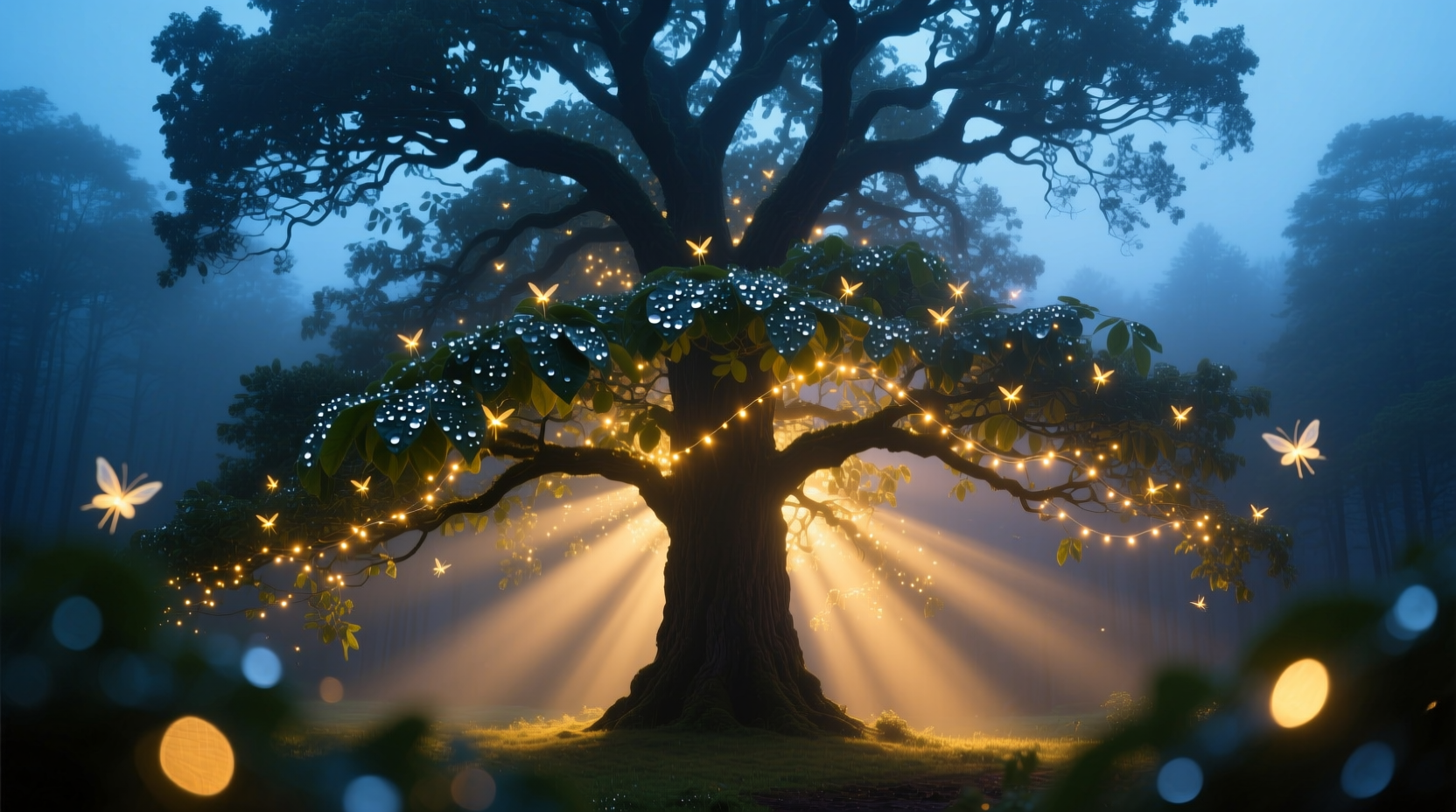
Successful layering begins with understanding function—not aesthetics alone. Each light type serves a structural role in the three-dimensional architecture of your tree:
- Base Layer (Structure & Warmth): Soft, even illumination that defines the tree’s silhouette and establishes ambient temperature. Think of this as the “canvas”—not meant to dazzle, but to unify and ground.
- Mid Layer (Rhythm & Texture): The primary visual rhythm. This layer adds pattern, repetition, and tactile suggestion—whether through tightly coiled strings, clustered clusters, or woven netting. It carries the tree’s dominant personality.
- Accent Layer (Focus & Contrast): Intentional points of emphasis—brighter, cooler, or more directional—that draw attention to specific branches, ornaments, or natural features like pine cones or ribbon bows.
- Highlight Layer (Sparkle & Surprise): The finest, most deliberate touches: fiber optics, micro LEDs, or programmable flicker elements placed only where they’ll catch the eye in motion or reflect off glass or metal.
This hierarchy prevents visual competition. Without a strong base layer, accents feel jarring. Without rhythm in the mid layer, highlights scatter rather than sing. With all four present and balanced, the tree breathes.
Choosing the Right Light Types for Each Layer
Not all lights are interchangeable—even if they share the same color temperature or bulb count. Their physical design, beam angle, spacing, and control capabilities determine their ideal layer role. Here’s how to match form to function:
| Light Type | Ideal Layer | Why It Fits | Key Limitation to Avoid |
|---|---|---|---|
| Incandescent or LED Mini String Lights (50–100 bulbs, 6–12” spacing) | Base Layer | Soft, diffused glow; flexible wire allows deep weaving into inner branches; warm white variants (2200K–2700K) mimic candlelight without glare. | Don’t use ultra-cool white (5000K+) here—it flattens depth and creates clinical contrast against ornaments. |
| LED Net Lights (2’x4’, 150–300 bulbs) | Mid Layer | Provides instant, even texture across large surface areas; lightweight mesh drapes naturally over outer foliage; ideal for creating “halo” effect around tree perimeter. | Avoid heavy-duty commercial nets—they’re stiff, bulky, and obscure branch structure instead of enhancing it. |
| Directional Spotlights (LED PAR30 or MR16, 25°–40° beam) | Accent Layer | Pinpoints specific zones: a cluster of mercury glass balls, a vintage tinsel garland, or the trunk’s natural knotwork; adjustable focus prevents spill onto ceiling or walls. | Never aim directly at eyes or reflective surfaces—use dimmers and warm-white bulbs (2700K–3000K) to maintain cohesion. |
| Fiber Optic Tree Topper or Micro LED Clusters (battery-operated, <1mm bulbs) | Highlight Layer | Creates pinpoint sparkle without heat or wiring bulk; ideal for delicate placements—inside hollow ornaments, wrapped around twig bows, or nestled in faux snow. | Don’t overuse—limit to 3–5 intentional points per tree. More dilutes impact. |
Notice the progression: base lights are *integrated*, mid-layer lights are *draped*, accents are *aimed*, and highlights are *placed*. That sequence reflects increasing specificity—and decreasing quantity.
A Step-by-Step Layering Timeline (For a Standard 7-Foot Flocked Fir)
Timing matters as much as technique. Rushing layers leads to tangled wires and compromised placement. Follow this 45-minute sequence—designed for efficiency and precision:
- Prep & Base (10 min): Fluff tree fully. Starting at the trunk, weave warm-white mini string lights (100-count) inward-first—wrap each branch from base to tip, then move upward in spiral fashion. Keep wires tight against limbs. Use 3–4 strands total, spaced evenly vertically. Unplug when done.
- Mid-Layer Draping (12 min): Drape two 2’x4’ warm-white net lights over the tree’s outer third—first over top half, then bottom half—allowing gentle overlap at the waist. Tuck loose edges behind outer branches; never pull taut. Adjust until netting follows natural branch contours, not fights them.
- Accent Positioning (15 min): Mount two adjustable LED spotlights (2700K, 30° beam) on adjacent wall brackets, 36” from tree base, angled upward at 45°. Focus one on upper-third ornament cluster (e.g., silver bells), the other on lower-third focal point (e.g., hand-blown glass icicle). Dim both to 60% brightness.
- Highlight Placement (5 min): Using tweezers or needle-nose pliers, insert five micro LED clusters (warm white, battery-powered) into these precise locations: inside one large clear ornament (centered), wrapped once around a velvet bow’s knot, tucked beneath a pinecone’s lowest scale, hidden in the crook of a top-tier branch, and secured behind a mirrored star topper for reflected sparkle.
- Final Calibration (3 min): Stand 8 feet back. Observe balance: Is the base glow consistent? Does the net layer pulse gently, not dominate? Do accents land precisely—or bleed into background? Adjust spotlight focus or reposition one highlight if needed. Then plug in all layers simultaneously.
This timeline assumes no pre-lit tree and standard household tools (step stool, gloves, tweezers). For artificial trees with dense PVC tips, reduce net light count by one—over-layering obscures form.
Real Example: The “Maple Street” Tree Transformation
In December 2023, interior stylist Lena Ruiz faced a challenge: her client’s 7.5-foot pre-lit Nordmann fir had factory-installed cool-white lights that made ornaments look washed out and the room feel sterile. The client loved vintage mercury glass but hated how it “disappeared” under flat illumination.
Lena removed the factory lights entirely—a bold but necessary step. She began with 120-warm-white mini lights (2700K, 6” spacing), hand-woven deep into the tree’s interior framework. Next, she draped a single 2’x4’ net light over the outer canopy, choosing a matte-finish version that diffused rather than reflected. For accents, she installed two low-voltage MR16s with barn-door shields to narrow beams—aiming one at a hanging mercury glass mobile suspended 12” from the trunk, the other at a cluster of antique brass stars wired to lower branches. Finally, she embedded six fiber optic strands (each with 20 micro-tips) inside hollow glass ornaments—activated only when the tree was viewed from the hallway entrance, creating a “secret sparkle” effect.
The result? A tree that felt intimate and luminous from the sofa, yet revealed new details when walking past. The mercury glass regained its liquid shimmer. And crucially—the client reported guests consistently paused in the doorway, drawn in by what they described as “the way the light moves, not just shines.”
“Depth in lighting isn’t about stacking intensity—it’s about orchestrating perception. A warm base layer tells the eye ‘this is solid.’ A rhythmic mid-layer says ‘this has texture.’ Accents whisper ‘look here.’ Highlights make you lean in. When those cues align, the tree stops being an object and starts telling a story.” — Rafael Torres, Lighting Designer & Author of Architectural Light Language
Common Layering Pitfalls (and How to Fix Them)
Even experienced decorators misstep when layering. These five issues appear most frequently—and each has a direct, actionable correction:
- Pitfall: “Bulb Bloat” — Using too many lights per layer, especially in the mid-layer, resulting in visual noise and lost branch definition.
Solution: For a 7-foot tree, cap mid-layer bulbs at 300 total. Count them before draping. If using net lights, choose 150-bulb versions over 300-bulb for denser trees. - Pitfall: Temperature Clash — Mixing cool-white (5000K) base lights with warm-white (2700K) accents, creating jarring, unbalanced color zones.
Solution: Stick to one dominant temperature (2700K–3000K) across all layers. Use dimmers—not color filters—to vary intensity. Reserve cool white only for *one* intentional highlight (e.g., a single blue-glass ornament). - Pitfall: Static Hierarchy — All layers operating at full brightness, eliminating visual rhythm and making the tree feel “shouted at.”
Solution: Apply the 70/20/10 rule: Base layer at 70% brightness, mid-layer at 20%, accents/highlights at 10%. Use smart plugs or dimmer switches—not manual toggles—to maintain ratios. - Pitfall: Ignoring the Trunk — Focusing only on foliage, leaving the trunk dark and visually “cutting off” the tree’s base.
Solution: Wrap 2–3 strands of warm-white mini lights vertically around the trunk (spaced 6” apart), starting 6” above soil line. Conceal plugs behind burlap wrap or moss. - Pitfall: Forgetting the Back — Lighting only the front-facing side, creating a flat appearance when viewed from angles.
Solution: After completing front layers, walk behind the tree. Add 1–2 extra mini-light strands to the rear third of branches—woven less densely, focused on silhouette reinforcement, not detail.
FAQ
Can I layer lights on a pre-lit tree?
Yes—but with caveats. First, verify the pre-lit wiring can handle added load (check manufacturer specs). Second, avoid covering existing lights with netting or dense strings—heat buildup risks damage. Instead, use the factory lights as your base layer, then add only mid-layer net lights (if lightweight) and *external* accents (spotlights, fiber optics). Never splice or modify pre-lit wiring.
How many total lights do I need for effective layering?
Forget “100 lights per foot.” Focus on distribution: For a 7-foot tree, aim for 300–400 base-layer bulbs (woven deep), 150–300 mid-layer bulbs (net or string), 2–4 accent points (spotlights), and 5–8 highlight points (micro LEDs). Total bulbs range 450–750—not more, not less. Density without purpose creates glare, not glamour.
Do I need special tools or electrical knowledge?
No specialized tools beyond gloves, tweezers, and a step stool. For safety: use UL-listed lights only, never exceed outlet wattage limits (1,440 watts per 15-amp circuit), and plug layers into separate surge-protected power strips—not daisy-chained outlets. If using spotlights requiring low-voltage transformers, hire an electrician for hardwiring—don’t DIY.
Conclusion
A layered tree doesn’t happen by accident. It emerges from deliberate choices: selecting lights by function, not just aesthetics; respecting the tree’s natural architecture; and trusting restraint over abundance. Depth isn’t added—it’s revealed. Sparkle isn’t sprayed on—it’s coaxed out through contrast, placement, and patience. When you step back from your finished tree and feel that quiet pull—the instinct to linger, to trace the path of light from trunk to tip—you’ll know the layers have spoken in harmony.
This year, resist the urge to “just add more.” Instead, ask: What does this branch need? Where does the eye want to rest? What would make that ornament sing? Answer those questions with intention, and your tree won’t just glow—it will resonate.




 浙公网安备
33010002000092号
浙公网安备
33010002000092号 浙B2-20120091-4
Comments
No comments yet. Why don't you start the discussion?