
Fragrance layering is more than a trend—it’s a refined art that transforms the way scent interacts with your skin and environment. When done correctly, it can extend the life of your perfume, deepen its complexity, and create a signature aura that evolves throughout the day. Yet, many people attempt layering only to end up with a muddy, overwhelming, or disjointed aroma. The key lies not in quantity but in harmony: understanding scent families, application techniques, and product compatibility. This guide breaks down the science and style behind effective fragrance layering, offering actionable strategies to make your scent last longer—without clashing.
The Science Behind Scent Longevity
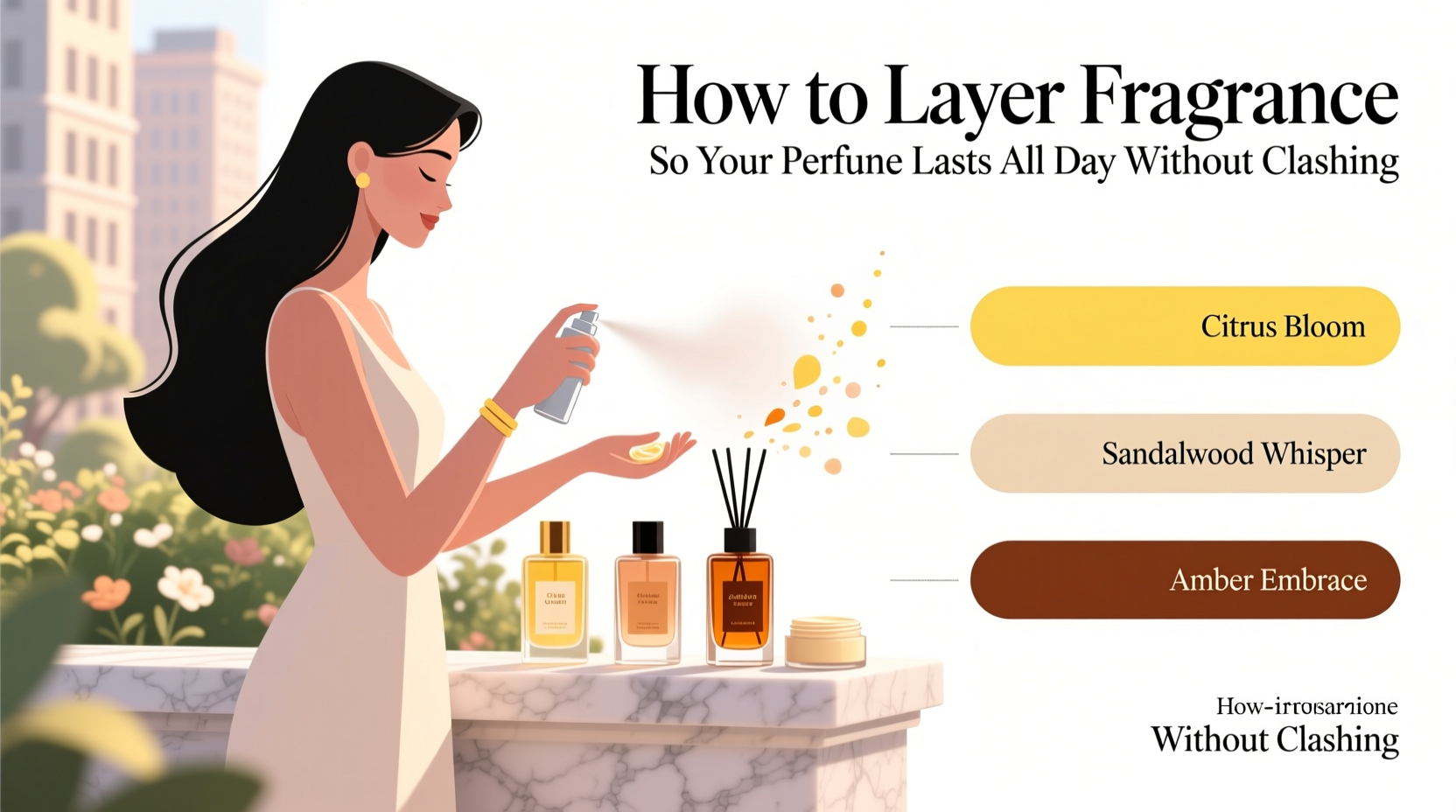
Perfume doesn’t simply fade; it evaporates in stages known as \"notes.\" Top notes are the first impression—light, volatile molecules like citrus or herbs that dissipate within 15–30 minutes. Middle (or heart) notes emerge next, often floral or spicy accords that define the character of the fragrance. Finally, base notes—such as sandalwood, vanilla, or musk—anchor the scent and can linger for hours.
The challenge? Most off-the-shelf perfumes lose their presence by midday, especially if applied over dry skin or incompatible products. Layering works by reinforcing these notes across different concentrations and textures, creating a cumulative effect that resists evaporation. A well-layered fragrance routine uses complementary scented products—from body wash to oil to eau de parfum—to build depth and endurance.
“Layering isn't about mixing every scent you own. It's about building a narrative—one that unfolds from morning to night.” — Isabelle Marais, Master Perfumer at Osmologie Paris
Step-by-Step Guide to Fragrance Layering
Effective layering follows a logical sequence, starting from the most hydrating and subtle products to the most concentrated. Follow this timeline for optimal results:
- Start with a scented shower gel or soap in the same fragrance family as your target perfume. This primes your skin with a faint base note and opens pores for better absorption.
- Apply a matching body lotion or moisturizer immediately after bathing. Hydrated skin holds scent longer. Choose one infused with the same core ingredients as your perfume.
- Use a fragrance oil or solid perfume on pulse points before spraying. These are richer and slower to evaporate, forming a stable foundation.
- Spray your eau de parfum or extrait onto secondary pulse points, avoiding oversaturation. Focus on wrists, inner elbows, and behind knees.
- Reinforce with a light mist of matching room spray or hair perfume if desired—but sparingly. These add ambient diffusion without direct skin overload.
Choosing Compatible Scents: What Works Together?
Not all fragrances are meant to be layered. Clashing occurs when opposing scent families compete instead of complementing. For example, pairing a sharp green tea cologne with a heavy gourmand vanilla perfume often results in confusion rather than cohesion.
To avoid discord, align your choices within the same olfactory group. Here’s a breakdown of major fragrance families and compatible partners:
| Fragrance Family | Key Notes | Best Paired With | Avoid Mixing With |
|---|---|---|---|
| Floral | Rose, jasmine, peony, lily | Soft musks, light woods, clean cotton | Heavy spices, leather, tobacco |
| Oriental/Amber | Vanilla, amber, cinnamon, incense | Gourmands, warm resins, patchouli | Citrus-heavy colognes, aquatic scents |
| Woody | Sandalwood, cedar, vetiver, oud | Smoky accords, leather, dark chocolate | Fruity florals, sharp citruses |
| Fougère | Lavender, coumarin, oakmoss | Barbershop scents, citrus top notes | Floral gourmands, tropical fruits |
| Citrus/Aromatic | Bergamot, lemon, mint, basil | Marine notes, green tea, fresh linen | Dense orientals, smoky woods |
When experimenting with different brands or lines, look for shared key notes. If your perfume features bergamot and vetiver, seek a body oil with those same elements—even if labeled under a different name.
Common Mistakes That Cause Scent Clashes
Even experienced users fall into traps that undermine their efforts. Recognizing these pitfalls can save both your nose and your reputation:
- Over-application: More is not better. Applying multiple strong perfumes overwhelms the senses and masks individual notes.
- Mixing across genders: While unisex fragrances exist, traditionally feminine florals and masculine spice blends rarely harmonize unless intentionally designed to do so.
- Ignoring skin chemistry: Your body alters how scent develops. Test combinations on your skin, not just on blotter strips.
- Using unscented products inconsistently: Switching between scented and unscented lotions creates gaps in the scent trail, breaking continuity.
- Layering too late in the day: Adding a new, unrelated scent hours later disrupts the evolution of the original fragrance.
Real Example: Building a Cohesive Morning-to-Night Scent
Sophia, a marketing executive based in London, wanted her signature scent—a niche floral-woody blend with violet and cashmere musk—to last through back-to-back meetings and an evening event. She previously relied solely on reapplying her EDP, which led to an overpowering cloud by 7 PM.
Her revised routine:
- Showered using a violet-infused body wash.
- Applied a shea-butter-based body cream with violet leaf and white musk.
- Massaged a drop of sandalwood-vanilla fragrance oil onto her collarbones and wrists.
- Lightly sprayed her perfume (2 sprays: one behind each ear, one at the nape).
The result? Her scent remained present but elegant throughout the day. Coworkers commented on her “soft, comforting aura,” and she didn’t feel the need to reapply until late evening. By reinforcing the same olfactory theme across textures, she achieved longevity without heaviness.
Checklist: Build Your Own Layering Routine
Before creating your personalized fragrance layering system, ensure you’ve covered these essentials:
- ✅ Identify your primary perfume’s fragrance family and key notes.
- ✅ Source a matching or complementary scented body wash or soap.
- ✅ Choose a rich, unscented or on-theme moisturizer for daily use.
- ✅ Invest in a fragrance oil or solid perfume with similar base notes.
- ✅ Limit your spray perfume to 2–3 strategic applications per day.
- ✅ Avoid mixing more than two core scents in a single day.
- ✅ Patch-test new combinations on your skin before full adoption.
- ✅ Store all fragrance products away from heat and sunlight to preserve integrity.
Frequently Asked Questions
Can I layer different brands of perfume?
Yes, but only if they share dominant notes and belong to the same fragrance family. For example, a Jo Malone woodsy scent may pair well with a Diptyque Baies body cream if both emphasize cassis and patchouli. Blind mixing without consideration often leads to imbalance.
How do I know if two scents clash?
If the combined aroma feels chaotic, overly sweet, sour, or chemically harsh, they likely don’t work together. Trust your instinct—if you have to ask, the answer is probably yes. Let the scents sit on your skin for at least 30 minutes before judging, as initial impressions can be misleading.
Is it safe to layer fragrance oils with alcohol-based perfumes?
Absolutely. In fact, this combination is ideal: oils adhere to skin longer, while alcohol-based sprays provide immediate projection. Just ensure the oil is fully absorbed before spraying to prevent uneven distribution.
Expert Insight: The Role of Skin Type
Your skin plays a decisive role in how layered fragrances behave. Oily skin naturally holds scent longer due to increased sebum production, which binds aromatic molecules. Dry skin, however, tends to absorb and release fragrance rapidly, shortening its lifespan.
“Hydration is the invisible ingredient in lasting scent. Without it, even the finest perfume vanishes in hours.” — Dr. Lena Petrov, Cosmetic Chemist & Olfactory Consultant
For dry or mature skin, incorporate a non-greasy facial oil or body serum beneath your scented moisturizer. Those with sensitive skin should opt for alcohol-free, hypoallergenic layers to prevent irritation.
Conclusion: Make Your Scent Work for You
Fragrance layering isn’t about masking or overpowering—it’s about intentionality. By selecting complementary products, applying them in sequence, and respecting the natural evolution of scent, you can enjoy a nuanced, enduring aroma that moves seamlessly from dawn to dusk. Forget dousing and reapplying. Instead, build a thoughtful olfactory wardrobe where each piece supports the next.




 浙公网安备
33010002000092号
浙公网安备
33010002000092号 浙B2-20120091-4
Comments
No comments yet. Why don't you start the discussion?