
Most people hang lights first, drape garlands haphazardly, then wonder why their tree looks flat—like a holiday poster rather than a living, breathing centerpiece. Depth isn’t accidental. It’s built deliberately, through intentional sequencing, strategic placement, and thoughtful material selection. When done right, layered lighting and garlanding creates visual rhythm: warm glows recede into shadowed branches while textured ribbons and greenery advance toward the viewer. The result isn’t just “festive”—it’s dimensional, immersive, and quietly sophisticated. This method works whether you’re styling a 6-foot flocked spruce or a minimalist 4-foot tabletop pine. What matters is order, proportion, and restraint—not volume.
The Foundational Principle: Depth Is Built From Back to Front
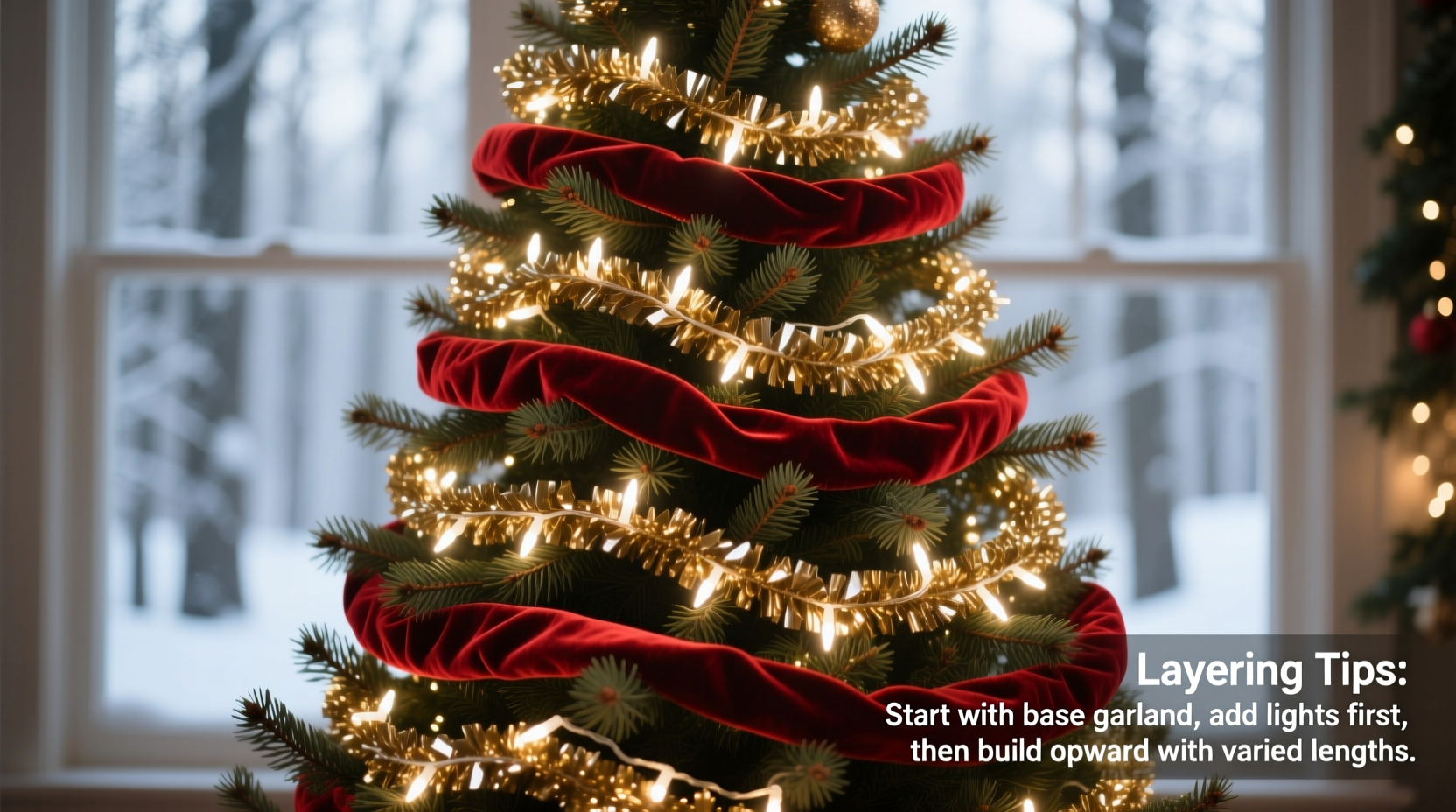
Think of your tree as a three-dimensional canvas with three distinct planes: the innermost (closest to the trunk), the mid-layer (the bulk of the branch structure), and the outermost (tips and surface contours). Each plane must be addressed in sequence—and each contributes uniquely to perceived depth. Lights anchor the foundation; garlands define rhythm and movement; ornaments complete the composition. Skipping or reversing this order collapses dimensionality. For example, wrapping garland tightly around the trunk before adding lights obscures light sources and eliminates shadow play. Conversely, hanging lights *after* heavy garlands forces awkward weaving and risks dislodging carefully placed elements.
A Step-by-Step Layering Sequence (With Timing Notes)
This is not a “hang-and-hope” process. It’s choreographed. Follow these steps in strict order—no shortcuts, no rearranging mid-process. Total time: 75–90 minutes for a standard 7-foot tree. Allow extra time for drying or cooling if using hot-glue accents or fresh greenery.
- Prep & Prime (10 min): Fluff branches from trunk outward. Remove any packaging wire or plastic ties. Gently bend upward lower branches to create natural lift and openness. Ensure the tree stand is level and stable.
- Inner Light Layer (20 min): Starting at the trunk, wrap incandescent or warm-white LED string lights *spiral-style*, moving upward every 4–6 inches. Keep strands taut but not tight. Tuck 70% of each loop deep into the branch interior—not along the surface. Use twist-ties or floral wire to secure loose ends near the trunk base.
- Mid-Layer Garland (25 min): Choose a flexible, lightweight garland (e.g., faux boxwood, birch bark, or velvet ribbon). Begin at the lowest interior branch junction and wind outward and upward in wide, irregular loops—varying loop size between 8\" and 18\". Anchor every third loop with a discreet U-pin or clear fishing line. Avoid symmetry; depth thrives on organic variation.
- Outer Light Accent (10 min): Add a second, contrasting light strand (e.g., cool-white micro LEDs or amber fairy lights) *only* on outer branch tips. Drape loosely—never wrap tightly. Let 30% of bulbs hang freely beyond the tip for a “halo” effect.
- Final Garment Touch (10 min): Weave a thin, textural accent (e.g., burlap ribbon, dried eucalyptus stems, or matte-black wire-wrapped twine) *only* along 3–5 major outer limbs. Place it asymmetrically—favoring one side or the top third—to create visual weight and directional flow.
Garland Selection: Material, Scale, and Placement Logic
Not all garlands contribute equally to depth—and many actively flatten it. Heavy, uniform garlands (like dense pinecone ropes or rigid metal chains) compress branch structure and eliminate negative space. Likewise, overly glossy or reflective materials bounce light uniformly, killing contrast. Depth relies on texture variation, opacity gradients, and strategic transparency.
| Garland Type | Depth Contribution | Best Placement Zone | Why It Works (or Doesn’t) |
|---|---|---|---|
| Faux boxwood or magnolia | High | Mid-layer (interior to mid-branch) | Matte finish absorbs light; irregular leaf shapes cast soft shadows; flexible stems conform to branch angles without flattening form. |
| Velvet or linen ribbon (2–3\" wide) | Medium-High | Mid- to outer-layer (loose drapes) | Light-absorbing fabric creates tonal gradation; subtle sheen catches highlights only where bent or folded—enhancing contour awareness. |
| Pinecone or berry rope | Low-Medium | Outer layer only (as accent) | Too dense for mid-layer; blocks light behind it. Best used sparingly on 2–3 prominent limbs to add focal weight—not coverage. |
| Metal chain or glass bead garland | Low | Avoid for depth-building | Reflects light uniformly, eliminating shadow gradients; rigid structure forces unnatural branch positioning and reduces airiness. |
| Dried citrus or cinnamon stick strand | Medium | Outer layer (short sections) | Natural translucency allows backlighting; irregular spacing creates rhythm; warm tones enhance light warmth—but overuse overwhelms. |
Light Layering Science: Why Two Light Types Are Non-Negotiable
A single light strand—no matter how high-quality—cannot generate depth alone. Human vision perceives dimension through luminance contrast: bright areas read as “forward,” darker zones as “receding.” A single light source illuminates front and back surfaces too evenly, collapsing spatial cues. Dual-layer lighting restores that contrast intentionally.
The inner layer (warm white, 2200K–2700K, incandescent-style LEDs) serves as ambient fill. Its purpose is not brightness, but *even diffusion*. Placed deep in the trunk and lower branches, it lifts shadows from the core without glaring—a “backlight” for the entire structure. The outer layer (cooler white, 3000K–4000K, or amber micro-lights) acts as directional highlight. Its job is to catch edge detail: the curl of a pine needle, the fold of a ribbon, the curve of an ornament hook. Because it sits only on outer tips, it doesn’t compete with the inner glow—it converses with it.
“Single-light trees look decorative but lack presence. Depth emerges when light has hierarchy: one layer that grounds, another that defines. That’s how museum installations achieve gravitas—and it’s achievable on any home tree.” — Lena Torres, Lighting Designer & Holiday Stylist, 12+ years designing for Nordstrom, Target, and private residences
Real-World Case Study: The “Flat Fir” Transformation
Sarah M., a graphic designer in Portland, struggled for five years with her 7.5-foot Fraser fir. She used premium pre-lit lights and two thick garlands—yet every photo looked like a cardboard cutout. “It had volume, but zero atmosphere,” she said. In December 2023, she followed the back-to-front layering method strictly: first, she removed all existing decor. Then she reinstalled 300 warm-white 5mm LEDs *deep* into the trunk and lower third—tucking each loop so only the bulb tip peeked out. Next, she draped 20 feet of matte olive-green faux eucalyptus garland in widening spirals from base to crown, anchoring only where branches forked. Finally, she added 100 cool-white micro-LEDs *exclusively* on the outer ⅓ of 12 primary limbs—leaving gaps between clusters. The difference wasn’t incremental. “The tree finally had breath,” she wrote in her follow-up note. “Shadows pooled where branches overlapped. Light didn’t glare—it glowed from within. And for the first time, my cat stopped trying to climb it… like she sensed it was real now.”
Common Depth-Killers (And How to Correct Them)
- Overwrapping: Circling garlands tightly around every branch creates a “cage” effect. Instead, use the “skip-and-loop” method: drape over one branch, skip two, loop under the next, then let the garland fall loosely. This preserves negative space—the essential ingredient for depth.
- Uniform Spacing: Hanging lights or garlands at mathematically even intervals reads as artificial. Vary distances: 4\", then 9\", then 3\", then 12\". Your eye registers rhythm, not repetition.
- Ignoring Branch Architecture: Forcing garland onto weak or downward-sloping branches breaks silhouette. Identify “structural limbs”—those that radiate outward at 30°–60° angles—and prioritize them. Let weaker branches remain lightly adorned or bare.
- Layering Ornaments Before Garlands: Ornaments act as punctuation, not infrastructure. Adding them before garlands means garlands must weave *around* ornaments, creating bulges and tension. Always build framework first.
FAQ
Can I use battery-operated lights for the inner layer?
Yes—but with caveats. Battery packs add bulk and heat near the trunk, potentially drying needles faster. Use lithium-ion packs (not alkaline) and place them low in the stand, not tucked into foliage. Limit inner-layer battery strings to 200 bulbs max and check battery temperature after 2 hours of operation.
What if my tree has sparse lower branches?
Embrace the void. Sparse lower branches are an asset for depth—they create a “negative space foundation” that makes upper layers feel more elevated. Enhance this by placing your inner light layer *only* on existing lower branches (no filler), then extending the mid-layer garland upward from the first strong branch junction—not from the ground. This reinforces vertical lift.
How do I prevent garlands from slipping down overnight?
Friction is your friend. Before draping, lightly mist synthetic garlands with water (not spray adhesive)—this adds temporary tack. For permanent hold, use 22-gauge green floral wire: twist once around branch + garland at anchor points, then snip flush. Never use tape or glue on live trees—it damages bark and attracts dust.
Conclusion: Depth Is a Discipline, Not a Decoration
Layering garlands and lights for depth isn’t about buying more—it’s about seeing differently. It asks you to slow down, observe structure, honor shadow as intentionally as light, and trust that restraint generates richness. A tree built this way doesn’t shout “Christmas!” It hums with quiet confidence: warm light breathing from within, textures catching the eye at unexpected angles, space held thoughtfully between elements. That’s the kind of tree guests pause beside—not to admire the ornaments, but to feel the calm, dimensional presence it holds in the room. You don’t need rare materials or professional tools. You need sequence, intention, and willingness to work from the inside out. Start this year with one deliberate loop, one tucked light, one conscious choice to let space speak. Your tree—and your holidays—will carry that depth long after the season ends.




 浙公网安备
33010002000092号
浙公网安备
33010002000092号 浙B2-20120091-4
Comments
No comments yet. Why don't you start the discussion?