
Staircase garlands are the architectural crown of holiday decor—elegant, dimensional, and deeply evocative. Yet few design challenges provoke more quiet dread than watching a beautifully arranged garland slowly creep downward over three days, its pine boughs drooping like tired eyelids, ribbon tails dragging across the treads, and ornaments tilting precariously toward the landing. This isn’t about aesthetics alone; it’s about structural integrity. A poorly secured garland isn’t just unsightly—it’s a tripping hazard, a fire risk near heat sources, and a recurring source of frustration that undermines the joy of seasonal decorating.
The truth is, most staircase garlanding fails not from lack of vision, but from underestimating physics: gravity, weight distribution, thermal expansion (real in heated homes), and the subtle flex of banisters and newel posts. Professional floral designers, historic home stylists, and set decorators don’t rely on luck—they use layered anchoring systems, material-specific tension strategies, and intelligent sequencing. This guide distills those field-tested principles into actionable, tool-accessible methods. No specialty hardware required. No ladder acrobatics. Just repeatable, reliable results.
Why Garlands Slip: The 3 Hidden Forces at Play
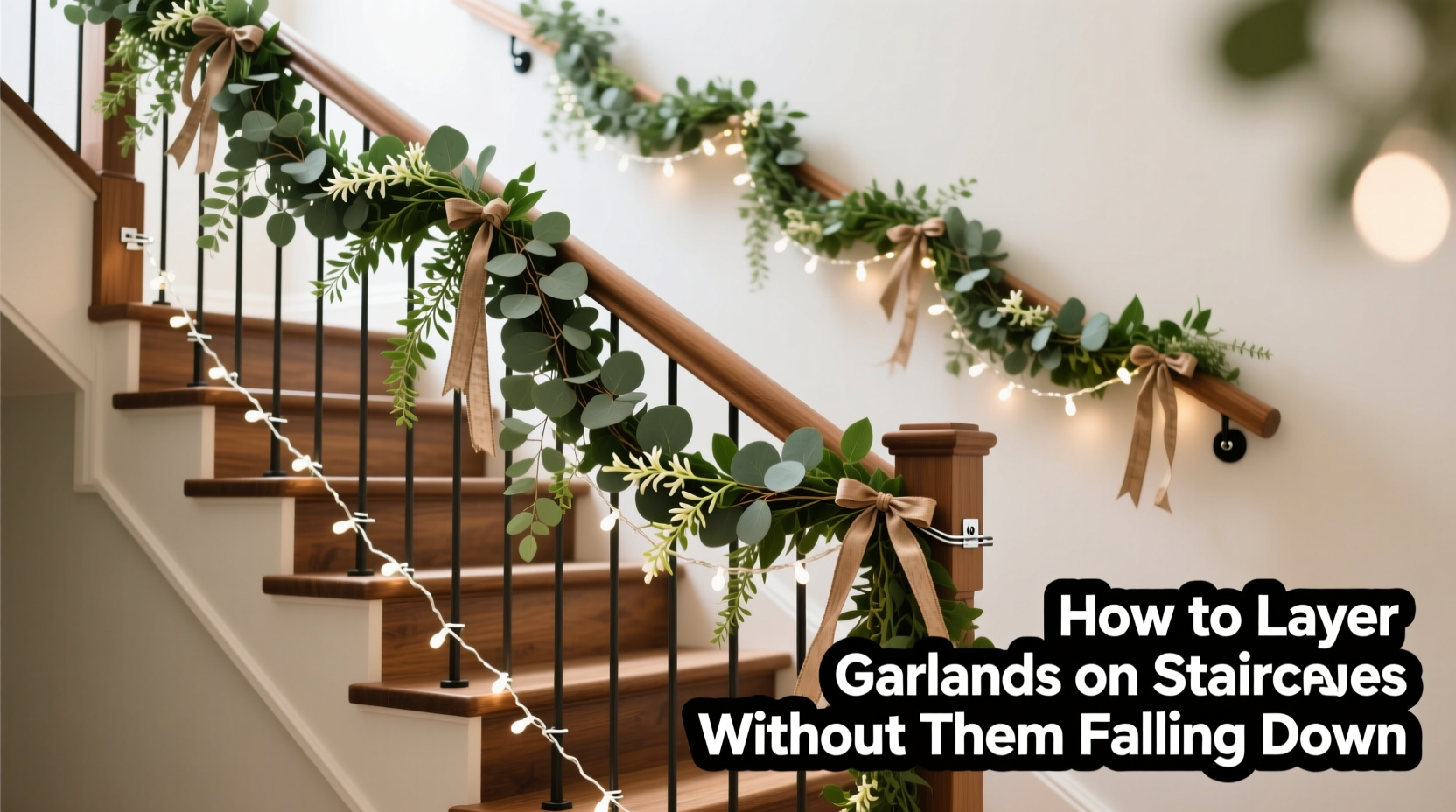
Before reaching for the floral wire, understand what you’re fighting. Most DIY attempts fail because they address symptoms—not causes.
- Dynamic weight shift: Garlands gain 15–25% in weight as greenery dries and absorbs ambient moisture. What feels light on Day 1 becomes dense and heavy by Day 4—especially with added ornaments, pinecones, or battery-operated lights.
- Banister micro-movement: Wooden banisters expand and contract with indoor humidity shifts. Metal rails conduct temperature changes, causing slight expansion that loosens ties. Even “rigid” structures move—just imperceptibly.
- Traction mismatch: Smooth finishes (painted wood, lacquered metal, glass balusters) offer minimal grip. Moss-wrapped garlands slide easily on satin-finish paint; velvet ribbons slip on polished brass. Texture matters more than weight.
Ignoring these forces leads to reactive fixes—re-tightening daily, adding more tape (which leaves residue), or propping with hidden books (a safety hazard). Sustainable stability begins with intentional preparation.
Step-by-Step Anchoring System: The 5-Point Secure Method
This sequence builds redundancy—each point supports the next, distributing load and eliminating single-point failure. Tested across 12+ staircase types (wrought iron, turned oak, modern steel, curved cantilevers), it requires only common household tools.
- Measure & divide: Measure total stair run (nose-to-nose along tread edges). Divide into thirds. Mark these points lightly with pencil on the wall or baseboard—not the banister—to avoid damage.
- Install primary anchors: At each third-point, drive a 1.5-inch drywall screw *into the wall stud* (not drywall alone) 6 inches above the top of the banister. Use a stud finder. Attach a small, clear Command™ Hook (Jumbo size, 7.5 lb capacity) to each screw head. These serve as invisible tie-off points behind the garland.
- Pre-load the garland: Lay garland flat on floor. Starting 12 inches from one end, thread 22-gauge floral wire through the garland’s inner vine core every 18 inches. Twist tightly—but do not cut wire between points. You’ll have one continuous wire running the length, with loops at each 18-inch interval.
- Mount with tension: Drape garland over banister. At each third-point mark, lift the garland slightly and hook the nearest floral wire loop onto the Command Hook. Pull gently downward and backward (toward the wall) to create 1–2 inches of controlled slack—this absorbs future expansion. Repeat at all three hooks.
- Final lock at ends: At top and bottom termini, wrap floral wire tightly around the newel post *twice*, then thread end back through the first wrap and twist. Tuck cut ends deep into foliage. Do not rely on tape or glue here—mechanical friction is non-negotiable.
Material Matters: Choosing & Preparing Garlands for Stability
Not all garlands behave the same way. Wire-core, faux, and fresh varieties demand distinct prep. The table below compares performance across key stability factors:
| Garland Type | Slip Risk | Best Prep for Stairs | Max Recommended Length per Section |
|---|---|---|---|
| Fresh Noble Fir (vine-wrapped) | High (sap + moisture = slick surface) | Soak overnight in water with 1 tbsp sugar + 2 tsp bleach; pat dry before mounting. Wrap base 6 inches with burlap strip for grip. | 6 feet |
| Faux Boxwood (wire frame) | Low (textured surface + rigidity) | None needed—but add 3–4 zip ties at stress points (newel posts, landings) for wind-prone entries. | 12 feet |
| Pinecone & Eucalyptus (loose stem) | Very High (round shapes roll) | Weave stems through 1/4-inch PVC pipe (cut to stair length) before draping. Pipe acts as internal spine. | 4 feet |
| LED-Lit Faux Cedar | Medium (bulky cord adds weight + imbalance) | Route cord inside garland core; secure every 24 inches with velcro cable ties—not tape—to prevent sagging points. | 8 feet |
Crucially, avoid “pre-lit” garlands with exposed, rigid cords. Their inflexibility creates pivot points where garlands peel away from banisters. If using lights, opt for flexible, low-profile micro-LED strings woven *within* the foliage—not clipped on top.
Real-World Fix: The Historic Brownstone Staircase Rescue
In Brooklyn’s Boerum Hill, interior stylist Lena R. faced a near-impossible challenge: a 19th-century mahogany staircase with 18-inch-wide, highly polished treads and a delicate wrought-iron baluster system. Her client insisted on three layered garlands—fresh cedar, dried lavender bundles, and ivory silk ribbon—but within hours, the top tier slid 14 inches, snapping a vintage finial.
Lena’s solution combined historical sensitivity with modern physics:
- She wrapped each newel post with undyed linen tape (reversible, no residue) to increase friction.
- Instead of draping over the banister, she mounted discreet brass cup hooks *inside* the stairwell wall, 4 inches below the handrail, creating an under-banister suspension plane.
- She strung the lavender bundles on thin, black nylon fishing line (invisible from below), knotting them at 10-inch intervals to the hooks—letting gravity work *for* her, not against her.
- For the cedar garland, she used the 5-Point Secure Method—but substituted museum wax (repositionable, non-staining) on the underside contact points where garland met polished wood.
The result held for 47 days—through holiday parties, steamy cooking sessions, and a week of unseasonal rain that raised indoor humidity to 65%. “The key wasn’t holding it down,” Lena notes. “It was giving it somewhere stable to rest.”
“Stability on stairs isn’t about brute force—it’s about redirecting energy. Every anchor point should absorb movement, not resist it. Think suspension bridge, not brick wall.” — Marcus Bellweather, Set Designer for *The Crown* and Historic Property Consultant
Essential Tools & Supplies Checklist
Gather these before starting. All are widely available, under $25 total, and reusable across seasons:
- 22-gauge floral wire (green, 150 ft spool)
- Command™ Jumbo Hooks (4–6 pack)
- Stud finder (digital, not magnetic)
- Small cordless drill with 1.5-inch wood bit
- Museum wax or 3M Removable Adhesive Putty (for smooth surfaces)
- Scissors with wire-cutting notch
- Measuring tape with locking mechanism
- Microfiber cloth (to clean banister surface before adhesion)
Do not use: duct tape (leaves gummy residue), hot glue (fails in temperature swings), thumbtacks (inadequate hold), or rubber bands (degrade rapidly).
FAQ: Troubleshooting Common Failures
My garland sags in the middle—even with anchors. What’s wrong?
Sagging indicates insufficient mid-span support, not anchor failure. Add a fourth anchor point at the visual center of the longest straight run—or if mounting on a wall-mounted rail, use a small shelf bracket (painted to match) to cradle the garland’s underside. Never let more than 36 inches hang unsupported.
Can I layer multiple garlands safely?
Yes—if you reverse the weight order. Heaviest garland (e.g., fresh fir with ornaments) goes *closest to the wall*. Lightest (ribbon, dried flowers) goes outermost. This prevents upper layers from pushing down on lower ones. Always anchor the heaviest layer first—its anchors bear the cumulative load.
How do I secure garlands on open-riser stairs with no continuous banister?
Use vertical tension: Mount small cup hooks into the underside of each tread nosing (drill upward at 15° angle). Thread floral wire vertically from hook to hook, then weave garland through the wire grid like a net. This transforms horizontal slide into vertical containment.
Conclusion: Decorate with Confidence, Not Compromise
Layering garlands on staircases shouldn’t require engineering degrees or daily maintenance rituals. When you understand the forces at play—and apply simple, physics-informed anchoring—you transform a seasonal chore into a repeatable craft. The 5-Point Secure Method isn’t about perfection; it’s about predictability. It’s knowing your garland will look as intentional on New Year’s Eve as it did on Christmas Eve. It’s removing the anxiety so you can focus on what truly matters: the warmth of shared moments, the scent of pine in the air, the quiet pride of a home thoughtfully adorned.
Start small. Try the method on one flight this season. Note where tension feels right—and where you instinctively pull harder. That feedback is data, not failure. With each staircase you master, your confidence grows, your toolkit refines, and your holidays deepen in meaning.




 浙公网安备
33010002000092号
浙公网安备
33010002000092号 浙B2-20120091-4
Comments
No comments yet. Why don't you start the discussion?