
Decorating a large Christmas tree with layered strands of lights can transform it into a radiant centerpiece for the holidays. But as the number of light strands increases, so does the risk of electrical overload, blown fuses, or even fire hazards. Achieving a lush, glowing effect isn’t just about aesthetics—it’s also about safety, smart planning, and understanding basic electrical principles. Whether you're decorating a 9-foot spruce in your living room or a towering tree in a public space, this guide walks you through the process of layering lights effectively while staying within safe limits.
Understanding Electrical Load and Light Capacity
Before wrapping a single strand around your tree, it's essential to understand what \"overload\" means in practical terms. An electrical circuit in a typical home is rated for 15 or 20 amps at 120 volts. Most standard outlets are connected to a 15-amp circuit, which can handle up to 1,800 watts (15 amps × 120 volts). However, for safety, experts recommend using only 80% of a circuit’s capacity—around 1,440 watts—to prevent overheating.
Christmas lights vary significantly in power consumption. Traditional incandescent mini-lights can use 40–50 watts per 100-light strand, while LED strings typically consume only 4–8 watts for the same length. This difference is critical when calculating how many strands you can safely connect.
Manufacturers usually specify the maximum number of strands that can be daisy-chained together—a limit based on wire gauge, fuse rating, and heat dissipation. For example, many incandescent strands carry a “max 3 sets” warning, whereas LED strings often allow 40 or more connected in series.
Step-by-Step Guide to Layering Lights Safely
Layering multiple strands of lights adds depth and dimension, making the tree look fuller and more professionally decorated. The key is to plan your layout before plugging anything in. Follow this sequence to build a stunning, safe display.
- Assess your tree size and outlet access. Measure the height and circumference. Determine how many extension cords you’ll need and where they’ll run. Avoid running cords under rugs or across high-traffic areas.
- Choose LED lights whenever possible. LEDs use less energy, generate less heat, and allow more strands to be connected safely. They’re also more durable and longer-lasting.
- Divide your tree into zones. Split the tree vertically into thirds—bottom, middle, top—and assign a separate power source or circuit to each zone if possible. This prevents concentrating too much load on one outlet.
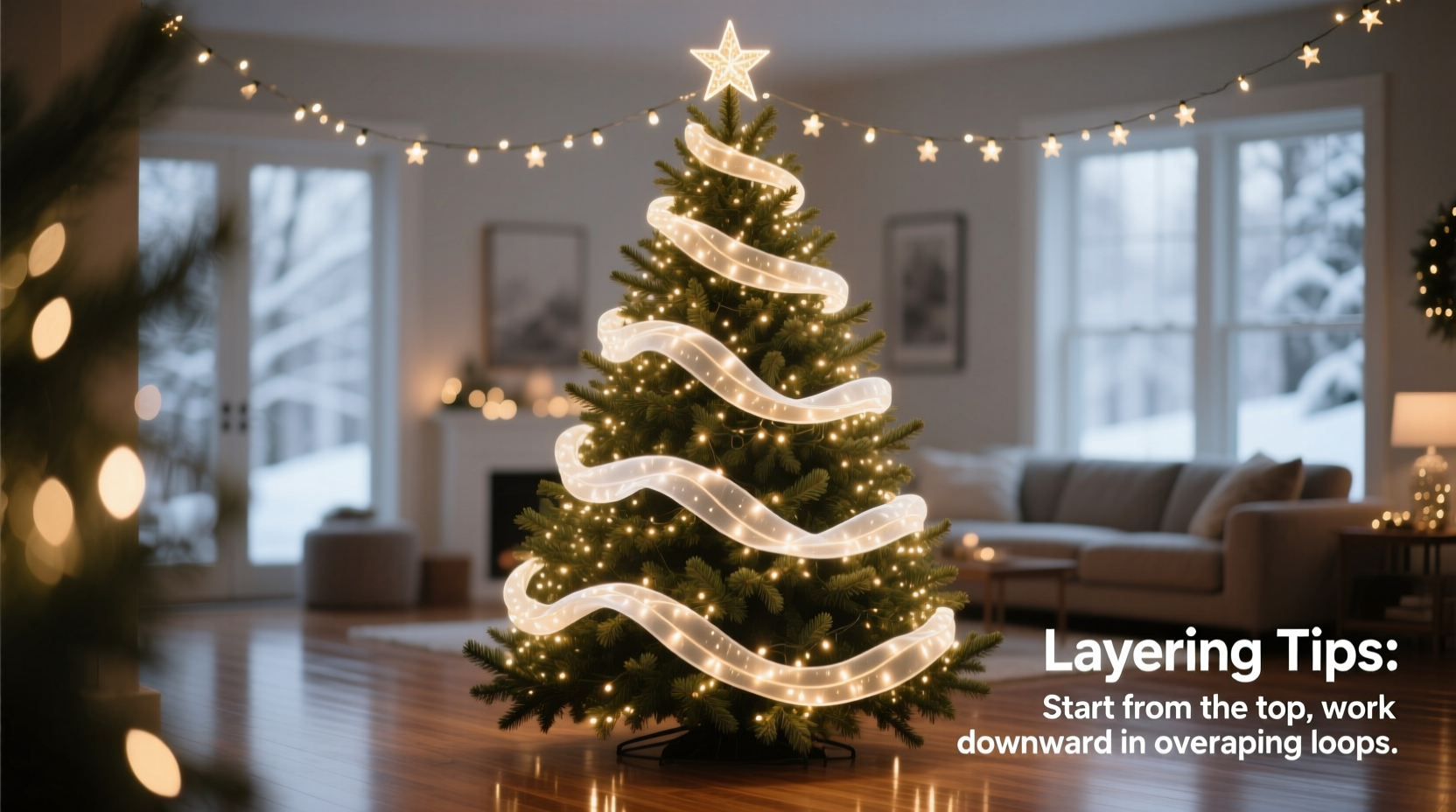
- Start with a base layer. Wrap the first set of lights evenly from trunk to tip, following a spiral path. Use clips—not nails or staples—to secure strands to branches. This layer provides foundational illumination.
- Add accent layers. Once the base is complete, weave additional strands deeper into the branches to create a three-dimensional glow. Focus on filling dark spots and enhancing fullness.
- Use multiple circuits. Plug different layers into separate outlets or power strips connected to different breakers. This distributes the electrical load and reduces strain on any single circuit.
- Test before finalizing. Turn on all lights simultaneously to ensure no flickering, dimming, or tripped breakers. If issues occur, reduce the number of connected strands or redistribute them.
Do’s and Don’ts of Multi-Strand Lighting
Mistakes in holiday lighting often stem from small oversights that compound into larger problems. The table below outlines best practices and common pitfalls to avoid.
| Do | Don't |
|---|---|
| Use LED lights to minimize power draw | Daisy-chain more than the manufacturer’s recommended number of incandescent strands |
| Plug heavy loads into different wall outlets on separate circuits | Use indoor-rated lights outdoors or vice versa |
| Inspect wires for fraying, kinks, or damaged sockets before use | Cover extension cords with flammable materials like fabric or paper |
| Use surge-protected power strips with individual switches | Leave lights on unattended or overnight without supervision |
| Label cords by zone or circuit for easy troubleshooting | Mix old and new strands of different wattages or types on the same run |
Real Example: Decorating a 10-Foot Tree Without Overload
Consider Sarah, who decorates a 10-foot pre-lit artificial tree in her family room each year. In past years, she added extra strands to enhance brightness but repeatedly tripped the breaker. After consulting an electrician, she restructured her approach:
She replaced all incandescent add-ons with cool-white LED mini-lights, each consuming 6 watts per 100 bulbs. She divided the tree into three sections: bottom (plugged into a floor outlet), middle (connected via a power strip on a dedicated circuit), and top (using a lightweight string plugged into a nearby lamp outlet). Each section used no more than four LED strands daisy-chained together—well under the 40-string max allowed by the manufacturer.
By spreading the load across three circuits and using low-wattage LEDs, Sarah achieved a brighter, safer display without overloading any single outlet. She also installed a smart plug on the middle section, allowing her to turn off the lights remotely and monitor energy usage.
“Many holiday electrical fires start because people assume ‘if it plugs in, it’s safe.’ But cumulative load matters just as much as individual strand ratings.” — Mark Reynolds, Certified Electrician & NFPA Safety Advisor
Checklist: Safe Multi-Layer Lighting Setup
Use this checklist before powering on your tree to ensure safety and performance:
- ☐ Confirm total wattage of all light strands is under 80% of circuit capacity
- ☐ Verify that no daisy chain exceeds manufacturer’s maximum connectable sets
- ☐ Use only UL-listed lights and extension cords rated for indoor use
- ☐ Inspect all cords and sockets for damage, corrosion, or exposed wires
- ☐ Distribute power draws across multiple outlets or circuits
- ☐ Secure cords with insulated clips—never nails, staples, or tape
- ☐ Test all strands individually before final installation
- ☐ Install a ground fault circuit interrupter (GFCI) outlet if near moisture sources
- ☐ Set a timer or smart plug to turn lights off after 8–10 hours
- ☐ Keep a fire extinguisher accessible and smoke detectors operational
Frequently Asked Questions
Can I mix LED and incandescent lights on the same tree?
You can use both types on the same tree, but never daisy-chain them together. Their voltage requirements and power draws differ significantly, which can lead to overheating or premature failure. Instead, plug each type into separate circuits or power strips.
How many strings of lights can I safely connect together?
It depends on the type. For incandescent mini-lights, most manufacturers limit daisy-chaining to 3 or 4 sets. For LEDs, the limit is often 40 or more. Always refer to the label on the string for the exact number. Exceeding this limit risks overheating the first plug in the chain.
Is it safe to leave Christmas tree lights on overnight?
While modern LED lights generate minimal heat, it’s still not recommended to leave any electrical decorations on unattended or while sleeping. Use a timer to automatically shut off lights after bedtime—typically between 10 p.m. and 7 a.m.
Maximizing Aesthetic Impact Without Adding Risk
A visually rich tree doesn’t require hundreds of light strands. Strategic placement can create the illusion of density. Start by focusing on inner branches—placing lights closer to the trunk casts a warm backlighting effect that makes outer ornaments sparkle. Use cooler tones (like daylight white) on the outer edges and warmer tones (soft white) toward the center for a professional gradient.
Consider adding a few commercial-grade C7 or C9 LED capsulated bulbs sparingly for focal points. These are brighter but should be used in very limited numbers and always on their own circuit due to higher wattage.
Another technique: stagger the timing of different layers. Use smart plugs to turn on the base layer first, then the mid-layer after 15 minutes. This reduces initial surge load and creates a dramatic lighting sequence during evening displays.
Conclusion: Shine Bright, Stay Safe
Layering multiple strands of Christmas lights on a large tree can elevate your holiday décor from ordinary to extraordinary—but only if done with care and awareness. By choosing energy-efficient LEDs, respecting circuit limits, and distributing electrical loads wisely, you can create a dazzling display that’s as safe as it is beautiful. Remember, the goal isn’t just to light up a tree, but to do so in a way that protects your home and loved ones throughout the season.




 浙公网安备
33010002000092号
浙公网安备
33010002000092号 浙B2-20120091-4
Comments
No comments yet. Why don't you start the discussion?