
Layering multiple strands of Christmas lights—whether wrapping railings, draping trees, or outlining windows—creates rich visual depth and festive warmth. But behind every dazzling display lies a critical electrical reality: each strand draws power, and stacking them carelessly can trip breakers, melt sockets, or worse, create fire hazards. This isn’t about guesswork or tradition—it’s about understanding your home’s circuit capacity, reading manufacturer specifications accurately, and applying consistent, measurable safety practices. Over 40% of residential electrical fires during the holiday season originate from decorative lighting, according to the U.S. Fire Administration. Most are preventable—not with less light, but with smarter layering.
Why “Just One More Strand” Is Risky Business
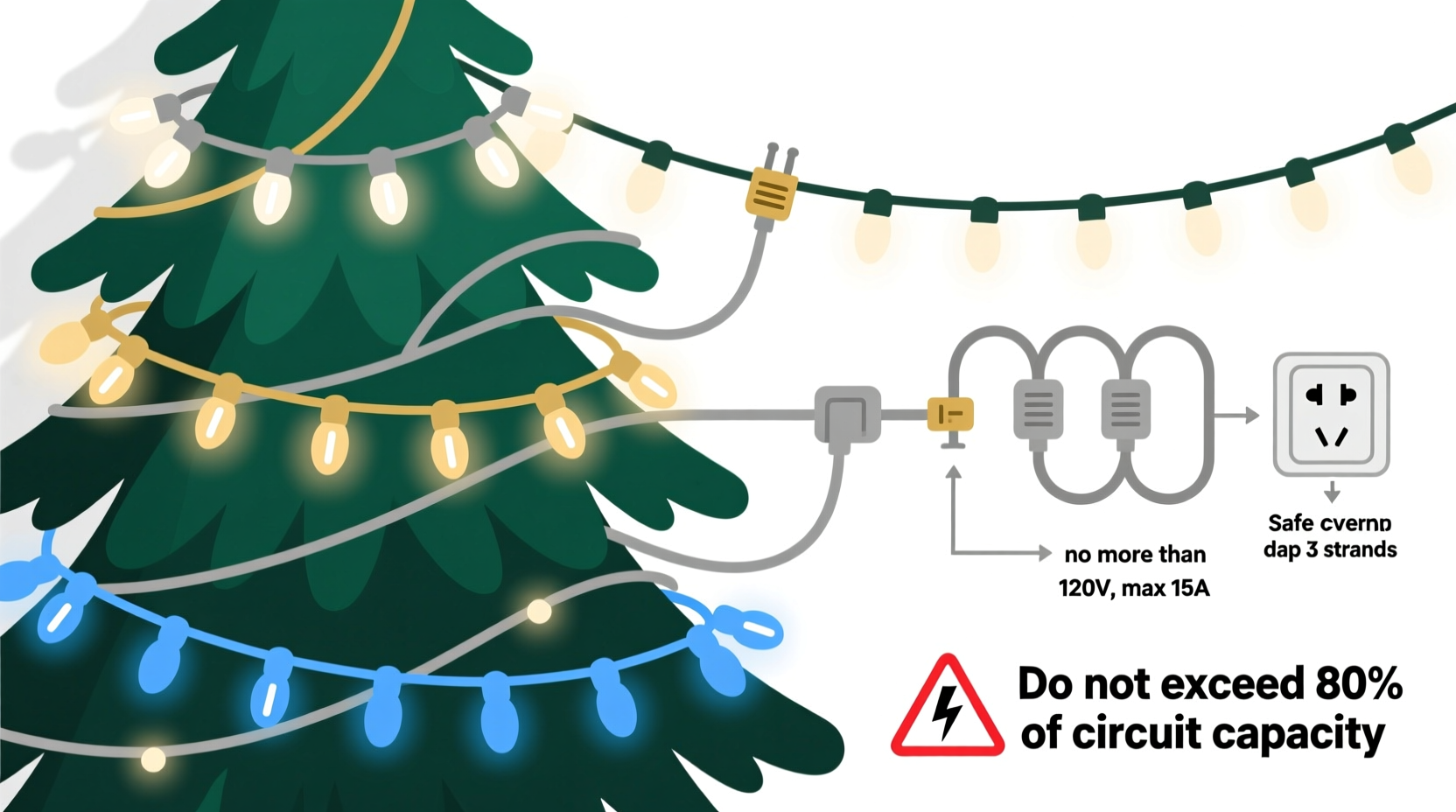
Modern LED strings draw far less power than incandescent ones—but that doesn’t mean unlimited stacking. Many homeowners assume low-wattage LEDs eliminate overload risk. That misconception is dangerous. While a single 50-light LED strand may use only 4–7 watts, layering eight strands on one outlet (e.g., for a large front porch) can still exceed safe limits when combined with other devices—especially if using older extension cords, daisy-chained power strips, or outlets shared with refrigerators or sump pumps.
Electrical circuits in homes are typically rated at 15 or 20 amps. At 120 volts, that translates to 1,800 or 2,400 watts maximum per circuit—*not* per outlet. Yet many people treat each wall outlet as an independent power source. In reality, multiple outlets in a room or even across floors often share the same breaker. A single overloaded circuit can shut down lighting, HVAC, or security systems mid-holiday—and repeated overloads degrade wiring insulation over time, increasing long-term fire risk.
Step-by-Step: Calculate Your Real-World Load Capacity
Accurate layering starts with measurement—not estimation. Follow this verified sequence before plugging in a single strand:
- Identify the circuit: Turn off one breaker at a time and test which outlets and lights go dark. Map all connected receptacles (including garage, basement, and outdoor GFCI outlets). Label the breaker accordingly.
- Determine circuit amperage: Check your panel—most residential circuits are 15A or 20A. If unsure, assume 15A unless confirmed otherwise.
- Calculate safe continuous load: Electrical codes require circuits to operate at no more than 80% of capacity for continuous loads (defined as operating >3 hours). So for a 15A circuit: 15 × 120V = 1,800W → 80% = 1,440W max continuous.
- Inventory existing loads: Add up wattage of all permanently connected devices on that circuit (e.g., doorbell transformer: 10W; hardwired smoke detector: 5W; always-on LED nightlight: 1W). Subtract this from your 1,440W budget.
- Measure actual strand wattage: Don’t trust the box. Use a plug-in power meter (like a Kill A Watt) to measure each strand *while lit*, including any built-in timers or controllers. Record both “inrush” (initial surge) and steady-state readings.
- Apply derating for extension cords: If using extension cords longer than 6 feet, reduce your remaining wattage budget by 15% for 16-gauge cords, 10% for 14-gauge, and 5% for 12-gauge. Thinner wires generate heat under load—especially outdoors where cold temperatures increase resistance.
This process takes 20 minutes but prevents hours of troubleshooting—or worse, emergency calls. It also reveals hidden constraints: for example, a “15-strand max” label on LED lights assumes perfect 12-gauge wiring and 20°C ambient air. In practice, on a 15A circuit already powering a Wi-Fi router (12W), garage door opener (30W), and landscape transformer (60W), your true remaining budget may be just 1,338W—enough for 12 average LED strands (110W each), not 15.
Do’s and Don’ts of Layering: A Practical Comparison
| Action | Do | Don’t |
|---|---|---|
| Cord Management | Use outdoor-rated, 14-gauge or thicker extension cords labeled “W-A” (weather-resistant, approved for wet locations); limit to one cord per outlet. | Daisy-chain multiple extension cords or power strips—even if they’re “heavy-duty.” Each connection point adds resistance and heat buildup. |
| Strand Connection | Connect strands end-to-end only if explicitly rated for series connection (check UL listing: “UL 588” + “For Indoor/Outdoor Use” + “Connectable” icon). | Assume all “male-to-female” ends are safe to link. Many modern LED sets have non-connectable controllers that lack internal fusing for cascaded loads. |
| Outlet Usage | Plug light strands directly into GFCI-protected outlets whenever possible—especially outdoors or in garages. Test GFCIs monthly. | Use multi-outlet adapters (“octopus plugs”) or surge protectors marketed for electronics (not lighting). These often lack thermal cutoffs for sustained low-voltage loads. |
| Layering Strategy | Stagger start times using programmable timers (e.g., tree lights on at 4:30 p.m., porch lights at 5:00 p.m.) to reduce peak demand. | Run all layers simultaneously on the same circuit without verifying total draw—even if each strand individually seems “safe.” |
| Maintenance | Inspect each strand before use: check for cracked insulation, bent prongs, corroded sockets, or discoloration near plugs (a sign of past overheating). | Use strands with damaged wires, missing ground pins, or melted connectors—even if “they still light up.” |
Real-World Case Study: The Elm Street Porch Project
In December 2022, Sarah M., a homeowner in Portland, OR, planned a layered porch display: 6 strands wrapped around columns, 4 draped along the railing, and 3 outlining the front door—23 strands total. All were new, UL-listed LED lights advertised “up to 40 strands connectable.” She plugged them in via three 50-foot, 16-gauge extension cords into a single outdoor GFCI outlet.
Within 45 minutes, the GFCI tripped. Resetting it worked briefly—until the lights warmed up. By evening, the outlet cover was warm to the touch, and one cord’s jacket had softened near the plug. Sarah paused, mapped her circuit (15A, shared with garage lights and furnace control board), and measured actual draw: 1,580W—140W over safe continuous load. Her 16-gauge cords were dropping voltage under load, forcing drivers to draw more current to maintain brightness—a classic thermal feedback loop.
She reconfigured: moved 8 strands to a separate 20A kitchen circuit (unused evenings), swapped to 14-gauge cords, added a $25 plug-in power meter, and staggered timers. Final load: 1,320W—within 80% limit. The display ran flawlessly for 47 days, with no trips or heating issues. Her key insight? “The box told me what was *possible*. My meter told me what was *safe*.”
Expert Insight: What Electrical Inspectors See Every Holiday Season
“The most common violation I document isn’t too many lights—it’s too many *connections*. I’ve pulled apart nests of 7 extension cords feeding one outlet, all rated for 10A but sharing a 15A circuit. Heat builds at every plug, every socket, every splice. UL tests lights at 25°C. Your attic or snowy porch is often -10°C or 35°C—both extremes degrade insulation faster. If you wouldn’t run a space heater through that setup, don’t run Christmas lights through it.”
— Rafael Torres, Licensed Master Electrician & NFPA 70E Compliance Trainer, 18 years residential inspection experience
Torres emphasizes that modern LED drivers contain sensitive electronics vulnerable to voltage drop and thermal stress—more so than old incandescent filaments. A 5% voltage drop (common with undersized cords) can increase driver current draw by 12–18%, accelerating capacitor failure and creating hot spots invisible to the naked eye.
Essential Pre-Layering Checklist
- ☑️ Verified circuit amperage and mapped all connected outlets
- ☑️ Calculated 80% continuous load limit (e.g., 1,440W for 15A)
- ☑️ Measured existing loads on the circuit (appliances, transformers, always-on devices)
- ☑️ Tested each light strand with a power meter—not relying on packaging specs
- ☑️ Selected outdoor-rated, 14-gauge or thicker extension cords (no daisy-chaining)
- ☑️ Confirmed all outlets are GFCI-protected and tested functional
- ☑️ Inspected every strand for physical damage, corrosion, or discoloration
- ☑️ Planned staggered operation via timers to avoid simultaneous peak demand
FAQ: Critical Questions Answered
Can I mix LED and incandescent strands on the same circuit?
No—never mix them. Incandescent strands draw 5–10× more power than equivalent LED sets and generate significant heat. Their higher inrush current can trip breakers even when LED strands on the same circuit appear fine. Worse, mixing creates inconsistent voltage demands that stress LED drivers, shortening lifespan and increasing flicker or failure. Dedicate separate circuits or outlets for each technology—or replace incandescents entirely.
My lights flicker only after 20 minutes. Is that normal?
No. Flickering after warming up signals thermal overload: either the driver is overheating due to poor ventilation, the extension cord is undersized, or the circuit is nearing capacity. Measure temperature at the plug and first 6 inches of cord—if above 40°C (104°F), stop use immediately. Flickering is an early warning—not a quirk.
How do I know if my outlet is on a shared circuit with high-draw appliances?
Turn off the suspected breaker and observe for 15 minutes. Does the refrigerator compressor cycle on? Does the HVAC blower activate? Does a sump pump kick in during rain? Any active device means that circuit is shared. For absolute certainty, hire an electrician to perform a circuit tracer test—they’ll map every wire in under an hour.
Conclusion: Light Boldly—But Ground Your Decisions in Data
Layering Christmas lights isn’t about restraint—it’s about intentionality. The most breathtaking displays aren’t those that ignore limits, but those built on precise calculation, thoughtful sequencing, and respect for physics. When you measure instead of assuming, inspect instead of ignoring, and stagger instead of synchronizing, you transform seasonal decoration into a demonstration of practical stewardship—of your home, your family’s safety, and the quiet joy of lights that shine steadily, warmly, and safely all season long.
You don’t need fewer strands. You need better data. Start tonight: grab a power meter, flip your breaker panel, and map one circuit. Then layer—not with hope, but with confidence.




 浙公网安备
33010002000092号
浙公网安备
33010002000092号 浙B2-20120091-4
Comments
No comments yet. Why don't you start the discussion?