
In the heart of Paris, style isn’t about excess—it’s about precision. The way a woman drapes a silk scarf or slips on a pair of loafers speaks volumes with quiet confidence. Nowhere is this more evident than in how she layers her jewelry. A single gold chain might catch the light as she sips espresso at a sidewalk café, layered subtly with another barely-there piece that feels intentional, not overdressed. This is the essence of Parisian minimalist necklace layering: understated elegance, curated simplicity, and a sense of effortlessness that belies careful consideration.
But achieving that look—where multiple necklaces coexist harmoniously without appearing busy—isn’t accidental. It’s rooted in proportion, material harmony, and an intuitive understanding of balance. Too many chains can overwhelm; too few might feel incomplete. The sweet spot lies in thoughtful curation. Whether you're dressing up a turtleneck or adding quiet sophistication to a summer dress, mastering this technique elevates your everyday style with minimal investment and maximum impact.
The Philosophy Behind Parisian Minimalist Jewelry
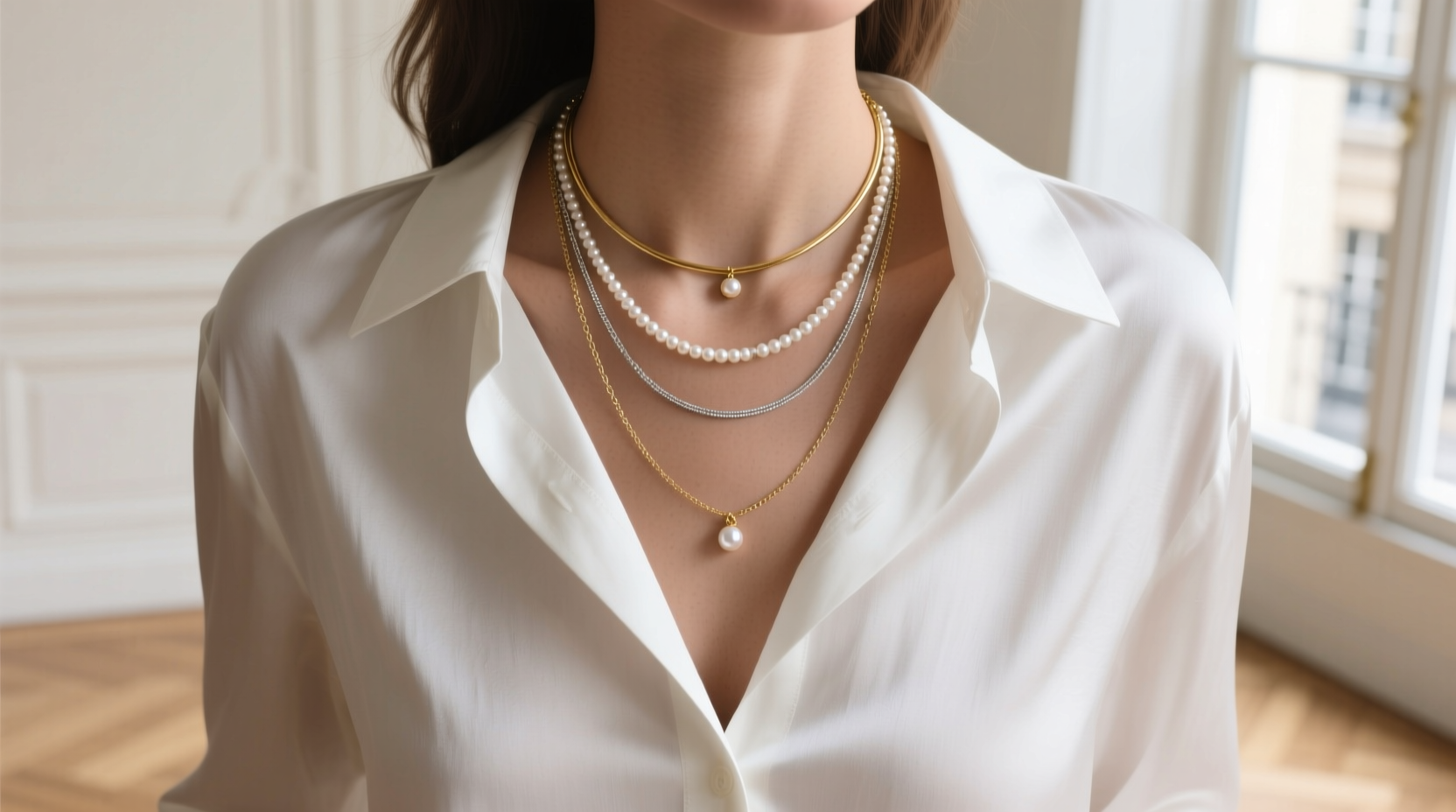
Parisian style resists trends in favor of timelessness. It values quality over quantity, authenticity over spectacle. When it comes to jewelry, this means choosing pieces not for their size or sparkle, but for their emotional resonance and wearability. A Parisian doesn’t stack five pendants around her neck because they’re “on trend.” She selects two delicate chains—one inherited, one recently acquired—that speak to her personal narrative.
This approach rejects the idea that more is better. Instead, it embraces negative space. The skin between the chains matters as much as the metal itself. Gaps are intentional. Chains don’t compete; they converse. There’s room to breathe, both visually and emotionally.
“The most elegant women I know wear only what feels true to them. One good chain often says more than ten flashy ones.” — Camille Laurent, Paris-based stylist and founder of *L’Élégance Intime*
This mindset shifts the focus from accumulation to intentionality. Before layering, ask: Does this piece reflect who I am today? Would I still want to wear it in five years? If the answer is yes, it earns its place.
The Three Golden Rules of Layering
Layering necklaces successfully follows a quiet logic—three guiding principles that keep the look refined and never chaotic.
1. Vary the Lengths Strategically
The most common mistake? Wearing chains of identical length. They tangle, overlap, and create visual noise. Parisians avoid this by adhering to a simple rule: each chain should sit at a distinct level on the collarbone or décolletage.
A classic combination includes:
- Choker (14–16\"): rests high on the neck, often just above the collarbones.
- Princess (17–19\"): falls just below the throat, ideal for pairing with a pendant.
- Matinee (20–24\"): extends to the top of the bust, perfect for drawing the eye downward.
Spacing each length by at least 2 inches prevents overlap and creates a cascading effect that feels organic.
2. Stick to One Metal Tone
Mixing gold and silver can work in bold fashion statements—but not in minimalist layering. Parisians typically commit to a single metal: warm yellow gold, soft rose gold, or cool white gold. Consistency in tone unifies the look, even when styles differ.
If your wardrobe leans toward warm tones (beige, camel, rust), yellow gold complements naturally. Cooler palettes (navy, gray, black) often pair better with white or platinum finishes. Choose based on your coloring and existing jewelry collection.
3. Limit Pendants—and Keep Them Small
A pendant should enhance, not dominate. In minimalist layering, less is more. One small charm—a tiny initial, a discreet cross, a minimalist bar—is enough. Avoid large medallions or dangling elements that draw disproportionate attention.
If using multiple pendants, ensure they vary in size and hang at different levels so they don’t collide. Better yet: let one chain carry the pendant while the others remain clean and smooth.
Building Your Minimalist Necklace Wardrobe
Start with a foundation of versatile, high-quality basics. Think of these as the capsule wardrobe of your jewelry drawer—pieces that mix and match effortlessly.
| Chain Type | Best For | Material Tip |
|---|---|---|
| Box Chain (16\") | Everyday wear, solo or layered | Opt for 14k gold-filled for durability |
| Figaro Chain (18\") | Adding subtle texture | Avoid overly thick links—keep it under 1.5mm |
| Cable Chain (20\") | Longer layer with lightweight pendant | Choose a spring ring clasp for security |
| Spiga (Wheat) Chain (22\") | Mid-length layer with gentle movement | Prioritize polished finish over matte |
You don’t need dozens of necklaces. Four well-chosen chains are enough to create countless combinations. Begin with three:
- A short choker-style chain (16\")
- A mid-length chain with a subtle detail (18–19\")
- A longer, slightly heavier chain (22\")
Add a fourth only if it introduces a new texture—like a delicate rope or snake chain—without disrupting the harmony.
Step-by-Step: How to Layer Necklaces Like a Parisian
Follow this sequence to build a balanced, clutter-free layered look every time.
- Start with your longest chain. Drape the 22\" piece first. Let it settle naturally. This sets the baseline.
- Add the mid-length next. Place the 18–19\" chain over it. Ensure there’s visible space between the two—no overlapping.
- Finish with the shortest. Fasten the 16\" chain last. It should rest clearly above the others, framing the face.
- Adjust spacing. Gently pull each chain down to fine-tune positioning. Step back and check in the mirror from a distance.
- Check for tangling. Move your head side to side. If chains twist or cling, reconsider the combination or use anti-tangle clips.
- Evaluate the overall effect. Is it balanced? Can you see each piece distinctly? If not, remove one layer.
Remember: symmetry isn’t the goal. Slight asymmetry—like a pendant drifting slightly off-center—adds to the effortless vibe.
A Real-Life Example: Clémentine’s Morning Routine
Clémentine, a 34-year-old editor at a Paris lifestyle magazine, layers necklaces daily—not as a statement, but as ritual. Every morning, after applying moisturizer and slipping into her uniform of a striped Breton top and dark jeans, she opens a small velvet pouch containing three chains.
First, she puts on a 20\" cable chain with a 3mm disc pendant engraved with her daughter’s initials. Then, over it, she adds a 17\" box chain in rose gold—thin, almost invisible unless caught in sunlight. Finally, she fastens a 14\" choker of interlocking gold beads, a gift from her mother.
She doesn’t look in the mirror until she’s buttoning her coat. “I trust the system,” she says. “If I have to think too hard, it’s already too much.” Her colleagues often compliment her “quiet luxury” look—never flashy, always composed.
What makes her combination work?
- All pieces are rose gold.
- Lengths are spaced evenly: 14\", 17\", 20\".
- Only one has a pendant, and it’s tiny.
- The textures contrast subtly: beads, smooth box links, and a thin cable.
It’s not about showing off jewelry. It’s about carrying meaning close to the heart—with grace.
Do’s and Don’ts of Minimalist Layering
| Do | Don't |
|---|---|
| Vary chain lengths by at least 2 inches | Wear three chains all at 18\" |
| Stick to one metal color | Mix yellow and white gold haphazardly |
| Use only one small pendant | Hang multiple large charms |
| Let necklines guide your choice | Layer heavy chains with a turtleneck |
| Invest in quality over quantity | Buy cheap chains that tarnish quickly |
Your Minimalist Necklace Checklist
Before building your own layered look, use this checklist to ensure clarity and cohesion:
- ☐ I have at least 2-inch differences between chain lengths
- ☐ All chains are the same metal tone (gold, silver, etc.)
- ☐ No more than one pendant is used—and it’s small (under 8mm)
- ☐ Chains vary slightly in thickness or texture for visual interest
- ☐ I’ve tested the combination in motion (turned head, leaned forward)
- ☐ The overall look feels balanced, not crowded
- ☐ Each piece has personal significance or long-term wearability
If you can check all seven, you’re on track for that elusive Parisian ease.
Frequently Asked Questions
Can I layer necklaces with a high neckline?
Yes, but adjust accordingly. With turtlenecks or crewnecks, stick to shorter chains—14\" to 16\"—and limit to one or two layers. Long chains will disappear beneath the fabric. Alternatively, opt for a single elongated pendant that peeks out subtly.
How do I stop my chains from tangling?
Tangling happens when chains are too similar in length or too fine. To prevent it: choose varied lengths, store them separately, and consider using anti-tangle clips (small silicone guards that slide onto chains). Also, fasten each chain individually rather than linking them together.
Is it okay to mix materials, like leather and metal?
In strict minimalist Parisian style, it’s rare. The aesthetic favors purity of material. However, a single leather cord with a small metal accent can work as a standalone piece. Avoid combining leather cords with multiple metal chains—they disrupt the cohesive metallic flow.
Final Thoughts: Less Is Always More
Layering necklaces like a Parisian minimalist isn’t about following rigid rules—it’s about cultivating a mindset. It’s choosing restraint over excess, meaning over mass. It’s understanding that elegance often lives in what’s left unsaid, unseen, unadorned.
The most powerful accessory isn’t the necklace itself, but the confidence with which you wear it. When each chain has purpose, when every link reflects intention, you don’t need volume to make an impression. You simply need to be present.
Start small. Begin with two chains. Wear them for a week. Notice how they feel, how people respond. Refine. Remove. Repeat. Over time, you’ll develop a sixth sense for what belongs and what doesn’t. And one day, someone will lean in and say, “Your jewelry is so beautiful,” not realizing it’s not the gold that captivates them—but the silence between it.




 浙公网安备
33010002000092号
浙公网安备
33010002000092号 浙B2-20120091-4
Comments
No comments yet. Why don't you start the discussion?