
Layering necklaces is more than just stacking chains—it’s an art form that elevates your personal style with depth, texture, and intention. When done well, layered necklaces create a dynamic focal point around the neckline, drawing attention and expressing individuality. The key lies in balancing different lengths, materials, and pendants to achieve harmony rather than clutter. Whether you're dressing up for a night out or adding subtle flair to a casual outfit, mastering necklace layering transforms even the simplest ensemble into something memorable.
The trend has evolved from bohemian stacks in the 2010s to today’s curated, minimalist-meets-maximalist approach. Designers like Jennifer Fisher and Alighieri have championed thoughtful layering as a way to tell stories through jewelry—each piece carrying memory, meaning, or mood. But beyond aesthetics, effective layering requires understanding proportions, choosing complementary pieces, and knowing when to step back. This guide breaks down exactly how to combine necklaces of varying lengths for a polished, intentional look.
Understand Necklace Length Categories
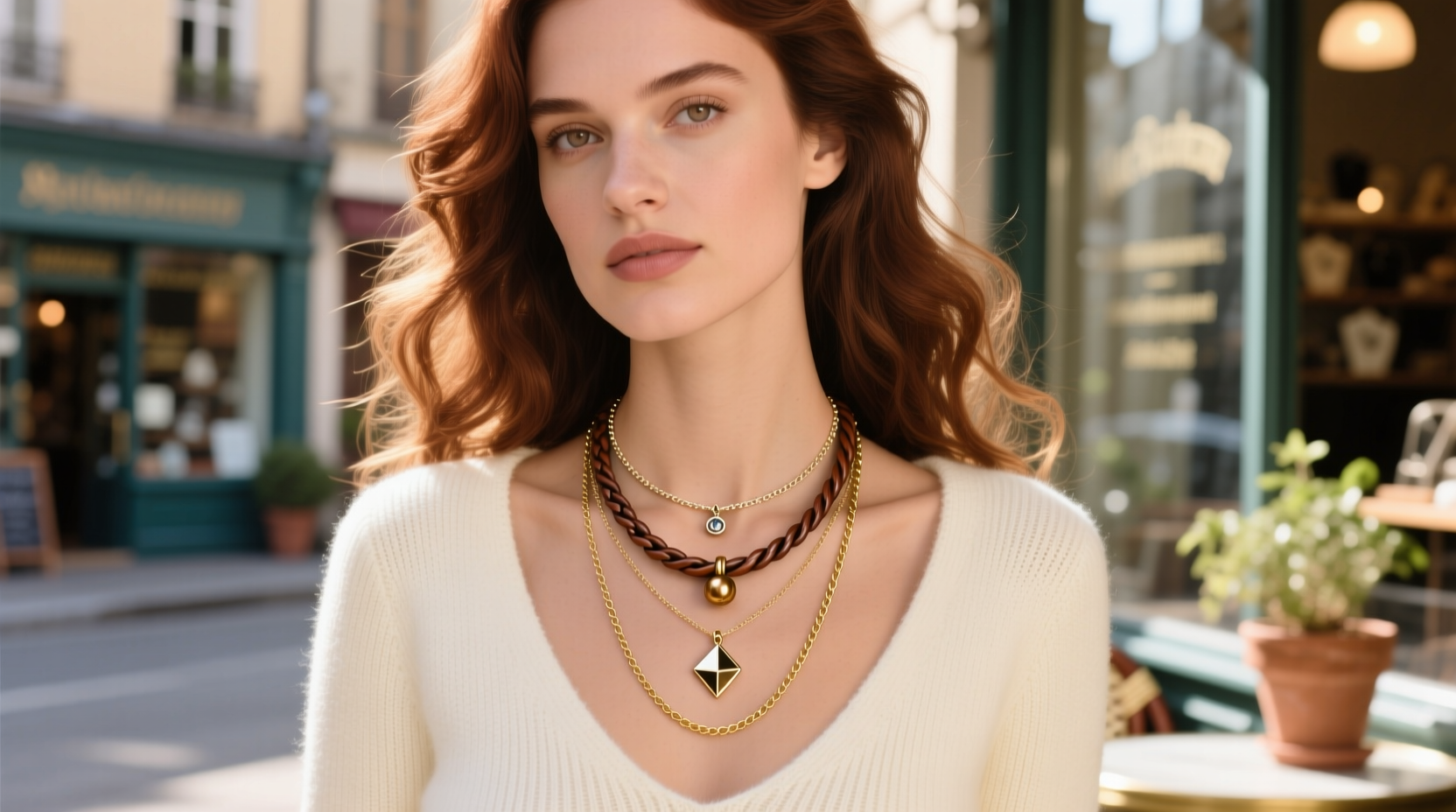
Before combining multiple necklaces, it's essential to know standard length classifications. These determine where each chain sits on the body and how they interact visually when layered.
| Length (inches) | Name | Sits On | Best For Layering? |
|---|---|---|---|
| 14–16 | Choker / Princess | Base of neck to collarbone | Yes – ideal top layer |
| 18 | Matinee | Just below collarbone | Yes – middle anchor |
| 20–22 | Opera | Middle of chest | Yes – adds depth |
| 24–30+ | Rope / Lariat | Below bust or longer | Limited use – best solo or with two shorter layers |
When layering, aim for at least a 2-inch difference between each necklace so the pieces don’t tangle and their positions remain distinct. A common mistake is using chains too close in length—they compete instead of complementing.
Create Visual Balance with Strategic Pairing
Balance doesn't mean symmetry—it means ensuring no single element overwhelms the others. Think of necklace layering like arranging music tracks: melody, rhythm, and bass must coexist without one drowning out the rest.
Start by selecting a base necklace—usually an 18- or 20-inch chain with minimal detailing. This acts as your rhythmic foundation. Then add contrast: perhaps a delicate choker with a small pendant for melodic emphasis, and a longer, textured chain (like a curb or figaro) for depth.
- Vary thickness: Combine a thin cable chain with a medium box chain and a bold rope link. Avoid stacking three chunky chains—they’ll appear bulky.
- Mix metals thoughtfully: Gold, silver, and rose gold can coexist if there’s intention behind it. Stick to two metals max unless your wardrobe already embraces eclectic styles.
- Limit dominant pendants: Only one necklace should feature a large or eye-catching charm. Others should support, not compete.
“We often see clients over-layer because they love each piece individually. But jewelry is about editing. Three well-chosen chains speak louder than six crowded ones.” — Lena Torres, Jewelry Stylist at Atelier Adorn
Step-by-Step Guide to Building Your Stack
Follow this five-step process to build a cohesive, flattering necklace combination tailored to your neckline and outfit.
- Determine your frame and neckline. Petite frames suit fewer, finer layers (2–3). Taller individuals can carry 3–5 pieces. High necklines (turtlenecks, crewnecks) work best with longer chains that extend below the fabric edge.
- Select a centerpiece. Choose one meaningful or statement necklace—perhaps a locket, initial pendant, or birthstone. Let this be the star; everything else enhances it.
- Pick supporting lengths. Use the “rule of thirds”: one short (14–16\"), one mid (18–20\"), and optionally one long (22–24\"). This creates natural spacing.
- Test material harmony. Lay the chains flat on a surface. Do they flow together? If one looks out of place, swap it for a simpler version in the same metal.
- Wear and adjust. Put them on and observe in a full-length mirror. Turn side-to-side. Are they tangling? Is the longest chain overwhelming? Remove or replace until movement feels effortless.
Common Mistakes and How to Avoid Them
Even experienced stylists occasionally misstep when layering. Recognizing these pitfalls helps refine your technique.
| Mistake | Why It Fails | Solution |
|---|---|---|
| All chains the same length | Creates a tangled cluster; lacks dimension | Space lengths at least 2 inches apart |
| Too many pendants | Looks chaotic; distracts from face | One focal pendant only; others plain or tiny |
| Ignoring neckline context | Necklaces disappear under high collars or clash with V-necks | Match longest chain to neckline depth |
| Over-mixing textures | Beading, chains, leather cords compete | Stick to 2–3 textures max; prioritize cohesion |
Another frequent error is neglecting comfort. Heavy stacks can pull or irritate the skin. If a necklace consistently slides forward or causes discomfort, reconsider its place in rotation—even beautiful pieces shouldn’t compromise wearability.
Real-Life Example: Office to Evening Transformation
Sophie, a 32-year-old marketing consultant, wanted to transition her look from day meetings to after-work dinners without changing jewelry. Her solution was strategic layering.
During the day, she wore a simple 18-inch gold vermeil cable chain alone—a professional, understated touch. For evening events, she added two pieces: a 16-inch choker with a tiny moon pendant and a 22-inch matte-finish wheat chain. The result? A refined progression from minimalism to subtle glamour.
The shorter choker framed her jawline, the mid-length chain anchored near her collarbones, and the longer piece drew the eye downward, elongating her silhouette in cocktail attire. By keeping all pieces in warm-toned gold and limiting pendants to one, the stack remained elegant, not excessive.
This example shows how versatility isn’t about owning dozens of necklaces, but about building a modular system where components work alone or together depending on context.
Checklist: Build Your Perfect Layered Look
Use this practical checklist before assembling your next necklace stack:
- ☐ I’ve chosen a maximum of three primary lengths (e.g., 16\", 18\", 22\")
- ☐ There’s at least a 2-inch gap between each chain
- ☐ Only one necklace has a prominent pendant or charm
- ☐ Metal tones are consistent or intentionally mixed (no more than two types)
- ☐ Chain thickness varies—thin, medium, and/or bold—but not all thick
- ☐ The longest chain complements my current neckline (doesn’t vanish under fabric)
- ☐ I’ve tested the set for tangling and comfort while moving
- ☐ The overall look draws attention upward toward my face, not down to the chest
Running through this list ensures your layered necklaces enhance your appearance rather than distract from it.
Frequently Asked Questions
Can I layer necklaces with different metal finishes?
Yes, but do so intentionally. Mixing gold and silver works best when balanced—for example, two gold chains with one silver accent. Modern fashion embraces tonal contrast, especially with rose gold bridging warm and cool tones. Just avoid random mixing; let one metal dominate.
How many necklaces is too many?
For most settings, more than four necklaces risks appearing cluttered. In editorial or avant-garde contexts, more is acceptable, but in daily wear, restraint wins. If you can’t easily see individual chains or they constantly tangle, scale back. Quality over quantity always applies.
Do certain face shapes suit layered necklaces more?
All face shapes can wear layered necklaces effectively—the trick is alignment. Round faces benefit from longer vertical layers that elongate the neck. Square jaws pair well with curved pendants and soft chain lines. Oval and heart-shaped faces have more flexibility but still benefit from balanced spacing.
Final Thoughts and Style Encouragement
Layering necklaces isn’t about following rigid rules—it’s about cultivating confidence in self-expression. The most compelling stacks reflect personality: a vintage locket passed down from a grandmother, a modern signet representing independence, a delicate chain marking a milestone. When combined with awareness of proportion and harmony, these pieces become more than accessories—they become narrative threads.
Start small. Try two chains first. Observe how they move with you, how light catches different surfaces, how outfits respond to added detail. Over time, you’ll develop an instinct for what works with your body, wardrobe, and lifestyle.




 浙公网安备
33010002000092号
浙公网安备
33010002000092号 浙B2-20120091-4
Comments
No comments yet. Why don't you start the discussion?