
Layering necklaces is one of the most effective ways to elevate an outfit—from casual tees to evening gowns. But few styling pleasures come with as much frustration as untangling a knotted mess of chains every time you want to wear them. The good news: with the right approach, you can create stunning layered looks in under five minutes while keeping your jewelry tangle-free. This guide reveals practical methods, smart organization strategies, and insider techniques used by stylists and jewelers alike.
Why Necklaces Tangle—and How to Stop It
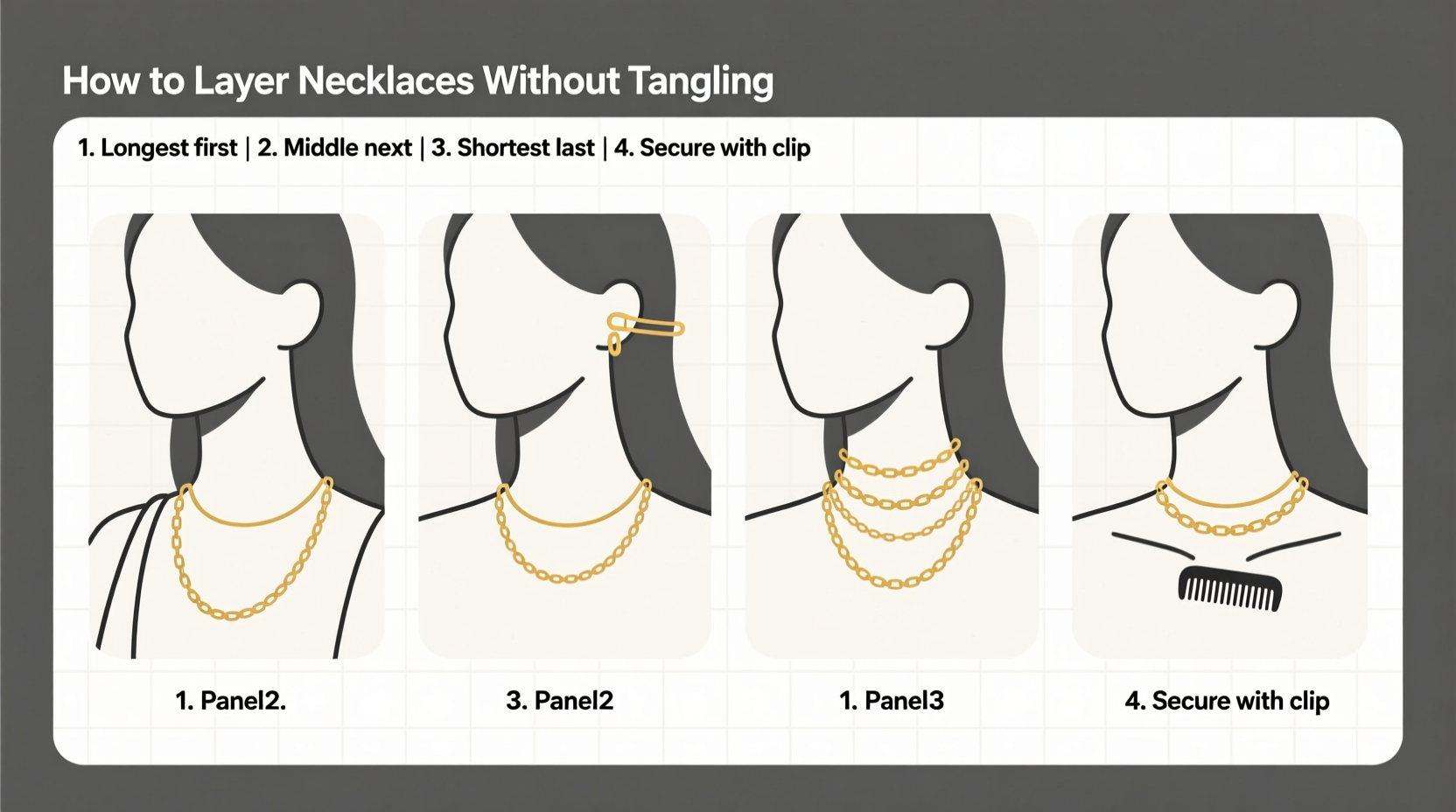
Necklaces tangle primarily due to movement, improper storage, and mismatched lengths or weights. When chains are tossed into a drawer or left hanging loosely, their links catch on each other, especially when made from fine materials like delicate cable or box chains. Friction increases when different metals or textures interact—such as a thick curb chain dragging against a dainty pendant necklace.
The solution isn’t just about careful handling—it’s about system design. Just like cords for headphones, jewelry needs structure. Preventing tangles starts long before you put on your outfit; it begins with how you store, select, and sequence your pieces.
Step-by-Step: Create a Tangle-Free Layered Look in Under 5 Minutes
- Choose Your Base Chain (30 seconds): Start with the shortest necklace. Typically, this is a choker or 16-inch chain. Opt for a simple design—like a delicate gold or silver link—to anchor the look.
- Select Complementary Lengths (1 minute): Add two more necklaces, increasing in length by at least 1–2 inches each. For example: 16\", 18\", and 20\". This staggered approach prevents overlapping and reduces contact between chains.
- Pre-Straighten Each Piece (1 minute): Lay all selected necklaces flat on a soft surface. Gently pull each end to release minor kinks. If stored properly, they should need minimal adjustment.
- Put Them On in Order (2 minutes): Fasten the shortest necklace first. Then add the next, letting it settle naturally over the first. Finally, secure the longest. Avoid pulling or adjusting aggressively—let gravity do the work.
- Final Check & Adjust (30 seconds): Stand in front of a mirror. Smooth any twists. Use fingertips to separate pendants or charms that may have clustered. Done.
This method works because it minimizes handling time and leverages strategic spacing. The entire process takes less than five minutes when practiced consistently.
Smart Storage: The Foundation of Tangle-Free Jewelry
No matter how skilled you are at styling, poor storage will sabotage your efforts. Jewelry drawers filled with loose chains are tangle traps. Instead, adopt systems that isolate each piece while keeping them accessible.
| Storage Method | Best For | Tangle Prevention Level |
|---|---|---|
| Hanging jewelry organizer | Long chains, statement pieces | High – vertical separation reduces contact |
| Individual fabric pouches | Fine chains, sentimental items | Very High – complete isolation |
| Travel roll with slots | On-the-go layering sets | High – fixed positions prevent shifting |
| Drawer divider tray | Mixed metals and short chains | Moderate – only if chains are coiled and clasped |
| Open bowl or dish | Daily-wear single necklaces | Low – high risk of tangling |
A travel roll is particularly effective for pre-planned layering sets. Many designers now sell “layering kits” with matching chains already separated in individual slits—ideal for those who want a polished look without daily effort.
Expert Insight: What Professional Stylists Do Differently
Top fashion stylists don’t rely on luck when layering jewelry. They use precision planning and consistent routines to maintain flawless presentation—even during hectic shoots.
“Time saved on untangling is time earned for creativity. I prep my clients’ go-to necklace stacks the night before, laid out on velvet strips. In the morning, they just slip them on—one after another—in under three minutes.” — Lena Torres, Celebrity Fashion Stylist
Torres also emphasizes material pairing: “Mixing too many textures—like rope, snake, and cable chains—increases friction. Stick to two complementary styles per look. And always check clasp strength—nothing ruins a moment faster than a broken chain mid-event.”
Real Example: From Morning Chaos to Effortless Elegance
Sarah, a marketing executive in Chicago, used to spend up to ten minutes every morning wrestling with her favorite trio of gold necklaces. She’d often arrive at meetings flustered, with one chain still twisted around another. After reading about segmented storage, she invested in a hanging organizer with labeled hooks.
She assigned each necklace a permanent spot based on length and began laying them out the night before. Now, she grabs them in order, clips them on, and walks out the door in under four minutes. “It sounds small,” she says, “but it changed my mornings. I feel put together instead of rushed.”
Her routine evolved further when she started using a magnetic clasp extender on her longest chain—making it easier to reach and reducing fumbling during fastening.
Checklist: Tangle-Free Necklace Routine
- ✅ Store each necklace separately using pouches, hooks, or slots
- ✅ Always fasten the clasp before storing
- ✅ Choose layered sets with incremental lengths (e.g., 16”, 18”, 20”)
- ✅ Limit layers to 2–3 pieces unless using uniform styles
- ✅ Pre-plan combinations and lay them out the night before
- ✅ Use a soft cloth to wipe down chains weekly to reduce grime buildup (which increases stickiness)
- ✅ Inspect clasps monthly for wear and replace damaged ones promptly
Following this checklist ensures both longevity and ease of use. Over time, these habits become automatic, turning what was once a chore into a seamless part of your routine.
Common Mistakes That Cause Tangling
Even with good intentions, small oversights lead to big knots. Watch out for these frequent errors:
- Storing multiple necklaces in the same compartment: Even brief contact during movement can form tight knots.
- Using overly long chains in layered sets: A 30-inch chain draped over shorter ones creates loops where tangling occurs easily.
- Leaving pendants unsecured: Swinging pendants act like hooks, catching on adjacent chains.
- Putting on necklaces while seated hunched over: This causes chains to fall unevenly and twist across the neck and shoulders.
- Ignoring metal compatibility: Softer metals like vermeil or thin sterling silver are more prone to bending and snagging.
To mitigate pendant-related snags, consider temporarily securing them with a tiny rubber band or placing a folded tissue between pendant and chain during storage.
FAQ: Quick Answers to Common Concerns
Can I layer necklaces of the same length?
You can, but it increases the chance of tangling. If wearing similar lengths, choose one dominant focal point—like a pendant on one chain—and keep the others minimal. Alternatively, use a spacer bar—a small metal rod that clips onto both chains to keep them apart.
What’s the best way to untangle a necklace quickly?
Place the necklace on a flat surface. Use a pin or earring back to gently loosen the knot from the outside in. Apply a drop of olive oil or baby shampoo to reduce friction if needed. Never pull hard—this can break the chain.
Are certain chain types less likely to tangle?
Yes. Rigid styles like Figaro, rope, or wheat chains resist twisting better than fluid types like cable or trace chains. However, rigid chains are heavier, so balance comfort with practicality.
Conclusion: Style Without the Struggle
Layering necklaces doesn’t have to be a battle against knots and frustration. With intentional selection, smart storage, and a streamlined routine, you can achieve a sophisticated, multi-chain look in under five minutes—every single time. The key is consistency: treat your jewelry like the investment it is, and build systems that protect both its appearance and your peace of mind.
Start tonight. Organize your most-worn pieces. Assign them a place. Try the step-by-step method tomorrow morning. You’ll be surprised how such small changes deliver lasting elegance and efficiency.




 浙公网安备
33010002000092号
浙公网安备
33010002000092号 浙B2-20120091-4
Comments
No comments yet. Why don't you start the discussion?