
Jonestown is one of the most historically significant and somber locations tied to modern American history. While it no longer exists as a functioning settlement, the site remains a point of interest for researchers, historians, and travelers seeking to understand the events of November 18, 1978. Locating Jonestown on a map requires more than just typing a name into a search engine—its remote placement, lack of formal infrastructure, and historical ambiguity demand careful navigation. This guide provides a precise method for identifying the site, understanding its geographical context, and exploring the surrounding region with awareness and respect.
Understanding the Historical Context of Jonestown
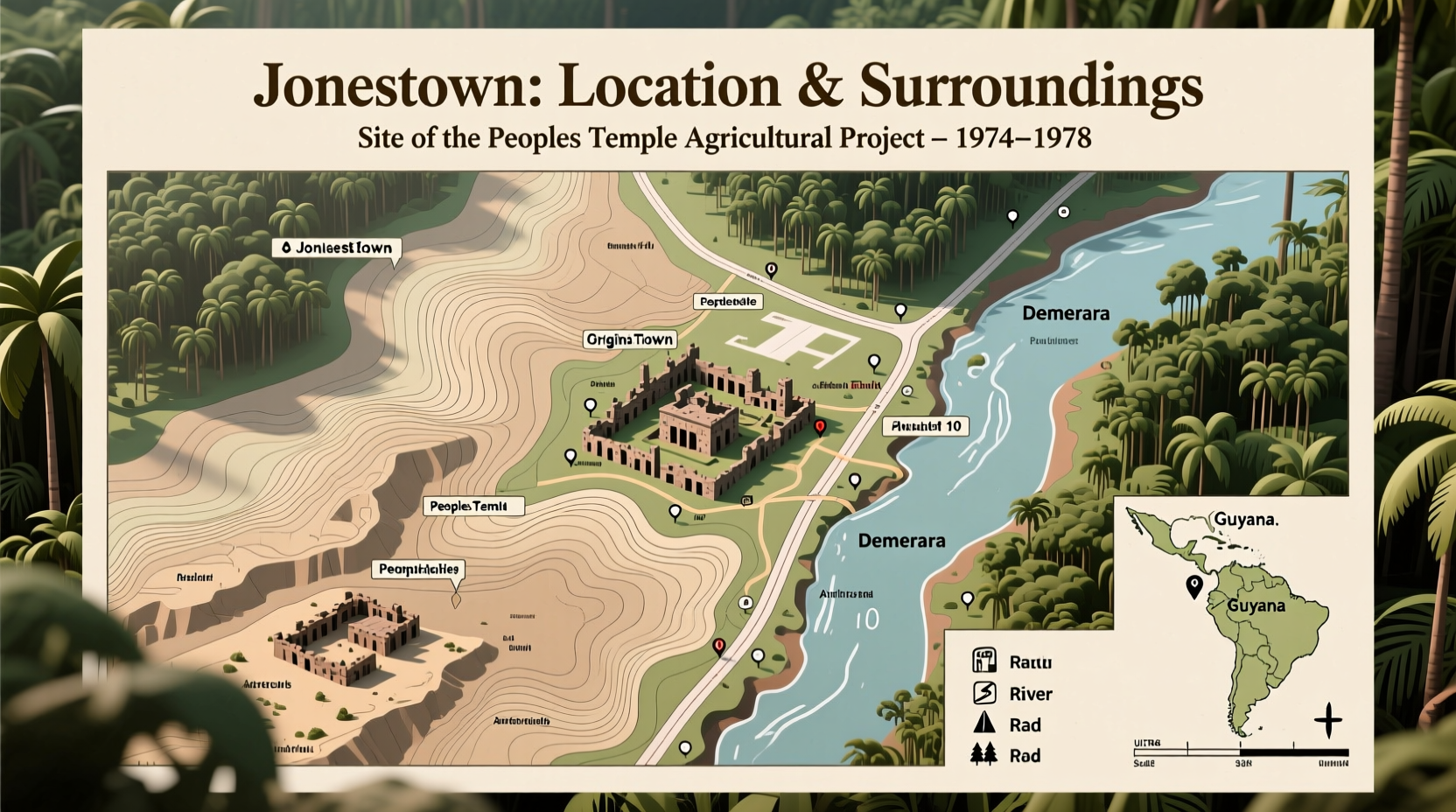
Jonestown was established in the mid-1970s by members of the Peoples Temple, a religious group led by Jim Jones. The settlement was created in northwestern Guyana as an agricultural utopia, intended to be self-sufficient and isolated from perceived societal corruption in the United States. However, it became internationally known after over 900 people died there in a mass murder-suicide event, marking one of the largest single losses of American civilian life in a non-natural disaster until September 11, 2001.
Today, the physical remnants of Jonestown are minimal. Dense jungle has reclaimed most structures, and no official memorial or maintained site currently exists at the original location. Despite this, the coordinates and general area remain identifiable through historical records, survivor accounts, and satellite imagery.
“Jonestown wasn’t just a place—it was a convergence of idealism, isolation, and tragedy. To find it on a map is to confront a complex chapter in human behavior.” — Dr. Rebecca Langford, Historian of 20th Century Social Movements
Step-by-Step Guide to Finding Jonestown on a Map
Locating Jonestown requires combining digital tools, geographic knowledge, and historical data. Follow these steps to pinpoint the approximate location accurately:
- Open a reliable mapping platform such as Google Earth, Google Maps, or Bing Maps. Google Earth is recommended due to its high-resolution satellite imagery and historical layer options.
- Search for Port Kaituma, Guyana. This small coastal village is the nearest populated settlement to Jonestown and serves as the primary reference point.
- Navigate northeast of Port Kaituma approximately 6 miles (10 kilometers) inland. The terrain becomes densely forested, and roads turn to dirt trails.
- Enter the approximate coordinates: 6.435° N, 58.848° W. These coordinates mark the estimated center of the former Jonestown settlement.
- Switch to satellite view and look for subtle signs of past human activity: faint grid-like patterns in vegetation, slight discoloration in tree cover, or linear breaks that may indicate old pathways.
- Zoom out slightly to observe the surrounding geography—nearby rivers, creeks, and the proximity to the Venezuelan border.
Geographical Overview of the Region
Jonestown lies in the Barima-Waini region of northwestern Guyana, near the border with Venezuela. The area is part of the Guiana Shield, characterized by tropical rainforest, laterite soil, and high biodiversity. Access remains extremely limited due to poor road conditions and seasonal flooding.
The nearest airstrip, now largely abandoned, was located just west of the settlement and served as the final landing point for Congressman Leo Ryan and his delegation before their tragic ambush in 1978. Today, reaching the site would require chartering a small aircraft to Port Kaituma, followed by a challenging overland trek through dense jungle.
| Feature | Description |
|---|---|
| Nearest Town | Port Kaituma (~10 km southeast) |
| Coordinates | Approx. 6.435° N, 58.848° W |
| Country | Guyana |
| Region | Barima-Waini (Region 1) |
| Topography | Tropical lowland rainforest, flat terrain |
| Accessibility | By air to Port Kaituma, then foot or boat |
| Current Status | Abandoned, reclaimed by jungle |
Real Example: A Researcher’s Journey to the Site
In 2016, historian David Chen undertook a field expedition to document the remnants of Jonestown. Flying into Georgetown, Guyana’s capital, he traveled by domestic flight to Port Kaituma. With the help of a local guide familiar with the area’s trails, he hiked for nearly three hours through humid forest, navigating by GPS and old aerial maps.
Upon arrival, Chen found little more than scattered concrete slabs, rusted metal fragments, and a partially collapsed water tank. “It was quiet—unnervingly so,” he later wrote. “The silence felt heavier than the heat. You could sense the absence of thousands of decisions, routines, voices.” His team documented the site with photographs and GPS markers but left no markings, respecting both the environment and the memory of those who perished.
This example underscores that while Jonestown can be located digitally, physically visiting it demands preparation, respect, and an understanding of the emotional weight the site carries.
Practical Tips for Digital Exploration
For most people, visiting Jonestown in person is neither feasible nor advisable. However, meaningful exploration is possible using digital tools. Here are actionable tips for responsible virtual investigation:
- Use Google Earth’s measurement tool to trace the layout of the former settlement based on survivor sketches.
- Overlay historical maps from the National Archives or academic sources to compare land use changes.
- Explore oral histories from survivors to contextualize what different areas were used for—dormitories, kitchen, medical hut, pavilion.
- Avoid sharing or promoting sensationalized content; focus on educational and respectful engagement.
Frequently Asked Questions
Is Jonestown marked on Google Maps?
No, Jonestown is not officially labeled on standard map views. However, entering the coordinates (6.435° N, 58.848° W) will take you to the approximate location. Satellite imagery shows a subtle clearing in the forest, consistent with historical descriptions.
Can tourists visit Jonestown today?
There is no official tourist access. While technically possible via private charter and guided trek, the journey is arduous and the site unmarked. Most experts recommend virtual exploration for safety, environmental, and ethical reasons.
Why is Jonestown located so remotely?
Jim Jones chose the location specifically for its isolation. He believed separation from mainstream society would protect the community from government interference and allow the Peoples Temple to operate autonomously. The remoteness, however, contributed to the lack of oversight and the tragedy’s scale.
Final Checklist for Accurate Location
Before concluding your search, verify the following:
- You have entered the correct coordinates: 6.435° N, 58.848° W
- You are viewing satellite mode, not street map
- You have identified Port Kaituma as the reference point
- You have cross-referenced with at least one historical map or survivor account
- You understand that no physical structures remain visible today
- You approach the topic with sensitivity to the victims and their families
Conclusion: Mapping Memory with Respect
Finding Jonestown on a map is more than a technical exercise—it is an act of remembrance and reflection. The site’s physical invisibility contrasts sharply with its enduring presence in collective memory. By using accurate tools, respecting the gravity of the location, and engaging thoughtfully with its history, we honor those who lived and died there.
Whether you're a student, researcher, or curious individual, take the time to go beyond coordinates. Learn the stories, examine the causes, and consider how isolation, ideology, and leadership can converge with devastating consequences. The real value of locating Jonestown isn’t just in finding a dot on a map, but in understanding the human landscape behind it.




 浙公网安备
33010002000092号
浙公网安备
33010002000092号 浙B2-20120091-4
Comments
No comments yet. Why don't you start the discussion?