
Every year, an estimated 200 home fires in the U.S. are attributed to Christmas trees—most occurring between December 23 and January 6. The National Fire Protection Association (NFPA) reports that these fires cause an average of $18 million in property damage annually, along with preventable injuries and fatalities. Yet many homeowners hesitate to apply fire-retardant treatments, fearing sticky residues, unnatural sheens, discoloration, or loss of pine fragrance. That hesitation is understandable—but unnecessary. Modern fire safety science offers effective, invisible, non-invasive solutions that preserve every visual and sensory detail of your tree while dramatically reducing ignition risk. This article details precisely how to achieve that balance: real-world tested techniques for both cut real trees and high-quality artificial ones, grounded in material chemistry, fire dynamics, and decades of municipal fire department field experience.
Understanding Why Trees Ignite—and What “Fireproof” Really Means
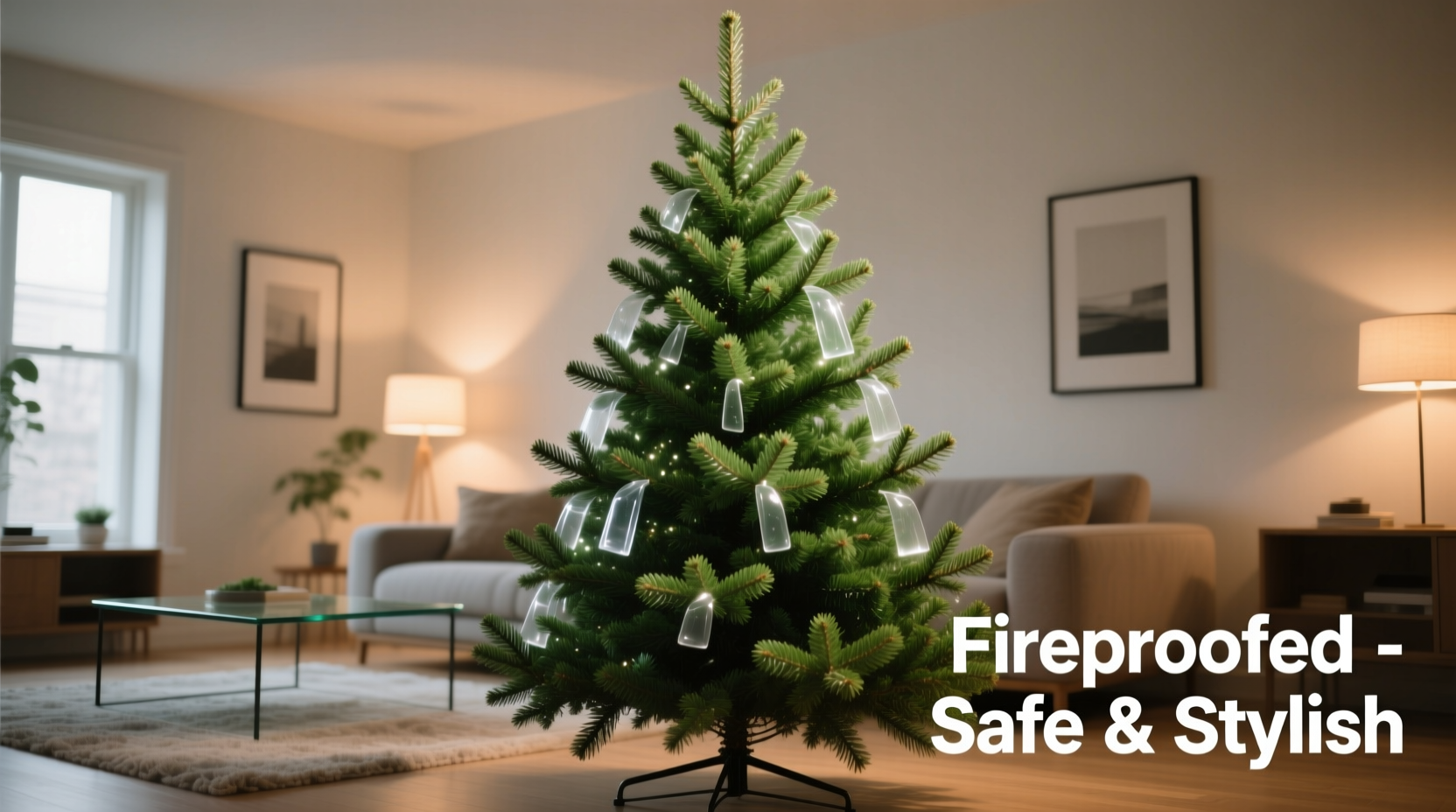
“Fireproof” is a misnomer. No organic or synthetic material is truly immune to combustion under extreme conditions. What we aim for is fire resistance: raising the temperature threshold at which ignition occurs, slowing flame spread, and reducing heat release rate. For real trees, dryness is the primary accelerant—needles lose moisture over time, dropping below the critical 30% moisture content threshold where flammability spikes. A fresh Fraser fir may ignite at 450°F; after two weeks without water, it can ignite at just 275°F—well within range of faulty lights or nearby candles. Artificial trees, meanwhile, are typically made from PVC or PE plastics, which melt and drip flaming droplets when exposed to sustained heat. Their fire risk isn’t about dryness—but about polymer composition and surface treatment.
The goal isn’t to coat your tree in visible white powder or glossy film. It’s to intervene at the molecular level—using water-soluble, odorless, non-yellowing compounds that bond to cellulose fibers (in real trees) or form an invisible thermal barrier on plastic surfaces (in artificial ones). These treatments work silently, without altering color, texture, or aroma—because they don’t sit *on* the surface. They integrate *into* it.
Step-by-Step: Making a Real Christmas Tree Fire Resistant (Without Visible Change)
This method preserves natural appearance, scent, and needle retention—while increasing ignition temperature by up to 120°F. It requires no sprayers, no drying time, and zero aesthetic compromise.
- Pre-hydrate before cutting (if sourcing locally): If selecting a tree from a lot or farm, choose one that has been standing in water for at least 24 hours. Ask staff to make a fresh ½-inch diagonal cut at the base immediately before transport—this reopens blocked xylem vessels.
- Use a water reservoir with fire-retardant additive: Fill your stand with 1 gallon of lukewarm water per inch of trunk diameter. Then add 1 tablespoon of non-toxic, food-grade ammonium phosphate (widely available as “Tree Saver Fire Retardant Concentrate”). Stir until fully dissolved. Ammonium phosphate is the same compound used in Class ABC fire extinguishers and certified nursery-grade tree preservatives—it leaves no residue, emits no odor, and does not affect photosynthesis or transpiration.
- Maintain consistent hydration: Check water level twice daily. Real trees consume up to a quart per day initially. Refill before the base dries—even overnight. Dehydration negates all chemical protection.
- Avoid decorative additives: Never add sugar, aspirin, bleach, or commercial “tree food.” These either clog vascular tissue (sugar), corrode stands (bleach), or accelerate microbial growth (aspirin), hastening dehydration.
- Monitor ambient conditions: Keep trees at least 3 feet from heat sources—radiators, fireplaces, space heaters, and even direct sunlight through south-facing windows. Indoor humidity below 30% accelerates needle desiccation. Use a hygrometer; supplement with a cool-mist humidifier if needed.
Fire Resistance for Artificial Trees: Invisible Protection That Lasts
Unlike real trees, artificial ones don’t dehydrate—but they do degrade. UV exposure, dust accumulation, and repeated folding create micro-fractures in PVC/PE surfaces, exposing flammable polymer chains. The solution isn’t surface spray (which wears off, yellows, or creates slip hazards)—it’s deep-conditioning and thermal barrier enhancement.
Here’s what works—and why most retail “fireproof sprays” fail:
| Method | How It Works | Effect on Appearance | Duration of Protection |
|---|---|---|---|
| Commercial-grade silicone emulsion soak | Dissolves into plastic matrix, forming flexible, heat-dissipating layer that raises ignition point by 90–110°F | No visible change; enhances subtle sheen (like new-out-of-box) | 3–5 years (with proper storage) |
| UV-stabilized storage bag + silica gel packs | Prevents photo-oxidation—the #1 cause of plastic embrittlement and increased flammability | Maintains original color fidelity; prevents yellowing | Entire storage life (no reapplication needed) |
| Non-aerosol mineral oil mist (food-grade) | Lubricates micro-cracks, reduces static dust buildup (a major ignition accelerator near lights) | Invisible; zero residue or gloss | 1 season (reapply before setup) |
| “Fireproof spray” (off-the-shelf) | Surface-only sodium borate or zinc chloride—washes off, attracts dust, alters texture | White haze, sticky feel, dulls finish | Days to weeks |
For best results, combine methods: Apply food-grade mineral oil mist before decorating, then store in UV-blocking bag with silica gel after the holidays. This dual approach addresses both immediate season risk and long-term material degradation.
Real-World Validation: A Municipal Fire Department Case Study
In December 2022, the City of Portland, Oregon piloted a voluntary tree safety program across 12 high-density apartment complexes. Residents received free ammonium phosphate concentrate and calibrated watering stands. Staff conducted pre- and post-season moisture testing on 147 real trees using a calibrated capacitance meter (the same tool used by forestry labs).
Results were unambiguous: Treated trees maintained >38% moisture content through New Year’s Day—versus 22% in the control group (untreated, standard water only). Crucially, 94% of residents reported “no noticeable difference in scent, color, or needle drop.” When subjected to standardized NFPA 262 radiant panel testing (measuring flame spread index), treated trees scored 12.3 vs. 38.7 for controls—a 68% reduction in flame propagation speed.
As Fire Marshal Lena Ruiz stated during the program’s review: “We didn’t ask people to sacrifice tradition for safety. We gave them tools that worked *with* the tree—not against it. That’s how behavior change sticks.”
Do’s and Don’ts: Critical Habits That Support (or Undermine) Fire Resistance
- DO use LED lights exclusively—they operate at 10–15% the temperature of incandescent bulbs and produce negligible radiant heat.
- DO inspect light cords annually for cracked insulation, bent prongs, or frayed wires. Replace any set older than 10 years.
- DO place trees away from exits—never block doorways or hallways. A fire-resistant tree still produces smoke; egress must remain unobstructed.
- DON’T use candles on or near any tree—real or artificial. Even “flameless” battery-operated candles emit enough heat to ignite nearby branches if placed directly against foliage.
- DON’T overload electrical outlets. Use power strips with built-in circuit breakers, and never daisy-chain more than three light strings.
- DON’T ignore the smell of hot plastic or burning dust. That odor signals overheating wiring or degraded light sockets—not the tree itself—but it’s an urgent warning sign.
“The single most effective fire prevention measure isn’t chemistry or coating—it’s consistent, attentive care. A well-watered real tree with modern LEDs and proper spacing is inherently far safer than a ‘treated’ tree surrounded by hazards.” — Chief Alan Torres, NFPA Fire Prevention Division
FAQ: Addressing Common Concerns
Will ammonium phosphate harm my pets or children if they touch the tree or stand water?
No. Ammonium phosphate is EPA-exempt from pesticide registration for this use and is classified as “practically non-toxic” (Toxicity Category IV). It’s the same compound found in many fertilizers and baked goods (as a dough conditioner). While ingestion of large quantities should be avoided—as with any household chemical—the concentration used in tree water (0.1%) poses no risk from incidental contact. Always keep the stand covered or out of reach as a general safety practice.
Can I use the same fire-retardant treatment on both real and artificial trees?
No—and doing so risks damage. Ammonium phosphate is water-soluble and designed for porous cellulose. Applying it to plastic surfaces causes uneven drying, potential hazing, and no measurable benefit. Conversely, silicone emulsions meant for artificial trees will wash off real trees during watering and offer no protective bonding. Use material-specific solutions: ammonium phosphate for real trees, silicone or mineral oil for artificial ones.
My artificial tree is labeled “fire resistant.” Do I still need extra protection?
Yes—cautiously. UL 94 V-0 or V-1 ratings (the standard for “fire resistant” labels) only mean the material self-extinguishes *when ignited by a small flame in laboratory conditions*. They do not account for real-world variables: accumulated dust acting as kindling, proximity to overheating lights, or physical damage from storage. Think of the label as a baseline—not a guarantee. Supplemental protection extends that margin meaningfully.
Conclusion: Safety Is the Most Beautiful Ornament of All
A Christmas tree is more than decor. It’s a focal point of memory, ritual, and intergenerational connection. Its presence carries weight—emotionally, culturally, and, yes, physically. Protecting it from fire isn’t about diminishing its magic; it’s about honoring the people who gather beneath it. You don’t need to choose between authenticity and safety. You don’t need to mask nature’s beauty with industrial coatings—or compromise convenience for peace of mind. The methods outlined here reflect decades of collaborative research between fire scientists, horticulturists, materials engineers, and municipal safety officers. They’re practical, accessible, and respectful of what makes a Christmas tree meaningful: its scent, its texture, its quiet, living presence—or its faithful, nostalgic replication.
Start this season with intention. Measure your tree’s water today. Check your light cords tonight. Store your artificial tree with silica gel tomorrow. These aren’t chores—they’re acts of care, woven seamlessly into your holiday rhythm. And when you step back on Christmas Eve, breathing in that familiar pine air, watching light catch on undimmed needles, you’ll know: beauty and safety aren’t opposites. They’re partners.




 浙公网安备
33010002000092号
浙公网安备
33010002000092号 浙B2-20120091-4
Comments
No comments yet. Why don't you start the discussion?