
Forget plastic tinsel and pre-lit firs. The most memorable holiday centerpieces aren’t bought—they’re curated. A book or record Christmas tree isn’t just décor; it’s a tactile manifesto of identity. It signals curiosity, nostalgia, and quiet rebellion against mass-produced cheer. Whether you’re a bibliophile who’s reorganized their shelves three times this year or a vinyl collector who still cleans each LP with a carbon-fiber brush, this project transforms archival material into festive architecture. Done right, it’s structurally sound, visually arresting, and deeply personal—no glue gun required (though one helps). More than decoration, it’s conversation fuel, shelf-worthy art, and a subtle nod to the analog soul in a digital season.
Why Books and Records Work—Beyond the Aesthetic
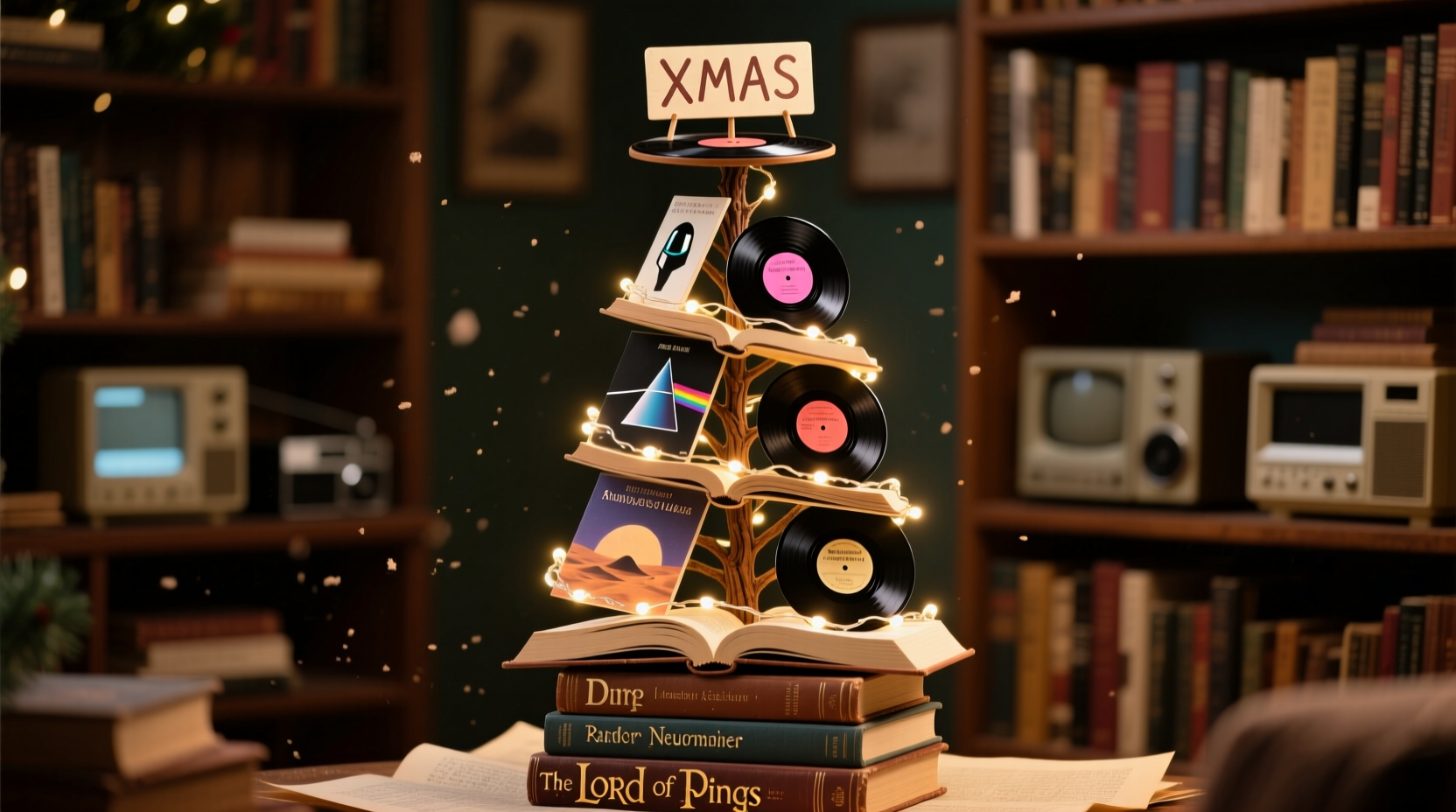
Books and records share an underappreciated physical logic: consistent dimensions, rigid spines or edges, and inherent weight distribution. A standard hardcover book averages 6–9 inches tall and 0.75–1.5 inches thick—ideal for stacking in graduated tiers. Vinyl records (12-inch LPs) offer perfect circular symmetry and rigidity, while 7-inch singles add playful scale variation. Unlike cardboard cutouts or wire frames, these materials carry narrative weight. That dog-eared copy of Dune isn’t just a green wedge—it’s a decade of rereads. The warped Beatles LP isn’t mere geometry—it’s sonic history made visible.
Structural integrity comes from interlocking geometry: books stacked spine-out create natural “branches” that splay slightly as height increases; records stacked flat with staggered rotation form a stable conical silhouette. Neither requires nails, screws, or permanent modification—preserving collectible value while enabling seasonal reuse.
Materials & Prep: Curating Your Tree’s DNA
Your tree’s character begins with selection—not just quantity, but intention. Avoid random piles. Instead, curate by theme, color, era, or emotional resonance. A monochrome tree (all navy cloth-bound classics) reads as minimalist and scholarly; a rainbow gradient (from crimson romance novels to violet sci-fi paperbacks) feels joyful and kinetic. Vinyl trees gain personality through label design: Motown’s Tamla swirls, Blue Note’s stark typography, or early punk sleeves with ripped collage.
Prep is non-negotiable. Dust every book spine and wipe each record with a microfiber cloth dampened with distilled water. Never use alcohol or commercial cleaners on vinyl—residue attracts dust and degrades grooves. For books, test cleaning solutions on an interior page first; many vintage inks bleed. Remove loose bookmarks, receipts, or sticky notes—these create uneven pressure points during stacking.
| Material Type | Ideal Quantity (for 3–4 ft tree) | Key Prep Steps | Red Flags to Avoid |
|---|---|---|---|
| Hardcover Books | 45–60 volumes | Wipe spines; reinforce loose hinges with archival PVA glue; remove protruding bookmarks | Water-damaged covers, detached spines, excessive warping |
| 12\" Vinyl Records | 25–35 LPs | Clean with anti-static brush + distilled water; inspect for cracks near labels | Visible warping (>2mm deviation), deep surface scratches, broken edges |
| 7\" Singles | 15–20 (for top tiers) | Same cleaning as LPs; group by thickness for uniform stacking | Warped centers, bent labels, missing sleeves affecting weight balance |
Two Proven Construction Methods: Book Tree vs. Record Tree
Each method demands distinct physics—and rewards different sensibilities.
The Book Tree: Stacked Spine-Out Pyramid
This approach leverages book spines as architectural elements. Begin with your widest base tier: arrange 12–15 books horizontally, spine-out, in a tight circle. Their spines should touch, forming a continuous ring. Stack the second tier directly atop the first—but rotate each book 15–20 degrees clockwise so spines angle slightly inward, creating gentle taper. Continue upward, reducing book count per tier (Tier 3: 10 books; Tier 4: 8; Tier 5: 6) while increasing rotation. The final tier (top) uses 3–4 books stood vertically on end, spine-in, forming a sharp apex.
Stability hinges on weight distribution: heavier books (art tomes, encyclopedias) belong at the base; lighter paperbacks rise higher. Never exceed 6 tiers—height beyond that risks top-heaviness. Use removable, acid-free double-stick tape at contact points between tiers if wobbling occurs. This tape leaves no residue and won’t damage covers.
The Record Tree: Rotated Disc Stacking
Vinyl trees rely on rotational friction and concentric alignment. Start with a sturdy, flat base—a 12-inch wooden disc sanded smooth works best. Place your first LP centered on the base. For Tier 2, place a second LP directly atop it—but rotate it 30 degrees. Tier 3 adds another LP rotated another 30 degrees (60° total from base). Continue this pattern, decreasing diameter only when using smaller records (e.g., switch to 7\" singles at Tier 5). The cumulative rotation creates interlocking friction that resists sliding.
Crucially: never stack more than 35 records. Beyond that, downward pressure risks warping lower discs—even high-quality pressings. Insert thin, food-grade silicone rings (1mm thick, 11.5\" inner diameter) between every 5th record. These absorb micro-vibrations and distribute load evenly. They’re invisible once stacked and prevent permanent deformation.
“The beauty of analog objects as décor lies in their honesty—they don’t pretend to be something else. A book tree celebrates weight, texture, and time. It’s anti-disposable design.” — Dr. Lena Torres, Design Historian & Author of Tactile Culture: Materiality in the Digital Age
Real-World Build: A Case Study from Portland
In December 2023, software engineer Maya R. built a 42-inch book tree for her open-concept living room using 52 volumes from her late father’s library—mostly mid-century physics texts, astronomy atlases, and translated Russian sci-fi. She faced two challenges: inconsistent book heights and sentimental hesitation about stacking irreplaceable editions.
Her solution was pragmatic and respectful. She measured every spine, then grouped books into height bands (within ¼ inch tolerance) and assigned tiers by thickness—not title. The heaviest volume, a 1958 Principles of Nuclear Physics, anchored the base. For the top three tiers, she used lightweight paperback editions of Solaris and The Martian Chronicles—books her father had gifted her at age 12. To honor provenance without risk, she inserted handwritten index cards between tiers listing publication years and brief notes (“Dad’s marginalia on p. 142”). The tree stood unassisted for 47 days, surviving holiday gatherings and two curious cats. Post-holiday, every book returned to its shelf—unscuffed, unaltered, and newly cherished.
Geek-Chic Styling: Elevating Function to Narrative
Ornamentation must deepen, not distract from, the core material. Skip generic baubles. Instead, embed meaning:
- Book Trees: Tuck tiny LED fairy lights *between* spines—not wrapped around them—to cast warm glows onto cover textures. Hang miniature brass bookends shaped like owls or rockets from upper-tier spines using clear fishing line. Clip vintage library checkout cards (with handwritten “Merry Solstice” notes) to lower-tier edges.
- Record Trees: Suspend translucent acrylic ornaments etched with spectrogram patterns from favorite songs using magnetized hooks attached to the record’s edge. Weave thin copper wire through the center holes of top-tier singles to hold tiny Edison-bulb string lights. Place a single, framed album lyric (“The stars look very different today”) beneath the base.
For scent—often overlooked in geek-themed trees—skip pine sprays. Instead, place a small dish of dried orange peel and crushed cardamom pods near the base. Its citrus-warm aroma subtly echoes vintage library stacks and recording studio coffee breaks.
Step-by-Step Assembly Timeline (Under 90 Minutes)
- Prep (15 min): Sort, clean, and measure all books/records. Group by height/thickness. Cut silicone rings (if using). Charge LED lights.
- Base Setup (5 min): Place wooden base on level surface. Mark center point with pencil.
- Tier 1 (10 min): Arrange widest books or largest records. Verify level with smartphone app or carpenter’s level.
- Tiers 2–5 (35 min): Stack progressively smaller tiers, checking rotation angles (book method) or rotation increments (record method). Insert silicone rings every 5 records.
- Lighting & Detailing (20 min): Weave lights, attach ornaments, place scent dish. Step back and adjust any leaning tiers.
- Final Check (5 min): Gently nudge each tier—no movement should exceed 1mm. Ensure no overhang exceeds 1.5 inches per side.
FAQ
Can I mix books and records in one tree?
Yes—but only with engineering rigor. Use records for the base (their uniform diameter provides unmatched stability) and transition to books at Tier 3 or 4. Anchor the first book tier with a custom-cut wooden ring that fits snugly over the top record. Without this interface, weight transfer causes slippage. We recommend this hybrid only for experienced builders.
How do I store components safely after the holidays?
Disassemble immediately post-season. Store books upright on shelves—not stacked flat—to prevent spine compression. Keep records vertically in anti-static inner sleeves inside outer jackets, stored in a cool, dry place away from direct sunlight. Never stack records horizontally long-term—even 10 LPs exert enough pressure to warp the bottom disc.
Will this attract pests or dust more than a traditional tree?
No—books and records are less hospitable to pests than organic materials. However, their textured surfaces do trap dust. Combat this with a weekly pass of an electrostatic duster (not feather dusters, which scatter particles). For records, use a carbon-fiber brush before and after display to lift static-attracted dust.
Conclusion: Your Tree Is Already Growing
You don’t need a workshop, a budget, or permission to build meaning into your holidays. A book or record tree asks only for attention—to the weight of a spine, the groove of a record, the quiet pride in what you’ve collected and kept. It resists the fleeting. It honors craft over consumption. And when guests pause mid-sentence to trace a title with their finger or tilt their head to read a faded label, you’ve done more than decorate—you’ve invited them into your intellectual lineage.
Start small. Choose five books from your nightstand. Find three records you haven’t played in months. Stack them. Adjust the angle. Add one light. See how it changes the room—and how it changes your relationship to the objects you call yours. Then share your build: tag a photo with #AnalogTree and tell us which volume or album holds the deepest story for you. Because the best traditions aren’t inherited—they’re assembled, one thoughtful layer at a time.




 浙公网安备
33010002000092号
浙公网安备
33010002000092号 浙B2-20120091-4
Comments
No comments yet. Why don't you start the discussion?