
For many households, the Christmas tree is both a centerpiece and a flashpoint: a symbol of joy that doubles as an irresistible climbing structure, chew toy, or impromptu litter box for curious cats and exuberant dogs. Yet “pet-proofing” shouldn’t mean defaulting to a bare, unadorned spruce in the corner—or worse, skipping the tree altogether. Modern pet owners deserve aesthetics *and* safety. The good news? With thoughtful planning, smart material choices, and behavioral reinforcement—not just barriers and bitter sprays—you can create a tree that delights the eye, calms the nerves, and coexists peacefully with your furry family members. This isn’t about compromise. It’s about intelligent integration.
1. Choose the Right Tree Type—and Position It Strategically
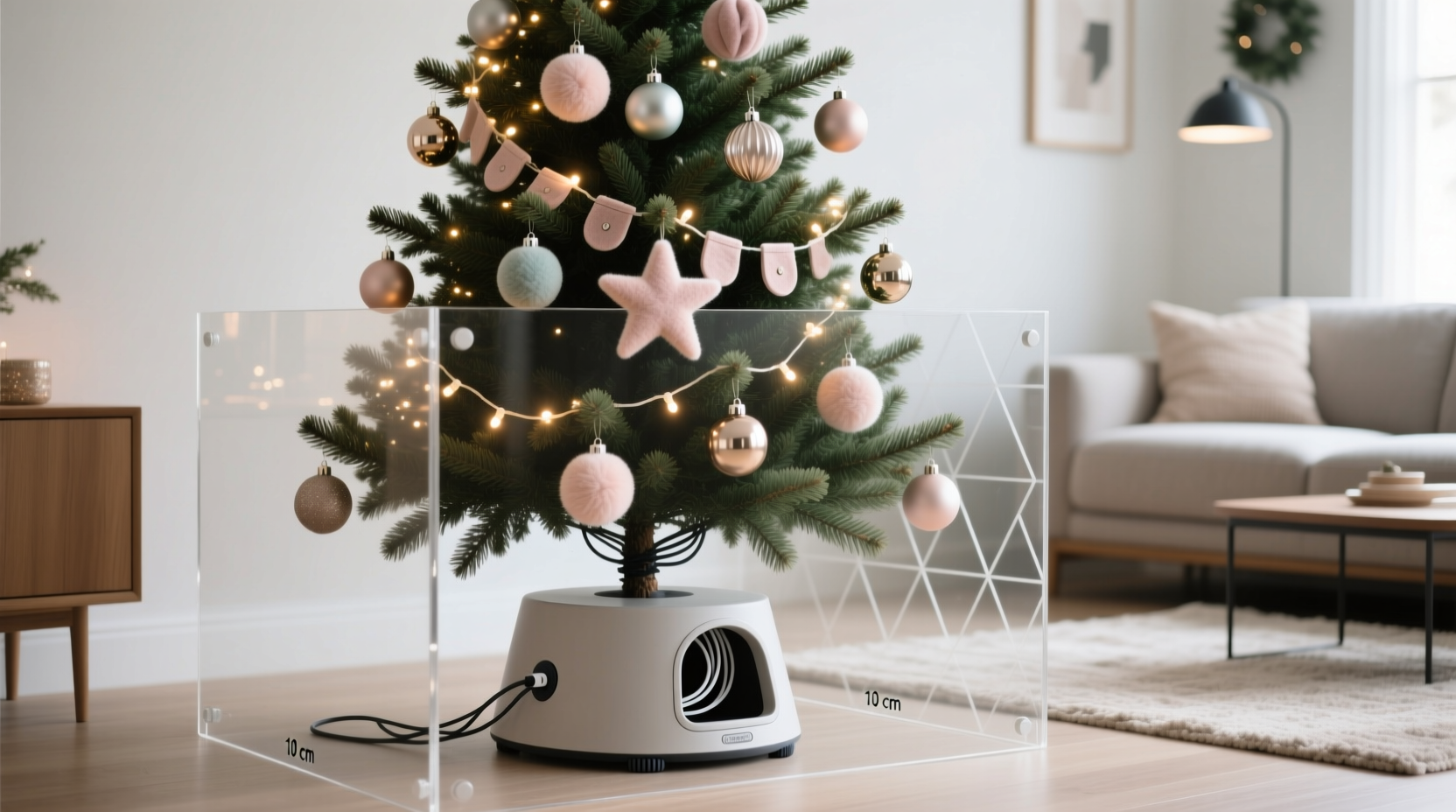
Not all trees pose equal risk. Real firs (like Fraser or Balsam) have softer needles and lower sap content than pines or spruces—making them less irritating if nibbled and less likely to cause oral trauma. Artificial trees offer more control, but not all are created equal: avoid PVC-based models with lead-stabilized plastics (especially older ones), and opt for newer PE (polyethylene) trees with molded, non-shedding branches and no sharp wire armatures.
Placement matters as much as species. Avoid high-traffic zones like hallways or near pet beds, and never place the tree directly beside furniture your cat uses to launch onto branches. Instead, anchor it in a low-traffic, open area with clear sightlines—ideally against a solid wall where two sides are naturally restricted. If you have a multi-level home, skip the staircase landing; elevated placements invite jumping and increase fall risk for both pets and ornaments.
2. Reinforce Stability—Without Visual Clutter
A wobbly tree is the single biggest hazard: it invites investigation, triggers prey instincts, and becomes unstable under even light contact. Yet bulky stands and industrial braces ruin visual flow. The solution lies in dual-layer anchoring—discreet and elegant.
First, use a heavy-duty, water-filled base stand (minimum 2 gallons for a 6–7 ft tree). Fill it completely—not halfway—to maximize mass and lower the center of gravity. Second, add invisible support: run two thin, clear monofilament lines (like fishing line) from the top third of the trunk to discreet wall anchors—screwed into studs, not drywall. Anchor points should be at least 45 degrees from vertical and hidden behind garlands or large ornaments. Test stability by gently pushing the trunk at shoulder height; it should move no more than ½ inch.
This method avoids unsightly cables, eliminates tripping hazards, and maintains clean sightlines—so your tree remains the focal point, not its supports.
3. Ornament Selection & Placement: A Design-Driven Safety Framework
Ornaments aren’t just decorative—they’re functional tools in your pet-safety system. Prioritize weight, texture, and placement over novelty alone. Lightweight glass balls may shimmer, but they shatter easily and scatter sharp fragments. Instead, choose ornaments made from wood, felt, thick ceramic, or hand-blown glass with reinforced bases. Avoid anything with dangling ribbons, bells, or string-like elements—these trigger predatory behavior and pose strangulation or ingestion risks.
Adopt a tiered ornament strategy:
- Bottom 24 inches: Leave completely bare—or use only large, immovable items like woven baskets, stacked books wrapped in kraft paper, or weighted ceramic pinecones (no glue, no paint).
- Middle zone (24–48 inches): Place medium-weight ornaments with smooth, rounded profiles. Cluster similar colors or textures here to maintain visual rhythm.
- Top third (48+ inches): Reserve delicate, reflective, or heirloom pieces. This is also where you’ll hang tinsel sparingly—if at all—since static electricity attracts curious noses and paws.
| Safety Priority | Acceptable Options | High-Risk Items to Avoid |
|---|---|---|
| Chew Resistance | Wooden stars, wool-felt animals, cork baubles, baked clay ornaments | Popcorn strings, dried citrus slices, candy canes, salt-dough ornaments |
| Breakage Risk | Thick ceramic, resin with matte finish, fabric-wrapped orbs | Thin glass, mercury glass, hollow plastic, mirrored acrylic |
| Attachment Security | Ornament hooks with rubber grips, wide-loop ribbons knotted twice, magnetic hangers on metal-trunk trees | Flimsy plastic hooks, single-knot ribbon, suction-cup hangers |
4. Electrical Safety & Lighting That Works With—Not Against—Pets
String lights present three overlapping risks: chewing (exposed wires), overheating (cheap LEDs), and entanglement (loose cords). But dim, tangled lighting also undermines style. The fix is layered: upgrade hardware, conceal intelligently, and leverage light behavior.
Start with UL-listed, low-voltage LED lights rated for indoor use—specifically those with insulated, double-jacketed wiring (look for “SJTW” or “SPT-2” rating on packaging). These resist puncture and generate minimal heat. Replace any set with frayed ends, exposed copper, or inconsistent brightness—signs of internal damage.
Then, conceal strategically. Wrap lights *under* garlands—not over them—so the cord runs along the branch underside, shielded by greenery. Use twist-ties (not staples or nails) to secure excess length to the trunk interior. For floor-level safety, route the main power cord inside a rigid, slit PVC conduit painted to match your base—or run it vertically up the wall behind the tree and plug into an outlet mounted at least 4 feet high.
Finally, consider timing. Pets respond strongly to movement and flicker. Steady, warm-white LEDs (2700K–3000K color temperature) are less stimulating than multicolor chasing sequences or strobing effects. Set timers to turn lights off when the house is empty or during overnight hours—reducing both temptation and fire risk.
5. Behavioral Integration: Training, Distraction & Environmental Enrichment
Physical barriers and clever decor only go so far. Lasting safety comes from reshaping your pet’s relationship with the tree—not through punishment, but through redirection, consistency, and enrichment. This is where style and function converge most meaningfully.
Begin before the tree arrives. Introduce your pet to the space where it will stand using positive association: feed meals nearby, place favorite toys there, and reward calm presence with treats. Once the tree is up, continue reinforcing distance—not with “no,” but with “yes.” When your dog pauses 3 feet away, mark it (“yes!”) and toss a high-value treat *away* from the tree. Over time, they learn that proximity = reward, but *interaction* = neutral or redirected activity.
Simultaneously, provide compelling alternatives. For cats: install a tall, stable cat tree *near* (but not adjacent to) the Christmas tree, draped with seasonal-scented catnip or silvervine. For dogs: rotate puzzle feeders daily, freeze Kongs with pumpkin-and-yogurt mixtures, or bury scent games in a designated “sniff zone” rug. The goal isn’t to distract *from* the tree—it’s to satisfy the underlying drive (exploration, chewing, climbing) elsewhere.
“Pets don’t see ‘danger’—they see opportunity. Our job isn’t to suppress curiosity, but to guide it toward safer, more rewarding outlets. A well-enriched pet rarely seeks trouble—even around a glittering evergreen.” — Dr. Lena Torres, DVM, Certified Veterinary Behaviorist, Animal Behavior Clinic of Portland
Real-World Application: The Henderson Family’s Balanced Approach
The Hendersons live in a Seattle bungalow with two rescue cats (Miso, a 3-year-old Maine Coon mix, and Pip, a 10-month-old Bengal) and a 6-year-old Golden Retriever named Juno. Last year, Miso scaled the 7-ft Fraser fir twice, snapping a branch and knocking down three ornaments; Pip chewed through a light cord; and Juno tried to “dig” under the base, spilling 3 gallons of water.
This December, they implemented a coordinated plan: they chose a 6.5-ft PE artificial tree with a weighted, cast-iron base and added two nearly invisible monofilament lines anchored to wall studs. All ornaments below 30 inches were removed—replaced by a circular woven seagrass basket filled with pine-scented cedar chips and tucked with Juno’s favorite squeaky squirrel. The middle zone featured handmade wooden birds and thick ceramic stars; the top held vintage glass balls secured with rubber-grip hooks. Lights were warm-white, low-voltage LEDs, wrapped under garlands of dried eucalyptus and cinnamon sticks. Crucially, they installed a 6-ft cat tower 5 feet left of the tree—sprinkled daily with silvervine—and gave Juno a frozen “pumpkin pie” Kong every evening while lights were on.
Result? Zero incidents in four weeks. More importantly, their living room feels intentional and cohesive—not like a fortress. Guests comment on the “calm, grounded elegance” of the display. As Sarah Henderson shared: “We stopped seeing the tree and pets as competing priorities. Once we designed *for both*, the whole space felt more human—and more humane.”
Step-by-Step: Your 7-Day Pet-Safe Tree Setup Timeline
- Day 1: Measure space, assess pet mobility (leap height, chewing habits), and select tree type/size. Order weighted base, monofilament line, and vet-approved deterrent spray (e.g., bitter apple, applied only to trunk base).
- Day 2: Assemble and stabilize tree *before* decorating. Fill base fully. Attach monofilament lines. Test sway.
- Day 3: Install lighting—wrap under garlands, conceal cord routing, test timer settings.
- Day 4: Hang ornaments using tiered strategy. Place all breakables and dangling items above 48 inches.
- Day 5: Introduce pets to the space with treats and play. Begin rewarding calm proximity.
- Day 6: Set up enrichment alternatives (cat tower, puzzle feeders, sniff rugs) and establish daily rotation schedule.
- Day 7: Final walk-through: check hook security, cord tension, ornament weight distribution, and water level (for real trees). Take photos—not just for social media, but to document setup for next year’s refinement.
FAQ
Can I use essential oils or citrus sprays to deter pets from the tree?
No—many essential oils (including tea tree, eucalyptus, citrus, and pine) are toxic to cats and dogs when inhaled or ingested. Even diluted sprays can cause respiratory distress, liver damage, or neurological symptoms. Stick to vet-approved bitter apple or unscented pet deterrents, and apply only to the trunk base—not foliage or ornaments.
Is a fake tree really safer than a real one for pets?
It depends. A high-quality PE artificial tree with no loose wires, non-toxic materials, and proper anchoring is generally safer than a real tree shedding needles (which can puncture intestines) or drinking stagnant water (which breeds bacteria and mold). However, cheap PVC trees may contain hazardous flame retardants or lead. Always verify material safety certifications—and never assume “artificial = automatically safe.”
My dog loves to carry pinecones. Is it okay to use them as ornaments?
Only if they’re sealed, sanitized, and securely attached. Raw pinecones harbor mold spores (like Aspergillus) that can cause serious lung infections in dogs. Boil them for 20 minutes, bake at 200°F for 1 hour, then seal with food-grade, non-toxic varnish. Never use glue-heavy or painted versions—chipping creates ingestion hazards. Better yet: use cast-resin pinecones designed for décor—they mimic texture without biological risk.
Conclusion
A pet-safe Christmas tree isn’t a diminished version of the holiday ideal—it’s a more thoughtful, more resilient, and ultimately more beautiful expression of it. It reflects intentionality: choosing materials that honor both craftsmanship and care, arranging space to respect boundaries without building walls, and honoring your pet’s nature while guiding it with kindness. Style isn’t sacrificed when safety is woven into the design process from the first measurement to the final bow—it’s deepened. You gain not just peace of mind, but pride in a home where joy and responsibility coexist seamlessly.
Start small this season: pick one strategy—a stabilized base, a tiered ornament plan, or a dedicated enrichment zone—and commit to it fully. Observe how your pet responds. Adjust. Refine. Next year, build on what worked. Because the most enduring holiday traditions aren’t the ones that look perfect in photos—they’re the ones that feel warm, safe, and wholly yours.




 浙公网安备
33010002000092号
浙公网安备
33010002000092号 浙B2-20120091-4
Comments
No comments yet. Why don't you start the discussion?