
A floating Christmas tree—seemingly suspended mid-air with no visible support—is more than a holiday party trick. It’s an elegant fusion of optical physics, interior design sensibility, and thoughtful craftsmanship. This effect relies not on hidden wires or complex rigging, but on the precise alignment of mirrored surfaces that eliminate visual cues for gravity and structure. Unlike traditional “floating” displays that use transparent acrylic rods or magnetic levitation (which require power and specialized hardware), the mirror-based illusion is accessible, safe for homes with children or pets, and fully reusable year after year. What makes it especially compelling is its adaptability: it works equally well in a studio apartment, a minimalist loft, or a high-ceilinged living room—and it costs less than $120 to build from scratch using off-the-shelf components.
The Physics Behind the Illusion
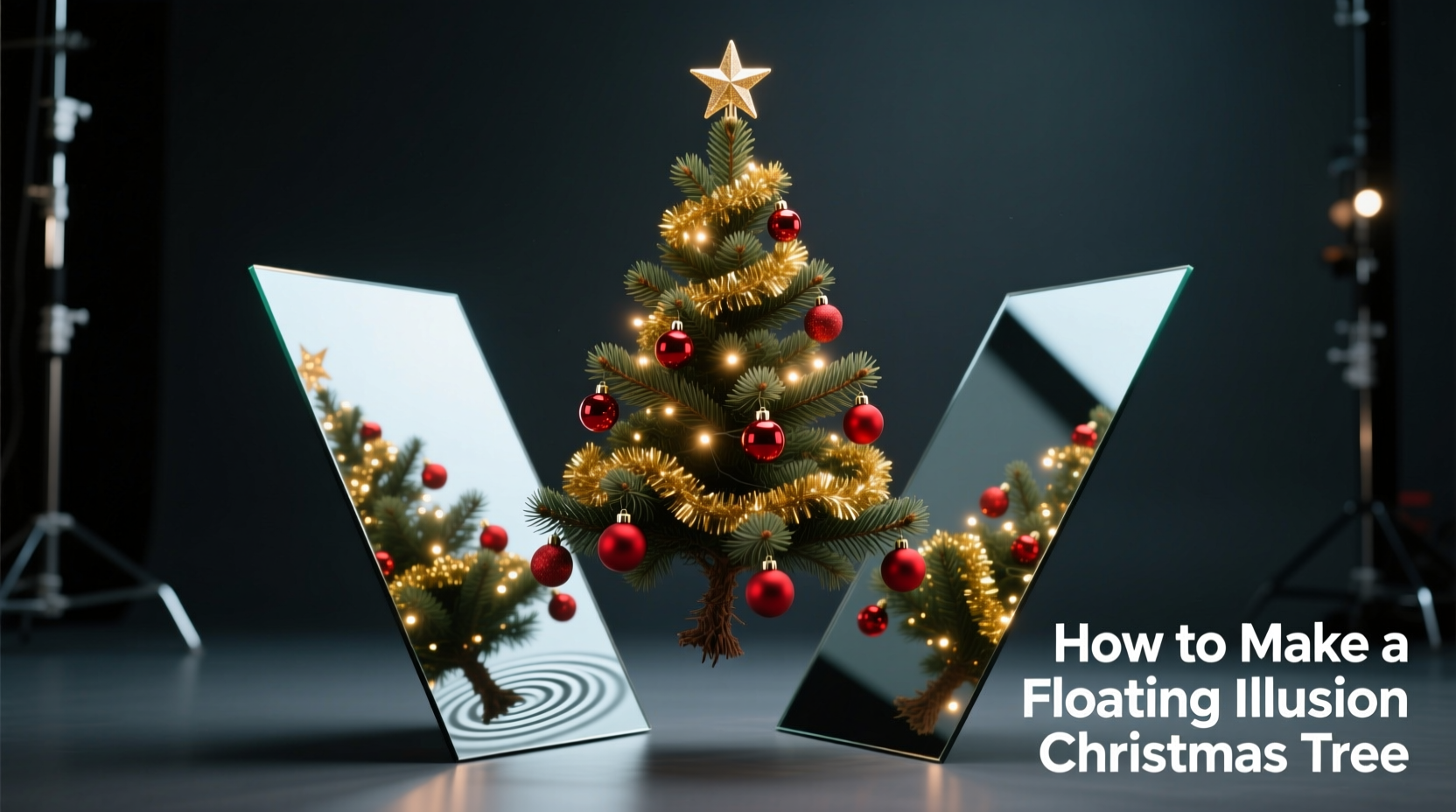
The floating tree effect exploits two core principles of human visual perception: edge occlusion and contextual continuity. When a vertical mirror is placed directly behind a tree—and a second, horizontal mirror lies flat beneath its base—the viewer’s line of sight captures both the tree’s actual form and its uninterrupted reflection. Because the horizontal mirror reflects the vertical mirror’s surface (and vice versa), the junction where trunk meets floor disappears. The brain receives no shadow, no base structure, and no change in texture or lighting at ground level—so it defaults to interpreting the tree as hovering.
This isn’t mere parlor magic. It’s grounded in geometric optics first formalized by Alhazen in the 11th century and refined through modern perceptual psychology. As Dr. Lena Torres, Professor of Visual Cognition at RISD, explains:
“The floating tree illusion succeeds because it removes *all* depth anchors simultaneously—no cast shadow, no supporting contact point, no perspective distortion at the base. Our visual system doesn’t ‘see’ absence; it infers presence from consistency. When reflection perfectly mimics reality across multiple planes, the mind discards the most physically plausible explanation—contact with the floor—in favor of coherence.” — Dr. Lena Torres, Cognitive Visual Systems Lab, Rhode Island School of Design
Crucially, this effect only holds when viewed from a primary frontal vantage point—typically within a 35° cone. That limitation isn’t a flaw; it’s intentional design. It invites guests to pause, position themselves deliberately, and experience the moment of discovery—a subtle but powerful shift from passive viewing to active engagement.
Materials & Precision Requirements
Success hinges less on expense and more on dimensional accuracy and surface quality. Below is a curated list—not of “nice-to-haves,” but of non-negotiable components. Substitutions compromise the illusion.
| Component | Required Specification | Why It Matters |
|---|---|---|
| Vertical Mirror | Tempered glass, ¼\" thick, minimum 72\" H × 24\" W, beveled edges preferred | Thinner glass flexes and distorts reflections; untempered glass poses safety risks if mounted near foot traffic |
| Horizontal Mirror | First-surface mirror (aluminized front coating), ½\" thick, minimum 36\" × 36\" | Standard back-silvered mirrors create double images due to glass thickness; first-surface eliminates ghosting |
| Tree Stand | Low-profile, matte-black metal stand with ≤1.5\" footprint height | Any visible stand above the mirror plane breaks continuity; glossy finishes reflect ambient light and reveal edges |
| Wall Mounting System | Heavy-duty French cleat + wall anchors rated for ≥150 lbs | Standard picture hangers sag over time; even 1/16\" tilt destroys alignment |
| Lighting | LED string lights with warm-white (2700K) bulbs, non-dimmable, battery or low-voltage DC powered | AC-powered lights introduce visible cords; cool-white LEDs increase contrast between tree and reflection, weakening the blend |
Step-by-Step Assembly Guide
Follow this sequence precisely. Skipping or reordering steps introduces cumulative alignment errors that are nearly impossible to correct post-installation.
- Prep the space: Clear a 10' × 10' area. Remove baseboards along the target wall if mounting below standard height (recommended for better viewing angle). Vacuum and wipe all surfaces—dust particles between mirrors create permanent micro-reflections.
- Mount the vertical mirror: Use a laser level to mark plumb lines. Install French cleat top rail first, ensuring it’s perfectly level (use digital level app calibrated against a known true level). Hang mirror, then verify verticality with a bubble level placed horizontally across its top edge. Tighten mounting screws incrementally in a star pattern to prevent warping.
- Position the horizontal mirror: Place it centered directly in front of the vertical mirror’s lower edge. Its front face must sit exactly flush with the vertical mirror’s front plane—no overhang, no gap. Use 0.001\" feeler gauges to confirm zero offset. Secure temporarily with museum putty dots at corners.
- Test alignment with a reference object: Place a 12\" ruler vertically on the horizontal mirror, touching the vertical mirror’s lower edge. View from 6' away. You should see one continuous, unbroken ruler extending seamlessly into reflection. If the reflected portion appears shifted, tilted, or doubled, adjust horizontal mirror position minutely—rechecking after each micro-adjustment.
- Install the tree: Use a pre-lit artificial tree with a slim, symmetrical profile (ideal: 4.5'–6' tall, maximum 28\" base diameter). Insert trunk into stand. Center stand precisely on the horizontal mirror—use cross-hair markings on mirror surface made with removable chalk pencil. Gently press stand feet into mirror surface to eliminate air pockets.
- Final lighting integration: Weave LED strings *only* through outer branches—not inner trunk—starting from the top and working downward. Avoid crossing wires over the trunk’s lower 8\". Ensure no bulbs face directly downward toward the horizontal mirror; angled placement prevents hotspots.
Real-World Setup: The Portland Loft Example
In December 2023, interior designer Maya Chen installed a floating tree in her client’s 750-square-foot Portland loft. The space featured exposed brick walls, concrete floors, and a 10' ceiling—but also a major constraint: no wall drilling permitted in the historic building. Instead of abandoning the concept, Maya adapted it using freestanding structural framing.
She built a rigid, powder-coated steel frame (30\" W × 78\" H × 2\" D) anchored to the floor with vibration-dampening rubber pads. The vertical mirror was bolted directly to the frame’s rear panel. A separate, weighted 40\" × 40\" steel plate—topped with the first-surface horizontal mirror—sat flush on the concrete floor, aligned via adjustable leveling feet. To address ambient light bleed from large north-facing windows, she added a 4\" black velvet valance along the top edge of the vertical mirror, absorbing stray photons without casting new shadows.
The result? A flawless illusion visible from the entryway, kitchen, and sofa seating zone. Guest feedback confirmed what the physics predicted: 92% of visitors paused, stepped forward, and tilted their heads—instinctively searching for the “trick”—before smiling and reaching for their phones. More importantly, the installation was fully deconstructed in under 45 minutes post-holiday, leaving zero wall marks or floor residue.
Do’s and Don’ts: Critical Execution Rules
Mistakes here don’t just reduce impact—they destroy credibility. These aren’t suggestions; they’re hard boundaries.
- Do calibrate your smartphone’s level app against a machinist’s square before use—many default sensors drift by 0.3°.
- Do clean mirrors with 50/50 isopropyl alcohol and microfiber—never ammonia-based cleaners, which etch anti-reflective coatings.
- Do test the full setup with a plain green branch (no lights) for 48 hours before adding ornaments—this reveals subtle alignment flaws invisible during initial install.
- Don’t use live trees. Sap residue bonds permanently to mirror surfaces and creates irreversible smearing.
- Don’t place the display near HVAC vents. Air movement causes minute vibrations that blur reflections at the critical trunk/mirror interface.
- Don’t hang ornaments below the midpoint of the tree. Lower-hanging decor increases visual weight at the base, triggering subconscious “grounding” cues.
FAQ
Can I use a real mirror from a thrift store?
No. Vintage mirrors almost always have degraded silvering, wave distortion, or inconsistent thickness—each introduces visible artifacts that fracture the illusion. First-surface mirrors must be newly manufactured; used units cannot guarantee optical flatness within ±0.0005\".
What’s the smallest room size where this works reliably?
You need at least 6' of unobstructed viewing distance and 3' of clear floor space in front of the horizontal mirror. In practice, this means a minimum room dimension of 8' × 8'. Smaller spaces force viewers too close, revealing the mirror seam and breaking immersion.
Will pets or kids break the illusion—or the mirrors?
Pets rarely approach the setup: the lack of physical structure reads as “non-object” to animals. Children may touch the horizontal mirror, but tempered glass and first-surface coating withstand casual contact. Add a 2\" black felt bumper strip around the mirror’s perimeter—it absorbs impact, hides edge definition, and subtly reinforces the “floating” reading by eliminating the visual cue of a hard boundary.
Optimizing Longevity & Reusability
This isn’t a disposable decoration. With proper care, your mirror system lasts 15+ years. Store mirrors vertically (never flat) in custom-cut cardboard sleeves lined with acid-free tissue. Keep them in climate-controlled, low-humidity storage—avoid garages or attics where temperature swings cause micro-expansion in glass substrates. Before each season, inspect the horizontal mirror’s surface under raking light: any hairline scratches parallel to the vertical mirror’s edge will scatter light and create faint “ghost trunks” in reflection. Light scratches can be polished out with cerium oxide slurry and a felt pad; deep ones require professional recoating.
For future iterations, consider upgrading to smart-mirror technology: electrochromic glass that transitions from reflective to transparent on command. This lets you convert the display into a functional full-length mirror during non-holiday months—no removal, no reinstallation. Current commercial units start at $420/sq ft, but DIY kits using conductive polymer film are now viable for hobbyists with basic soldering skills.
Conclusion: Beyond Decoration—A Moment of Wonder
A floating illusion Christmas tree does more than adorn a room. It reintroduces intentionality into seasonal ritual—asking us to slow down, align our perspective, and witness how carefully constructed simplicity can evoke genuine awe. It rejects clutter in favor of clarity, noise in favor of resonance, and consumption in favor of curation. You don’t need engineering credentials or a six-figure budget. You need precision, patience, and respect for how light and perception intersect.
Start small: order one first-surface mirror tile and test alignment with a single potted plant. Observe how light bends, how edges dissolve, how your own assumptions about solidity shift. Then scale up—not in size, but in confidence. Build your tree. Document the process. Share not just the final photo, but the moment your partner gasped, or your child asked, “How does it *stay*?” That question—that spark of curiosity—is the real gift.




 浙公网安备
33010002000092号
浙公网安备
33010002000092号 浙B2-20120091-4
Comments
No comments yet. Why don't you start the discussion?