
Small Christmas figurines—porcelain angels, hand-painted nutcrackers, miniature villages, vintage Santas, or delicate glass ornaments—carry memory, craftsmanship, and quiet magic. But in compact apartments, narrow hallways, or homes where floor space is at a premium, traditional mantels or sideboards often aren’t viable. A well-designed floating shelf display solves this elegantly: it lifts your collection into the visual field without consuming square footage, creates intentional focal points, and transforms empty wall space into curated holiday storytelling. Unlike generic DIY shelves found online, a purpose-built display for *small* figurines demands precision—not just in mounting, but in depth, weight distribution, lighting integration, and aesthetic harmony. This guide distills over a decade of interior styling and carpentry experience into a practical, safety-first framework. No assumptions about prior tool knowledge. Every measurement, material choice, and finishing technique reflects real-world constraints: plasterboard walls, uneven studs, fragile collectibles, and the need for reusability year after year.
Why Standard Floating Shelves Fall Short for Figurines
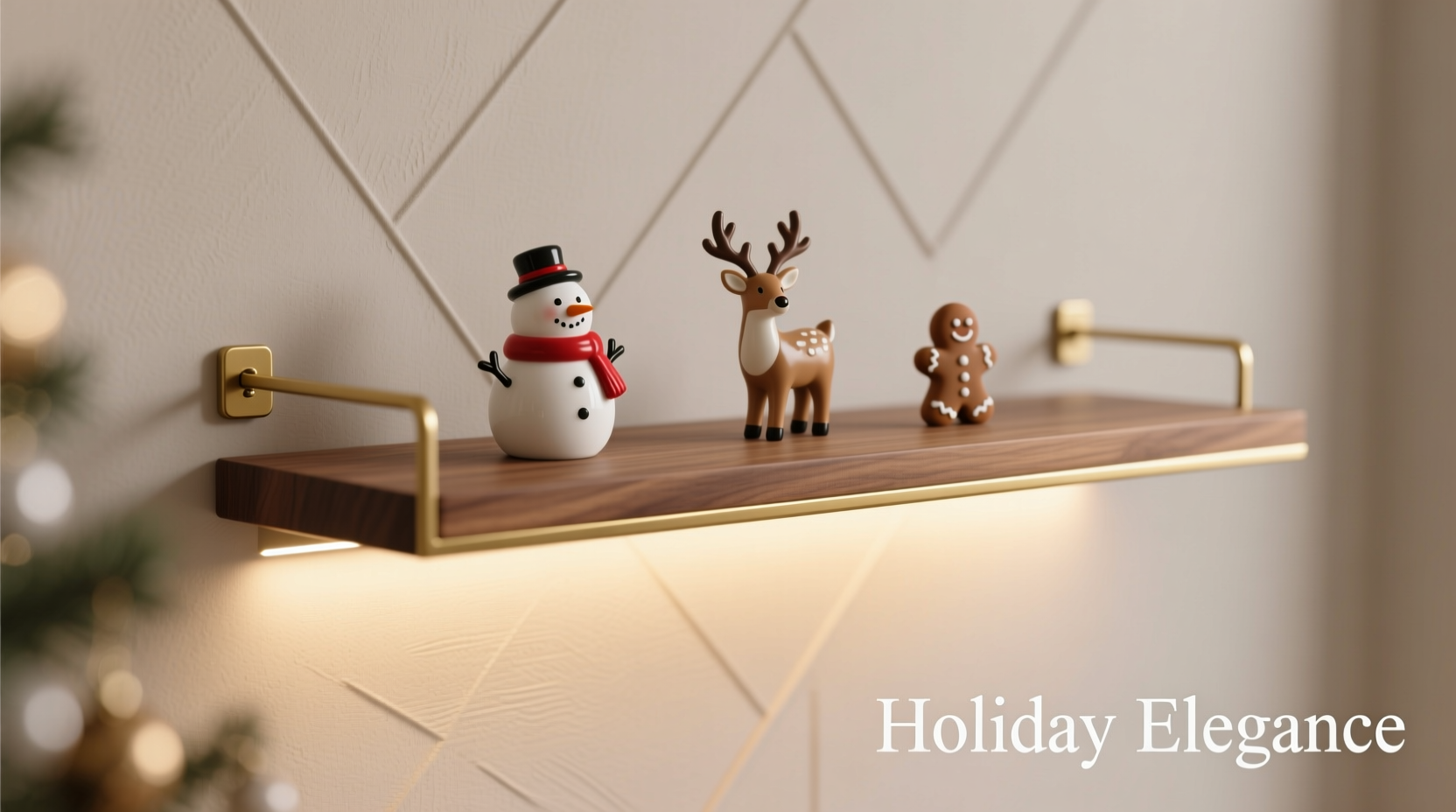
Most off-the-shelf floating shelves prioritize books or decorative bowls—items with low center-of-gravity and even weight distribution. Small Christmas figurines break those assumptions. A 3-inch ceramic angel may weigh only 80 grams, but its base is often narrow, curved, or asymmetrical. A cluster of five can shift unexpectedly under vibration (e.g., footsteps, door slams) or accidental brush. Worse, many budget “floating” shelves rely on single-point French cleats or thin metal brackets hidden behind the shelf—adequate for lightweight décor, but dangerously unstable when supporting multiple delicate objects that require micro-adjustments during styling.
Interior stylist Lena Torres, who curates seasonal displays for boutique hotels across New England, confirms this gap:
“I’ve seen more figurine disasters from poorly anchored shelves than from children or pets. It’s not about weight alone—it’s about torque. A shelf that sags 1/16 inch over time changes the balance point for every object on it. For collectors, that’s not just inconvenient—it’s emotionally costly.”
The solution isn’t heavier hardware alone. It’s a system: structural integrity paired with thoughtful surface design, visual rhythm, and protective detailing—all tailored to the scale and fragility of miniature holiday pieces.
Materials & Tools: Precision Over Power
Choosing materials isn’t about cost-cutting—it’s about matching physical properties to functional needs. Below is a vetted selection based on tensile strength, dimensional stability, and compatibility with common wall types (drywall, plaster, brick veneer).
| Component | Recommended Specification | Why It Matters |
|---|---|---|
| Shelf Board | 1¾\" thick solid hardwood (walnut, maple, or white oak); 8–12\" deep; max 48\" length | Thickness prevents sagging under clustered weight; hardwood grain resists dents from frequent rearrangement; depth accommodates base widths while keeping profile light. |
| Mounting System | Heavy-duty concealed bracket kit with dual ⅜\" lag bolts per stud + 3/16\" steel backplate (e.g., Mount-It! MI-705 or GRK Fasteners Rugged Shelf Kit) | Single-bolt systems flex; dual-bolt + steel plate eliminates lateral wobble and distributes load across two studs—critical for vibration-prone walls. |
| Wall Anchors | Toggle bolts (for drywall without studs) OR masonry anchors (for brick/stone); rated for ≥150 lbs each | Never rely on plastic anchors for figurine shelves—even if weight seems low. Thermal expansion, humidity shifts, and repeated styling cause cumulative anchor fatigue. |
| Surface Protection | Self-adhesive felt pads (1/8\" thick, ¾\" diameter) + museum-grade acrylic anti-slip liner (cut to shelf width) | Felt pads prevent micro-scratches on bases; acrylic liner adds grip without residue and is removable without damaging finishes. |
| Finishing | Water-based polyurethane (matte or satin), applied in 3 thin coats with 220-grit sanding between | Oil-based finishes yellow over time and can react with porcelain glazes; water-based offers clarity, durability, and zero amber shift—preserving true color fidelity. |
A 7-Step Build & Install Process
This sequence prioritizes safety, adjustability, and long-term reliability. Each step includes a verification checkpoint—never skip these.
- Measure & Map Your Wall Space: Identify two adjacent wall studs using a reliable stud finder (not a magnet). Mark their centers with painter’s tape. Measure the horizontal distance between them—this is your maximum safe shelf length. Subtract 2 inches for clearance. Note any obstructions (outlets, vents, crown molding).
- Cut & Finish the Shelf Board: Have your hardwood cut to final dimensions at the lumber yard. Sand edges smooth (150 → 220 grit). Apply first coat of polyurethane. Let cure 24 hours in a dust-free room. Lightly sand, wipe clean, apply second coat. Repeat for third coat. Cure fully for 72 hours before handling.
- Drill Pilot Holes for Brackets: Position brackets on the shelf underside exactly 2 inches from each end. Drill pilot holes for lag bolts—depth must match bolt length (typically 1¼\"). Verify bracket alignment with a level before marking.
- Locate & Reinforce Stud Positions: At your marked stud centers, drill a ⅛\" pilot hole through drywall into the stud. Insert a 3\" wood screw to confirm solidity. If resistance feels weak, add a second screw 1\" above/below—this braces the stud against lateral shear.
- Mount Brackets to Wall: Hold bracket flush against wall, aligned with stud centers. Drive lag bolts until washer seats firmly—but do not overtighten. Use a torque wrench set to 45 ft-lbs (or tighten until resistance increases sharply, then stop). Verify both brackets are perfectly level and coplanar using a 24\" aluminum level.
- Set Shelf & Check Load Distribution: Lift shelf onto brackets. Tap gently with rubber mallet to seat fully. Place a digital level on the front edge—no deviation beyond ±0.5°. Then place 5 lb of evenly distributed weight (e.g., stacked books) along the front third of the shelf. Wait 5 minutes. Recheck level and listen for creaks. If either occurs, unmount and inspect bracket seating.
- Apply Surface Protection: Cut acrylic liner to shelf depth minus ¼\". Adhere centered. Apply four felt pads: one at each corner, ½\" from edges. Press firmly for 30 seconds. Let adhesive cure 12 hours before placing figurines.
Styling for Impact: The 3-Zone Visual Framework
A floating shelf becomes memorable not through quantity, but through deliberate composition. Apply this proven spatial strategy used by museum exhibit designers:
- Anchor Zone (Left Third): Place your tallest or most iconic piece here—a 6-inch heirloom Santa or a vintage ceramic tree. Its height establishes vertical rhythm and draws the eye inward.
- Harmony Zone (Center Third): Group 3–5 smaller pieces with shared attributes: same color family (e.g., all ivory-and-gold), similar era (1950s mid-century), or complementary silhouettes (curved bases balancing angular ones). Keep bases within a 2-inch depth band for visual cohesion.
- Whisper Zone (Right Third): Leave 30–40% of this area intentionally empty—or place one minimalist object: a single frosted pinecone, a brass bell, or a tiny wrapped gift box. Negative space creates breathing room and prevents visual fatigue.
Lighting transforms static display into atmospheric experience. Avoid overhead recessed lights that cast harsh shadows. Instead, install a low-voltage LED picture light (2700K CCT, 90+ CRI) mounted 6–8 inches above the shelf. Angle downward at 30°—this highlights texture without glare on glazed surfaces. Battery-operated puck lights work for renters but require monthly battery checks.
Real-World Application: The Boston Brownstone Balcony Niche
Sarah M., a Boston architect and collector of 19th-century German nutcrackers, faced a persistent challenge: her historic brownstone’s narrow foyer had a 14-inch-deep arched niche—too shallow for a standard shelf, too high for a table. Previous attempts with adhesive hooks failed twice (once dropping a 1892 Bisque angel). She adopted this method with modifications:
- Used 12\" deep walnut board (max depth for the niche), cut to 36\" length to span two studs she located behind plaster lath. Installed custom-milled steel brackets with extended arms to clear the arch’s curve.Added a subtle ¼\" bevel to the shelf front to soften shadow lines against the textured plaster wall.Styled using the 3-Zone Framework—anchoring with a 7-inch carved wooden St. Nicholas, grouping three 2-inch Dresden lace angels in the center, and leaving the right zone open except for a single antique brass candle holder (unlit, for form only).
Two years later, Sarah reports zero movement, no finish wear, and consistent compliments from guests. Crucially, she removed the shelf last January for spring redecorating—reinstalled it in 22 minutes, with no wall damage. Her insight: “The time investment upfront meant zero compromises later. It’s not a shelf—it’s infrastructure for memory.”
FAQ: Practical Concerns Addressed
Can I install this on plaster walls without damaging them?
Yes—with caution. Plaster lath is brittle. Use a masonry bit to drill pilot holes, then switch to a wood bit only after penetrating the lath. Anchor directly into the wood studs beneath (locate with a magnetic stud finder). Never use toggle bolts in plaster—they fracture the substrate. If studs are inaccessible, consult a professional about epoxy-set threaded rods.
How do I clean figurines safely while they’re on the shelf?
Remove each piece individually. Dust with a soft goat-hair brush (never compressed air—it forces grit into crevices). For grime, dampen a microfiber cloth with distilled water only—no soap or alcohol, which degrade paint and patina. Dry immediately with a second lint-free cloth. Never spray cleaner onto the shelf surface.
What’s the safest way to store figurines off-season?
Use acid-free tissue paper and rigid cardboard boxes lined with foam inserts. Place each figurine in its own compartment—never stack or nest. Store boxes upright (not flat) in a climate-controlled closet (40–60% RH, 60–70°F). Avoid attics or basements. Label boxes clearly: “Fragile | Glass Bases | Do Not Stack.”
Conclusion: Build Legacy, Not Just Shelves
A floating shelf for Christmas figurines is never merely utilitarian. It’s a vessel for continuity—holding generations of tradition in a space that honors their delicacy and significance. When you choose solid hardwood over particleboard, invest in dual-stud anchoring over quick-fix hardware, and apply museum-grade surface protection, you’re not just preventing breakage. You’re affirming value. You’re saying these small objects deserve permanence, care, and intentionality in your home. That mindset shifts decoration from seasonal task to meaningful ritual. So measure twice, sand thoroughly, level obsessively—and then arrange your first piece with reverence. The shelf will hold more than porcelain and paint. It will hold presence.




 浙公网安备
33010002000092号
浙公网安备
33010002000092号 浙B2-20120091-4
Comments
No comments yet. Why don't you start the discussion?