
There’s a quiet magic in walking a garden path after dusk—when light emerges not from wires or switches, but from the sun stored in small, unassuming stakes, softened by the warm, organic texture of pinecones. This isn’t just decorative lighting; it’s intentional landscape storytelling. A glowing pathway made with solar stake lights and pinecones merges sustainability with sensory appeal—offering gentle illumination, tactile interest, and seasonal resilience without grid dependency or ongoing energy costs. Unlike plug-in string lights or buried LED strips, this method requires no trenching, no electrician, and no monthly bill. It’s accessible to renters and homeowners alike, scalable from a single step to a 50-foot winding trail, and deeply rooted in biophilic design principles that connect us to natural materials and rhythms.
The pinecone—a humble forest floor relic—is more than rustic charm. Its fractal geometry diffuses light subtly, its resinous surface repels moisture, and its hollow structure allows airflow around solar components, preventing heat buildup that degrades battery life. Paired with modern solar stake lights—many now featuring high-efficiency monocrystalline panels, lithium-ion batteries, and warm-white LEDs with 8–12 hour runtimes—the result is both functional and poetic: light that breathes with the day, grounded in nature’s own architecture.
Why This Combination Works—Beyond Aesthetics
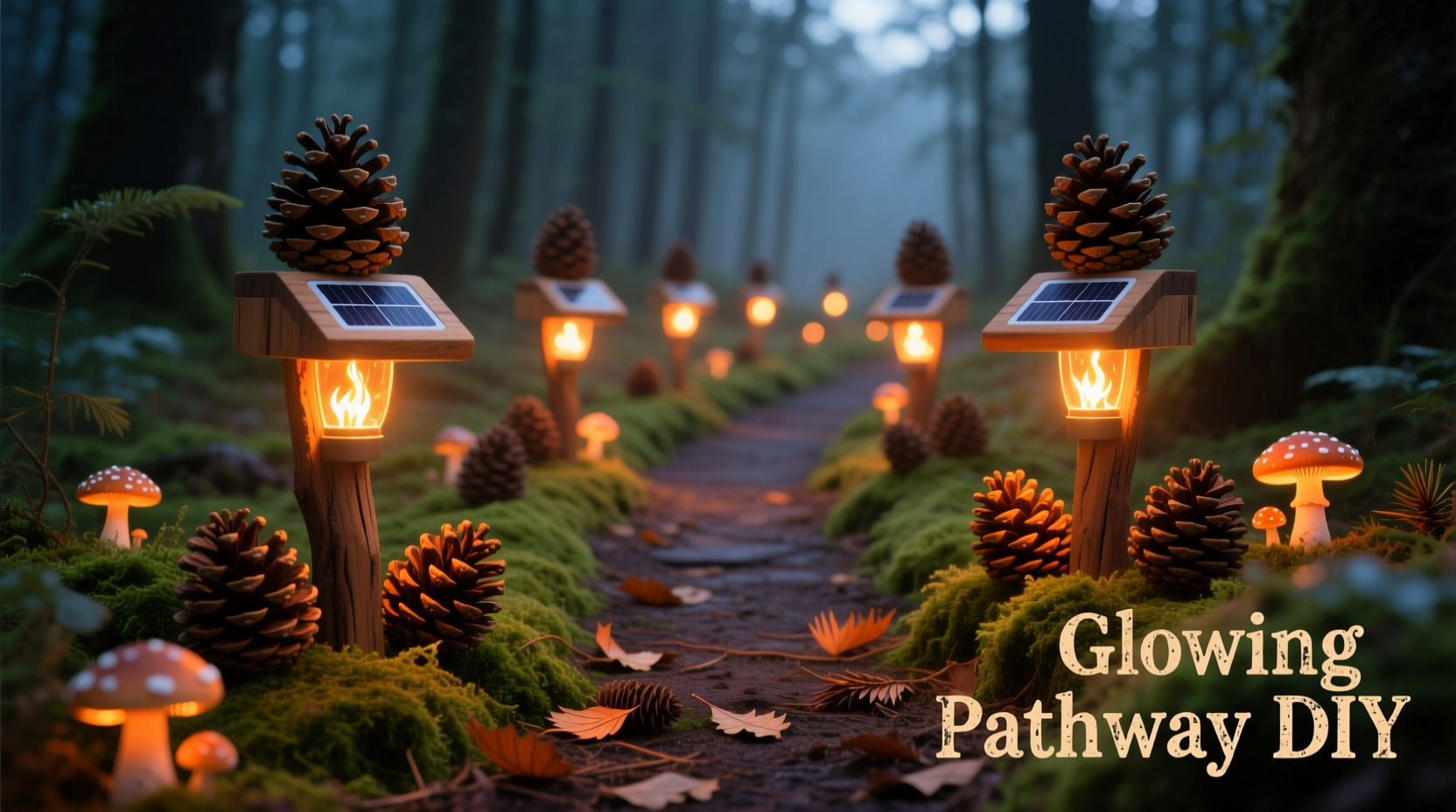
Solar stake lights and pinecones form an unexpectedly synergistic duo—not because they’re commonly paired, but because their physical and functional properties complement each other precisely. Solar lights need three things to perform reliably: consistent daily sun exposure, thermal ventilation, and protection from soil saturation. Pinecones address all three.
When placed around the base of a solar stake, pinecones create a raised, porous micro-mulch layer. This elevates the stake’s solar panel slightly above ground level—reducing shadowing from adjacent foliage or uneven terrain—and channels rainwater laterally rather than pooling directly at the stake’s base. Their natural waxy cuticle resists water absorption, so they won’t rot or compact like wood chips, maintaining air gaps that prevent condensation buildup inside the light housing.
From a design standpoint, pinecones introduce scale variation and textural contrast. Their tapered, layered forms draw the eye downward along the path, reinforcing directional flow. Unlike uniform gravel or stone, pinecones age gracefully—lightening to silvery taupe over months, then developing subtle moss patches in shaded, humid areas, which further softens the transition between artificial light and living landscape.
Choosing the Right Solar Stake Lights
Not all solar lights are created equal—and selecting the wrong type will undermine even the most thoughtful pinecone arrangement. Performance hinges on three technical specs: panel efficiency, battery chemistry, and lumen output relative to beam angle.
Monocrystalline solar panels (black, uniform surface) outperform polycrystalline (blue-speckled) by 15–25% in low-light or overcast conditions—critical for pathways that may receive only 3–4 hours of direct sun due to tree cover. Lithium-ion (Li-ion) or lithium-iron-phosphate (LiFePO₄) batteries retain charge longer through winter cycles and handle partial charging better than older NiMH units. And while 20–40 lumens sounds dim, a narrow 15°–30° beam angle focused downward creates a strong “pool” of light ideal for footpath safety—more effective than 80-lumen flood-style lights that scatter illumination uselessly into shrubbery.
Look for IP65 or higher waterproof ratings, indicating full protection against dust and low-pressure water jets. Avoid lights with plastic lens covers prone to yellowing; tempered glass or UV-stabilized polycarbonate maintains clarity for 3+ years.
| Feature | Recommended Spec | Why It Matters |
|---|---|---|
| Solar Panel Type | Monocrystalline | Higher energy conversion in partial shade; faster recharge on cloudy days |
| Battery Chemistry | Lithium-ion or LiFePO₄ | Retains 80% capacity after 500+ charge cycles; performs better below 0°C |
| Lumen Output & Beam | 25–35 lumens, 20°–25° beam angle | Creates defined, glare-free light pools exactly where feet land |
| Stake Height | 12–18 inches above ground | Clears tall groundcover; positions light source at optimal height for path visibility |
| Light Color Temperature | 2700K–3000K (warm white) | Minimizes insect attraction; supports human circadian rhythm at night |
A Step-by-Step Installation Timeline
Plan for two afternoons: one for preparation and layout, one for final installation. Work during daylight hours—ideally between 10 a.m. and 3 p.m.—to assess real-world sun exposure and sightlines.
- Day 1, Morning: Site Assessment & Layout
Walk your intended pathway at noon. Note where sunlight falls directly on potential stake locations. Mark shaded zones with biodegradable spray chalk. Use a measuring tape to space stakes 3–4 feet apart—closer for curves or steps, farther on straightaways. Place temporary markers (e.g., smooth river stones) at each spot. - Day 1, Afternoon: Pinecone Prep
Rinse collected pinecones in a bucket of water mixed with 1 tablespoon white vinegar per quart (removes dust, spider mites, and residual sap). Drain thoroughly. Spread in a single layer on wire racks in a shaded, breezy area for 48 hours. Do not oven-dry—they’ll become brittle and shatter under foot traffic. - Day 2, Morning: Soil & Stake Prep
At each marked location, use a trowel to loosen topsoil to a depth of 2 inches. Remove grass runners or weeds. Insert stakes firmly—ensure panels face true south (in the Northern Hemisphere) and tilt 15° toward the equator if possible. Verify alignment with a compass app and inclinometer tool. - Day 2, Afternoon: Pinecone Placement & Final Tuning
Arrange 3–5 medium pinecones (3–5 inches long) around each stake base in a loose radial pattern—tips pointing outward, bases gently cupping the stake. Leave a 1-inch gap between cone bases and the stake housing for airflow. Step back every 3–4 stakes to check visual rhythm: cones should feel intentional, not scattered. - Day 3 onward: Observation & Refinement
Monitor for three consecutive sunny days. At dusk, walk the path and note any dark spots. If a stake underperforms, check for leaf litter on its panel or nearby overhanging branches casting afternoon shade. Adjust cone placement only if airflow seems restricted—never pack cones tightly.
Real-World Example: The Maple Lane Pathway Revival
In Portland, Oregon, landscape designer Lena Torres transformed a neglected 22-foot side-yard path for a historic Craftsman bungalow. The original concrete was cracked and bordered by mature Japanese maples whose dense canopy limited solar access to just 2.5 hours midday. Previous attempts with standard solar lights failed within six weeks—panels stayed damp, batteries died by November.
Lena selected 14 monocrystalline Li-ion lights (30 lumens, 22° beam) and gathered 200 locally foraged Douglas fir pinecones. She elevated each stake 1.5 inches using gravel sub-bases before inserting them, then arranged cones in asymmetrical trios—two larger cones flanking a smaller, vertically oriented one—to create subtle visual hierarchy. She also pruned lower maple branches to increase dappled light penetration without sacrificing canopy integrity.
Two years later, the pathway remains fully operational through Pacific Northwest winters. Battery replacement has been unnecessary; only two lights required panel cleaning after an unusually dusty August. Homeowners report the pinecones have developed soft silver-gray patinas and host tiny native moss colonies—turning functional lighting into a living, evolving element. As Lena notes: “The cones didn’t just hide the hardware—they invited time into the design. People pause to touch them, notice how they change, and remember the forest they came from.”
“The most sustainable landscape elements are those that work *with* decay, not against it. Pinecones don’t ‘protect’ solar lights—they participate in their lifecycle, turning technical maintenance into quiet observation.” — Dr. Aris Thorne, Ecological Landscape Architect and author of *Resilient Grounds*
Maintenance, Troubleshooting, and Seasonal Adaptation
This system thrives on minimal intervention—but neglecting subtle cues leads to gradual performance loss. Unlike wired lighting, solar-pinecone pathways reveal issues through behavior: inconsistent glow, shortened runtime, or uneven color temperature across fixtures.
Every spring, inspect stakes for soil heave (especially after freeze-thaw cycles) and gently re-seat any that have tilted. Wipe panels with a microfiber cloth dampened with distilled water—never abrasive cleaners or paper towels that scratch anti-reflective coatings. In late fall, remove cones only if heavy snow load is expected; otherwise, leave them. Their insulating mass actually buffers ground temperature swings that stress batteries.
Pinecones naturally shed scales over 12–18 months. Don’t replace them on a schedule—replace them by function. When you notice cones lying flat or crumbling under light pressure, gather the debris and add fresh ones. Retain the weathered pieces as mulch beneath shrubs; their slow decomposition enriches soil without altering pH.
Common Issues & Practical Fixes
- One or two lights dim while others shine brightly: Check for localized shading (a new vine tendril, fallen branch) or dirt accumulation on just that panel. Clean with vinegar-water solution.
- All lights fade after 3–4 hours: Batteries are likely degraded. Replace only the battery—not the entire unit—if the light model supports it (check manufacturer specs). Most modern Li-ion units are sealed, so upgrade to newer models with higher mAh ratings.
- Pinecones attract ants or earwigs: This signals underlying moisture retention. Gently lift cones and place a thin layer of food-grade diatomaceous earth beneath them before repositioning. Avoid chemical pesticides—they degrade cone surfaces and harm beneficial insects.
- Cones turn black or slimy in rainy climates: You’ve chosen overly resinous cones (e.g., pitch pine). Switch to Ponderosa or Eastern white pine cones, which have lower sap content and better airflow geometry.
Frequently Asked Questions
Can I use painted or dyed pinecones?
Avoid acrylic paints, metallic sprays, or permanent dyes. They seal the cone’s natural pores, trapping moisture against the stake base and accelerating corrosion. If color is desired, use natural mineral pigments (like ochre or charcoal powder) mixed with diluted linseed oil—applied sparingly to outer scales only. Even then, expect fading within 4–6 months. Let the pinecone’s natural aging tell the story instead.
How many pinecones do I need per stake?
Three to five medium-sized cones (3–5 inches long) provide optimal coverage and airflow. Fewer looks sparse; more invites compaction and restricts ventilation. For wider paths (over 4 feet), add a second ring of smaller cones (1.5–2.5 inches) spaced 4–6 inches from the stake—never stacked vertically.
Will deer, rabbits, or squirrels disturb the setup?
Pinecones themselves aren’t food sources for most herbivores, but curious squirrels may occasionally roll or reposition them—especially in early installation weeks. This rarely damages stakes. To deter persistent interference, embed a single clove or cinnamon stick upright in the soil beside each stake (renew every 3 weeks). Their strong scent is harmless to wildlife but disrupts exploratory behavior.
Conclusion: Light That Grows With Your Garden
A glowing pathway built with solar stake lights and pinecones refuses to be merely utilitarian. It’s a dialogue between human intention and natural process—where technology serves ecology, not dominates it. Each pinecone carries the memory of wind, fire, and forest succession; each solar cell embodies captured sunlight, converted quietly into safe, gentle guidance. There’s dignity in this simplicity: no hidden wires, no scheduled maintenance contracts, no carbon ledger. Just light that rises and falls with the sun, softened and given meaning by the earth’s own artifacts.
You don’t need horticultural expertise or a contractor’s license to begin. Start with three stakes and a dozen pinecones along your front step. Observe how the light pools change with the seasons—brighter and crisper in winter’s low-angle sun, softer and more diffused in summer’s haze. Notice how neighbors slow their pace when passing, drawn to the warmth and irregularity of the glow. This is landscape design at its most humane: not about control, but coexistence.




 浙公网安备
33010002000092号
浙公网安备
33010002000092号 浙B2-20120091-4
Comments
No comments yet. Why don't you start the discussion?