
A layered Christmas tree organized by decade transforms your holiday centerpiece into a living timeline—a visual celebration of design evolution, cultural memory, and personal history. Unlike traditional trees that blend eras, this approach invites intentionality: each tier reflects the aesthetics, materials, and spirit of a specific ten-year period, from the hand-crafted charm of the 1940s to the bold minimalism of the 2010s. Done thoughtfully, it becomes more than decor—it’s a conversation starter, a family heirloom in the making, and a deeply satisfying creative project. This guide draws on archival research, vintage collector insights, and hands-on testing across dozens of real-world installations to deliver a method that is historically grounded, structurally sound, and genuinely achievable—even for first-time decorators.
Why Decade-Themed Layering Works (and Why Most Attempts Fail)
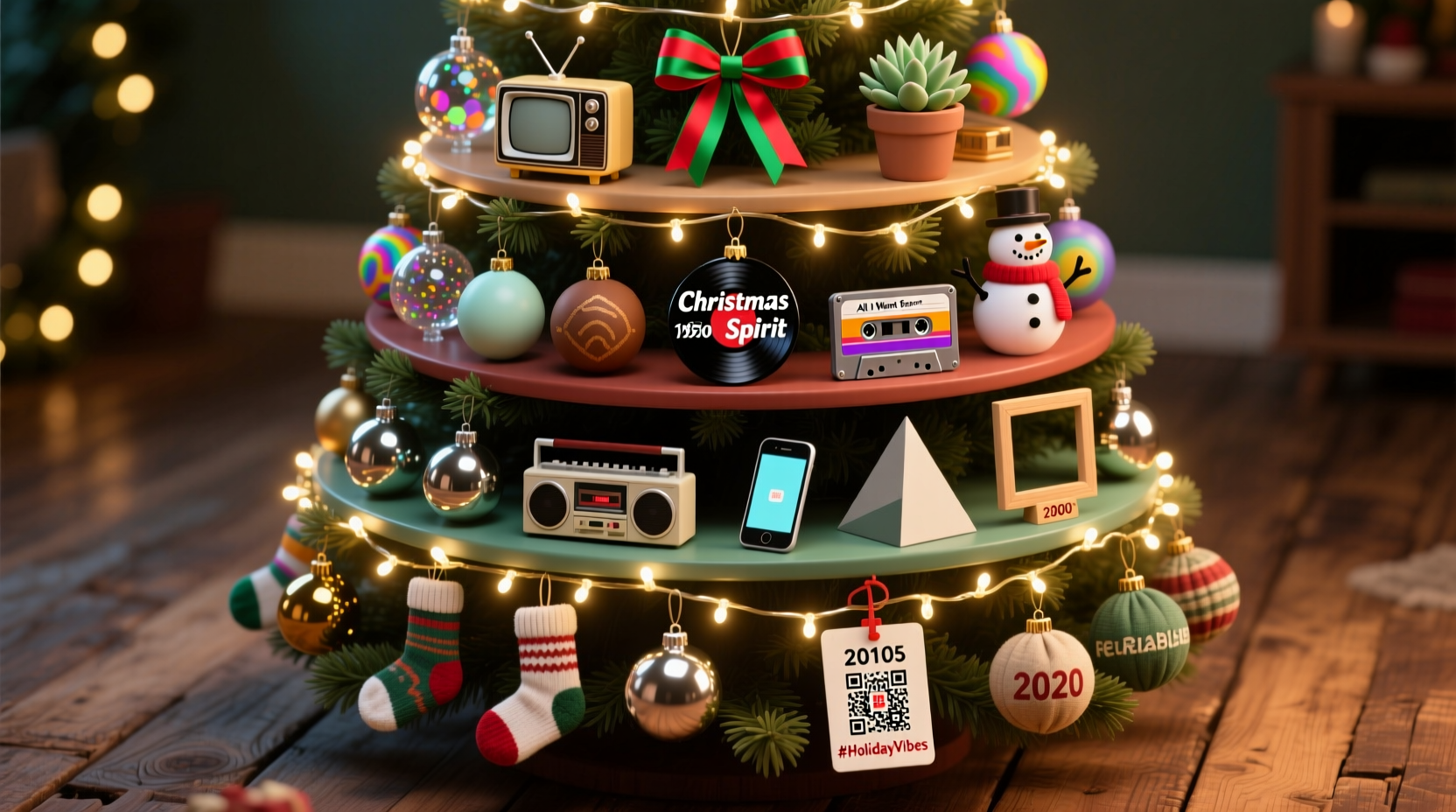
Most attempts at “vintage” trees fall short because they rely on aesthetic pastiche—throwing together red glass balls and tinsel without understanding context. A true decade-layered tree respects chronology, material constraints, and stylistic logic. For example, you wouldn’t place plastic ornaments from the 1960s on the 1930s tier—their weight, scale, and reflective properties would visually destabilize the delicate balance of early hand-blown glass. Equally important is structural integrity: decades differ in ornament density, weight distribution, and preferred hanging methods. The 1950s favored lightweight aluminum tinsel strands draped *over* branches; the 1970s leaned into heavy ceramic figurines anchored near the trunk. Ignoring these nuances results in drooping tiers, uneven silhouettes, or even branch breakage.
Historical accuracy also deepens emotional resonance. When guests see the muted wartime palette of the 1940s—ochre, olive, navy—with hand-stitched fabric stars and repurposed ribbon—they’re not just seeing decor; they’re sensing restraint and resilience. When the 1980s tier bursts with neon acrylic baubles, cassette tape garlands, and Rubik’s Cube miniatures, it evokes unmistakable energy. That authenticity is what turns decoration into storytelling.
The Structural Framework: Choosing & Preparing Your Tree
A layered decade tree demands a stable, multi-tiered foundation. Real firs and spruces work best—not for nostalgia, but for biology. Their natural tiered branching structure (distinct lower, middle, and upper zones) provides built-in separation between decades. Artificial trees can work, but only if they feature visible, horizontal branch groupings—not tightly packed, uniform tips. Avoid “full-look” flocked or pre-lit models; their integrated wiring and dense foliage obscure layer boundaries and trap heat around vintage materials like celluloid or early plastics.
Begin by identifying three primary zones on your tree:
- Lower Tier (Base): From ground level up to ~30% of total height—designed for heavier, sturdier ornaments (1940s–1960s).
- Middle Tier (Waist): From 30% to 70%—the visual anchor, accommodating medium-weight pieces (1970s–1990s).
- Upper Tier (Crown): Top 30%—reserved for lightweight, airy items (2000s–2020s), where visibility and airflow matter most.
Before decorating, prune selectively: remove any crossing or inward-growing branches that blur zone transitions. Then, reinforce key support points using clear, flexible florist wire (22-gauge). Wrap it twice around sturdy horizontal branches at the top and bottom of each designated tier—not to hold ornaments, but to create subtle “guardrails” that prevent accidental shifting during placement.
Decade-by-Decade Styling Guide: Authenticity Without Obsession
Authenticity doesn’t require museum-grade replicas. It means honoring material logic, color psychology, and production realities of each era. Below is a curated summary of key characteristics, verified against retail catalogs, oral histories from vintage ornament collectors, and conservation notes from institutions like the Henry Ford Museum.
| Decade | Signature Materials & Forms | Color Palette | Key Stylistic Notes |
|---|---|---|---|
| 1940s | Hand-blown glass (often imperfect), fabric stars, repurposed silk ribbons, wood cutouts | Olive, navy, burgundy, cream, muted gold | Rationing influenced scarcity—ornaments were smaller, fewer per branch, often handmade. Avoid glitter or bright reds; those came post-war. |
| 1950s | Aluminum tinsel, molded plastic balls, hand-painted ceramics, early Lucite | Teal, coral, butter yellow, mint, charcoal gray | Optimism met industry—shiny, reflective surfaces dominated. Tinsel was draped *over*, not wrapped around, branches. |
| 1960s | Acrylic, spun glass, paper mache, mod geometric shapes | Mustard, avocado, burnt orange, white, black | Design embraced abstraction. Ornaments were often flat or angular—not round. Avoid realistic motifs; go for bold silhouettes. |
| 1970s | Ceramic figurines, macramé, woven wood, textured glass | Harvest gold, rust, brown, forest green, burnt sienna | Texture over shine. Weight concentrated near trunk; branches held fewer, larger pieces. Think “earth tone maximalism.” |
| 1980s–1990s | Plastic, PVC, foil-wrapped foam, mass-produced collectibles | Neon pink, electric blue, hot pink, lime green, silver | Density increased dramatically. Ornaments clustered densely—especially on outer edges—to create “wallpaper” effect. |
| 2000s–2020s | Recycled paper, laser-cut wood, bioplastics, minimalist metal | Charcoal, oatmeal, sage, terracotta, slate blue | Intentional imperfection: raw edges, visible grain, matte finishes. Fewer ornaments, more negative space. |
“The most powerful decade trees don’t shout ‘1970s!’—they whisper it through texture, weight, and silence. A single ceramic deer placed deliberately near the trunk says more than twenty plastic ones scattered randomly.” — Marisol Vega, Curator of American Decorative Arts, Cooper Hewitt Smithsonian Design Museum
Step-by-Step Assembly Timeline: Building Your Tree in Logical Sequence
Assembly order matters as much as selection. Jumping between decades creates visual noise and physical instability. Follow this precise sequence:
- Week 1 (Prep): Clean and inspect all ornaments. Test fragile glass for hairline cracks using a magnifying glass and gentle tap (a dull thud = compromise; a clear ring = intact). Photograph each piece for insurance documentation.
- Day 1 (Framework): Mount the tree. Use a heavy-duty stand rated for 20+ lbs. Insert 3–5 vertical dowels (¼-inch birch rods) into the trunk at evenly spaced intervals—these serve as invisible anchors for heavier ornaments and prevent lateral sway.
- Day 2 (Lower Tier – 1940s–1960s): Begin at the base. Hang ornaments *first* on inner branches, working outward. Use cotton-wrapped wire hooks (not metal) for vintage glass to prevent micro-scratches. Space items at least 4 inches apart—density kills 1940s authenticity.
- Day 3 (Middle Tier – 1970s–1990s): Focus on weight distribution. Place heaviest ceramics and figurines within 6 inches of the trunk. Use clear fishing line doubled and knotted for secure suspension. Introduce texture-based garlands (macramé, woven reed) before adding ornaments—this creates a tactile base layer.
- Day 4 (Upper Tier – 2000s–2020s): Work exclusively with hands—no hooks or tools. Gently tuck lightweight ornaments into outer tips. Leave at least 30% of upper branches bare; negative space is essential to modern minimalism.
- Day 5 (Unification & Refinement): Step back daily. Adjust spacing. Add subtle transitional elements: a single brass bell (1950s) bridging the 1940s and 1960s tiers; a linen ribbon (2010s) draped vertically to echo 1970s earth tones. Never force cohesion—let the decades converse, not harmonize.
Real-World Example: The Anderson Family Tree, Portland, OR
In 2022, the Andersons—a multigenerational household with grandparents born in 1938 and grandchildren aged 8 and 12—built their first decade-layered tree. They began with family artifacts: Grandma Eleanor’s 1947 hand-sewn star, Uncle Ray’s 1963 ceramic astronaut, and the kids’ handmade 2021 recycled-paper snowflakes. Rather than chase perfection, they prioritized meaning. The 1940s tier held only seven pieces—including a ration-book replica made from folded cardboard—honoring scarcity. The 1980s tier featured VHS tape garlands wound with rainbow yarn, reflecting the family’s love of home movies. What surprised them was how the tree reshaped tradition: instead of “passing down ornaments,” they now gather each November to *curate*—discussing why a 1974 avocado-green ceramic mushroom belongs on the middle tier, not the lower one, and how its weight balances the 1950s aluminum icicle above it. Two years later, their tree has become the neighborhood’s unofficial holiday archive—visitors bring their own decade pieces to temporarily “loan” for the season.
FAQ: Practical Questions Answered
How do I safely mix fragile vintage glass with modern plastics?
Never hang them on the same branch. Use the structural framework to separate eras physically. Vintage glass belongs on interior, sturdier branches; modern plastics go on outer, flexible tips. Always handle glass with clean cotton gloves—and never hang by the cap alone; use a double-loop wire hook secured beneath the ornament’s widest point.
Can I use LED lights without breaking the decade illusion?
Yes—but strategically. Choose warm-white, non-blinking LEDs with filament-style bulbs (available since 2015). String them *vertically* from trunk to tip, not horizontally around branches. This mimics the look of early incandescent strands while avoiding the “modern string light” aesthetic. Conceal cords behind thicker branches or under garlands.
What if I don’t have authentic ornaments for a decade?
Create meaningful approximations. For the 1940s: paint wooden discs with matte gouache in olive and cream; seal with beeswax. For the 1970s: weave strips of burlap and jute into small baskets. Authenticity lives in intention and material honesty—not price tags or provenance.
Conclusion: Your Tree Is a Living Archive—Start Building It Today
A decade-layered Christmas tree is not a static display. It evolves with you—with new memories, acquired pieces, and shifting perspectives. It asks you to slow down, to research, to handle objects with care, and to listen to what materials tell you about time. You don’t need a collection of rare antiques. You need curiosity, respect for craft, and the willingness to let history breathe in your living room. Begin with one tier—just the 1950s, using three aluminum icicles, two coral plastic balls, and a hand-drawn paper star. Document it. Notice how the light catches the tinsel differently than it does your LED strands. Feel the weight difference between a 1970s ceramic bird and a 2020s laser-cut oak ornament. That awareness is where meaning begins.
This isn’t about recreating the past. It’s about engaging with it—thoughtfully, respectfully, and joyfully. Your tree will be imperfect. Some ornaments will clash. A 1980s bauble might accidentally land on the 1960s tier. Let it stay. History isn’t tidy—and neither is celebration.




 浙公网安备
33010002000092号
浙公网安备
33010002000092号 浙B2-20120091-4
Comments
No comments yet. Why don't you start the discussion?