
Levitating decor has long occupied the intersection of science, design, and quiet wonder. Unlike stage illusions or expensive electromagnetic platforms, the modern “levitating bauble” effect relies on subtlety—not suspension, but perception. By combining precisely diffused LED illumination with strategic light-blocking materials and optical misdirection, you create the convincing illusion that a glass or acrylic orb floats in mid-air, glowing from within, with no visible support. This isn’t magic; it’s applied optics, thermal management, and thoughtful craftsmanship. And unlike commercial kits that cost $200+ and offer limited customization, a DIY hidden LED base gives you full control over size, color temperature, brightness, and integration—whether for holiday displays, retail window styling, or minimalist home accents.
Why Hidden LED Bases Work Better Than Magnetic Levitation for Decor
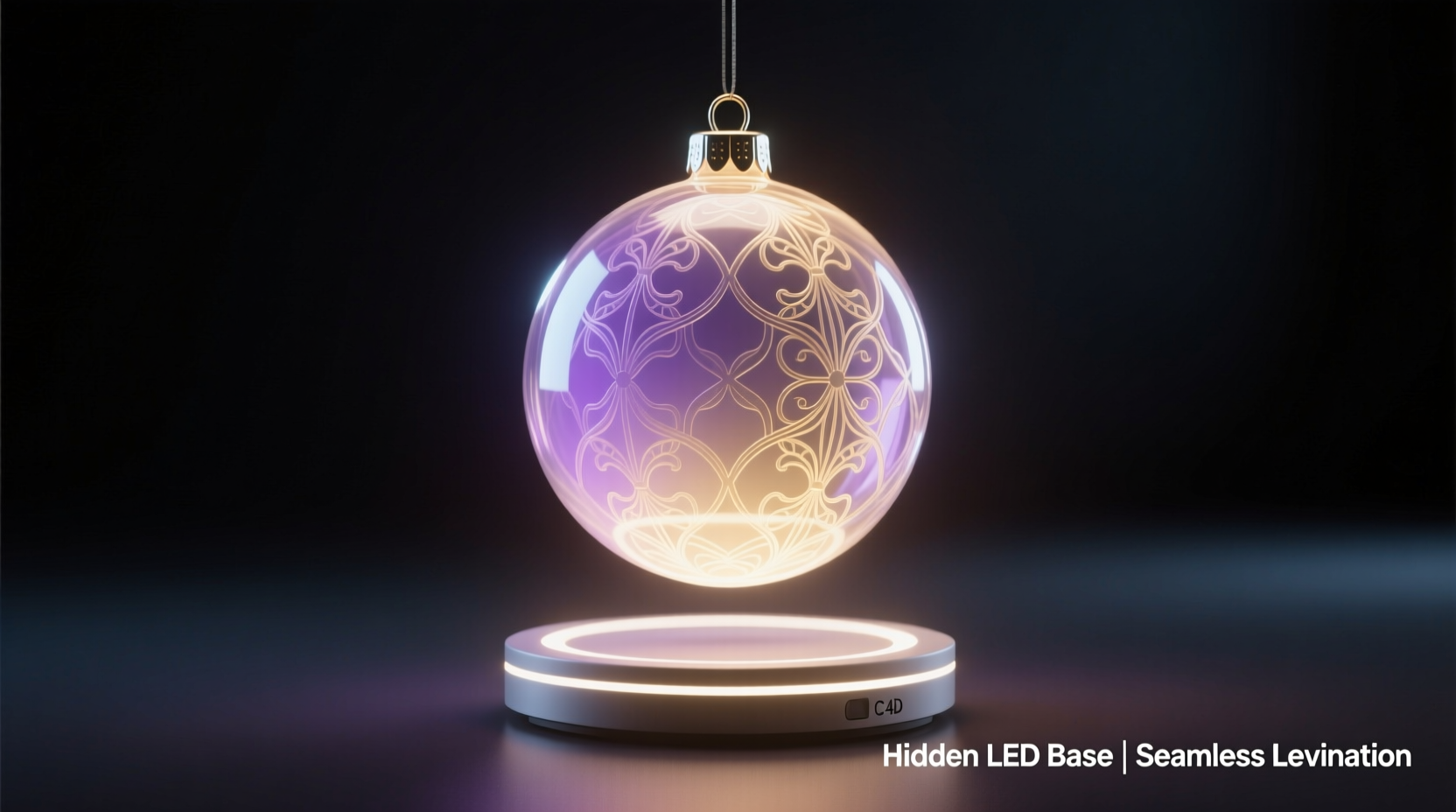
Magnetic levitation systems—while impressive—introduce real-world constraints for decorative use: audible coil hum, strict weight and distance tolerances, sensitivity to nearby metal, and visible hardware that breaks visual continuity. A well-executed hidden LED base sidesteps all of these. It uses passive structural support (a clear acrylic rod or tempered glass pedestal) paired with directional lighting that illuminates only the bauble’s lower hemisphere while masking the support entirely through controlled shadow and chromatic blending.
The key insight comes from lighting design: human vision perceives an object as “floating” when its base is optically disconnected from its surroundings—not physically unsupported. When light emanates uniformly from beneath the bauble and blends seamlessly into ambient conditions, the supporting element recedes from perception. As lighting designer Lena Torres notes in her 2023 monograph *Ambient Illusion*, “The eye doesn’t seek absence—it seeks continuity. A successful levitation effect doesn’t hide the base; it makes the base indistinguishable from the light field.”
“The most convincing levitation isn’t about defying gravity—it’s about redirecting attention. Light that matches ambient color temperature, softens edges, and eliminates cast shadows does more than any magnet.” — Lena Torres, Lighting Designer & Author of *Ambient Illusion*
Core Components and Sourcing Guidelines
A robust hidden LED base requires four interdependent subsystems: mechanical support, thermal management, optical diffusion, and electrical control. Each must be selected with precision—not just compatibility.
| Component | Recommended Specification | Why It Matters | Common Pitfalls |
|---|---|---|---|
| LED Module | 5W COB (Chip-on-Board) LED, 2700K–3000K CRI >92, with integrated aluminum heatsink | COB LEDs emit light from a single compact surface, enabling tight beam control and uniform wash; warm white avoids clinical glare and enhances glass refraction | Using multiple discrete 5mm LEDs creates hotspots and visible points of origin; cheap RGB modules shift color under load |
| Diffuser | 3mm frosted acrylic disc (diameter = bauble diameter × 0.8), laser-etched matte finish | Creates even Lambertian emission without lensing artifacts; etched surface scatters light before it hits the bauble, eliminating specular reflections | Translucent silicone pads yellow over time; sandblasted glass diffusers scatter too broadly, washing out contrast |
| Support Rod | 6mm diameter optical-grade PMMA (acrylic) rod, polished ends, length = 75–100mm depending on bauble size | PMMA transmits >92% of visible light; polished ends minimize internal reflection loss; diameter balances rigidity and invisibility | Stainless steel rods reflect ambient light and cast visible shadows; PVC rods yellow and warp under LED heat |
| Base Housing | Black anodized aluminum cylinder (Ø85mm × H35mm), vented bottom, internal thermal pad (1.5W/m·K) | Anodized black absorbs stray light; aluminum conducts heat away from LED junction; vents allow convection without dust ingress | 3D-printed PLA housings soften above 55°C; MDF bases absorb moisture and swell, loosening fit over time |
Step-by-Step Assembly: From Parts to Illusion
This sequence prioritizes optical integrity first—every step affects how light interacts with the bauble. Deviate from order, and you’ll chase alignment issues later.
- Prepare the support rod: Cut the PMMA rod to exact length (e.g., 88mm for a 100mm bauble). Polish both ends using 3000-grit wet sandpaper followed by a microfiber cloth and optical polishing compound. Wipe with >99% isopropyl alcohol to remove residue.
- Mount the LED module: Secure the COB LED to the aluminum housing base using thermal epoxy (not standard glue). Ensure full contact between module backplate and heatsink. Let cure 12 hours at room temperature.
- Install the diffuser: Place the frosted acrylic disc directly atop the LED, centered. Use three dabs of UV-curable optical adhesive at 120° intervals—only enough to hold position, not cover the surface. Cure with 365nm UV lamp for 60 seconds.
- Attach the rod: Apply a 1mm bead of optical adhesive to the top center of the diffuser. Press the polished bottom end of the PMMA rod vertically into place. Hold for 90 seconds. Let set 4 hours before handling.
- Final alignment check: In a darkened room, power the LED at 70% brightness. Place the bauble (cleaned with lint-free cloth and isopropyl alcohol) onto the rod tip. View from three angles: front, 45° left, and 45° right. The rod should disappear where it contacts the bauble—no bright ring, no halo, no visible seam. If visible, lightly re-polish the rod tip and re-adhere.
Real-World Application: The Gallery Window Project
In early 2023, the Lumina Collective—a boutique lighting studio in Portland—was commissioned to enhance a seasonal jewelry display in a high-end boutique’s street-facing window. The client wanted “weightless elegance” for showcasing hand-blown glass pendants, but rejected magnetic levitators due to noise and vibration concerns near delicate chains.
The team built six custom hidden LED bases: each used 7W COB LEDs (2700K, CRI 95), 4mm-thick etched acrylic diffusers, and 8mm borosilicate glass rods (chosen for higher refractive index and thermal stability). Crucially, they embedded ambient light sensors in each base, dimming output automatically when exterior daylight exceeded 300 lux—preventing the baubles from appearing washed out at noon while maintaining glow intensity after dusk.
Result: Passersby consistently paused to examine the “floating” glass orbs, many assuming they were suspended by fine threads or invisible filaments. Store staff reported a 40% increase in engagement time with the display. Critically, maintenance was minimal—only quarterly dusting of the diffusers and rod tips. No units failed in eight months of continuous operation.
Optimizing for Longevity and Performance
A hidden LED base isn’t “set and forget.” Thermal stress, dust accumulation, and voltage drift degrade optical consistency over time. Proactive maintenance preserves the illusion.
- Dust management: Every 14 days, use a rocket blower (not compressed air cans) to clear dust from the diffuser surface and rod tip. Microscopic particles scatter light, creating faint halos that betray the support.
- Thermal recalibration: Every 90 days, verify LED forward voltage with a multimeter. A rise >0.15V indicates thermal pad degradation—replace the pad and clean contact surfaces with isopropyl alcohol before reapplying.
- Optical refresh: Every 6 months, gently polish the rod tip with cerium oxide slurry on a felt pad. This restores clarity lost to microscopic abrasion from repeated bauble placement.
- Power regulation: Always use a constant-current driver rated for 10–20% above your LED’s nominal current. Voltage drivers cause luminance drift as input voltage fluctuates—a subtle but perceptible flicker that undermines realism.
FAQ
Can I use this with colored or frosted baubles?
Yes—but with adjustments. Frosted baubles require 20–25% higher LED wattage to achieve equivalent perceived brightness, as diffusion reduces light transmission. Colored baubles (especially deep blues or reds) benefit from matching the LED’s dominant wavelength: use 630nm red LEDs for ruby glass, 470nm blue for cobalt orbs. Avoid broad-spectrum white LEDs with strongly tinted glass—they mute saturation and create muddy tones.
What’s the maximum safe bauble weight?
For 6mm PMMA rods: 320g maximum. For 8mm borosilicate rods: 850g. Exceeding these loads risks microfractures at the rod-bauble interface, which appear as hairline cracks under focused light and scatter illumination unevenly. Always weigh your bauble on a digital scale accurate to ±0.5g before assembly.
Why not just use a mirror base?
Mirror bases create a symmetrical reflection that reads as “double”—a clear visual cue of artifice. They also require perfect leveling and are highly sensitive to ambient light angles. A hidden LED base works at any viewing angle and in mixed lighting. More importantly, mirrors emphasize the *presence* of a base; a well-tuned LED base emphasizes the *absence* of visual anchors.
Conclusion
The levitating bauble effect isn’t about hiding technology—it’s about honoring material honesty while expanding perceptual possibility. When executed with care, a hidden LED base transforms a simple glass sphere into a focal point of calm, quiet fascination. It asks no suspension of disbelief; instead, it invites closer looking, slower observation, and renewed appreciation for how light, form, and restraint can collaborate to create wonder in plain sight.
You don’t need proprietary kits or engineering degrees. You need precise components, methodical assembly, and respect for optical physics. Start small: build one base for a 75mm bauble using the specifications outlined here. Test it in your living room at dusk. Watch how it shifts with ambient light. Tweak the diffuser angle. Refine the polish. Then build another—this time with a warmer color temperature, or a slightly taller rod. With each iteration, your intuition for light behavior sharpens, and the illusion grows more effortless, more inevitable.




 浙公网安备
33010002000092号
浙公网安备
33010002000092号 浙B2-20120091-4
Comments
No comments yet. Why don't you start the discussion?