
Desk space is precious—especially during the holiday season, when festive clutter threatens productivity and calm. Yet the desire for seasonal warmth, quiet joy, and personal expression remains strong. A mini Christmas tree solves this tension: small enough to nestle beside your keyboard or notebook, meaningful enough to reflect intentionality, and sustainable enough to align with modern values. Unlike mass-produced plastic ornaments or single-use decor, a tree built from what you already have—old magazines, wine corks, tin cans, cardboard boxes—carries quiet significance. It’s not just decoration; it’s a tactile reminder that sustainability and celebration need not compete. This guide walks through every practical detail: sourcing, shaping, assembling, and styling a sturdy, visually cohesive 6–8 inch tree that stands upright on its own, requires no electricity or adhesives beyond basic craft glue, and lasts through multiple holiday seasons with minimal care.
Why Recycled Materials Make Better Mini Trees
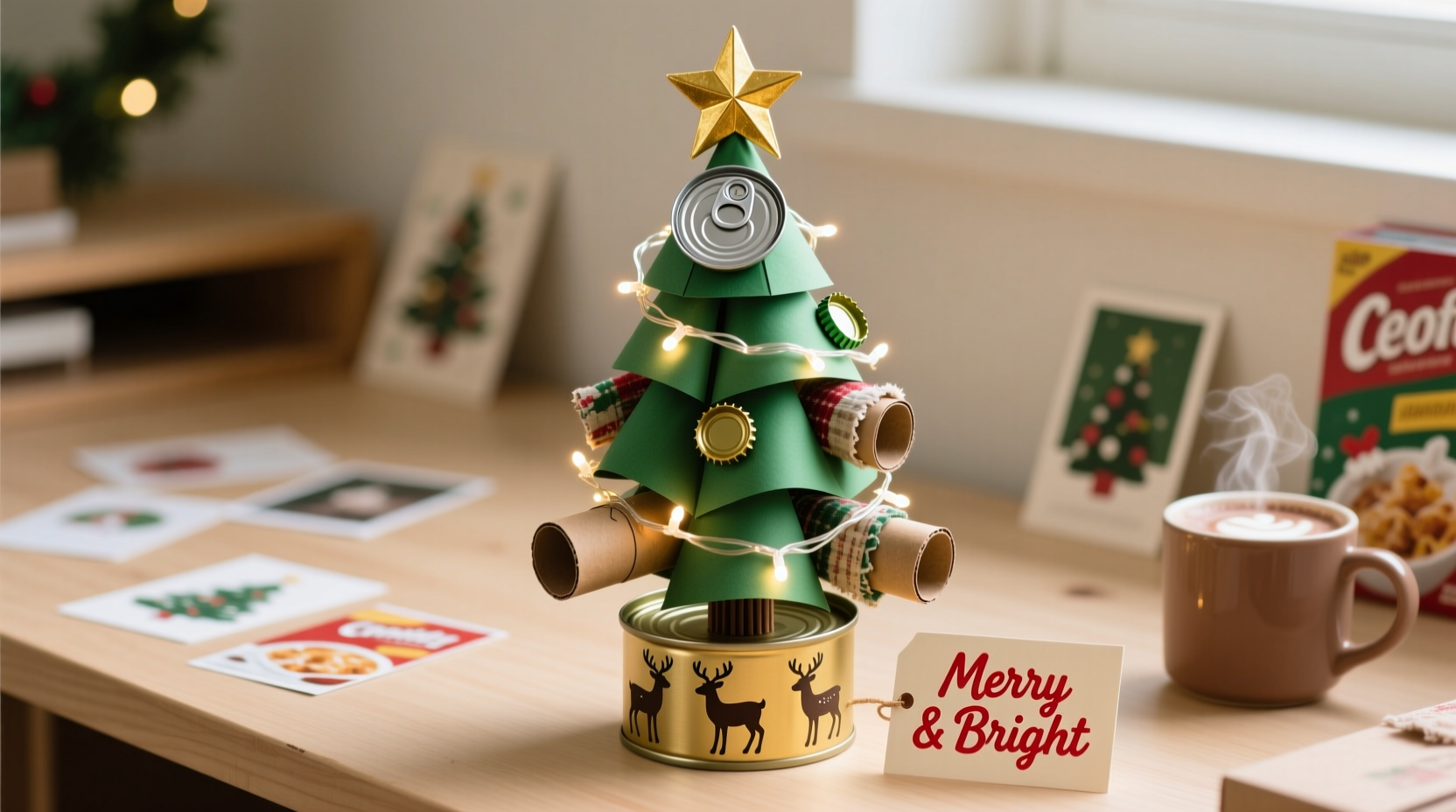
Most commercially available desk trees are made from PVC, molded plastic, or low-grade metal alloys—materials that degrade over time, leach microplastics, and contribute to landfill waste after one season. In contrast, repurposed materials offer structural integrity, textural richness, and environmental accountability. Cardboard provides compressive strength when layered and scored correctly. Aluminum can tabs form durable, reflective “boughs” that catch ambient light without glare. Old book pages hold crisp folds and subtle patina, while wine corks lend natural insulation and grip. Crucially, using what’s already in your home eliminates shipping emissions, packaging waste, and the carbon footprint of manufacturing. As Dr. Lena Torres, material ecologist at the Sustainable Design Institute, observes:
“The most sustainable object isn’t the one labeled ‘eco-friendly’—it’s the one that never entered the supply chain at all. A desk tree made from yesterday’s mail is an act of material literacy: seeing potential where others see waste.”Beyond ethics, recycled components introduce visual authenticity. No two bottle-cap tiers match exactly; no cork trunk has identical grain. That variation creates warmth, personality, and a sense of handmade honesty rare in mass decor.
What You’ll Actually Need (No Specialty Stores Required)
Gather these items from your recycling bin, pantry, or junk drawer—no shopping trips needed. All quantities assume a 7-inch tall, three-tiered tree with a stable 3-inch base diameter.
| Material | Source Examples | Minimum Quantity | Why It Works |
|---|---|---|---|
| Corrugated cardboard | Pizza boxes, shipping boxes, cereal box inserts | One 8×10 inch sheet (2 layers) | Provides rigidity, easy to cut, scores cleanly for angled boughs |
| Aluminum can tabs | Cola, beer, soda cans (remove cleanly with tab-pull tool or pliers) | 42–48 tabs | Lightweight, rust-proof, naturally shiny—ideal for “ornament” accents |
| Wine or champagne corks | Used corks saved over time—or ask local restaurants for donations | 3 medium corks (or 1 large + 2 small) | Natural grip, dense grain, excellent for vertical stability as trunk core |
| Old book/magazine pages or scrap paper | Discarded novels, outdated catalogs, printer misprints | 12–15 sheets (letter size) | Folds crisply, holds creases, offers vintage typography or color variation |
| Non-toxic white craft glue & toothpick | Craft drawer or office supply cabinet | Small bottle + 1 toothpick | Low-VOC, dries clear, bonds porous materials without warping |
Step-by-Step Assembly: Build Stability First, Then Beauty
This sequence prioritizes structural integrity—critical for a tree that won’t topple when brushed by a sleeve or jostled during typing. Each step builds load-bearing capacity before adding decorative layers.
- Prepare the trunk core: Stack three corks vertically (largest at bottom). Insert a wooden skewer or stiff paperclip through their centers to lock alignment. Let dry overnight if gluing ends together—this creates a unified, non-rotating column.
- Create the base disc: Cut a 3-inch diameter circle from double-layered corrugated cardboard. Score a shallow 1/4-inch deep groove along the center circumference (use a ruler and utility knife), then gently bend upward to form a subtle lip—this prevents lateral sliding.
- Build tiered boughs: Cut three cardboard circles: 2.5 inches (top), 3.5 inches (middle), 4.5 inches (bottom). On each, score radial lines every 30° (12 lines per circle) to 1/3 depth. Fold alternating sections up and down to create gentle, interlocking “branches” that cradle weight evenly.
- Assemble the frame: Glue the largest bough circle to the base disc’s top surface, aligning grooves. Center the cork trunk over it and secure with glue inside the base groove. Repeat with middle and top boughs, letting each layer dry fully (20 minutes minimum) before adding the next.
- Add recycled ornamentation: Thread tabs onto thin copper wire or doubled embroidery floss. Knot tightly, then wrap the wire around bough tips—no glue needed. For paper ornaments, fold origami-style stars or cones (see FAQ for folding diagram reference) and tuck points into scored cardboard grooves.
Real-World Example: How Maya Transformed Her Remote Workspace
Maya Chen, a UX researcher in Portland, worked remotely full-time and felt her desk lacked seasonal grounding. Her apartment had strict recycling rules—and zero storage space for new decor. She collected materials over six weeks: 37 soda tabs from her household and neighbors, five wine corks from a local café’s donation bin, and discarded pages from a library’s weeded poetry collection. Using only a safety scissors, toothpick, and school glue, she built her first tree in 92 minutes—including drying time. “It didn’t look ‘perfect’ at first—the corks wobbled slightly,” she shared. “But after reinforcing the base groove with a second cardboard ring, it held firm through video calls, coffee spills, and even her cat’s curious paw swipes. Now it sits beside my monitor, and colleagues always ask about it on Zoom backgrounds. It’s become my quiet symbol of resourcefulness—not scarcity.” Her tree remains in use three holiday seasons later, with only two tabs replaced after accidental drops.
Design Principles for Visual Harmony (Without Buying Anything)
A cohesive aesthetic emerges not from uniformity—but from intentional repetition and restraint. Apply these principles using only your recycled stock:
- Color rhythm: Limit your palette to three tones max—e.g., cream paper + silver tabs + warm cork. Avoid mixing glossy magazine pages with matte book pages unless deliberately contrasting texture.
- Scale consistency: If using paper ornaments, keep all folds under 1.5 inches wide. Tabs should hang at staggered lengths (1/4”, 3/8”, 1/2”)—not random.
- Negative space respect: Leave at least 40% of each bough visible. Overloading obscures structure and makes the tree feel heavy, not joyful.
- Tactile layering: Alternate smooth (tabs), fibrous (paper), and granular (cork) surfaces within line of sight—this creates subconscious visual interest without color.
FAQ: Practical Questions Answered
Can I use plastic bottle caps instead of aluminum tabs?
Yes—but with caveats. Plastic caps lack the natural reflectivity and weight distribution of aluminum. Drill a tiny hole near the rim (not center) and thread with thin wire to prevent spinning. Avoid caps with textured logos—they catch dust and reduce light bounce. Aluminum remains strongly preferred for durability and visual lift.
How do I store it safely between Decembers?
Disassemble carefully: remove wire-wrapped tabs and store flat in a small box lined with tissue. Keep bough circles stacked with parchment paper between layers to prevent warping. Store the cork trunk upright in a dry cupboard—never sealed in plastic, which traps moisture and encourages mold. Reassemble in under 15 minutes each year.
What if I don’t have corks? What’s the best substitute?
A tightly rolled, glued bundle of 8–10 layers of corrugated cardboard strips (1/4-inch wide × 4 inches long) works exceptionally well. Compress firmly, apply glue to each layer as you roll, and let cure 24 hours. It’s lighter than cork but equally stable when anchored in the scored base groove. Avoid pencils or dowels—they’re too smooth and slip.
Maintenance, Longevity, and Quiet Joy
This tree isn’t meant to be pristine—it’s meant to age gracefully. Dust weekly with a soft makeup brush (no water or cleaners). If a tab loosens, rethread with fresh wire rather than re-gluing. Over time, paper ornaments may soften at edges; embrace this as evidence of use, not wear. The cork trunk will deepen in tone, the cardboard grain will mellow, and the aluminum will develop a soft patina—none diminish function. In fact, these changes enhance character. Unlike disposable decor, this tree accrues meaning: the tabs represent shared moments (a holiday party, a neighbor’s gift), the paper holds fragments of stories read and reread, the cork recalls celebrations past. Its longevity isn’t measured in years alone—it’s measured in how often it sparks conversation, calms a stressed moment, or reminds you that care and creativity begin with what’s already at hand.
Your Turn: Grow Something Meaningful This Season
You don’t need a craft studio, a budget, or permission to bring warmth to your workspace. You need only what’s already circulating in your life—discarded, overlooked, waiting for reinterpretation. Building this tree takes less time than scrolling through online decor ads. It asks for attention, not expenditure. It rewards patience, not perfection. And when you place it beside your keyboard—its modest height holding steady, its recycled surfaces catching the afternoon light—you’ll feel something rare in digital work: grounded presence. Start today. Empty your recycling bin. Sort three tabs. Cut one circle. Fold one page. Let the rest unfold. Your desk, your values, and your quiet holiday spirit will thank you.




 浙公网安备
33010002000092号
浙公网安备
33010002000092号 浙B2-20120091-4
Comments
No comments yet. Why don't you start the discussion?