
Minimalism in holiday decor is often misunderstood—not as absence, but as precision. A minimalist Christmas tree isn’t about stripping away until nothing remains; it’s about distilling the season’s essence into gestures that resonate: texture over tinsel, rhythm over repetition, silence between ornaments. Many attempt minimalism only to land on something stark, unfinished, or unintentionally austere—a tree that reads less “curated sanctuary” and more “waiting for decoration.” The truth is elegance emerges not from scarcity, but from selectivity. It lives in the weight of a single handmade glass bauble suspended at eye level, the quiet gleam of matte brass against deep green needles, the deliberate pause created by negative space. This article offers a grounded, experience-informed approach—tested across urban lofts, Scandinavian-inspired homes, and heritage cottages—to building a tree that feels both reverent and relaxed, refined yet warm.
The Philosophy Behind Minimalist Elegance
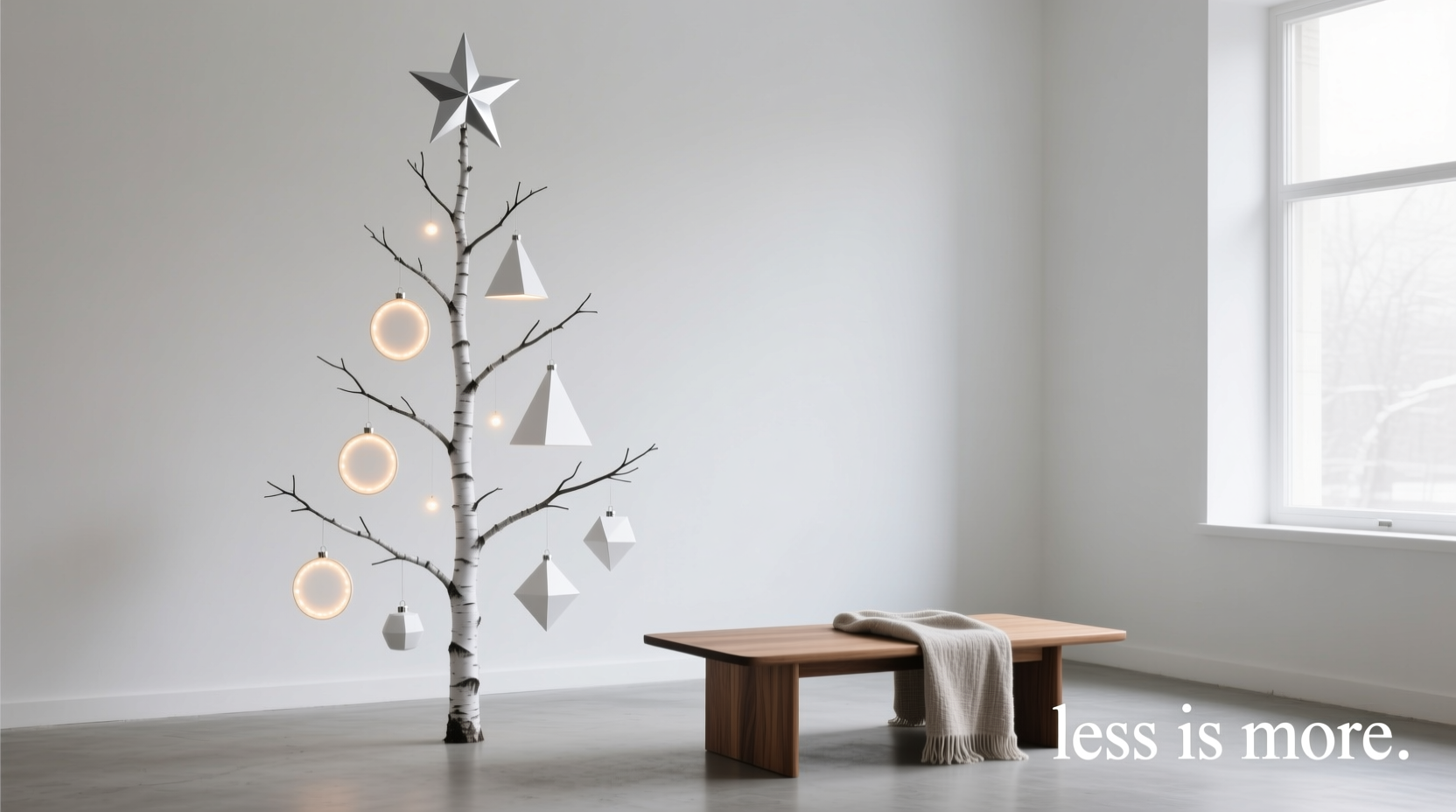
Elegance in minimalism is never accidental. It arises from three interlocking principles: intentionality, material integrity, and spatial awareness. Intentionality means every element has earned its place—not because it’s “festive,” but because it contributes meaningfully to light, texture, contrast, or memory. Material integrity refers to choosing objects with inherent presence: uncoated wood grain, hand-blown glass with subtle imperfections, hammered metal that catches light differently at each angle. These materials don’t shout; they invite closer looking. Spatial awareness is perhaps the most overlooked. On a minimalist tree, negative space isn’t empty—it’s active. It allows the eye to rest, creates visual breathing room, and subtly amplifies the impact of each ornament. As interior designer Sofia Lin notes in her monograph *Quiet Light*, “A well-placed void doesn’t subtract—it frames. It teaches the viewer how to see the object beside it.”
“Elegance is the art of editing until only what belongs remains—and then polishing that remainder until it glows with quiet certainty.” — Sofia Lin, Interior Designer & Author of *Quiet Light*
Five Pillars of an Elegant Minimalist Tree
Building such a tree rests on five non-negotiable foundations. Deviate from one, and the balance tilts toward sterility or insufficiency.
- Tree Selection & Prep: Choose a real Nordmann fir or Fraser fir—their dense, horizontal branching structure provides natural rhythm and supports sparse placement without revealing gaps. Avoid sparse or spindly varieties like Douglas fir for this aesthetic. Before decorating, fluff each branch outward and upward to create volume and lift—this prevents flatness and gives ornaments room to breathe.
- Color Discipline: Restrict your palette to no more than three core tones—including neutrals. For example: charcoal grey + ivory + brushed brass; forest green + oat + antique silver; or black + cream + matte gold. Avoid pure white unless balanced with warmth (e.g., cream, not stark white) and avoid red unless used as a single, intentional accent (e.g., one vintage velvet ribbon).
- Ornament Hierarchy: Assign roles—not just aesthetics. Use 60% textural anchors (wood, ceramic, linen-wrapped), 30% reflective accents (glass, metal), and 10% narrative pieces (a single heirloom, a handmade ceramic star). Never mix finishes within the same category—e.g., don’t pair polished chrome with brushed brass on the same branch.
- Placement Logic: Ornament distribution follows the golden ratio—not symmetry. Place larger pieces at the lower third (near trunk base), medium at mid-level (eye line), and smallest or most delicate at the upper third (just below the tip). Leave at least 8–10 inches of unadorned branch between major pieces. No cluster should contain more than three items.
- Lighting as Architecture: Use warm-white (2200K–2400K), non-dimmable LED micro-lights—no blinking, no color-changing. String them first, before any ornaments, following a spiral path from base to tip. Then, gently tuck lights deeper into branches rather than letting them sit on the surface—this creates ambient glow, not glare.
Step-by-Step: Building Your Tree in Four Hours
This timeline assumes a 6.5-foot pre-fluffed real tree, basic tools (scissors, small ladder, soft cloth), and pre-selected decor. Timing includes reflection—not rushing.
| Phase | Time | Key Actions |
|---|---|---|
| Prep & Lighting | 60 min | Test lights; drape spirally from base upward, tucking strands deep into inner branches. Step back every 15 minutes to assess evenness. Adjust until light feels diffused—not dotted. |
| Anchor Layer | 75 min | Hang 5–7 large textural pieces: e.g., 3 walnut spheres (2.5”, 3.5”, 4.5”), 2 hand-thrown stoneware orbs (unglazed, matte black), 1 oversized linen-wrapped sphere (ivory, 5”). Space evenly across lower and mid-sections. Use clear monofilament—never visible wire. |
| Reflective Layer | 45 min | Add 12–15 smaller reflective elements: matte brass cones, smoked glass teardrops, or mercury-glass ovals. Vary heights—but keep all within a 3-inch vertical range per cluster. No two identical shapes adjacent. |
| Narrative & Finish | 60 min | Place your singular meaningful piece (e.g., a grandmother’s 1940s blown-glass bird). Add one continuous ribbon—3” wide, matte velvet—in your secondary neutral tone, draped asymmetrically from top to base (not wrapped). Final check: walk around slowly. If your eye lingers longer than 2 seconds on any spot, reduce density there. |
Real Example: The Brooklyn Loft Transformation
In late November 2023, Maya R., a graphic designer in Williamsburg, faced a common dilemma: her 7-foot Balsam fir looked “like a sad pinecone” after removing decades of inherited ornaments. Her space featured exposed brick, oak floors, and floor-to-ceiling windows—minimalist by default, but cold in December. She followed the five pillars strictly but added one personal adaptation: she commissioned four custom ceramic ornaments from a local potter—each a different organic shape (a seed pod, a folded leaf, a smooth river stone, a crescent moon)—all glazed in the same muted celadon. She hung them at precise intervals along the central axis, creating a subtle vertical thread. She used only warm-white fairy lights and a single 4-inch-wide charcoal-grey velvet ribbon, pinned at the apex and allowed to cascade loosely down one side, ending just above the stand. Guests consistently remarked not on “how few” ornaments there were—but on “how calm” the room felt. One neighbor described it as “the first Christmas tree I’ve ever wanted to sit beneath and read poetry next to.” That’s the hallmark: when minimalism serves atmosphere, not austerity.
What to Do (and Not Do): A Practical Checklist
- ✅ Do choose ornaments with tactile variation—rough ceramic next to smooth glass, nubby wool next to cool metal.
- ✅ Do use monofilament fishing line instead of ornament hooks—creates invisibility and lets pieces hang freely.
- ✅ Do test scale against your tree: hold an ornament at arm’s length—if it disappears visually, it’s too small.
- ❌ Don’t mix more than two metallic finishes (e.g., brass + silver = visual noise).
- ❌ Don’t hang ornaments facing outward only—rotate some slightly inward to catch light from unexpected angles.
- ❌ Don’t add garlands unless they’re substantial and textural (e.g., dried olive branches, oversized cinnamon sticks wired together)—avoid thin beads or plastic chains.
Common Pitfalls & How to Correct Them
Even seasoned decorators misstep. Here’s how to recognize and resolve the most frequent issues:
- Problem: “It looks like a skeleton—too much space.”
- Solution: You’ve over-edited. Add one or two more textural anchors—preferably larger and lower on the tree. A 5-inch matte-black ceramic sphere placed near the trunk base adds grounding mass without visual clutter.
- Problem: “Everything blends together—no focal point.”
- Solution: Introduce controlled contrast. Swap a neutral ornament for one with subtle tonal shift—e.g., replace ivory ceramic with bone-colored; swap brushed brass for antique brass with visible patina. Contrast need not be color—it can be finish, weight, or silhouette.
- Problem: “It feels cold or sterile.”
- Solution: Warmth comes from organic irregularity. Replace one perfectly round ornament with a hand-thrown ceramic piece showing finger marks or slight asymmetry. Or drape a single strand of dried eucalyptus (not fresh—too green) low on one side. Its dusty-blue hue and papery texture soften edges.
FAQ
Can I use artificial trees for minimalist elegance?
Yes—but only high-fidelity models: full-profile PE (polyethylene) tips, realistic needle texture, and built-in branch layering. Avoid PVC or slim-profile fakes. Pre-fluff aggressively, then treat it exactly like a real tree: prioritize depth of lighting, use heavier ornaments to anchor branches, and avoid shiny surfaces that reflect lights chaotically.
How many ornaments do I actually need for a 6.5-foot tree?
Between 22 and 35 total—depending on size and density. A useful formula: multiply tree height (in feet) by 3.5. So 6.5 × 3.5 = ~23. This accounts for visual weight, not count alone. One large 5-inch ornament carries more presence than five 1-inch ones.
Is it okay to skip the tree topper?
Absolutely—if it serves the vision. Many elegant minimalist trees end with a simple, unadorned tip—especially if the tree is real and naturally tapered. If you prefer a topper, choose one that reads as architectural, not decorative: a single matte-black iron ring, a slender brass crescent, or a hand-carved wooden disc (no glitter, no bow). It must feel like an extension of the tree—not an afterthought.
Conclusion
An elegant minimalist Christmas tree is not a compromise—it’s a commitment to presence. It asks you to slow down, to choose deeply, to trust that restraint can generate more resonance than abundance. It honors the quiet dignity of the season: the hush before snowfall, the warmth of candlelight on bare wood, the comfort of familiar textures in unfamiliar simplicity. This approach doesn’t require expensive ornaments or rare materials—it requires attention. Attention to how light falls across a curve of glass. Attention to the way a ribbon’s drape echoes the slope of a branch. Attention to the space between things, where meaning accumulates. Start small this year. Choose one principle—perhaps lighting discipline or color restriction—and build from there. Let your tree become less of a statement and more of a sanctuary. Because the most enduring elegance isn’t seen—it’s felt in the stillness it invites.




 浙公网安备
33010002000092号
浙公网安备
33010002000092号 浙B2-20120091-4
Comments
No comments yet. Why don't you start the discussion?