
In an era where holiday clutter often overshadows the season’s spirit, a growing number of designers and home stylists are turning to architectural simplicity. The result? A new kind of Christmas centerpiece: the geometric wire frame tree. Stripped of tinsel, free from baubles, and unburdened by excess, this design speaks to modern minimalism while honoring tradition through form. Constructed entirely from bent metal rods or shaped wire, these trees rely on symmetry, proportion, and shadow play to evoke the essence of a fir without mimicking it literally. This approach isn’t just visually striking—it’s sustainable, reusable, and deeply personal. Whether mounted on a wall, freestanding in a corner, or suspended from the ceiling, a wireframe tree becomes less decoration and more sculpture.
The Philosophy Behind Minimalist Holiday Design
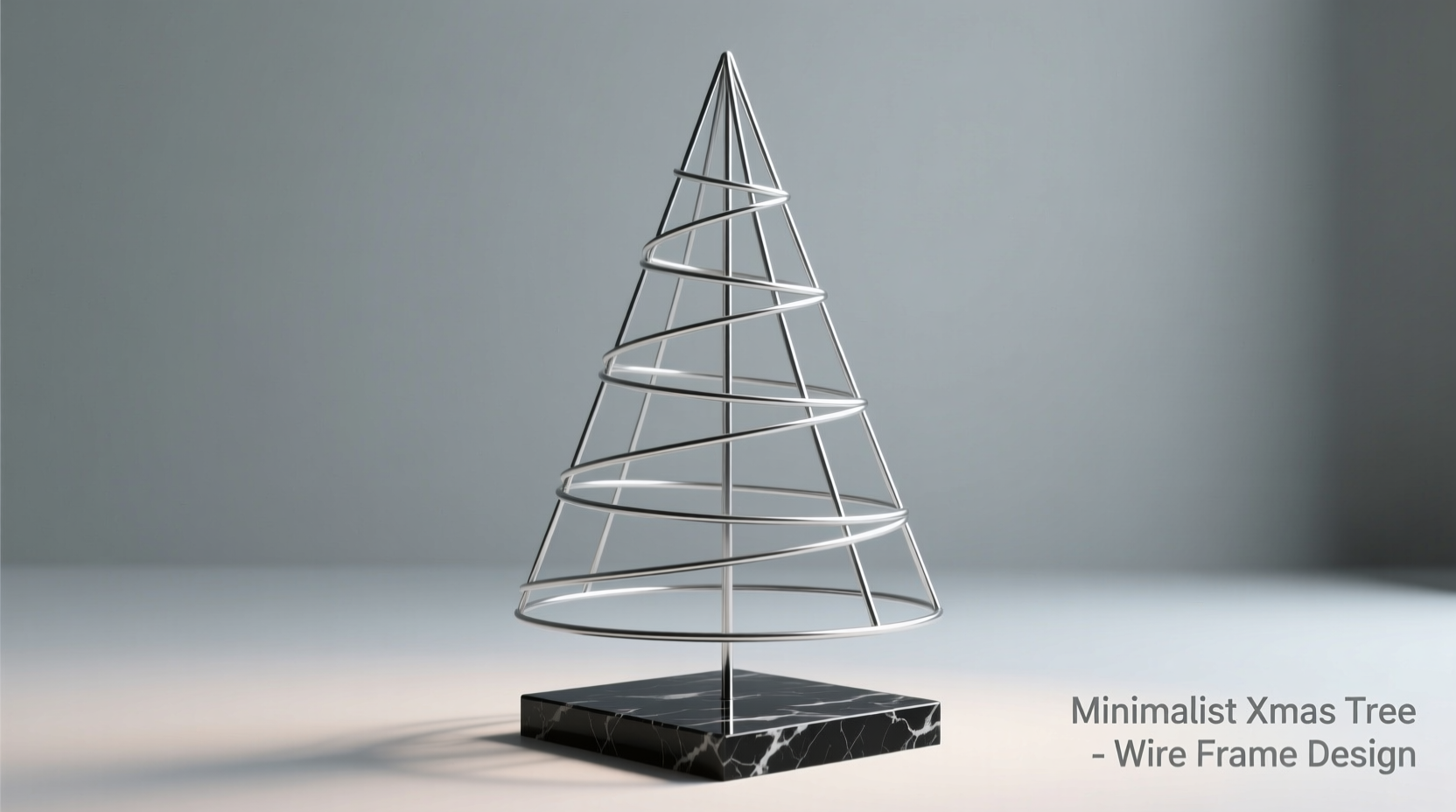
Minimalism during the holidays is not about deprivation; it's about intentionality. The geometric wire Christmas tree embodies this principle by reducing the festive symbol to its most essential lines. Unlike traditional trees that demand storage bins, tangled lights, and annual replacement, a wire version is built once and refined over time. Its presence is subtle but deliberate—inviting quiet contemplation rather than sensory overload.
This aesthetic draws inspiration from mid-century modern design, Bauhaus principles, and Japanese wabi-sabi, where imperfection and asymmetry coexist with precision. The absence of ornamentation forces attention to structure, balance, and spatial relationship. In doing so, the tree becomes part of the room’s architecture rather than a seasonal intrusion.
“Design should reveal meaning through restraint. A single line, properly placed, can carry more emotional weight than a hundred glittering trinkets.” — Lena Moretti, Industrial Designer & Author of *Silent Forms*
Materials and Tools You’ll Need
Creating a geometric wire frame tree requires few materials, but precision matters. Since the final piece relies entirely on clean lines and stable geometry, each component must be selected for durability and workability.
| Material/Tool | Purpose | Recommended Type |
|---|---|---|
| Steel or aluminum wire | Main structural element | 3–5mm diameter, tempered steel for rigidity |
| Wire cutters | Cutting precise lengths | Heavy-duty with insulated handles |
| Bending jig or mandrel | Forming consistent curves | Wood block with nails or metal dowels |
| Soldering iron or brazing kit | Joining wire segments | For metal-to-metal fusion (optional) |
| Base plate or mounting bracket | Stabilization | Cast iron disc or welded steel cross |
| Measuring tape & compass | Ensuring symmetry | Digital calipers for fine adjustments |
Alternative materials like copper or brass offer visual warmth and are easier to shape manually, though they may sag over time if unsupported. For indoor use, powder-coated black steel creates a bold silhouette against white walls. Outdoor installations benefit from stainless steel or galvanized wire to resist corrosion.
Step-by-Step Construction Guide
Building a geometric Christmas tree is a blend of art and engineering. Follow this sequence to create a balanced, self-supporting structure.
- Define the overall height and proportions. Most minimalist trees range from 4 to 7 feet tall. Decide whether you want a narrow spire or a broader conical profile. Use the golden ratio (1:1.618) to determine tier heights for visual harmony.
- Create a template on paper or digitally. Sketch concentric triangles or parabolic curves representing each level of the tree. Common designs include stacked isosceles triangles, spiraling helixes, or fractal branching patterns inspired by nature.
- Cut wire segments according to your plan. For a classic tiered tree, cut six wires per level—one for each edge of a triangular frame. Add 2 cm extra at each end for joining.
- Bend wires into shape using a jig. Secure one end, wrap around dowels or pins to achieve smooth curves, then release. Repeat for all pieces, ensuring uniformity.
- Assemble tiers from bottom to top. Align connection points and twist ends tightly together. For permanence, solder joints or use small metal couplings.
- Attach vertical supports. Run one or three central support rods from base to apex to stabilize the stack. These can double as mounting points for hanging the tree.
- Mount to a weighted base or wall anchor. If freestanding, embed the lower rod into a concrete-filled steel sleeve. For wall versions, use aircraft cable mounts drilled into studs.
- Final alignment check. View from multiple angles. Adjust any warped sections gently with pliers.
The entire process takes between 4 to 8 hours depending on complexity. First-time builders should start with a three-tier triangle model before attempting Möbius strips or tetrahedral forms.
Variations and Design Inspirations
While the classic pyramid remains popular, many artists have reinterpreted the Christmas tree through abstract geometry. These variations maintain recognizability while pushing creative boundaries.
- Tiered Hexagons: Replace triangles with hexagonal rings that decrease in size upward. Creates a honeycomb effect and casts intricate shadows.
- Spiral Helix: A single continuous wire twisted into a rising spiral, resembling a DNA strand or nautilus shell. Best mounted against a backlit wall.
- Floating Tetrahedrons: Stack interconnected triangular pyramids to form a jagged column. Offers dynamic depth and reflection.
- Negative Space Tree: Instead of outlining the tree, suspend wires to define the space around it—creating a ghost-like impression.
- Kinetic Version: Add low-friction bearings at joints so gentle air currents cause slow rotation, changing the silhouette throughout the day.
“We installed a 6-foot copper helix tree in our lobby last year. Guests didn’t realize it was a Christmas piece until someone pointed it out—then everyone saw it. That’s the power of suggestion through form.” — Daniel Park, Interior Director at Studio Lume
Mini Case Study: The Oslo Apartment Installation
In December 2023, designer Marte Vik built a geometric wire tree for her 45-square-meter Oslo flat. With limited floor space and a preference for uncluttered living, she rejected traditional trees outright. Her solution: a wall-mounted, five-tier triangular frame made from black-anodized aluminum rods, each level spaced 30 cm apart, spanning 180 cm vertically.
She used pre-bent irrigation tubing from a hardware store, cut to length and joined with brass ferrules. The entire assembly weighs under 1.5 kg and attaches via two hidden brackets. To enhance atmosphere without breaking minimalism, she placed a single LED puck light on the floor behind it, casting long triangular shadows up the wall.
Neighbors initially mistook it for modern art—until she hung a tiny folded origami star from the top vertex. “That one gesture,” she said, “was enough to shift perception. Suddenly, it was a Christmas tree.” The piece stayed mounted year-round, recontextualized with seasonal floor lighting.
Maintenance and Long-Term Use
One of the greatest advantages of a wire frame tree is longevity. Unlike real or artificial evergreens that degrade within years, a well-built metal tree can last decades. Still, care ensures continued elegance.
- Dust monthly with a microfiber cloth wrapped around a chopstick for tight spaces.
- If outdoors, inspect connections annually for corrosion or loosening.
- Store disassembled in labeled tubes if relocating frequently.
- Touch up scratches with matching enamel paint to prevent rust.
Unlike disposable decor, this tree evolves with your taste. Over time, you might repaint it gold for a luxe look, add motion elements, or reconfigure the tiers. Its value increases not in monetary terms, but in personal significance.
Frequently Asked Questions
Can I make a wire frame tree without soldering?
Yes. Mechanical fasteners like crimp beads, hose clamps, or threaded couplings can securely join wires. Twist ends tightly and reinforce with epoxy putty for added strength. Avoid glue-only bonds, as most adhesives fail under metal stress.
Is this safe around children or pets?
Ensure all sharp ends are capped or bent inward. Mount wall versions securely to prevent tipping. For households with toddlers, consider rounding all corners and anchoring the base with non-slip pads. Supervise initial interaction to prevent climbing.
How do I personalize it without adding clutter?
Subtle personalization preserves minimalism. Try weaving a single ribbon through one tier, using colored wire for one level, or placing a meaningful object—a family heirloom, a child’s drawing—on the surface beneath. Light itself can be personalized: adjust color temperature (warm vs. cool white) to change mood.
Checklist: Building Your Geometric Wire Tree
- Choose design concept (tiered, spiral, etc.)
- Select wire type and diameter
- Sketch full-scale template
- Gather tools: cutters, benders, measuring devices
- Cut and shape all wire components
- Assemble tiers with temporary twists
- Align and finalize joints (solder or clamp)
- Install support rods and base
- Mount securely in desired location
- Add ambient lighting for dimension
- Inspect stability and adjust as needed
Conclusion: Redefine What a Christmas Tree Can Be
The geometric wire frame Christmas tree is more than a craft project—it’s a statement about how we choose to celebrate. In rejecting excess, it gains clarity. In embracing line and space, it finds beauty. It challenges the assumption that holidays must be loud, bright, and packed with stuff. Instead, it offers stillness, focus, and a chance to reconnect with the symbolic core of the season.
With basic tools and thoughtful planning, anyone can build one. And once completed, it becomes a legacy piece—passed down, modified, remembered. This year, consider making something that doesn’t go in the bin come January. Make something that stands upright, slender and strong, year after year, whispering tradition through silence and steel.




 浙公网安备
33010002000092号
浙公网安备
33010002000092号 浙B2-20120091-4
Comments
No comments yet. Why don't you start the discussion?