
A minimalist Christmas tree isn’t just a design choice—it’s a quiet rebellion against seasonal excess. In small apartments, shared living spaces, rental units with strict decor policies, or homes where tradition meets intentional simplicity, the conventional evergreen can feel impractical, costly, or ecologically misaligned. Enter the LED-only tree: a sculptural, low-footprint, energy-efficient alternative that delivers warmth, rhythm, and holiday presence without pine needles, water trays, or structural bulk. This approach isn’t about compromise; it’s about distillation—reducing the symbol to its most essential elements: light, form, and intention. What follows is not a shortcut, but a considered methodology—tested across urban lofts, studio apartments, and even office lobbies—to build a tree that feels both timeless and unmistakably festive.
Why LED-only works—and when it shines brightest
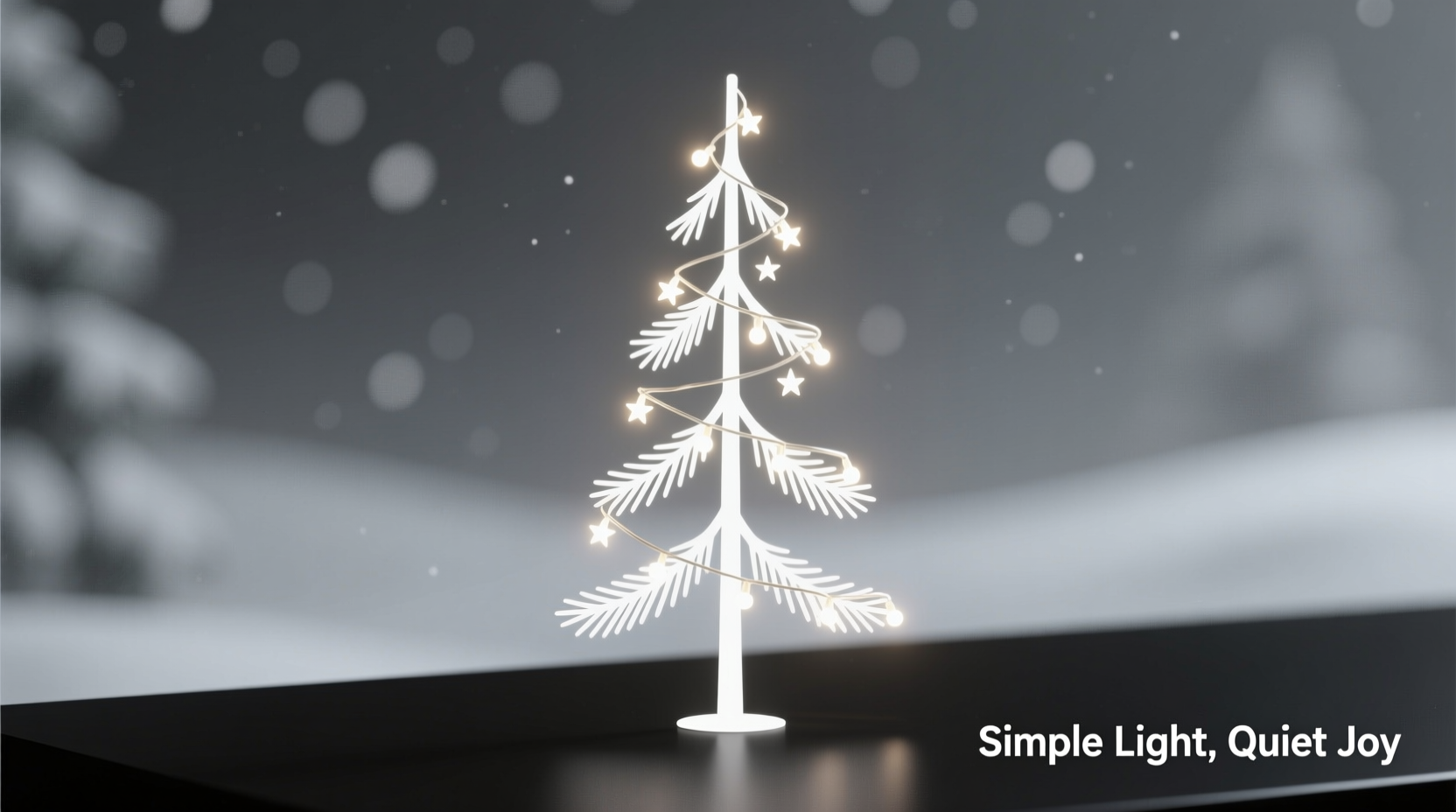
The LED string light tree succeeds because it answers three persistent modern constraints: spatial limitation, sustainability pressure, and aesthetic coherence. Unlike cut or potted trees, it requires zero floor space beneath it. Unlike artificial full-form trees, it generates no plastic waste at season’s end and avoids the visual weight of dense foliage. And unlike bare-bulb installations, it retains symbolic geometry—the upward taper, the layered silhouette, the centered focal point—that psychologically registers as “tree.” Interior designer Lena Park, who pioneered LED-only installations for The Modern Holiday Collective, observes:
“People don’t miss the branches—they miss the feeling of gathering under something luminous and intentional. When the light itself carries the shape, the ritual becomes more personal, not less.”This tree thrives in environments where scale matters: studio apartments under 400 sq ft, open-plan kitchens with limited vertical clearance, dorm rooms with fire-code restrictions, or minimalist Scandinavian or Japanese-inspired interiors where visual noise is actively curated out. It also excels for renters: no drilling, no adhesive residue, no assembly tools required.
Essential materials and smart selection criteria
Not all LED strings are equal for this application. Success hinges on deliberate component choices—not quantity, but quality and compatibility. Below is a comparative summary of key attributes:
| Feature | Ideal Specification | Why It Matters |
|---|---|---|
| Bulb Type | Warm white (2700K–3000K), non-dimmable or dimmable via remote | Cool white creates clinical glare; warm tones mimic candlelight and support cozy ambiance. Dimmability allows mood adjustment from daytime softness to evening glow. |
| Wire Gauge & Flexibility | Thin, highly flexible copper wire (24–26 AWG) with PVC or silicone coating | Rigid wires resist shaping; thick insulation adds bulk and limits tight spiraling. Silicone-coated wires withstand repeated coiling and hold form better over time. |
| Length per Strand | 10–25 meters (33–82 ft) | Shorter strands (<10 m) require splicing (not recommended); longer strands (>30 m) become unwieldy and prone to tangling during shaping. |
| Connection Method | End-to-end connectors rated for ≥3 strands in series (check manufacturer specs) | Most LED strings have voltage drop limitations. Exceeding the daisy-chain limit causes dimming or failure in later sections. Never assume “up to 10 strings” applies universally—verify per model. |
| Power Source | Low-voltage DC adapter (e.g., 12V or 24V) with UL/CE certification | Wall-plug AC adapters generate heat and hum; battery packs drain quickly and lack consistency. A certified DC supply ensures stable, quiet, cool operation for weeks. |
Recommended minimum: two 20-meter warm-white LED strings with memory wire cores (for shape retention) and IP44 rating (dust and splash resistance). Avoid multicolor or RGB strings unless you plan to use them exclusively in warm-white mode—color-shifting algorithms often interfere with consistent brightness and timing.
Step-by-step construction: From coil to conifer
This process takes 45–75 minutes, depending on experience and desired refinement. Work on a clean, uncluttered floor or large table. No ladder required.
- Pre-shape the core spiral: Starting from the plug end, gently coil the first LED string into a tight, flat spiral—about 15–20 cm (6–8 in) in diameter. Keep tension even; do not kink the wire. Secure the outermost loop with a single twist-tie (not tape—tape leaves residue). This forms the base “trunk ring.”
- Create the ascending cone: Uncoil the string gradually while lifting the center upward. With your free hand, begin forming concentric rings that rise and narrow—like stacking dinner plates tilted slightly inward. Each new ring should sit 8–10 cm (3–4 in) above the previous one and reduce in diameter by ~2 cm (0.8 in). Aim for 5–7 distinct horizontal planes. Use binder clips or removable clothespins to temporarily anchor rings to a vertical dowel (e.g., a 1.5-m wooden curtain rod) if needed for stability.
- Integrate the second strand: Begin the second string at the *topmost point* of the cone. Wind it downward in a continuous, gentle helix—crossing over each horizontal ring at a 30-degree angle. This adds depth, prevents “flat” appearance, and distributes light density evenly. Do not force tight turns; let the wire follow its natural flex. End the strand at the base ring, tucking the plug discreetly underneath.
- Refine symmetry and spacing: Step back. Observe from multiple angles. Gently adjust any ring that sags or protrudes. Use a ruler to verify vertical spacing consistency. If gaps appear between bulbs on the helix, loosen the helix slightly and reposition—never stretch the wire. Trim excess lead wire only after final shaping.
- Mount and secure: For wall mounting: attach two heavy-duty 3M Command™ Picture Hanging Strips (rated for 2.3 kg / 5 lbs each) to the back of the topmost ring and the midpoint ring. Press firmly for 30 seconds. For freestanding display: nest the entire structure inside a shallow, weighted ceramic bowl (≥20 cm diameter, ≥800 g weight). Tuck the power cord beneath the bowl’s rim and route it behind furniture.
This method yields a tree approximately 1.2–1.4 meters tall with organic taper and layered dimensionality—visually resonant, structurally self-supporting, and inherently scalable.
Real-world adaptation: A Brooklyn studio case study
Maria Chen, a graphic designer living in a 380-sq-ft Williamsburg studio, faced three constraints before last December: her lease prohibited permanent fixtures, her building banned live trees due to fire regulations, and her partner is allergic to pine resin. After discarding three pre-lit mini-trees (too plasticky, too bright, too “toy-like”), she adopted the LED-only method. Using two 15-meter warm-white micro-LED strings (0.8 cm bulb spacing) and a matte-black ceramic planter, she built a tree that stood 1.1 meters tall beside her sofa. She added tactile contrast by wrapping the base ring with undyed linen twine and placed a single brass star—no larger than a quarter—at the apex, held in place with museum wax. “It wasn’t about hiding the lights,” she notes. “It was about letting the light *be* the material. My neighbors thought it was custom-made. My cat ignored it completely—which, honestly, felt like the highest compliment.” Her tree remained lit 8 hours daily for 37 days without a single bulb failure. Total cost: $42. Setup time: 53 minutes.
Design refinements and subtle enhancements
The pure LED tree is complete on its own—but thoughtful additions deepen its resonance without violating minimalism. These are optional, not ornamental:
- Textural base layer: Place the tree atop a 30×30 cm slab of raw walnut, a folded oatmeal linen runner, or a smooth river stone. Avoid patterns or color; prioritize grain, weight, and tactility.
- Single-point accent: One object only—either at the apex (a tiny origami crane, a dried eucalyptus pod) or at the base (a vintage brass key, a smooth black basalt pebble). Size must be ≤5% of the tree’s height.
- Controlled ambient pairing: Pair with a single scent diffuser using cedarwood + clove (not cinnamon—too sweet) on low intermittent cycle. Light and scent should occupy the same sensory bandwidth: warm, dry, grounded.
- Light discipline: Program the LEDs to turn on at dusk and off at 11 p.m. Use a smart plug with geolocation—not a timer that ignores daylight shifts. Consistency reinforces ritual.
Avoid: garlands, ribbons, ornaments, tinsel, or secondary lighting sources. These reintroduce visual competition and dilute the form’s clarity. Minimalism here is not austerity—it’s precision.
Frequently asked questions
Can I use battery-powered LED strings?
Yes—but only high-capacity, rechargeable lithium-ion models (e.g., 2000+ mAh) with low-power consumption LEDs. Standard AA-battery sets deplete in 12–24 hours and introduce inconsistent voltage, causing flicker or premature dimming. Rechargeables add setup complexity (charging cycles, portability trade-offs) and rarely match the steady output of a quality DC adapter. Reserve batteries for temporary outdoor or travel use only.
How do I store it for next year without tangling?
Immediately after deconstruction: lay the tree flat. Loosen all rings fully. Coil each strand separately—starting from the plug end—into loose, 15-cm-diameter loops. Secure each coil with a fabric ribbon (not rubber bands, which degrade wire insulation). Store vertically in a rigid cardboard tube (e.g., a repurposed poster tube) lined with acid-free tissue. Never hang by the plug or compress under books. Proper storage preserves wire memory and prevents micro-fractures in solder joints.
Is this safe around children and pets?
Yes—when using certified low-voltage (≤24V DC) supplies and UL/CE-listed strings. Surface temperatures remain below 32°C (90°F) even after 12 hours of continuous operation. The absence of sharp branches, glass ornaments, or water reservoirs eliminates common hazards. That said, always route cords away from walkways and secure plugs to prevent tripping. For households with teething toddlers, add a 5-cm-wide band of soft cork tape around the base ring—provides grip and mild chew resistance.
Conclusion: Light as legacy
A minimalist Christmas tree made solely of LED string lights is more than décor—it’s a quiet assertion of values. It says: I honor tradition without replicating excess. I celebrate light without demanding sacrifice from forests or landfills. I create beauty through restraint, not accumulation. It asks nothing of the earth except electricity—and even that demand shrinks yearly as LED efficiency improves. This tree doesn’t gather dust in the attic for eleven months; it gathers meaning, moment by moment, as light falls across walls, reflects in windows, and settles on faces gathered nearby. Its power lies not in what it contains, but in what it omits: the noise, the clutter, the obligation to perform abundance. So unbox your strands. Feel the cool flexibility of the wire. Shape light into form. Let warmth rise—not from wattage alone, but from intention made visible. Your space, your rhythm, your quiet celebration awaits.




 浙公网安备
33010002000092号
浙公网安备
33010002000092号 浙B2-20120091-4
Comments
No comments yet. Why don't you start the discussion?