
Minimalist design isn’t about subtraction for its own sake—it’s about intentionality, clarity, and emotional resonance. When applied to holiday decor, it becomes a quiet act of resistance against seasonal overload: the tinsel, the plastic, the frantic accumulation of “more.” A Christmas tree made of lights alone strips away tradition’s scaffolding and reveals something essential: light as symbol, structure as suggestion, stillness as celebration. This approach works especially well in small apartments, modern lofts, rental units where drilling into walls is prohibited, or homes where allergies, pets, or young children make traditional trees impractical. It’s not a compromise. It’s a recalibration.
Creating this kind of tree demands more thought—not less—than buying a pre-lit artificial spruce. You’re designing a focal point without foliage, inviting attention through rhythm, scale, and restraint. The result isn’t “empty”; it’s distilled. It breathes. And when done well, it carries more presence than many full-grown firs.
Why Lights Alone Work—And Why They’re Often Overlooked
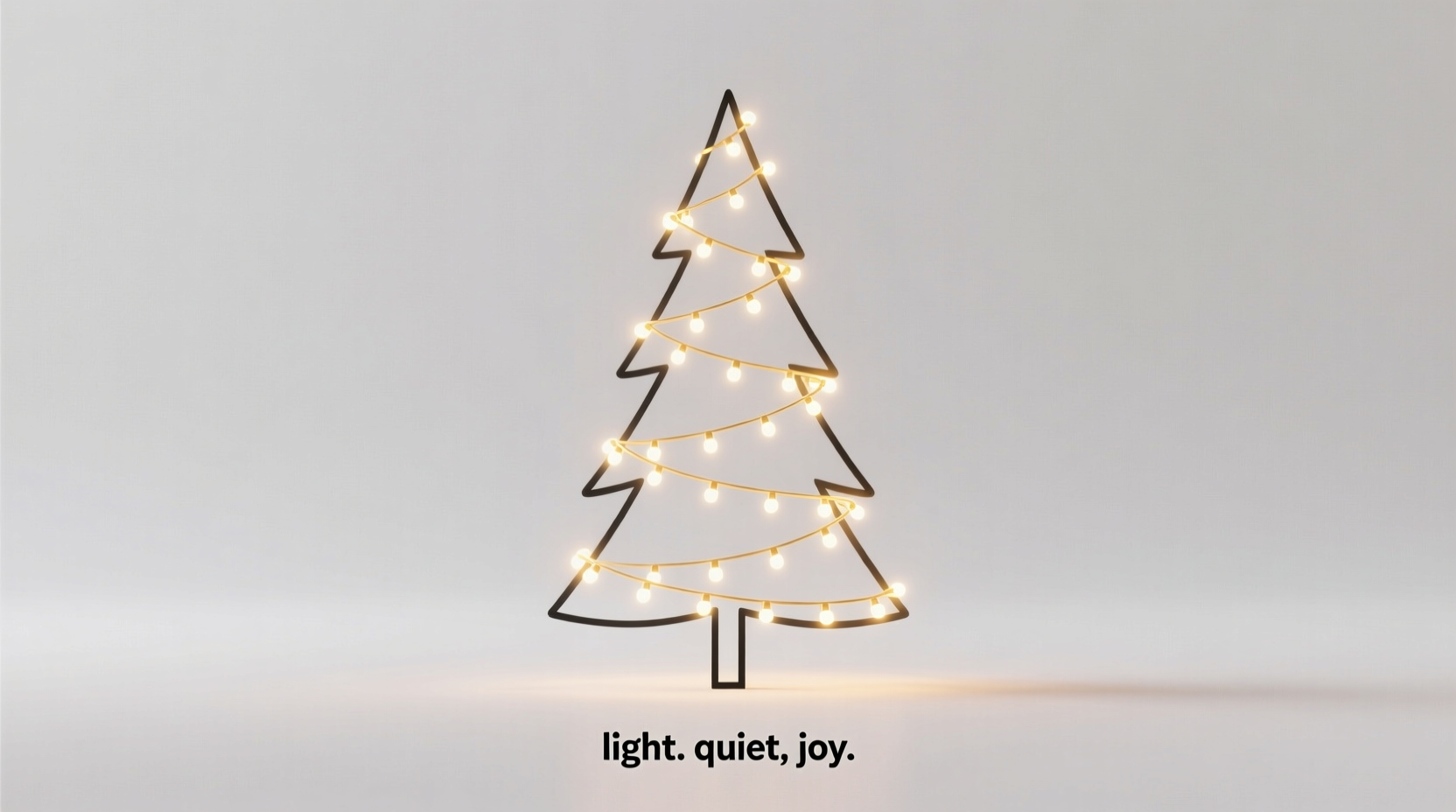
Most people assume a Christmas tree requires a trunk, branches, and volume. But the cultural archetype—the triangular silhouette crowned with a star—isn’t inherently tied to botanical form. It’s tied to light, hierarchy, and vertical aspiration. A cluster of warm-white fairy lights arranged in a gentle taper evokes that shape instinctively. Our peripheral vision reads height, symmetry, and upward movement long before our brain registers absence.
Neuroaesthetics research supports this: humans respond strongly to luminance contrast and rhythmic repetition. A vertical column of evenly spaced LEDs triggers the same visual satisfaction as a balanced evergreen—without triggering cognitive dissonance from mismatched textures or competing colors. Interior designer Lena Torres observed this firsthand while redesigning a downtown Toronto studio apartment: “The client had zero storage, a cat who climbed everything, and a deep aversion to pine needles. We installed 320 warm-white micro-LEDs on a custom brass rod frame. She cried the first time she turned them on—not because it looked like a ‘tree,’ but because it felt like coming home.”
“Light is the original ornament. Everything else is commentary.” — James R. Hargrove, Lighting Historian & Curator, Museum of Decorative Arts
Essential Materials & Strategic Selection Criteria
You don’t need specialty hardware—but you do need purpose-built components. Generic string lights fail here. Their uneven spacing, bulky plugs, inconsistent color temperature, and flimsy wire gauge undermine minimalism’s core promise: harmony.
| Component | Non-Negotiable Criteria | Why It Matters |
|---|---|---|
| LED String Lights | Warm white (2700K–2900K), 5mm or smaller bulbs, copper-wire base (not PVC-coated), 100+ bulbs per strand, dimmable | Cool white creates clinical glare; large bulbs break visual continuity; PVC wire sags and kinks; low bulb count exposes gaps; non-dimmable limits mood control. |
| Support Structure | Matte black or brushed brass pole (1.5–2m tall), 16–22mm diameter, wall-mounted or weighted floor base | Visible structure must recede visually. Glossy finishes reflect light distractingly. Thin poles lack gravitas; thick ones dominate. Wall-mounting eliminates floor clutter entirely. |
| Mounting Hardware | Low-profile adhesive hooks rated for 5kg+ per hook, or discreet toggle bolts for drywall | Traditional nails or screws leave permanent marks. Heavy-duty tape fails in humidity. Each attachment point must hold without visible strain. |
| Power Management | Single-outlet surge protector with built-in timer, UL-listed, cord length ≤1.8m | Multiple extension cords violate minimalism’s “one line” principle. Unshielded timers flicker. Excess cord creates visual noise and tripping risk. |
A Step-by-Step Assembly Process (No Tools Required)
This sequence prioritizes precision over speed. Rushing any step compromises the final serenity. Allow 90 minutes—even for experienced installers.
- Measure & Map Your Space: Stand where you’ll most often view the tree. Mark the ideal centerline on the wall (or floor) at eye level (1.5m). Use painter’s tape to outline a subtle triangle: base width = 60cm, height = 180cm. This is your visual envelope—not a rigid boundary, but a compositional guide.
- Prepare the Support Pole: Wipe down with isopropyl alcohol to remove oils. If using a wall-mounted pole, locate studs with a magnetic detector (not a knock-test). Mark drill points with pencil—centered on stud, 10cm below ceiling line. For floor stands, fill base with sand (not water) for silent, vibration-free stability.
- Wind Lights with Intentional Tension: Hold the pole vertically. Begin at the top. Wrap lights clockwise, maintaining 12cm vertical spacing between loops. Do *not* stretch the wire—let copper flex naturally. After each full wrap, pause and adjust adjacent loops so bulbs align horizontally. This creates optical continuity, not mechanical rigidity.
- Anchor & Conceal Connections: At the pole’s base, coil excess wire tightly into a 5cm disc. Secure with two wraps of matte-black fabric tape (not electrical tape—its sheen catches light). Route the power cord straight down the back of the pole, securing every 25cm with adhesive clips painted to match the pole’s finish.
- Final Calibration: Turn on lights at 30% brightness. Observe for 5 minutes. Adjust any misaligned bulbs by gently rotating their sockets—not pulling wires. Then increase to 60%. The goal is soft radiance, not brilliance. If the glow feels “busy,” reduce strand count by 20% and rewrap.
Real-World Case Study: The Brooklyn Micro-Apartment Tree
Mira Chen, a graphic designer living in a 380-square-foot Brooklyn walk-up, faced three constraints: no ceiling anchors permitted by her lease, a rescue terrier who chewed cords, and a lifelong dislike of “cluttered holidays.” She rejected all traditional tree options—not out of frugality, but principle. Her solution emerged after studying Japanese shibui aesthetics: understated elegance achieved through subtle imperfection.
Mira sourced twelve 100-bulb warm-white LED strands (2700K, 3mm bulbs, copper wire). Instead of a single pole, she used three matte-black aluminum rods (1.2m tall, 12mm diameter) arranged in a loose triangular formation—spaced 30cm apart, staggered in height by 5cm increments. She wrapped each rod individually with 400 bulbs, varying spacing slightly (11cm on left, 12cm center, 13cm right) to create gentle optical rhythm. Power ran through a single low-voltage transformer hidden inside a hollow ottoman.
The effect? Guests consistently described it as “a tree drawn in light.” No one questioned its legitimacy. Several asked where she’d hidden the branches. Mira’s insight: “When you stop trying to replicate nature, you start honoring light’s own architecture.” Her tree stayed up from December 1st to January 15th—uninterrupted, unobtrusive, and deeply personal.
Common Pitfalls & How to Avoid Them
Even with meticulous planning, subtle missteps can fracture minimalism’s calm. These aren’t failures—they’re refinements waiting to happen.
- Using Cool-White or Multicolor Lights: Cool white (4000K+) reads as clinical, even sterile. It evokes office lighting, not hearthlight. Multicolor variants introduce chromatic competition that defeats monochromatic focus. Stick to warm white—only.
- Overcrowding the Vertical Space: More bulbs ≠ more impact. Density beyond 8–10 bulbs per linear foot creates visual “noise” and washes out the taper. Trust negative space. Let the pole breathe between loops.
- Ignoring Ambient Light Sources: A minimalist light-tree competes poorly with overhead recessed LEDs or bright task lighting. Dim or turn off competing fixtures during evening hours. The tree should be the sole light source in its zone.
- Mounting Too High or Too Low: Center the brightest section at seated eye level (1.1–1.3m). Mounting higher makes it feel distant; lower makes it feel like a floor lamp. Height is psychological, not architectural.
- Skipping the Dimmer: Without dimming, you lose adaptability. Brightness should shift with time of day: 20% at dawn, 60% at dinner, 30% for late-night reading. A fixed intensity feels authoritarian, not serene.
FAQ
Can I use battery-operated lights for this?
Only if they meet all technical criteria (warm white, copper wire, consistent output) and last ≥72 hours on a single charge. Most battery sets dim unevenly over time or emit a faint hum—both violate minimalism’s demand for quiet reliability. Hardwired remains superior for permanence and control.
Won’t it look too sparse without ornaments or a topper?
That’s the point. Ornaments add narrative; this tree offers pure atmosphere. If you crave ritual, place a single object nearby: a smooth river stone, a vintage brass candle snuffer, or a framed black-and-white photo of winter trees. Let the light-tree serve as backdrop—not protagonist.
How do I store these lights without tangling?
Never wrap around cardboard or your hand. Instead: lay lights flat on a clean surface. Starting at the plug end, fold every 30cm into a loose “S” shape (like a gentle wave). Stack three S-folds into a 10cm square. Slide into a rigid, opaque box lined with acid-free tissue. Label clearly: “Tree Lights – Warm White – 2024.”
Conclusion: Light as Intentional Practice
A minimalist Christmas tree made of lights alone is more than decor—it’s a daily reminder that meaning resides not in accumulation, but in curation. It asks you to consider what truly belongs in your space, your time, your attention. There is no “right” number of bulbs, no universal height, no mandated color. There is only your relationship to light, silence, and the quiet confidence of saying: *this is enough.*
Start small. Choose one corner. Measure once. Wind slowly. Adjust patiently. Notice how the quality of your room changes—not just visually, but emotionally. You’ll find the absence of pine scent, the lack of tinsel glitter, the missing star topper doesn’t diminish the season. It clarifies it. The warmth you create isn’t generated by diodes alone. It rises from the decision to honor simplicity not as austerity, but as abundance—of calm, of clarity, of care.




 浙公网安备
33010002000092号
浙公网安备
33010002000092号 浙B2-20120091-4
Comments
No comments yet. Why don't you start the discussion?