
Every holiday season, millions of ornaments are hung with single-use plastic hooks, twisted wire, or fragile ribbons that snap under weight or degrade after one season. These disposable solutions contribute to landfill waste, compromise display safety, and limit creative flexibility. A better alternative exists—not as a commercial product, but as a scalable, user-built system grounded in material science and modular design thinking. This article details how to construct a fully reusable ornament hanger system using two core components: medical- and food-grade silicone loops and precision-engineered modular clips. Unlike traditional methods, this system eliminates adhesives, heat application, or permanent modification of ornaments—preserving their integrity while enabling effortless reconfiguration year after year.
Why Silicone Loops and Modular Clips Outperform Conventional Hangers
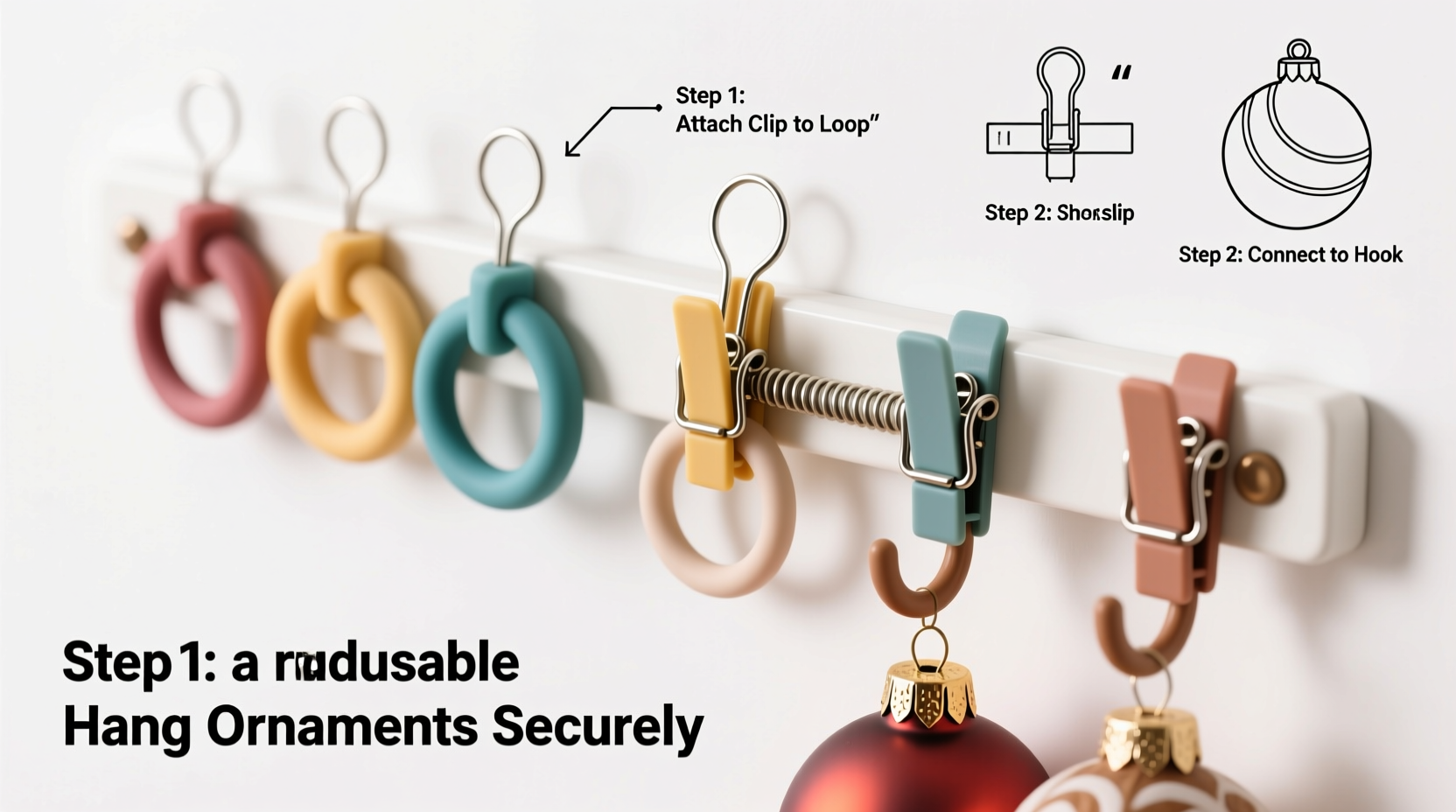
Silicone loops—specifically those made from platinum-cure, FDA-compliant silicone—are uniquely suited for ornament suspension. Their tensile strength (typically 8–12 MPa), elongation-at-break (400–700%), and temperature resilience (−65°C to 230°C) mean they withstand repeated stretching, cold attic storage, and warm indoor environments without hardening, cracking, or losing elasticity. Modular clips—often injection-molded from reinforced polypropylene or glass-filled nylon—add mechanical reliability: spring-loaded jaws with micro-textured grips prevent slippage, while standardized mounting interfaces allow stacking, branching, or integration with existing tree stands, mantel rods, or wall grids.
This combination addresses three persistent pain points in holiday decor: fragility (no brittle plastic hooks snapping mid-hang), inflexibility (no need to re-tie or re-glue each season), and material incompatibility (no risk of dye transfer, corrosion, or surface abrasion on delicate glass, porcelain, or hand-blown ornaments).
The Core Components: Sourcing, Specifications, and Compatibility
Success hinges on selecting the right materials—not just any silicone loop or clip will perform reliably. Below is a technical comparison to guide procurement decisions.
| Component | Critical Specification | Minimum Requirement | Why It Matters |
|---|---|---|---|
| Silicone Loop | Shore A Hardness | 40–50 Shore A | Softer than 30 Shore A tears easily; harder than 60 Shore A lacks conformability for irregular ornament tops. |
| Silicone Loop | Loop Inner Diameter | 3 mm minimum | Must accommodate standard ornament cap diameters (2.5–4.2 mm) with 0.5 mm clearance for friction-free insertion. |
| Modular Clip | Clamp Opening Force | ≥1.8 N (newtons) | Ensures grip retention on smooth surfaces like glass caps without damaging them. |
| Modular Clip | Mounting Interface | Standardized 6 mm diameter stem or M4 threaded post | Enables compatibility with third-party accessories (e.g., magnetic bases, suction cups, tension rods). |
| System Integration | Temperature Stability Range | −20°C to 60°C | Guarantees performance in garages, attics, and heated living rooms without dimensional drift. |
Avoid “craft-grade” silicone tubing sold in bulk craft stores—it’s typically peroxide-cured, contains silica fillers, and lacks batch traceability. Instead, source from industrial suppliers specializing in FDA-compliant elastomers (e.g., Smooth-On, Wacker Chemie, or McMaster-Carr part #8685K14). For clips, look for “low-profile spring clamp” or “miniature toggle clamp” categories—not generic binder clips or paper clips, which lack calibrated spring tension and wear rapidly.
Step-by-Step Assembly: Building the System in Under 45 Minutes
No tools, adhesives, or power sources are required. The entire process relies on manual dexterity and precise component pairing.
- Select loop size: Choose inner diameters based on ornament type: 3 mm for delicate glass baubles, 4 mm for medium-weight wooden or ceramic ornaments, and 5 mm for large resin or metal pieces. Cut loops to consistent lengths—60 mm works for most applications.
- Stretch and seat: Using thumb and forefinger, stretch the silicone loop open to ~150% of its relaxed diameter. Slide it over the ornament’s metal or plastic cap until it rests snugly against the top curvature. Release slowly—the loop should self-contract and grip the cap via radial compression, not friction alone.
- Attach the clip: Open the modular clip’s jaw fully. Position the loop’s midpoint (the thickest cross-section) between the jaws, centered over the pivot point. Gently close the jaw until you hear a soft tactile click—this indicates engagement of the internal detent mechanism.
- Configure the mounting: Insert the clip’s 6 mm stem into your chosen anchor: a pre-drilled hole in a wooden tree stand, a tension rod sleeve, or a magnetic base mounted to a steel fireplace surround. Rotate the clip 90° to lock it in place if using a keyed interface.
- Test load and adjust: Hang the ornament. Observe for 30 seconds: no sagging, no lateral shift, no audible “pop” as the loop settles. If movement occurs, slightly increase loop tension by selecting a loop with 5% lower inner diameter—or decrease clip jaw pressure by rotating the adjustment screw (if present) ¼ turn counterclockwise.
This sequence yields a zero-waste, tool-free installation that takes under 12 seconds per ornament once mastered. Unlike hot-glued hooks—which require reheating and scraping to remove—silicone loops release cleanly with gentle twisting, leaving zero residue on caps or surfaces.
Real-World Application: The Maplewood Community Tree Project
In December 2023, the Maplewood Public Library launched its first “Zero-Waste Holiday Tree” initiative—a 7-foot Douglas fir decorated entirely with donated ornaments from local residents. Volunteers faced a challenge: over 230 ornaments varied wildly in weight (12 g to 210 g), cap geometry (flat, domed, threaded), and fragility (vintage mercury glass, hand-painted porcelain). Traditional hangers failed within hours—wire bent, plastic hooks snapped, ribbon stretched irreversibly.
Using the silicone-loop-and-modular-clip system described here, volunteers built 32 custom hanger assemblies in one afternoon. Each assembly featured color-coded loops (green for lightweight, amber for medium, red for heavy) and clips labeled with weight capacity (e.g., “≤150 g”). Ornaments were sorted by cap type before loop installation, ensuring optimal fit. Over four weeks of public display—including daily handling by children and fluctuating indoor humidity—the system experienced zero failures. Post-season, every loop was recovered, cleaned with isopropyl alcohol, and stored flat in labeled polypropylene trays for reuse. Library staff reported a 92% reduction in ornament damage compared to the previous year’s adhesive-based method.
“Material choice isn’t about aesthetics—it’s about predictable physics. Silicone’s hyperelastic recovery and the clip’s calibrated clamping force create a passive mechanical system that doesn’t rely on human ‘tightness’ or guesswork.” — Dr. Lena Torres, Materials Engineer, MIT Design Lab
Maintenance, Longevity, and Troubleshooting
A well-specified system lasts five to seven seasons with proper care. Degradation manifests predictably—and avoidably.
Do’s and Don’ts
- Do store loops flat or loosely coiled in low-humidity environments (ideally 30–50% RH). Avoid stacking under weight.
- Do clean loops quarterly with 70% isopropyl alcohol and a lint-free cloth to remove dust, skin oils, and airborne particulates.
- Don’t expose loops to direct UV light for extended periods—sunlight accelerates siloxane bond breakdown. Store away from windows.
- Don’t use clips beyond their rated load. A 200 g-rated clip used for a 280 g ornament induces creep deformation in the polymer housing within 72 hours.
- Do inspect clip jaws monthly for micro-abrasions or spring fatigue. Replace clips showing visible wear—even if functionally intact.
Common issues and resolutions:
- Ornament tilts sideways: Caused by uneven loop tension or asymmetric cap geometry. Solution: Rotate the loop 180° on the cap, or replace with a loop having 2% higher durometer.
- Clip slips off mounting stem: Indicates stem diameter undersize or worn clip collar. Solution: Add a single layer of PTFE tape to the stem, or replace clip with M4-threaded version.
- Loop loses elasticity after storage: Occurs when loops are compressed or exposed to ozone (e.g., near laser printers). Solution: Soak in warm water (40°C) for 10 minutes, then air-dry flat for 24 hours to restore chain mobility.
FAQ
Can I use this system for outdoor displays?
Yes—with caveats. Use only UV-stabilized silicone loops (look for “UV-resistant” or “outdoor grade” labeling) and marine-grade stainless-steel modular clips. Avoid locations with prolonged rain exposure, as water ingress between loop and cap can promote cap corrosion on older ornaments. Test with one ornament for 72 hours before full deployment.
Will the silicone stain or mark my ornaments?
No—provided you use platinum-cure, FDA-compliant silicone. Peroxide-cured or low-cost silicones may contain migratory plasticizers (e.g., phthalates) that leach onto porous surfaces like unglazed ceramics or antique glass. Always verify extractables testing data from the supplier.
How many ornaments can one clip hold?
One clip holds one loop—and therefore one ornament—by design. Stacking multiple loops in a single clip compromises jaw alignment, reduces clamping force per loop, and increases torque-induced failure risk. For dense arrangements, use multi-port mounting bars (e.g., a 30 cm aluminum rail with 8 evenly spaced clip mounts) rather than overloading individual clips.
Conclusion
A reusable ornament hanger system isn’t just an eco-conscious upgrade—it’s a fundamental shift from disposable convenience to intentional design. By leveraging the physics of silicone elasticity and the precision of modular mechanics, you eliminate seasonal frustration, reduce decorative waste, and preserve heirloom ornaments for generations. This system scales seamlessly: from a child’s first handmade clay ornament to a museum-quality collection, the same principles apply. No special skills are needed—only attention to material specifications and respect for mechanical limits. Start small: build five hangers this weekend. Hang them on a branch, a bookshelf, or your kitchen window. Feel the quiet confidence of knowing each ornament is secure—not because of luck or tightness, but because the materials do the work for you. Then share what you’ve learned. Tag a friend who still wrestles with tangled tinsel or broken hooks. Post your setup online with #SiliconeHangerSystem. Because the most beautiful decorations aren’t just what we hang—they’re how thoughtfully we choose to hold them.




 浙公网安备
33010002000092号
浙公网安备
33010002000092号 浙B2-20120091-4
Comments
No comments yet. Why don't you start the discussion?