
Christmas trees are among the most beloved symbols of the season—but also one of its most ecologically fraught traditions. Over 35 million real trees are cut annually in the U.S. alone, many ending up in landfills where they emit methane as they decompose. Artificial trees, while reusable, are typically made from non-recyclable PVC and petroleum-based plastics, with an average lifespan of only six years before being discarded. For those committed to reducing holiday waste—not just trimming it—the solution isn’t about choosing between “real” or “fake.” It’s about reimagining what a tree *is*. A zero-waste Christmas tree built from reclaimed wood and living plants merges structural integrity with regenerative design: it stands for weeks, supports seasonal greenery, and, when the season ends, returns fully to the earth—or continues thriving indoors year after year. This isn’t a compromise. It’s an upgrade.
Why Zero-Waste Trees Matter Beyond the Holidays
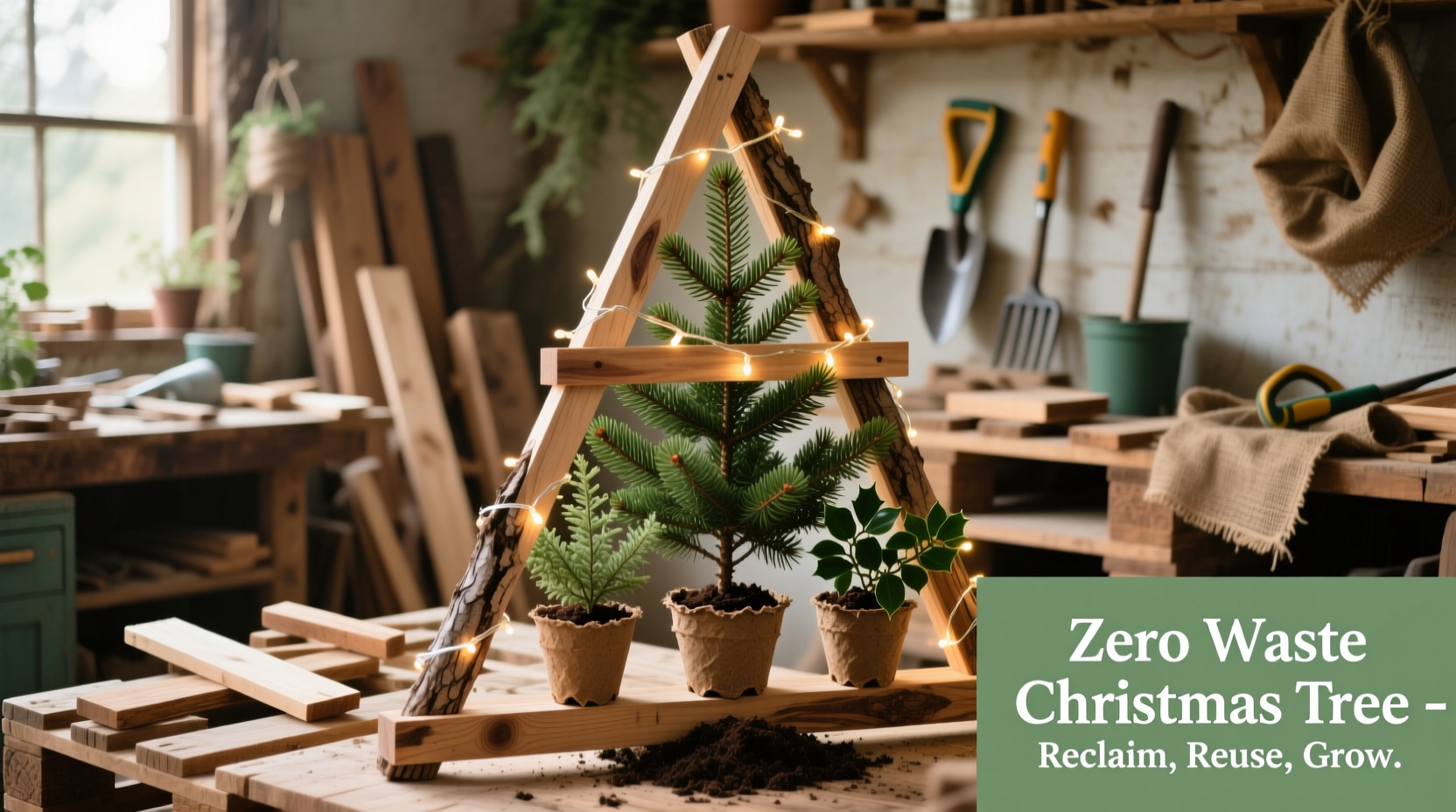
A zero-waste Christmas tree is more than a festive statement—it’s a functional rejection of linear consumption. Unlike conventional options, it avoids extraction (no felling mature evergreens), manufacturing emissions (no plastic molding or shipping containers full of synthetic trees), and end-of-life waste (no landfill-bound branches or unrecyclable components). Instead, it operates within circular principles: materials are salvaged, repurposed, or grown; structure is durable but repairable; plant elements are either perennial, edible, or compostable. According to Dr. Lena Torres, environmental designer and author of *Regenerative Holiday Design*, “The most sustainable tree isn’t the one you buy—it’s the one you co-create with materials already in circulation and life already present in your environment. That shift—from consumer to steward—is where real impact begins.”
“The most sustainable tree isn’t the one you buy—it’s the one you co-create with materials already in circulation and life already present in your environment.” — Dr. Lena Torres, Environmental Designer
This approach also fosters deeper seasonal connection. Tending to living branches, pruning herbs for garlands, or sanding reclaimed oak planks grounds the holiday ritual in tangible care—not passive consumption. And because every element is chosen intentionally, the resulting tree carries narrative weight: the pine boughs were gathered during a November walk; the base was milled from a fallen maple in a neighbor’s yard; the moss was harvested sustainably from a local forest floor (with permission and ethical guidelines). That story becomes part of the celebration.
Material Sourcing: Ethical Reclamation & Living Plant Selection
Building a zero-waste tree starts not with tools, but with ethics. Every material must meet two criteria: it must have already entered the human lifecycle (i.e., be reclaimed, salvaged, or secondhand), and it must be biodegradable, reusable, or perennial at end-of-life. No virgin timber. No dyed or treated lumber. No invasive species.
Reclaimed Wood Options:
- Flooring planks: Hardwood flooring removed during renovations offers consistent thickness and rich patina. Sand lightly to remove old finish—never strip with chemical removers.
- Old pallets: Only use heat-stamped “HT” (heat-treated) pallets—not “MB” (methyl bromide). Disassemble carefully; sand edges thoroughly to prevent splinters.
- Storm-damaged limbs: Fallen branches over 4 inches in diameter can be milled into sturdy cross-sections for the base or vertical supports.
- Salvaged beams: From deconstructed barns or warehouses—often dense, stable, and full of character.
Living Plant Selection: Prioritize hardy, low-maintenance, non-invasive species that thrive indoors for 4–6 weeks. Avoid cut conifers unless sourced from local tree farms practicing “cut-and-replant” stewardship (where each harvested tree is replaced with two saplings). Instead, choose living elements:
- Topiary boxwood or yew: Potted, slow-growing evergreens that tolerate indoor conditions and can be planted outdoors post-holiday.
- Rosemary: Grown upright in a pot, it naturally resembles a slender conifer and releases fragrance when brushed. Edible and drought-tolerant.
- Bay laurel: Dense, glossy leaves; grows well in containers and can be pruned into pyramidal forms.
- Ivy (Hedera helix): Use trained vines on a trellis frame—ideal for vertical greenery without bulk.
- Living mosses (e.g., sheet moss or cushion moss): Harvested ethically from forest floors (with landowner permission and only surface layers), then rehydrated and pressed onto wood bases.
The Step-by-Step Build: From Frame to Flourish
Constructing the tree takes approximately 4–6 hours across two sessions (framing + planting). No power tools required—though a hand drill and clamps simplify assembly. All fasteners must be reusable (stainless steel screws) or fully compostable (wood dowels, hemp twine).
- Design & Dimensions: Sketch a simple triangular silhouette (e.g., 60\" tall × 30\" wide at base). Decide whether the frame will be freestanding (heavier base) or wall-mounted (lighter, with French cleat).
- Prepare the Base: Cut three reclaimed wood pieces: one 18\" × 18\" square (bottom plate), two 12\" × 2\" × 1\" braces (angled at 30°). Drill pilot holes, join with dowels or screws, and seal with food-grade walnut oil (not polyurethane).
- Build the Trunk & Branch Supports: Use a single 1.5\" × 1.5\" × 60\" reclaimed hardwood post for the central trunk. Attach horizontal branch arms (12\", 18\", 24\" lengths) at staggered heights using mortise-and-tenon joints or recessed stainless-steel brackets. Sand all surfaces smooth.
- Install Living Elements: Drill shallow, angled holes (3/8\" diameter, 1\" deep) along each arm to hold potted plants. Secure pots with removable cork gaskets or felt pads to prevent slipping. For moss or ivy, apply a thin layer of natural wheat-paste adhesive (flour + water, boiled 2 minutes) before pressing into place.
- Final Greening & Embellishment: Nestle rosemary or bay topiaries into arm slots. Drape ivy vines down the trunk. Tuck sprigs of holly (from your own shrub, pruned responsibly) or dried eucalyptus between branches. Decorate with handmade ornaments: beeswax-dipped pinecones, cinnamon stick stars, or woven willow balls.
Once assembled, position near a south-facing window. Rotate the tree ¼ turn every 2 days to encourage even growth. Water potted plants at soil level—never overhead—to prevent mold on wood surfaces. Mist moss daily with rainwater or filtered water.
Zero-Waste Care & End-of-Season Transition
A zero-waste tree’s value extends far beyond December 25th. Its true sustainability lies in how it transitions out of the holiday role—without generating waste or requiring disposal.
| Element | Post-Holiday Action | Environmental Outcome |
|---|---|---|
| Reclaimed wood frame | Disassemble, sand, and store for next year. Replace worn dowels; refinish with oil if needed. | Reusable indefinitely; carbon footprint amortized over decades. |
| Potted rosemary/bay | Move to a cool garage for dormancy (4°C), then transplant outdoors in spring or keep as kitchen herb. | Lives for 15+ years; sequesters carbon; provides food. |
| Moss panels | Remove, dry flat, and crumble into garden compost or use as seed-starting medium. | Returns nutrients to soil; no synthetic residue. |
| Hemp twine & cork gaskets | Compost in home bin (breaks down in 6–8 weeks). | Completes nutrient cycle; no microplastics. |
| Dried eucalyptus/holly | Bundle and hang for potpourri, or add to compost pile. | 100% biodegradable; adds carbon-rich “brown” matter. |
This transition plan eliminates landfill contribution entirely—and creates continuity. The same rosemary that graced your tree’s upper third may flavor your January soups. The oak base may become a planter stand by March. Nothing is lost; everything evolves.
Real-World Example: The Portland Community Tree Project
In December 2023, the Portland Urban Forestry Collective launched its first neighborhood-scale zero-waste tree initiative in the Alberta Arts District. Using storm-fallen bigleaf maple from a city-maintained park, volunteers milled 12 identical trunk sections and assembled them into modular frames. Local nurseries donated potted dwarf Alberta spruce and rosemary topiaries. Residents contributed hand-knit wool garlands and beeswax ornaments. The trees stood in front of 12 small businesses for four weeks, each decorated with hyperlocal themes—e.g., a coffee roaster’s tree featured roasted coffee bean “ornaments” sealed in edible rice paper.
After New Year’s, every component was accounted for: wood frames were stored at the community workshop; 10 of 12 spruce trees were adopted by residents for backyard planting; rosemary went to school gardens; moss was composted at the city’s municipal facility. Not a single item entered the waste stream. More importantly, participation tripled year-over-year—not because it was easier, but because people reported feeling *more* connected to the season through the act of collective making. As project lead Maya Chen observed, “We stopped asking ‘What do we need to buy?’ and started asking ‘What do we already have—and who can help us grow it?’ That question changed everything.”
Frequently Asked Questions
Can I build this if I’ve never used tools before?
Yes. Start with a simplified version: use a single 2×4 scrap as the trunk, mount it vertically on a heavy stone base with epoxy, and attach three pre-drilled shelf brackets as branch arms. All hardware is available at hardware stores with instructions. Many community tool libraries offer free beginner workshops on safe hand-tool use.
Won’t the living plants die indoors?
Not if selected and cared for appropriately. Rosemary, bay, and boxwood tolerate indoor light and temperature for 4–6 weeks. Key practices: avoid drafty spots or heat vents, rotate daily, water only when the top inch of soil is dry, and mist foliage morning and evening. If leaves yellow, move closer to natural light—not brighter artificial light.
Is reclaimed wood safe for indoor use?
Yes—if properly vetted. Avoid painted, stained, or laminated woods unless you can verify non-toxic finishes (e.g., milk paint, linseed oil). Steer clear of railroad ties (creosote), telephone poles (pentachlorophenol), or anything with visible mold or insect damage. When in doubt, test a small piece outdoors for two weeks: if no odor develops and no dust forms when sanded, it’s likely safe.
Conclusion: Your Tree Is the First Branch of a New Tradition
A zero-waste Christmas tree isn’t about austerity or sacrifice. It’s about intentionality—choosing depth over disposability, collaboration over consumption, and growth over gloss. It asks you to see abundance where others see waste: in the discarded beam, the pruned rosemary stem, the moss clinging to a shaded rock. It invites neighbors to share tools and cuttings, children to water the bay topiary each morning, elders to tell stories as they wind twine around a branch arm. This tree doesn’t mark the end of a season—it marks the beginning of a practice. One that honors the materials that hold us, the plants that breathe for us, and the communities that sustain us. You don’t need perfection to begin. You need only one reclaimed plank, one living cutting, and the quiet certainty that how you celebrate matters—not just for this December, but for all the Decembers yet to come.




 浙公网安备
33010002000092号
浙公网安备
33010002000092号 浙B2-20120091-4
Comments
No comments yet. Why don't you start the discussion?