
Crafting an advertisement that captures attention and drives action is both an art and a science. In today’s crowded digital landscape, simply creating an ad isn’t enough—your message must resonate, persuade, and prompt immediate response. Whether you’re promoting a product, service, or brand, the difference between average performance and high conversion lies in strategic planning, audience insight, and persuasive execution. This guide breaks down the process into actionable steps, helping you build ads that don’t just get seen—they get results.
Understand Your Audience Deeply
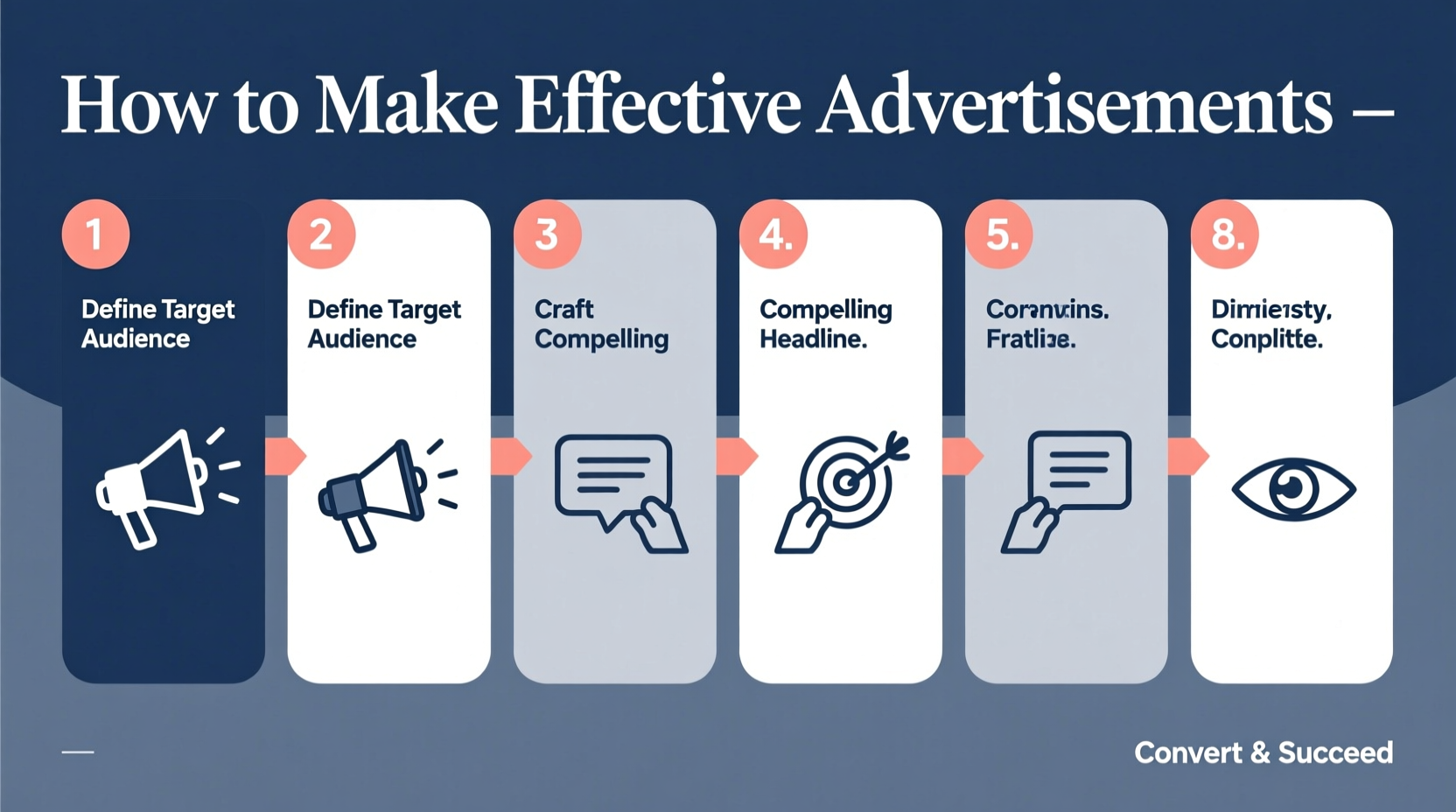
The foundation of any effective advertisement is a clear understanding of who you're speaking to. Without this, even the most creative copy can fall flat. Begin by defining your ideal customer profile: their demographics, pain points, desires, online behavior, and decision-making triggers.
Conduct market research through surveys, social listening, and competitor analysis. Use tools like Google Analytics, Facebook Audience Insights, or customer interviews to gather qualitative and quantitative data. The more specific your understanding, the more precisely you can tailor your messaging.
Define Clear Objectives and KPIs
Before writing a single word of copy, clarify what success looks like. Are you aiming for brand awareness, lead generation, direct sales, or app downloads? Each goal requires a different approach, tone, and call to action.
Set measurable key performance indicators (KPIs) such as click-through rate (CTR), cost per acquisition (CPA), conversion rate, or return on ad spend (ROAS). These metrics will guide your strategy and help evaluate performance objectively.
“An ad without a defined objective is like a ship without a rudder—it may move, but it won’t reach its destination.” — David Ogilvy, Advertising Legend
Step-by-Step Guide to Crafting High-Converting Ads
Creating an ad that converts follows a repeatable framework. Follow these seven steps to build compelling, results-driven campaigns:
- Research Competitor Ads: Analyze top-performing ads in your niche. Note their structure, value propositions, visuals (inferred), and emotional appeal.
- Identify a Unique Selling Proposition (USP): What makes your offer better or different? Focus on benefits, not just features.
- Write a Powerful Headline: Capture attention within 3 seconds. Use curiosity, urgency, or a bold promise.
- Clarify the Core Message: Keep it simple. One idea per ad. Avoid jargon and focus on customer outcomes.
- Include Social Proof: Mention testimonials, ratings, or number of customers served to build trust.
- Add a Strong Call to Action (CTA): Use action-oriented language: “Get Your Free Trial,” “Shop Now,” “Download Today.”
- Optimize for Platform & Format: Adapt tone and length for Facebook, Google Search, Instagram, or LinkedIn.
Real Example: How a SaaS Startup Increased Conversions by 70%
A B2B software company struggled with low engagement on their Google Ads. Their original ad read: “Cloud-based project management tool for teams.” It was accurate but uninspiring.
After audience research revealed that team leaders feared missed deadlines and communication gaps, they rewrote the ad: “Stop Missing Deadlines. Real-Time Project Tracking for Remote Teams. Start Free—No Credit Card Needed.”
They added specificity, addressed a pain point, included a risk-free offer, and used active language. Within four weeks, CTR increased by 52%, and conversions rose 70% with no change in budget.
Ad Copy Best Practices: Do’s and Don’ts
| Do’s | Don’ts |
|---|---|
| Focus on benefits (e.g., “Save 3 Hours a Week”) | Lead with technical features (e.g., “Uses AI-powered algorithms”) |
| Use power words: Free, Proven, Instant, Guaranteed | Use vague terms: Great, Awesome, Amazing |
| Include numbers and specifics (e.g., “Used by 10,000+ marketers”) | Make exaggerated claims without proof (“#1 Product Ever!”) |
| Test multiple CTAs (“Try It Free” vs. “See Pricing”) | Forget the CTA altogether |
| Align ad copy with landing page content | Create disconnect between ad promise and page experience |
Test, Measure, and Optimize Relentlessly
No ad is perfect on the first try. The most effective advertisers rely on continuous testing. A/B test one element at a time: headlines, CTAs, offers, or emotional tone.
Run split tests with two versions of an ad to see which performs better. Allocate at least 7–10 days per test to gather statistically significant data. Then scale the winner and iterate again.
Track performance across platforms and adjust bids, audiences, or creatives based on real-time feedback. Optimization isn’t a final step—it’s an ongoing process.
Checklist: Building a High-Performing Ad Campaign
- ✅ Define target audience and create detailed buyer personas
- ✅ Set a clear campaign objective (sales, leads, awareness)
- ✅ Research competitors’ top-performing ads
- ✅ Craft a unique value proposition (UVP)
- ✅ Write 3–5 headline variations using benefit-driven language
- ✅ Include a strong, action-oriented call to action
- ✅ Align ad copy with landing page messaging
- ✅ Launch A/B tests with one variable changed
- ✅ Monitor KPIs weekly and pause underperforming ads
- ✅ Scale winning ads and reinvest in top audiences
Frequently Asked Questions
How long should my ad copy be?
It depends on the platform and intent. Google Search ads perform best with concise, keyword-rich copy (under 90 characters for headlines). Facebook or LinkedIn ads can be slightly longer—up to 125 words—to tell a story. Always prioritize clarity over length.
Can I use the same ad across multiple platforms?
You can, but you shouldn’t. Each platform has a different user mindset. Instagram users respond to visual storytelling and lifestyle cues, while Google Search users are actively looking for solutions. Tailor tone, format, and message to fit each environment.
What makes an ad “convert” better than others?
Conversion-focused ads combine relevance, urgency, and credibility. They speak directly to a specific audience’s need, offer a clear next step, and reduce friction (e.g., free trials, guarantees). Emotional resonance often outperforms pure logic in driving action.
Final Thoughts: Turn Attention Into Action
Effective advertising doesn’t rely on luck or flashy design—it relies on strategy, empathy, and testing. Every word in your ad should serve a purpose: to grab attention, build interest, overcome objections, and drive action. By following a structured process—from audience research to continuous optimization—you position your brand to stand out in a noisy marketplace.
Great ads aren’t written in a day. They’re refined through data, feedback, and relentless improvement. Start small, test often, and let performance guide your decisions. The most successful campaigns aren’t born from inspiration alone—they’re built through disciplined execution.




 浙公网安备
33010002000092号
浙公网安备
33010002000092号 浙B2-20120091-4
Comments
No comments yet. Why don't you start the discussion?