
Making an international call used to mean navigating confusing dialing codes, unpredictable charges, and spotty audio quality. Today, technology has simplified the process, but many people still overpay or struggle with unreliable connections. Whether you're calling family abroad, coordinating with colleagues overseas, or traveling internationally, knowing the right method can save time, money, and frustration. This guide breaks down everything you need to know—from understanding country codes to choosing the most cost-effective tools—so your international calls are consistently clear and affordable.
Understanding the Basics of International Calling
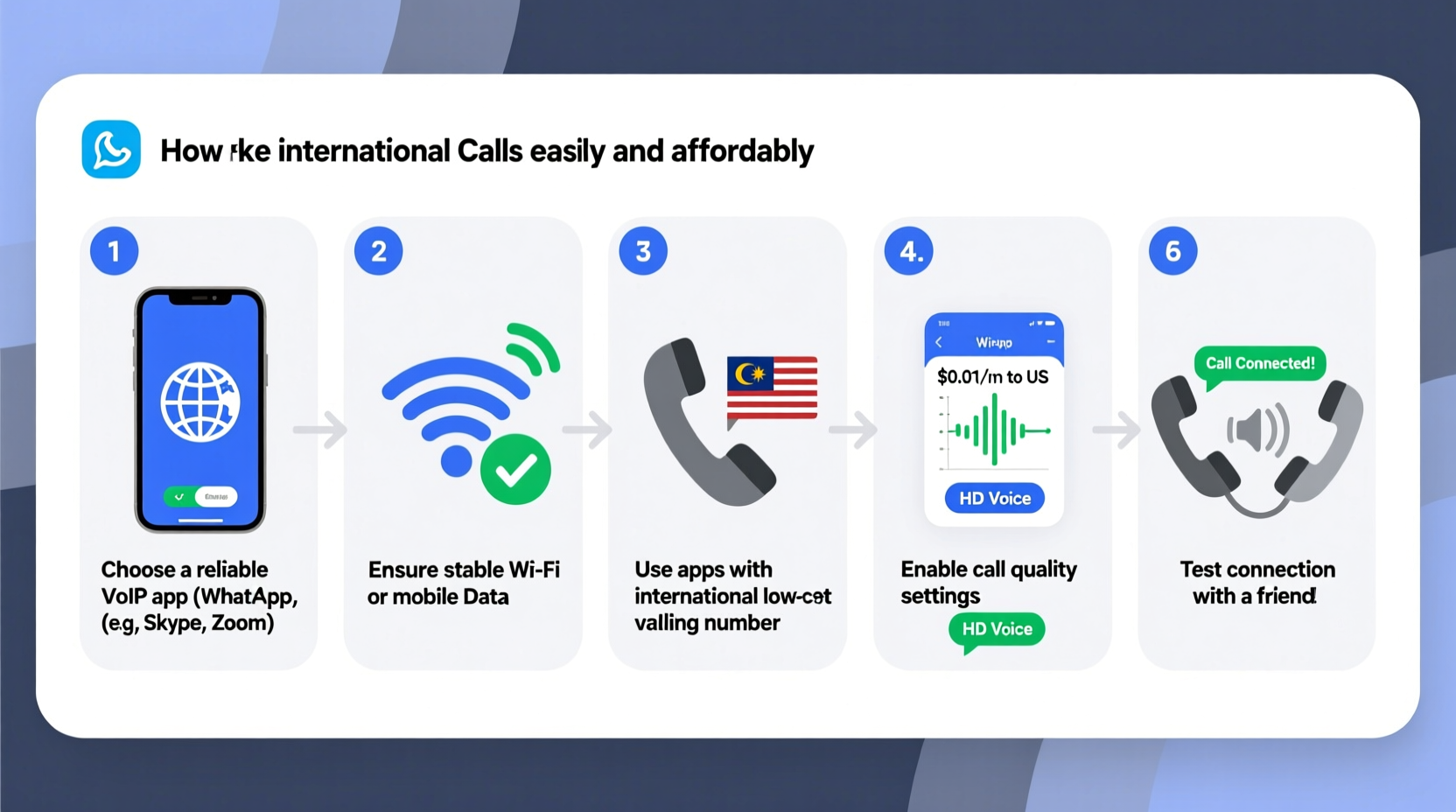
Before placing a call across borders, it’s essential to understand the structure of international phone numbers. Every country has a unique country code, which replaces the leading zero in local numbers. For example, the United States uses +1, the United Kingdom +44, and India +91. When dialing internationally, you must include this code after your exit code—the number that signals your phone carrier you’re making an outbound international call.
The most common exit codes are:
- + (plus sign): Universal format used on smartphones and VoIP services.
- 011: Used in the U.S. and Canada before the country code.
- 00: Used in most European and Asian countries.
For instance, to call London from New York, you’d dial: 011 44 20 XXXX XXXX—or simply +44 20 XXXX XXXX on a mobile device.
Step-by-Step Guide to Making an International Call
Follow these steps to ensure every international call connects smoothly and affordably:
- Verify the recipient’s full number, including area code and local number. Double-check for accuracy—especially if the number includes zeros that may or may not be included depending on context.
- Prefix with the \"+\" symbol followed by the destination country code. On mobile phones, long-press the \"0\" key to input \"+\" quickly.
- Remove any leading zeros from the area or city code. For example, when calling Paris (+33), omit the initial zero from the local number 01 XX XX XX XX, using only 1 XX XX XX XX after +33.
- Select your calling method: traditional carrier, VoIP app, or calling card—each with different costs and quality levels.
- Make the call and monitor connection quality. If audio is poor, consider switching to Wi-Fi or trying an alternative service.
This standardized approach works globally and reduces errors caused by regional dialing differences.
Choosing the Right Calling Method
Not all calling methods are created equal. The best choice depends on frequency, destination, budget, and internet access. Below is a comparison of the most common options:
| Method | Cost | Audio Quality | Best For |
|---|---|---|---|
| Traditional Carrier (Mobile/landline) | High ($1–$5/min) | Good | Occasional calls; no internet |
| VoIP Apps (WhatsApp, Skype, FaceTime) | Free or low-cost | Excellent (with stable internet) | Regular callers; smartphone users |
| International Calling Cards | Moderate ($0.05–$0.30/min) | Fair to good | Travelers; payphones |
| eSIM or Travel SIM with Roaming | Varies (data-dependent) | Good to excellent | Long-term travelers |
Voice over Internet Protocol (VoIP) services like WhatsApp, Google Voice, and Skype offer free or low-cost calling when both parties have internet access. These apps are ideal for frequent communication and often provide better clarity than traditional networks.
“Over 70% of international voice traffic now travels over IP networks. Consumers who switch from traditional carriers to VoIP save an average of 60% on monthly calling costs.” — Global Telecom Insights Report, 2023
Real-World Example: Maria’s Weekly Call to Manila
Maria lives in Toronto and calls her mother in Manila every Sunday. She used to rely on her mobile carrier, paying $3.50 per minute—adding up to nearly $90 a month. After researching alternatives, she switched to using WhatsApp over Wi-Fi. Her mother downloaded the app using a local café’s internet, and now they enjoy weekly video calls at no extra cost. Audio quality improved, and Maria eliminated a recurring expense without sacrificing connection reliability.
This shift required minimal effort: installing an app, verifying a number, and agreeing on a calling schedule. For Maria, the change was transformative—not just financially, but emotionally, as clearer calls strengthened their bond.
Affordability Tips and Common Pitfalls
Even small mistakes can lead to high charges or failed connections. Avoid these common issues:
- Forgetting to disable roaming: Without a data plan, using VoIP abroad can trigger expensive data fees.
- Dialing incorrect country codes: A single-digit error routes your call to the wrong country or fails entirely.
- Using hotel phones: Many hotels charge premium rates for international lines—sometimes over $5 per minute.
- Ignoring time zones: Calling at inconvenient hours disrupts relationships and reduces conversation quality.
Checklist: Preparing for an International Call
- ✅ Confirm the correct country and area code
- ✅ Save the contact with \"+\" prefix
- ✅ Choose the most cost-effective method (app, card, carrier)
- ✅ Connect to Wi-Fi if using VoIP
- ✅ Check the time difference
- ✅ Test microphone and speaker beforehand
- ✅ Have a backup method ready (e.g., SMS or email)
Frequently Asked Questions
Can I make international calls for free?
Yes, if both parties have internet access and compatible apps like WhatsApp, Facebook Messenger, Skype, or FaceTime (for Apple users). These services use data or Wi-Fi to transmit voice, eliminating per-minute charges. However, emergency calls and landline/mobile calls outside the app still incur fees unless covered by a specific plan.
Why does my international call keep dropping?
Frequent dropouts usually stem from unstable internet (for VoIP) or weak cellular signal. To fix this, try restarting your router, moving closer to the Wi-Fi source, or switching to airplane mode and re-enabling Wi-Fi. If using a traditional carrier, check for network congestion or temporary outages in either country.
Are there legal restrictions on international calling?
Some countries restrict or monitor VoIP services. For example, the UAE allows VoIP only through licensed providers, and North Korea bans most foreign calls. Always verify local regulations before relying on a specific app or service while traveling.
Final Thoughts: Stay Connected Without Breaking the Bank
Making international calls doesn’t have to be complicated or expensive. With the right knowledge and tools, anyone can maintain clear, consistent communication across continents. The key is preparation—understanding dialing formats, selecting affordable platforms, and avoiding common traps like roaming fees or incorrect numbers.
Technology has made global connectivity more accessible than ever. Whether you're sharing life updates with loved ones or managing cross-border business, taking control of how you call internationally empowers you to communicate confidently and affordably.




 浙公网安备
33010002000092号
浙公网安备
33010002000092号 浙B2-20120091-4
Comments
No comments yet. Why don't you start the discussion?