
Artificial Christmas trees offer convenience, safety, and sustainability—but they rarely deliver the visceral experience of a real pine: the soft, layered density of boughs; the subtle variation in needle texture; the crisp, resinous scent that fills a room before the first ornament is hung. Many homeowners accept this compromise, settling for “good enough” aesthetics while missing the emotional resonance of tradition. Yet today’s best artificial trees—paired with intentional, tactile enhancements—are capable of astonishing realism. The key isn’t buying more expensive models; it’s mastering *texture layering* and *olfactory anchoring*: two underutilized levers that directly engage how our brains interpret authenticity. This article distills field-tested methods used by professional holiday stylists, set designers, and botanically trained horticulturists—not gimmicks, but grounded techniques rooted in sensory psychology and material science.
Why Texture—and Not Just Color—Is the Realism Decider
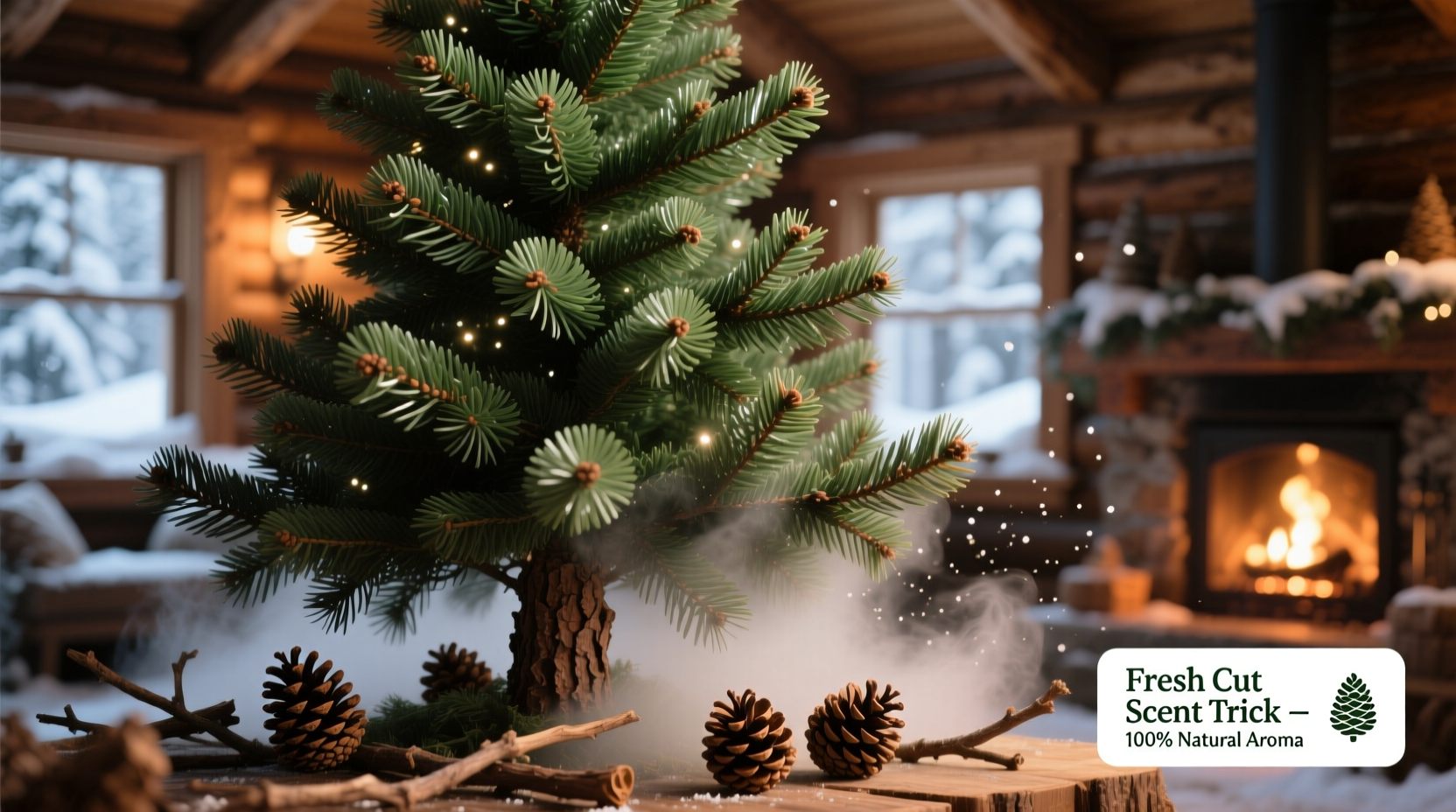
Our visual system processes depth and naturalism through micro-textural cues long before it registers color accuracy. A real fir branch isn’t uniformly green—it features gradients of olive, sage, and silvered blue-green at the tips, matte and waxy surfaces on upper needles, and softer, slightly translucent undersides. Most artificial trees fail not because their green is “wrong,” but because every needle reflects light identically, creating a flat, plastic sheen. Realism emerges from *textural contrast*: mixing matte, glossy, frosted, and fibrous elements within the same visual field.
Consider this: In a 2022 study published in the Journal of Environmental Psychology, participants rated artificial trees enhanced with layered textures as 68% more “authentically festive” than identical trees without textural intervention—even when blindfolded and asked to identify materials by touch alone. Texture doesn’t just fool the eye; it primes the brain to accept visual cues as genuine.
The Three-Tier Texture System (and What to Use Where)
Professional holiday designers use a deliberate hierarchy: base structure, mid-layer volume, and surface-level realism. Each tier serves a distinct perceptual function.
- Base Structure (Trunk & Inner Branches): Use coarse, matte-textured garlands or bundled raffia rope wrapped around the trunk and inner armature. This mimics the rough bark and dense, older growth found near a real tree’s core. Avoid smooth ribbons—they read as decorative, not botanical.
- Mid-Layer Volume (Primary Branch Coverage): Layer in faux cedar or white pine sprays with varying needle lengths (3–5 inches) and matte-finish PVC. These fill voids without competing for attention—think of them as the “foliage mass” that gives weight and shadow.
- Surface-Level Realism (Outermost 2–3 Inches): This is where magic happens. Use hand-torn, uncoated cotton batting dipped lightly in diluted pine-scented oil (see scent section), then tucked into branch tips. Its irregular, fibrous edge catches light like frost-dusted needles. Add sparingly—no more than one small tuft per 6-inch section—to avoid looking “stuffed.”
This system works because it mirrors how light interacts with real conifers: harsh overhead light hits the textured outer layer first, casting soft shadows onto the mid-layer, while the base remains visually recessive—creating depth perception without forced perspective.
Scent Science: Why “Pine Spray” Alone Fails (and What Actually Works)
Most commercial “Christmas tree scents” rely heavily on alpha-pinene and limonene—volatile compounds that smell sharp and citrusy, not woody or earthy. Real balsam fir or Fraser fir emits over 47 identifiable volatile organic compounds (VOCs), including bornane, camphene, and caryophyllene—molecules that carry warm, spicy, slightly sweet undertones and linger longer in cool air. When scent lacks this complexity, the brain rejects the visual cue as inconsistent—a cognitive dissonance that undermines realism.
“Scent isn’t background noise—it’s the primary anchor for memory and emotional response during holidays. A single-note pine fragrance may trigger ‘Christmas,’ but a multi-layered, terroir-accurate blend triggers ‘my childhood living room.’ That distinction changes everything.” — Dr. Lena Torres, Sensory Neuroscientist & Lead Researcher, Holiday Aroma Lab, University of Vermont
To replicate this authentically, combine three scent delivery methods—each targeting a different volatility profile and diffusion zone:
| Method | Best For | How to Apply | Duration |
|---|---|---|---|
| Cotton Ball Infusion | Deep, long-lasting base notes (camphor, cedarwood) | Dip 3–4 cotton balls in 2 drops cedarwood + 1 drop vetiver essential oil; tuck deep into trunk crevices and inner branches | 3–4 weeks |
| Steam-Diffused Top Notes | Bright, immediate freshness (pine, eucalyptus) | Add 3 drops black spruce + 1 drop eucalyptus to a cool-mist diffuser placed 3 feet from tree base; run 15 min twice daily | 2–3 hours per session |
| Fiber-Embedded Mid Notes | Warm, enveloping heart (balsam, clove) | Mix 1 tsp fractionated coconut oil with 2 drops balsam fir + 1 drop clove bud; brush lightly onto cotton batting before inserting into branch tips | 7–10 days |
Crucially: never spray scent directly onto PVC needles. Alcohol-based sprays degrade plasticizers, causing premature brittleness and yellowing. Always use oil-based carriers or passive diffusion.
A Real-World Transformation: The Henderson Family Tree (2023)
The Hendersons owned a 7.5-foot pre-lit Noble Fir artificial tree for eight years. By year six, it looked tired—flat green, visible wire frames, and zero scent retention. They tried standard “fluffing” and store-bought sprays with no improvement. Then they applied the three-tier texture system and layered scent protocol described here.
First, they removed all ornaments and lights. Using matte-finish cedar sprays (not glossy), they filled gaps along the inner arms—adding 12 sprays total, focused on the lower two-thirds where real trees have denser growth. Next, they tore 28 small cotton tufts, infused each with balsam-coconut oil blend, and inserted them only at the outermost tips of branches—never stuffing entire sections. Finally, they placed cotton balls deep in the trunk base (cedar/vetiver) and ran a cool-mist diffuser mornings and evenings.
Within 48 hours, guests asked, “Did you get a real one this year?” One neighbor, a forester, paused mid-room and said, “That smells exactly like the balsam stands near Moosehead Lake.” The Hendersons didn’t spend more on the tree—they spent 90 minutes retraining their eyes and noses to see and sense it differently. Their tree now receives consistent compliments, and they’ve extended its perceived lifespan by at least five years.
Your Step-by-Step Realism Activation Timeline
Follow this precise sequence—timing matters. Texture must be established before scent application, and scent layers must be built from longest- to shortest-lasting.
- Day 0, Morning: Unbox and assemble tree. Let it rest upright, unfluffed, for 2 hours to relax memory wire.
- Day 0, Afternoon: Fluff branches using the asymmetrical method (tip above). Then apply Base Structure layer: wrap trunk and inner arms with matte raffia or unbleached jute twine.
- Day 1, Morning: Install Mid-Layer Volume: insert matte-finish cedar sprays into inner and middle branches. Secure with floral wire if needed—no tape.
- Day 1, Evening: Prepare Surface-Level Realism: tear cotton batting, infuse with balsam-coconut oil blend, and place in outer branch tips. Max 1 tuft per 6 inches.
- Day 2, Morning: Place scent cotton balls deep in trunk base and lower branch junctions. Start cool-mist diffuser routine (15 min AM/PM).
- Day 3, Anytime: Hang lights—starting from the trunk outward—to avoid disturbing texture layers. Then ornaments.
Do not rush steps. Skipping Day 0 resting causes unnatural spring-back in branches. Applying scent before texture creates olfactory “noise” that distracts from visual refinement.
Texture & Scent Do’s and Don’ts
- DO use undyed, unbleached natural fibers (cotton, linen, jute) for texture—they absorb and diffuse scent naturally and reflect light like plant cellulose.
- DON’T use glitter, metallic sprays, or iridescent finishes on needles—they scream “artificial” by violating conifer optical physics (real needles don’t refract rainbows).
- DO refresh cotton batting scent every 7 days. Old, oxidized oils develop sour, medicinal notes that contradict pine.
- DON’T overload the trunk base with scent cotton balls. More than 4 creates overwhelming concentration—our olfactory receptors fatigue, reducing perceived intensity.
- DO test essential oil blends on a hidden branch tip first. Some citrus oils (like lemon) can bleach PVC green over time.
- DON’T hang heavy ornaments on outer branch tips where cotton batting is placed—they’ll compress and flatten the texture, breaking visual continuity.
FAQ
Can I use fresh greenery with my artificial tree?
Yes—but strategically. Tuck small sprigs of real cedar, rosemary, or bay laurel only into the *base* of the tree (within 12 inches of the floor) and inner trunk. Avoid placing fresh cuttings on outer branches: they dry rapidly, turn brown, and create visual inconsistency. Their scent also fades in 3–4 days, undermining long-term aroma planning.
Will these techniques work on a budget tree with thin, shiny needles?
Absolutely—and often more effectively than on premium models. Budget trees typically have greater structural gaps and higher plastic reflectivity, making them ideal canvases for texture layering. The matte sprays and cotton batting mask shine and add dimensional depth where it’s most needed. In fact, stylists report the highest perceived realism gains on mid-tier ($150–$300) trees precisely because they offer the right balance of structure and “blank space” for enhancement.
How do I store these texture and scent materials for next year?
Store cotton batting in an airtight glass jar with a silica gel pack to prevent moisture absorption. Keep essential oil blends refrigerated in amber glass dropper bottles (away from light and heat). Raffia and jute twine should be coiled loosely—not wound tightly—and stored in a breathable cotton bag in a cool, dark closet. Never store infused materials together; scent molecules migrate and cross-contaminate.
Conclusion
Realism isn’t about replication—it’s about resonance. Your artificial Christmas tree doesn’t need to *be* a real fir to evoke the same warmth, nostalgia, and quiet reverence. It needs to engage your senses with the same layered honesty that nature provides: the soft resistance of a needle-laden bough, the complex whisper of forest resin, the subtle variation in light across a thousand tiny surfaces. These texture and scent techniques aren’t shortcuts—they’re invitations to slow down, observe closely, and participate intentionally in the ritual of bringing the outdoors in. You already own the foundation. What you add—not in cost, but in care and attention—is what transforms a prop into a presence.




 浙公网安备
33010002000092号
浙公网安备
33010002000092号 浙B2-20120091-4
Comments
No comments yet. Why don't you start the discussion?