
A lush, full Christmas tree is often the centerpiece of holiday decor, radiating warmth and celebration. But achieving that rich, abundant look doesn’t require hundreds of ornaments or a massive budget. In fact, overloading a tree can create visual clutter, making it appear busy rather than beautiful. The secret lies not in quantity, but in strategy—using thoughtful design principles, intentional spacing, and clever illusions to create depth, volume, and dimension with fewer decorations.
Whether you're working with a slender pre-lit tree, a minimalist aesthetic, or simply want to stretch your ornament collection further, these techniques will help you craft a tree that looks luxuriously full without overcrowding. From branch manipulation to color layering, every choice contributes to perceived density. With a few adjustments and professional styling tricks, even a sparse tree can become the focal point of your holiday home.
1. Start with the Right Foundation: Tree Preparation
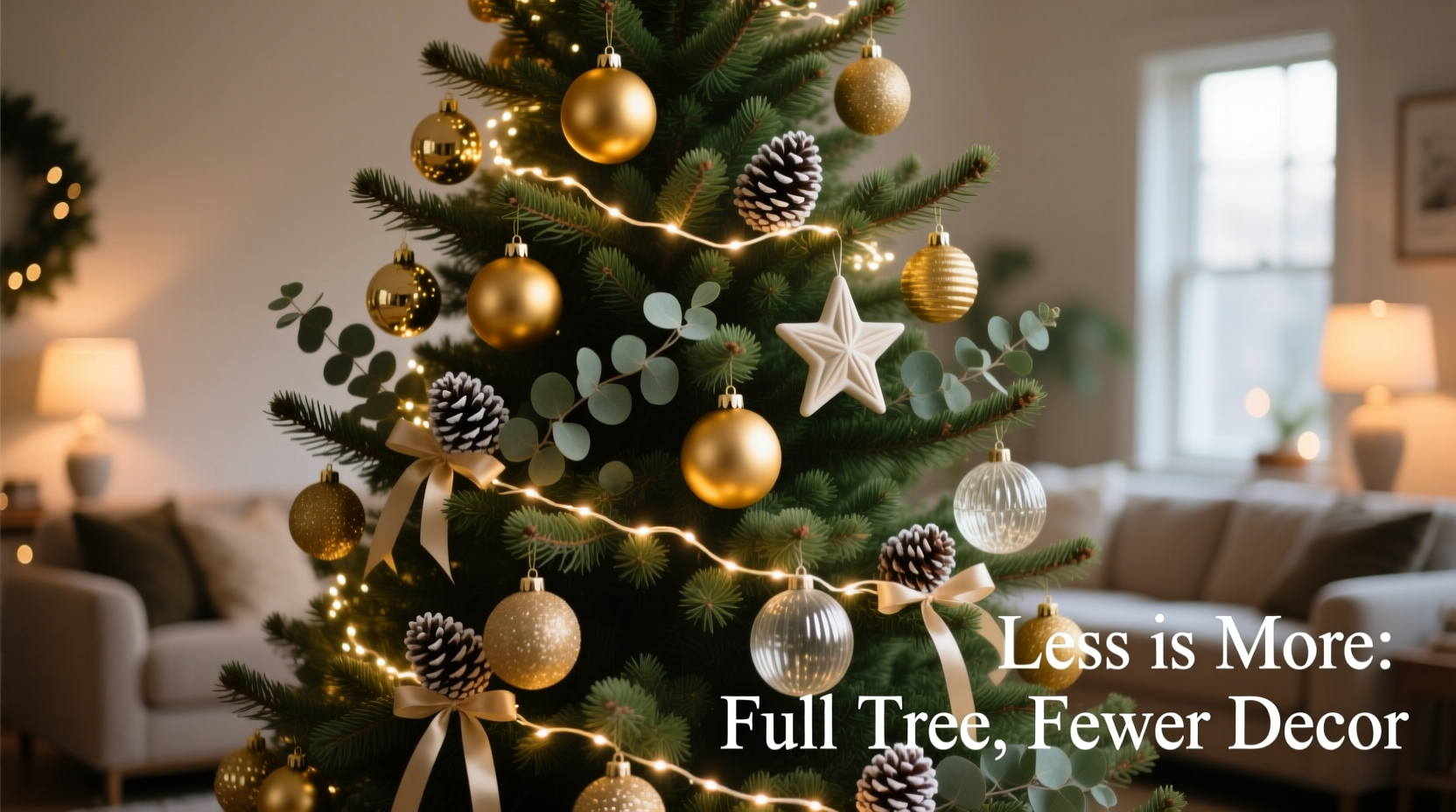
The illusion of fullness begins before the first ornament is hung. A poorly fluffed tree—especially artificial ones straight from the box—will never achieve the desired volume, no matter how many baubles you add. Most artificial trees come compressed, with branches folded inward for packaging. Skipping proper fluffing is one of the most common mistakes in holiday decorating.
Begin at the base and work outward, separating each branch tip by hand. Focus on creating space between layers and turning outer branches forward to increase visibility and width. For trees with hinged branches, gently bend them downward slightly to mimic the natural droop of real pine limbs, which helps fill vertical gaps and adds softness.
Consider adding garland or ribbon before hanging ornaments. These linear elements draw the eye along the tree’s contours, enhancing its three-dimensional presence. A well-prepared tree needs fewer ornaments because its structure already suggests abundance.
2. Use Strategic Ornament Placement to Create Depth
Ornament distribution is more important than ornament count. Placing all decorations on the outer surface makes a tree look flat and sparse underneath. Instead, use depth as a tool: tuck some ornaments deep into the branches, especially larger or reflective ones, to suggest volume behind the front layer.
Think of your tree in concentric spheres. The outermost layer should have moderate ornamentation, while the middle zone holds the majority. Place 60% of your ornaments in the inner and mid-layers, where they catch light and reflect off nearby branches, creating a glowing effect that implies fullness. Reserve only 40% for the outer tips.
“Depth creates mystery. When lights and ornaments shimmer from within the tree, the mind assumes there’s more there than meets the eye.” — Laura Bennett, Interior Stylist & Holiday Design Consultant
To aid placement, use ornament hooks with extended wires or small clips that allow you to position balls deeper into the canopy. Step back frequently while decorating to assess balance and avoid clustering on one side.
Step-by-step: Creating Visual Depth
- Begin by installing lights evenly throughout the interior and exterior branches.
- Select 3–5 large (3–4 inch) ornaments in reflective finishes (mirrored, metallic, or pearlized).
- Place these deep within the tree, aiming for central areas near the trunk where they’ll catch internal light.
- Add medium-sized ornaments (2–3 inch) in the mid-layer, spacing them about 6–8 inches apart.
- Use smaller accents (1–2 inch) sparingly on outer tips to define shape without overwhelming.
- Fill any visible gaps with sprigs of faux pinecones, berry clusters, or tucked-in garland ends.
3. Leverage Color and Finish for Maximum Impact
Color psychology plays a powerful role in perceived density. Certain hues and finishes naturally draw the eye and create the impression of more coverage. Warm metallics like gold, copper, and antique brass reflect ambient light and generate sparkle from multiple angles, making them appear more numerous than they are.
Monochromatic schemes—especially white, silver, or gold—all enhance cohesion and fullness. When all ornaments share a similar tone, the eye reads them as a unified field rather than isolated objects, minimizing negative space. This is particularly effective on slim or sparse trees.
| Color Scheme | Effect on Fullness | Best For |
|---|---|---|
| Monochromatic (e.g., all gold) | High – creates seamless visual flow | Narrow trees, modern decor |
| Metallic-heavy mix | High – reflective surfaces amplify light | Darker rooms, evening display |
| Multi-color traditional | Medium – requires more pieces for cohesion | Family-style trees, nostalgic themes |
| Pastel or muted tones | Low to medium – softer reflection | Rustic, Scandinavian styles |
Additionally, consider using ornaments of varying sizes within the same palette. A mix of large, medium, and small balls in graduated scale fills space more effectively than uniform sizing. Large ornaments act as anchors, medium ones build rhythm, and tiny ones provide punctuation.
4. Incorporate Layered Textures and Non-Ornament Elements
Ornaments aren’t the only way to add visual weight. Incorporating non-ball elements such as ribbons, garlands, and themed picks increases perceived density without relying solely on hanging decorations. These items occupy different spatial planes and break up flat areas.
Ribbon, especially wide wired varieties, can be looped and twisted around branches to create volume. Spiral it from top to bottom in a continuous cascade, securing each loop with hidden floral wire. The folds catch light and shadow, adding movement and mass. A single strand of wide ribbon can visually replace dozens of small ornaments.
Garlands made of popcorn, cranberries, or beads serve a dual purpose: they guide the eye vertically and horizontally across the tree, reinforcing its shape. Drape them in loose S-curves rather than tight spirals to avoid a caged look. For minimalist trees, a single strand of vintage-inspired popcorn garland adds nostalgia and texture without excess.
Tree picks—small clusters of faux berries, pinecones, or snow-dusted twigs mounted on wire stems—are underutilized tools. Insert them directly into branch junctions where gaps appear. Because they project outward and upward, they extend the tree’s silhouette beyond its natural outline, creating the illusion of greater size.
Mini Case Study: The Slender Pre-Lit Tree Transformation
Sarah M., a designer in Portland, faced a challenge with her 7.5-foot pre-lit artificial tree. Tall and narrow, it looked bare even after hanging 70 ornaments. She applied these fullness techniques:
- Re-fluffed all branches over two evenings, focusing on outward projection.
- Added a gold metallic garland in sweeping loops from top to bottom.
- Selected 12 large mirrored balls and placed them deep in the core.
- Used only gold and cream ornaments in varying sizes and finishes.
- Inserted 8 evergreen-pinecone picks at strategic gap points.
The result? Her guests assumed she had doubled her ornament count. “It looked like a department store display,” she said, “but I actually used fewer decorations than last year.”
5. Optimize Lighting to Enhance Volume
No element affects perceived fullness more than lighting. A dim or unevenly lit tree will always appear thinner, regardless of ornament density. Conversely, a well-lit tree glows from within, making shadows recede and branches seem more numerous.
Use warm-white LED lights for the most natural, inviting glow. Cool whites can wash out colors and emphasize gaps. Aim for 100 lights per foot of tree height—for a 6-foot tree, that’s 600 bulbs minimum. Wrap lights starting at the trunk and work outward, weaving deep into branches rather than just outlining the perimeter.
For extra impact, combine two types of lights: steady incandescent-style LEDs for base illumination and a secondary string of twinkle or fairy lights for dynamic sparkle. The contrast in brightness levels creates depth, mimicking how sunlight filters through a real forest canopy.
Checklist: How to Make Your Tree Look Fuller with Fewer Ornaments
- ✅ Fully fluff and shape every branch before decorating
- ✅ Use warm-white LED lights (100 per foot of height)
- ✅ Place 60% of ornaments deep within the tree
- ✅ Choose a cohesive color scheme (monochromatic or metallic)
- ✅ Mix ornament sizes: large (anchor), medium (fill), small (accent)
- ✅ Add ribbon or garland in flowing patterns
- ✅ Insert textured picks (pinecones, berries) into gaps
- ✅ Step back frequently to check balance and density
Frequently Asked Questions
Can I make a fake tree look full without buying new ornaments?
Absolutely. Focus on improving branch structure, upgrading lighting, and using non-ornament elements like ribbon and picks. Often, the issue isn’t a lack of ornaments but poor distribution and insufficient depth.
How many ornaments do I really need?
There’s no fixed number—it depends on tree size and style. As a guideline: a 6-foot tree typically needs 60–90 ornaments when styled strategically. Fewer may suffice if you use large statement pieces and layered textures. Quality and placement matter far more than quantity.
What if my tree has bald spots or weak sections?
Target those areas with cluster decorations. Attach a small grouping of three mini ornaments on longer hooks so they hang just below the gap, drawing attention downward. Alternatively, place a decorative pick or drape a loop of garland over the spot to camouflage it naturally.
Conclusion: Less Can Be More
A full-looking Christmas tree isn’t about how many ornaments you own—it’s about how thoughtfully you use them. By mastering the principles of depth, color harmony, and structural preparation, you can achieve a rich, luxurious appearance with fewer decorations. This approach not only saves money and storage space but also results in a more elegant, intentional display.
Holiday decorating should bring joy, not stress. You don’t need to hunt for rare ornaments or spend hours hanging hundreds of baubles. With smart techniques and a designer’s eye, even a modest collection can transform a simple tree into a breathtaking centerpiece. Start with what you have, apply these strategies, and watch your tree come alive with unexpected fullness.




 浙公网安备
33010002000092号
浙公网安备
33010002000092号 浙B2-20120091-4
Comments
No comments yet. Why don't you start the discussion?