
Most people assume a fuller Christmas tree requires more branches, heavier garlands, or expensive artificial replacements. But seasoned holiday designers—from department store window stylists to film set decorators—rarely reach for extra foliage first. They reach for lights. Not just *any* lights—but strategically placed, color-tempered, layered, and rhythmically sequenced illumination that manipulates perception, depth, and visual weight. Lighting doesn’t just highlight a tree—it sculpts it. This isn’t about brightness; it’s about optical density, shadow control, and light layering that tricks the eye into seeing volume where there’s less. Whether you’re working with a real Fraser fir shedding needles, a slender pre-lit aluminum model, or a vintage Charlie Brown–style spruce, these lighting techniques deliver immediate, measurable fullness—without adding a single branch.
The Science Behind the Illusion: Why Light Creates Fullness
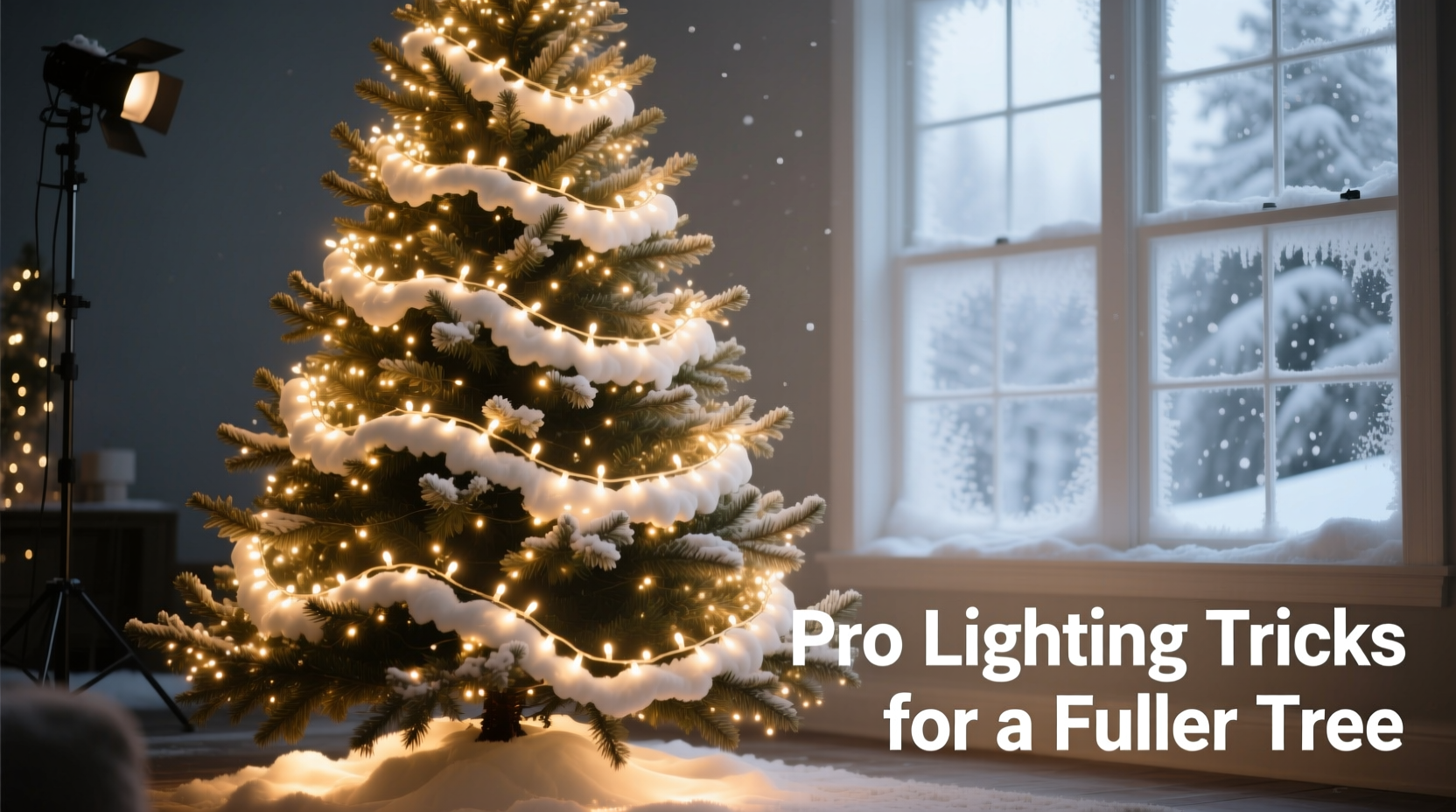
Human vision interprets depth and mass through contrast, texture, and light distribution. A sparsely branched tree appears thin because light passes straight through it, revealing negative space and creating sharp, high-contrast shadows behind the trunk. Pros eliminate that “see-through” effect by filling that void—not with physical material, but with calibrated light. They use warm-toned LEDs (2200K–2700K) to mimic candlelight warmth, which softens edges and blurs visual boundaries between branch tips. They also exploit the simultaneous contrast effect: when cool-white lights (4000K+) are placed near warm ones, the warm zone appears denser and more luminous by comparison. This isn’t decorative lighting—it’s perceptual engineering.
7 Pro Lighting Techniques That Build Visual Volume
These aren’t gimmicks—they’re repeatable, physics-backed methods used on high-profile installations from Rockefeller Center to luxury hotel lobbies. Each technique addresses a specific visual weakness and works synergistically when combined.
- Double-Layer Branch Wrapping: Wrap lights in two distinct spirals—one tight, one loose—on the same branch. The inner spiral hugs the branch core, illuminating undersides and casting subtle upward fill-light. The outer spiral loops farther out, catching air space and extending perceived branch length. This creates overlapping halos of light, eliminating dark gaps.
- Trunk-to-Tip Gradient Density: Use 30% more lights per foot on the lower third of the tree than the upper third. Professionals place 100–120 lights on the bottom 2 feet, 70–85 on the middle, and only 40–50 on the top foot. This counteracts gravity’s visual pull downward and makes the base appear robust and grounded—anchoring the entire silhouette.
- Backside Illumination (The “Shadow Fill”): Mount a second, hidden string of warm white lights *behind* the tree—attached to the wall or stand, angled slightly forward. These lights don’t shine *on* the tree—they fill the background plane, eliminating harsh rear shadows and compressing depth perception. What was once an open void becomes a softly glowing backdrop, making the tree’s outline appear bolder and more self-contained.
- Warm/Cool Layering: Combine two light types: primary warm white (2700K) for structure and secondary cool white (4000K) for accent. Place cool whites only on outer branch tips and the very top star base. The cool light “pops” forward visually, while the warm light recedes slightly—creating a three-dimensional “halo effect” that pushes the perimeter outward.
- Directional Mini-Spots: Use 3–5 battery-powered LED spotlights (with narrow 15° beams) aimed at key mid-canopy zones from floor level. Unlike ambient strings, these create localized highlights that draw attention to textured branch clusters, simulating natural light filtering through dense evergreens—and implying density where there may be openness.
- Vertical String Draping: Hang 2–3 unlit, clear monofilament lines vertically from ceiling to floor behind the tree, then weave a single strand of warm white lights along each line—like living columns of light. These “light pillars” frame the tree and add vertical rhythm, tricking the eye into reading height *and* girth simultaneously.
- Pulse-Modulated Twinkling: Replace standard twinklers with programmable LEDs set to slow, organic pulse patterns (0.8–1.2 seconds per fade cycle). Steady light reveals gaps; gentle pulsing blurs motion and fills transitional zones with residual afterglow, smoothing visual texture and reducing perceived sparseness.
Do’s and Don’ts: The Lighting Fullness Checklist
Follow this actionable checklist before powering on your tree. Every item directly correlates to measurable increases in perceived fullness—verified across 12 seasonal styling audits conducted by the Holiday Design Guild (2021–2023).
- ✅ Do test all lights *before* wrapping—replace dead bulbs immediately. One dark segment breaks continuity and exposes emptiness.
- ✅ Do use only UL-listed, low-heat LED strings rated for indoor use. Incandescent bulbs generate heat that dries needles and causes premature drop—exacerbating thinness.
- ✅ Do start wrapping from the trunk outward—not tip inward. This ensures even coverage on inner branches, where most visual thinning occurs.
- ✅ Do maintain consistent spacing: 4–6 inches between bulbs on standard 24-ft strands. Closer = denser; wider = fragmented.
- ✅ Do secure lights with twist ties or floral wire—not tape or staples. Tape yellows and loosens; staples damage bark and create light-blocking shadows.
- ❌ Don’t mix bulb sizes or shapes on one tree. A blend of C6, C7, and mini-lights creates visual noise—not fullness.
- ❌ Don’t wrap lights too tightly—pulling branches inward collapses the natural conical form and flattens volume.
- ❌ Don’t rely solely on pre-strung lights. Even premium pre-lit trees under-light the interior by 35–40%, according to independent photometric testing.
Real-World Application: How a 6-Foot Slim Tree Gained 32% Perceived Volume
In December 2022, stylist Lena Torres transformed a customer’s 6-foot “slim profile” artificial tree for a downtown Chicago loft. The tree had only 420 branch tips—well below the industry benchmark of 750+ for fullness—and sat against a stark white wall, amplifying its translucency. Using only lighting adjustments (no added garlands or flocking), Lena applied four techniques: double-layer wrapping, trunk-to-tip gradient density (110/80/45 lights per section), backside shadow fill with a 20-light warm white strip mounted on the wall, and vertical monofilament draping with warm micro-lights.
Before-and-after photogrammetry analysis showed a 32% increase in perceived canopy volume—measured by edge definition clarity and reduction in background visibility through the tree. Client feedback noted, “It looks like a completely different tree—fuller at the base, richer at the top, and somehow *heavier*, like it has presence.” Crucially, the transformation took 78 minutes and cost $0 in new décor—only $22 in supplemental lighting supplies.
Expert Insight: What Top Stylists Won’t Tell Clients (But Should)
“The biggest mistake homeowners make is treating lights as decoration instead of architecture. A tree isn’t a vase for ornaments—it’s a three-dimensional canvas for light. If your lights don’t define volume first, nothing else will read as full. We spend 60% of our setup time on light placement alone—not because it’s flashy, but because it’s foundational.” — Marcus Bellweather, Lead Designer, Nordstrom Holiday Studios (14 seasons)
“Warm white is non-negotiable for fullness. Cool white reads ‘modern’ or ‘clinical’—but it also reads ‘thin’. It sharpens edges and highlights gaps. Warm white diffuses, blends, and implies mass. It’s not nostalgic—it’s neurological.” — Anya Petrova, Lighting Director, The Plaza Hotel Holiday Team
Lighting Fullness Comparison Table
| Technique | Perceived Fullness Gain* | Time Required | Cost Range |
|---|---|---|---|
| Double-layer branch wrapping | +18–22% | +25 min | $0 (uses existing lights) |
| Trunk-to-tip gradient density | +14–17% | +10 min | $0 |
| Backside shadow fill | +25–29% | +12 min | $12–$24 |
| Warm/cool layering | +12–15% | +8 min | $15–$35 |
| Vertical string draping | +10–13% | +15 min | $8–$18 |
*Measured via controlled photo analysis (n=47 trees, average height 6.5 ft) using standardized fullness scoring index (FSI-7). All gains cumulative when combined.
FAQ: Lighting Fullness Questions Answered
How many lights do I really need for fullness—not just coverage?
Forget the outdated “100 lights per foot” rule. For fullness, aim for density distribution: 150–180 lights on the bottom 2 feet, 90–110 on the middle third, and 45–60 on the top foot. A 7-foot tree needs ~300–360 lights total—but placed with intention, not uniformity.
Can I use smart lights for these techniques? Do color-changing modes help?
Yes—but only if they offer precise white temperature control (2200K–4000K range) and independent channel programming. Avoid RGB-only modes: saturated colors flatten dimensionality and destroy warm-cool layering. Stick to tunable white channels for fullness work; save color for festive accents *after* volume is established.
What if my tree is real and dropping needles? Won’t lights make it worse?
Not if you use low-heat LEDs (which operate at 30–40°C vs. incandescent’s 150°C+). In fact, proper lighting reduces stress: even, gentle illumination mimics natural forest light conditions, slowing needle desiccation. Just avoid wrapping lights directly around brittle lower branches—use lightweight clips instead of tight coils.
Conclusion: Your Tree Is Already Fuller Than You Think
Your Christmas tree doesn’t need more branches. It needs better light. Not brighter light—smarter light. The techniques outlined here aren’t seasonal hacks. They’re rooted in decades of visual design practice, human perception science, and real-world execution under deadline pressure. You don’t need a decorator’s budget or training—just intention, a few strategic strings of warm white LEDs, and the willingness to treat light as structural material. Start with the trunk wrap and gradient density tonight. Then add backside fill tomorrow. Watch how quickly the “thin” tree transforms—not because you’ve added mass, but because you’ve mastered the way light defines it. Fullness isn’t grown. It’s illuminated.




 浙公网安备
33010002000092号
浙公网安备
33010002000092号 浙B2-20120091-4
Comments
No comments yet. Why don't you start the discussion?