
Perfume is more than a fragrance—it’s an extension of identity, a subtle signature that lingers in memory long after you’ve left a room. Yet, nothing undermines confidence like realizing your carefully chosen scent has vanished by midday. Many assume longevity depends solely on price or brand, but the truth lies deeper: technique, chemistry, and care play far greater roles. With the right approach, even modest fragrances can project elegance for hours. This guide reveals scientifically grounded, field-tested methods to extend your perfume’s presence from morning to night.
Understand Your Fragrance’s Chemistry
Fragrance longevity begins with understanding concentration levels. Perfumes are categorized by how much aromatic compound (essential oils) they contain versus alcohol and fixatives. The higher the oil concentration, the longer the scent typically lasts.
| Type | Oil Concentration | Average Longevity |
|---|---|---|
| Parfum (Extrait) | 20–30% | 6–8+ hours |
| Eau de Parfum (EDP) | 15–20% | 4–6 hours |
| Eau de Toilette (EDT) | 5–15% | 2–4 hours |
| Eau de Cologne | 2–4% | 1–2 hours |
If longevity is a priority, choose EDP or parfum over lighter variants. However, even a strong formulation won’t survive poor application or incompatible skin chemistry. Some skin types are naturally drier and absorb oils quickly, reducing projection. Others, with oilier skin, retain scent better due to natural moisture acting as a carrier.
Master the Art of Strategic Application
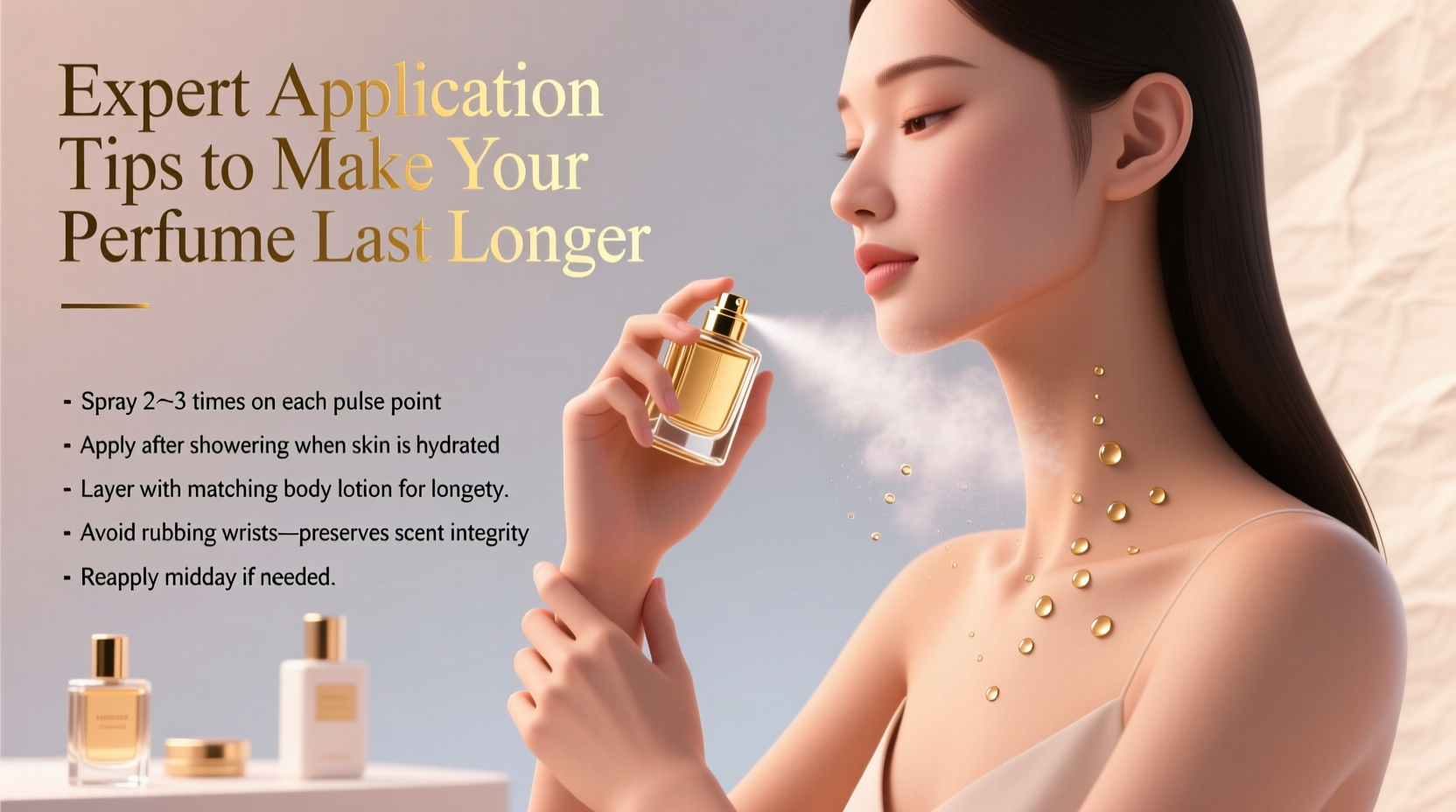
Where and how you apply perfume dramatically affects its lifespan. Most people spray wrists and neck, but few do it effectively. The key is targeting pulse points—areas where blood vessels run close to the skin, emitting gentle heat that activates and diffuses scent molecules.
Pulse Points That Work Best
- Wrists: Classic, but avoid rubbing them together—this breaks down top notes.
- Neck (sides): Warm and close to the nose when moving.
- Behind ears: Often overlooked; excellent for subtle projection.
- Inner elbows: Sheltered area that releases scent with movement.
- Back of knees: Heat rises, so walking gently lifts the aroma upward.
For stronger diffusion, consider layering. Spray lightly into the air and walk through it—this creates a fine mist that settles evenly across clothes and hair. Hair holds scent well due to keratin’s porous nature, but use sparingly; alcohol can dry strands over time.
“Applying fragrance to bare skin maximizes longevity, but layering with matching body products builds a scent reservoir.” — Clara Nguyen, Master Perfumer at Osmology Labs
Optimize Skin and Environment
Skin preparation is often the missing link in lasting fragrance. Dry skin evaporates scent within minutes. Hydrated skin forms a barrier that slows evaporation and enhances sillage—the trail your perfume leaves behind.
Step-by-Step Skin Prep Routine
- Shower using a neutral or complementary-scented body wash.
- Pat skin dry—don’t rub—to preserve moisture.
- Apply an unscented or matching-scent body lotion or petroleum jelly to pulse zones.
- Wait 2–3 minutes for absorption before spraying.
- Hold bottle 6–8 inches away and mist once per point.
For those with very dry skin, a balm-based fragrance base (available at specialty perfumeries) can act as a scent anchor. These are thicker emollients designed specifically to bind with fragrance molecules.
Environmental factors also matter. High humidity helps carry scent, while dry, air-conditioned offices sap volatility. In arid climates, reapplication may be necessary—but don’t overdo it. One extra spritz to the collar or scarf is often enough to revive a fading profile.
Storage and Fragrance Integrity
A perfume’s shelf life directly impacts performance. Even the best-applied scent will fail if the formula has degraded. Light, heat, and oxygen are the three main enemies of fragrance stability.
Do’s and Don’ts of Perfume Storage
| Do | Don’t |
|---|---|
| Store in original box in a cool, dark drawer | Leave on bathroom vanity (humidity + light) |
| Keep upright to prevent leakage and oxidation | Lay bottles on their side long-term |
| Use within 3–5 years of opening | Keep in direct sunlight or near radiators |
| Buy smaller bottles if you rotate scents frequently | Store in car glove compartments |
UV exposure causes chemical breakdown, turning once-floral accords sour or flat. A study by the International Fragrance Association found that citrus and green notes degrade fastest under light stress. If your perfume smells “off” or weaker than when purchased, it may have oxidized.
To extend usability, consider decanting into smaller, opaque atomizers for daily carry. This limits the main bottle’s exposure to air and keeps the full concentration intact.
Real-World Example: A Day in the Life of a Scent Strategist
Consider Lena, a corporate consultant who travels weekly between cities with varying climates. She wears a floral-woody Eau de Parfum but noticed it faded within two hours during flights and meetings. After consulting a fragrance coach, she adjusted her routine:
- Switched from EDT to EDP version of her favorite scent.
- Began applying a lanolin-based moisturizer post-shower.
- Started layering with a matching scented body oil.
- Stores a mini atomizer in her handbag for a single midday refresh on the nape of her neck.
- Keeps her primary bottle in a lined travel case, away from cabin light.
The result? Her fragrance now lasts 7–8 hours with noticeable sillage. Colleagues regularly compliment her “signature scent,” unaware of the method behind the magic.
Expert Checklist: Maximize Your Perfume Longevity
Follow this checklist daily to ensure optimal fragrance performance:
- ✅ Moisturize skin before applying perfume.
- ✅ Choose EDP or parfum concentration for all-day wear.
- ✅ Target 3–5 pulse points without rubbing.
- ✅ Store perfume in a cool, dark place.
- ✅ Layer with matching unscented or scented base products.
- ✅ Reapply minimally—once, if needed—on fabric or hair.
- ✅ Avoid spraying directly onto jewelry or light-colored fabrics.
- ✅ Replace opened bottles every 3–5 years.
Frequently Asked Questions
Why does my perfume disappear so quickly?
Several factors could be at play: dry skin, low fragrance concentration, improper storage, or olfactory fatigue—where your nose stops detecting your own scent. Try hydrating your skin and switching to a higher-concentration version of your fragrance.
Can I make a cheap perfume last like an expensive one?
Yes—technique matters more than price. A $30 EDP applied correctly on moisturized skin will outlast a $150 EDT sprayed on dry skin. Focus on preparation, application, and storage rather than assuming cost equals longevity.
Is it okay to mix perfumes?
Yes, but cautiously. Layering compatible scents (e.g., same fragrance family) can create depth and extend wear. Start by combining a light base (like musk) with a stronger top note. Test on skin first—some combinations turn sharp or soapy.
Final Thoughts: Make Your Scent a Statement
Lasting fragrance isn’t about dousing yourself in scent—it’s about precision, patience, and understanding the interplay between chemistry and habit. From choosing the right concentration to mastering pulse-point application and maintaining your collection, every step contributes to a presence that endures.
You don’t need ten bottles or constant reapplication. You need a strategy. Whether you’re preparing for a presentation, a date, or simply want to feel put-together from dawn to dusk, these expert-backed methods empower you to wear your fragrance with confidence—knowing it will speak for you, long after you’ve passed by.




 浙公网安备
33010002000092号
浙公网安备
33010002000092号 浙B2-20120091-4
Comments
No comments yet. Why don't you start the discussion?