
Finding the right ring size is essential for comfort, security, and long-term wearability. Whether you're shopping online for an engagement ring, a gift for a loved one, or simply replacing a lost band, getting the measurement correct matters. But what if you don’t have access to a professional ring sizer? You’re not out of luck. With a few common household items and careful technique, you can accurately determine your ring size from the comfort of your home.
The key is consistency, precision, and understanding that finger size can fluctuate throughout the day and year. This guide walks you through multiple proven methods, shares expert insights, and offers real-world tips to ensure your measurements are as accurate as possible—without ever stepping into a jewelry store.
Why Accurate Ring Sizing Matters
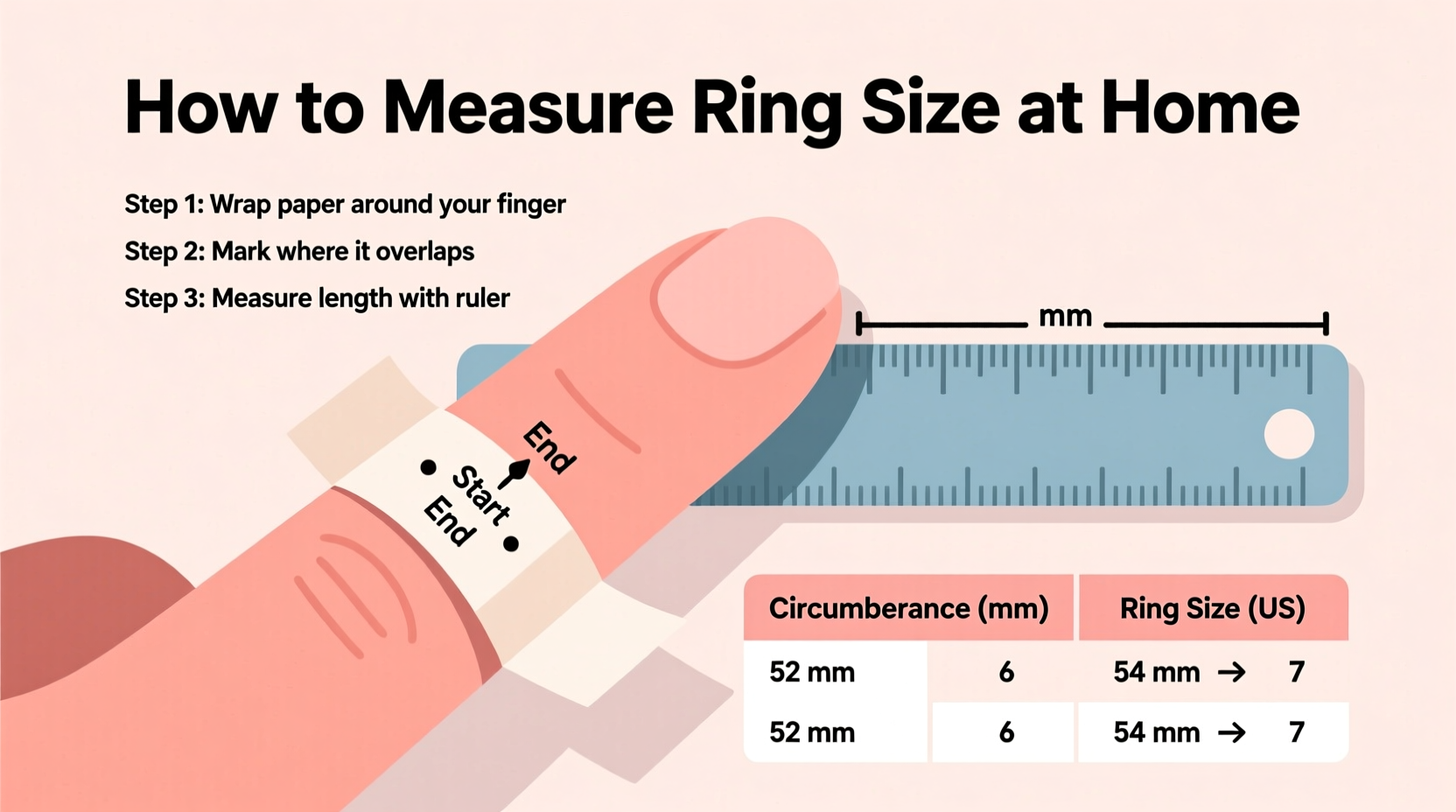
A ring that's too tight can restrict circulation and cause discomfort; one that's too loose risks slipping off and being lost forever. A properly fitted ring should slide over your knuckle with slight resistance and sit snugly on your finger without pinching. According to jewelers, nearly 30% of online ring purchases are returned due to incorrect sizing—a problem easily avoided with proper measurement.
Factors like temperature, hydration, and even time of day affect finger size. Fingers tend to swell in heat and during physical activity, while they shrink slightly in cold environments. For best results, measure when your hands are at room temperature, ideally in the late morning or early afternoon after normal daily activity but before exercise or exposure to extreme conditions.
Method 1: The String or Paper Strip Technique
This is the most widely used method for measuring ring size at home and requires only a strip of paper, string, scissors, a pen, and a ruler.
- Cut a thin strip of paper (about 1/4 inch wide) or use a piece of non-stretchy thread.
- Wrap it snugly around the base of your finger—the same spot where you intend to wear the ring.
- Ensure the strip is flat against the skin and doesn’t overlap. It should be tight enough to stay in place but not so tight that it cuts off circulation.
- Mark the point where the ends meet with a pen.
- Lay the strip flat on a surface and measure the length from the start to the mark in millimeters using a ruler.
- Use a ring size conversion chart (see table below) to find your corresponding size.
This method works best with non-elastic materials. Avoid using rubber bands or stretchy strings, as they can give inaccurate readings.
Accuracy Tips for the String Method
- Don’t wrap the string too tightly—leave just enough room to slide it over the knuckle comfortably.
- If you plan to wear the ring over a large knuckle, measure both the base of the finger and the knuckle width to ensure the ring will pass without excessive force.
- Repeat the process at least twice to verify consistent results.
Method 2: Using a Known Ring That Fits Well
If you already own a ring that fits perfectly on the intended finger, this is often the most accurate way to determine your size—especially for online orders.
- Take the well-fitting ring and place it over the tip of your finger until it rests naturally at the base.
- Mark where the inside edge of the ring sits on your finger using a fine-tip marker.
- Remove the ring and measure the distance between the base of your finger and the mark in millimeters. This is the inner diameter of the ring.
- Alternatively, trace the inner circle of the ring onto a piece of paper, then measure the diameter of the traced circle with a ruler.
- Convert the diameter (in mm) to a standard ring size using a conversion chart.
This method eliminates guesswork associated with wrapping techniques and provides a direct reference based on actual fit.
“Using an existing ring that fits correctly is the gold standard for at-home sizing. It removes variables like tension and alignment.” — Daniel Reyes, Master Jeweler & GIA Graduate
Method 3: The Ruler Direct Measurement Method
If you have a precise ruler with millimeter markings, you can measure your finger directly.
- Place the ruler across the widest part of your finger, from one side of the base to the other, avoiding the knuckle.
- Record the measurement in millimeters. This gives you the diameter of your finger.
- Refer to a ring size chart to convert the diameter into a standard size (e.g., US, UK, EU).
This method is quick but less accurate than wrapping or using a known ring, as it’s difficult to hold the ruler steady and align it perfectly perpendicular to the finger. Use it only as a secondary check.
Ring Size Conversion Table
| US Size | Inside Diameter (mm) | Circumference (mm) | UK / Australia | Europe |
|---|---|---|---|---|
| 4 | 14.86 | 46.7 | H | 47 |
| 5 | 15.70 | 49.3 | J | 50 |
| 6 | 16.51 | 51.9 | L | 52 |
| 7 | 17.35 | 54.5 | N | 55 |
| 8 | 18.19 | 57.1 | P | 58 |
| 9 | 18.98 | 59.7 | R | 60 |
| 10 | 19.84 | 62.3 | T | 63 |
Note: Sizes vary slightly by region. Always confirm which sizing standard the jeweler uses before ordering.
Common Mistakes to Avoid
Even small errors can lead to incorrect sizing. Here are the most frequent pitfalls and how to avoid them:
| Mistake | Why It’s Problematic | How to Fix It |
|---|---|---|
| Measuring cold fingers | Fingers shrink in cold temperatures, leading to a smaller-than-accurate reading. | Warm your hands first with warm water or hand movement. |
| Using stretchy material | Elastic strings or bands expand under tension, giving false readings. | Use non-stretch paper strips or sewing thread. |
| Ignoring knuckle size | A ring may fit the finger base but get stuck on a larger knuckle. | Measure both the base and the knuckle; choose a size that accommodates both. |
| Measuring only once | Finger size varies daily; a single measurement may not reflect average size. | Take 3 measurements across two days and average them. |
Real-Life Example: Sarah’s Engagement Ring Surprise
Sarah wanted to surprise her fiancé with a custom wedding band but didn’t know his ring size. He rarely wore rings, so there was no existing one to borrow. She waited until he fell asleep one evening and carefully wrapped a thin paper strip around his ring finger. She repeated the measurement the next morning when he was awake and active, ensuring consistency. Both readings matched: 17.35 mm—perfectly a US size 7.
To double-check, she visited a local jewelry store and borrowed a ring sizer. His true size? Also 7. Confident in her measurements, she ordered the band online. When presented with the ring, it slipped on effortlessly and fit perfectly. Her secret? Patience, repetition, and attention to environmental factors.
Step-by-Step Checklist for At-Home Ring Sizing
✅ Your At-Home Ring Sizing Checklist:
- Choose a time when fingers are warm and relaxed (late morning is ideal).
- Gather supplies: paper strip or non-stretch string, pen, ruler (mm), scissors.
- Wrap the strip snugly around the base of the intended finger.
- Mark where the ends meet—don’t pull too tight.
- Measure the length in millimeters.
- Compare to a ring size chart (use the circumference column).
- Repeat the process two more times to confirm accuracy.
- If using a known ring, trace its inner circle and measure the diameter.
- Add 0.5 mm to diameter if the ring has a wide band.
- Verify results with a second method if possible.
Frequently Asked Questions
Can I use a tape measure instead of a string?
Yes, a flexible sewing tape measure works well—if it has millimeter markings. Wrap it around the finger and read the circumference directly. Just make sure it lies flat and isn’t twisted.
What if my knuckle is much larger than the base of my finger?
This is common. Measure both the knuckle (widest point) and the base. The ring must fit over the knuckle comfortably. If the difference is significant, consider a ring with a flexible design or consult a jeweler about sizing options like spring inserts.
Do international ring sizes differ?
Yes. The US, UK, Europe, and Japan all use different numbering systems. Always confirm which standard the seller uses. Most reputable jewelers provide conversion charts. When in doubt, provide your measurement in millimeters—it’s universally understood.
Final Thoughts and Next Steps
Measuring ring size at home without a sizer is entirely feasible with care and the right approach. While professional tools offer precision, the methods outlined here—when applied consistently—can yield results within 0.1–0.2 mm of accuracy. The goal isn’t perfection on the first try, but reliability through repetition and awareness of influencing factors.
Whether you're shopping for a promise ring, anniversary gift, or everyday band, taking the time to measure correctly prevents disappointment and returns. And if uncertainty remains, many jewelers offer free resizing within a certain period—just be sure to check the policy before purchasing.




 浙公网安备
33010002000092号
浙公网安备
33010002000092号 浙B2-20120091-4
Comments
No comments yet. Why don't you start the discussion?