
Service dogs are more than pets—they are highly trained assistants that help individuals with disabilities perform daily tasks and maintain independence. Despite their critical role, there is widespread confusion about how to officially recognize a service dog under U.S. law. Unlike emotional support animals or therapy dogs, service dogs have specific legal protections under the Americans with Disabilities Act (ADA), but they do not require formal certification from any government agency. This guide clarifies what “certification” truly means, outlines the steps to ensure your dog is legally recognized, and helps you secure the proper documentation to protect your rights.
Understanding Legal Definitions: Service Dog vs. Emotional Support Animal
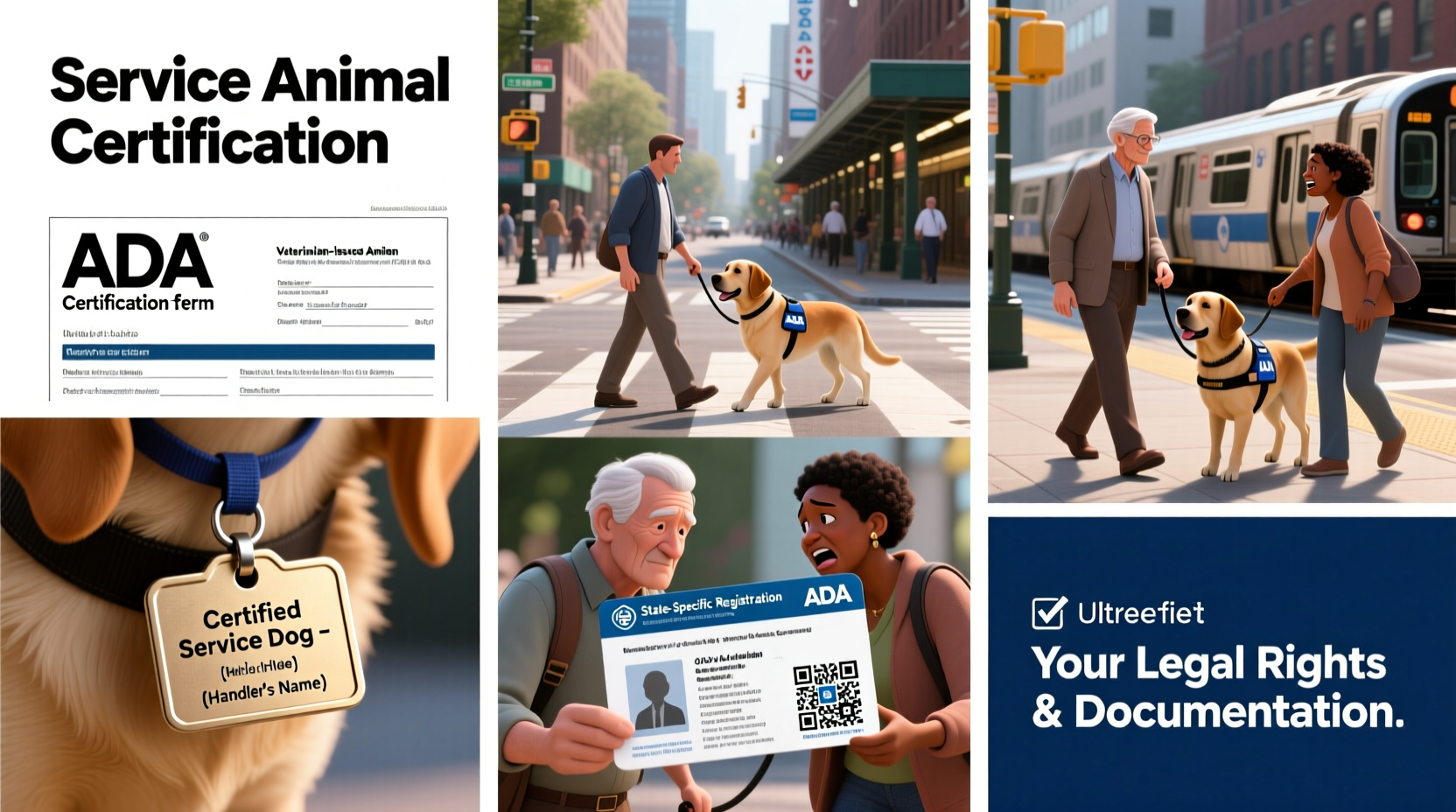
The first step in certifying your service dog is understanding the legal distinctions between different types of assistance animals. Under federal law:
- Service Dogs are individually trained to perform specific tasks for people with disabilities—such as guiding the visually impaired, alerting to seizures, retrieving dropped items, or providing balance support.
- Emotional Support Animals (ESAs) provide comfort through companionship but are not trained to perform tasks. They are protected under housing laws (Fair Housing Act) but not granted public access rights like service dogs.
- Therapy Dogs are trained to provide affection and comfort in settings like hospitals or schools, but they do not have public access rights under the ADA.
Only service dogs are guaranteed access to public spaces such as restaurants, stores, and transportation under Title II and III of the ADA. Importantly, the Department of Justice does not require registration, certification, or licensing for service dogs. However, proper training and documentation can help avoid conflicts and assert your rights confidently.
Step-by-Step Guide to Legally Recognizing Your Service Dog
While no official government certification exists, you can take concrete steps to ensure your dog meets legal standards and is recognized as a service animal when needed.
- Determine Eligibility: You must have a disability as defined by the ADA—a physical or mental impairment that substantially limits one or more major life activities.
- Select a Suitable Dog: Choose a dog with a calm temperament, good health, and the ability to focus in distracting environments.
- Train the Dog to Perform Specific Tasks: Training must be task-specific. For example, a dog for someone with PTSD might be trained to create space in crowded areas or wake them from nightmares. General obedience is not enough.
- Ensure Public Access Readiness: The dog must behave appropriately in public—no barking, lunging, or relieving itself indoors. It should remain under control at all times, typically via leash or harness.
- Create Personal Documentation: While not required, carrying a self-created letter or ID card can help facilitate interactions with businesses unfamiliar with ADA rules.
- Obtain a Doctor’s Letter if Needed for Housing or Travel: For airline travel or housing accommodations, a licensed mental health professional or physician may need to verify your disability and the necessity of the service dog.
What Documentation Should You Carry?
Although businesses cannot demand proof of certification, having organized documentation can prevent disputes. Consider assembling a service dog folder containing:
- A personalized letter from a healthcare provider stating your disability and the role of the dog.
- Vaccination records.
- Training logs or completion certificates from reputable programs (optional but helpful).
- A laminated ID card with the dog’s photo, name, and your contact information.
“Under the ADA, staff may only ask two questions: (1) Is the dog a service animal required because of a disability? and (2) What work or task has the dog been trained to perform? No further documentation can be required.” — U.S. Department of Justice, Civil Rights Division
Do’s and Don’ts of Service Dog Documentation
| Do’s | Don’ts |
|---|---|
| Carry a doctor’s letter for housing or air travel | Purchase fake \"certificates\" from online vendors |
| Keep vaccination and training records updated | Assume all staff will understand ADA rules |
| Use visible identifiers like vests or patches (not legally required but helpful) | Allow untrained dogs to enter public spaces as \"service animals\" |
| Practice public access skills regularly | Misrepresent an ESA as a service dog |
Real-World Scenario: Navigating Air Travel with a Service Dog
Sarah, a veteran with mobility limitations due to a spinal injury, trained her Labrador, Max, to retrieve items, open doors, and provide balance support. When booking a flight, she contacted the airline 48 hours in advance and submitted a DOT-compliant service dog form signed by her doctor and veterinarian. At the airport, gate agents asked only what tasks Max performed. She calmly explained his assistance duties, and they were allowed to board without issue.
However, on the return flight, a new agent requested “official certification.” Sarah politely cited the ADA and referred to the Department of Transportation’s guidelines. She presented Max’s training log and her doctor’s letter. After a brief consultation with a supervisor, they were permitted to board. This experience underscores the importance of preparation—even when the law is on your side, clarity and documentation ease enforcement.
Frequently Asked Questions
Is there an official service dog certification in the United States?
No. There is no federally recognized certification or registry for service dogs. Any website offering “official certification” is selling a non-binding document with no legal authority. Legitimacy comes from proper training and the dog’s ability to perform disability-related tasks.
Can landlords deny my service dog?
No. Under the Fair Housing Act, landlords must allow service dogs—and ESAs—as a reasonable accommodation, even in pet-restricted housing. They cannot charge pet fees, though they may hold tenants responsible for damages caused by the animal.
Can airlines require service dog paperwork?
Yes, under the revised Department of Transportation (DOT) rules effective 2021, airlines may require two forms: the Service Animal Air Transportation Form and the Service Animal Health Attestation Form. These verify behavior, health, and training. Emotional support animals are no longer considered service animals for air travel.
Expert Insight: The Importance of Task-Based Training
“The key difference between a service dog and a well-behaved pet is task training. If the dog isn’t performing work directly tied to a disability—like turning on lights for someone with limited mobility or interrupting self-harm behaviors in anxiety disorders—it doesn’t qualify under the ADA.” — Dr. Rebecca Schneider, Canine Behavior Specialist and ADA Consultant
This distinction is crucial. A dog that simply calms its owner through presence may be beneficial, but unless it’s trained to actively intervene, it does not meet the legal definition of a service animal.
Final Checklist Before Going Public
Before taking your service dog into public spaces, ensure you’ve completed the following:
- ✅ Confirmed that your condition qualifies as a disability under the ADA.
- ✅ Trained your dog to perform at least one specific task related to your disability.
- ✅ Practiced public access behaviors: ignoring distractions, remaining quiet, and staying within your personal space.
- ✅ Assembled a documentation packet including vet records, training notes, and a letter from your healthcare provider.
- ✅ Researched airline or housing policies if applicable and prepared required forms.
- ✅ Practiced responding calmly to inquiries using only the two permitted answers under the ADA.
Conclusion: Confidence Through Preparation
Officially recognizing your service dog isn’t about buying a piece of paper—it’s about ensuring your dog is trained, reliable, and ready to assist you in everyday life. While no government certification exists, thorough preparation, clear documentation, and knowledge of your rights empower you to navigate public spaces with confidence. Whether you’re managing a physical disability, psychiatric condition, or neurological disorder, a well-trained service dog can transform your independence. Take the time to train responsibly, document thoughtfully, and advocate wisely. Your partnership deserves both legal protection and public respect.




 浙公网安备
33010002000092号
浙公网安备
33010002000092号 浙B2-20120091-4
Comments
No comments yet. Why don't you start the discussion?