
Every home has one: the drawer that collects everything with nowhere else to go. A tangled mess of rubber bands, loose batteries, expired coupons, and mystery screws. The junk drawer is often tolerated as inevitable chaos. But it doesn’t have to be. With a few minutes of focused effort and everyday household items, you can transform your junk drawer into a functional, orderly space. More importantly, you can keep it that way—without buying specialty organizers or spending money.
The key isn’t perfection—it’s practicality. An organized junk drawer should make life easier, not add complexity. This guide walks through a proven method to declutter, categorize, and maintain your drawer using only what you already own. From repurposed containers to smart labeling tricks, these strategies are designed for real homes and real habits.
Step 1: Empty and Evaluate
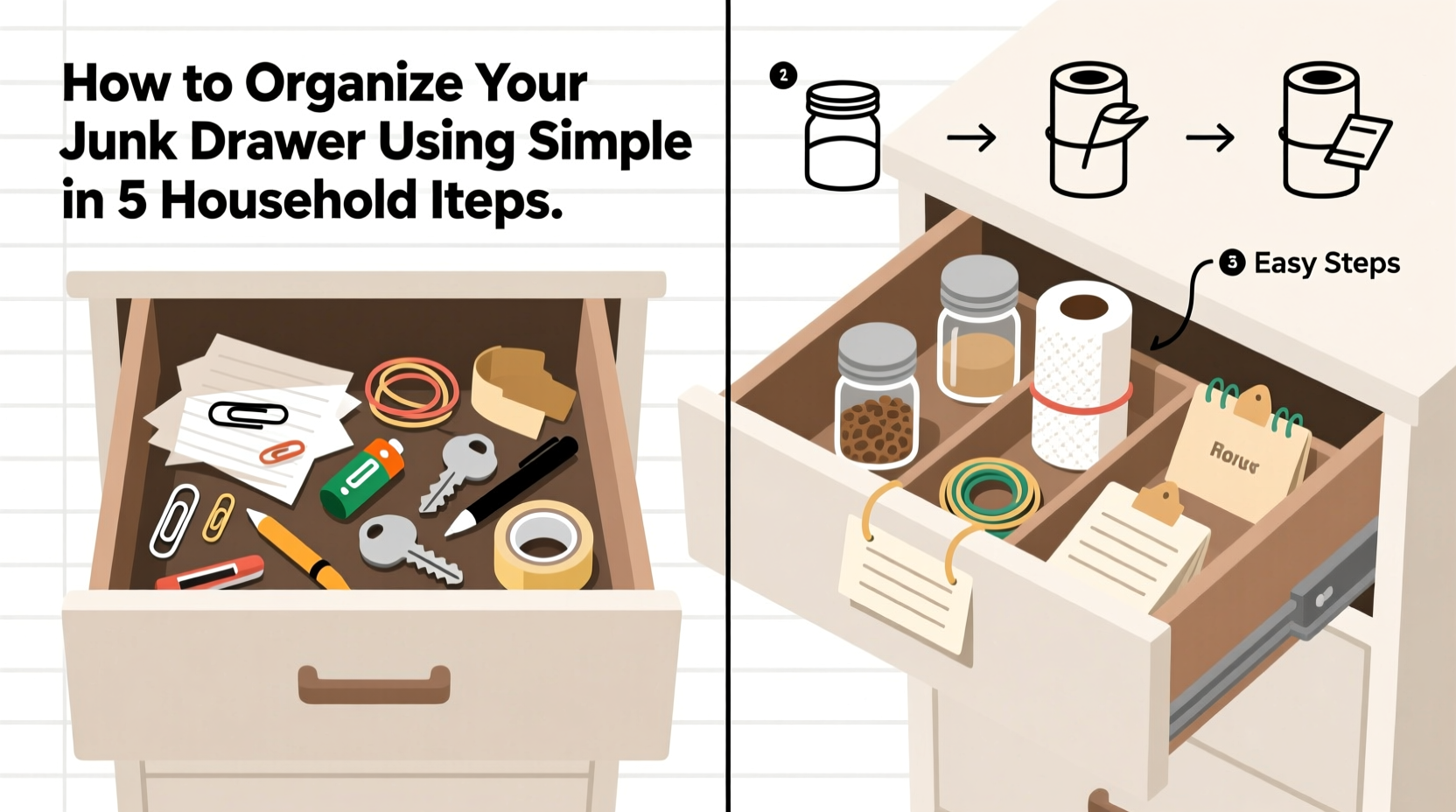
Begin by pulling everything out of the drawer. Place the contents on a clean surface like a kitchen counter or dining table. This visual audit reveals just how much accumulates in a small space. Resist the urge to start sorting immediately. First, assess each item with three questions:
- Have I used this in the past six months?
- Is it broken, expired, or unusable?
- Does it belong in this drawer—or somewhere else?
If an item fails all three, discard it. Expired batteries, dried-out glue sticks, old receipts, and single earbuds without their pair go straight into recycling or trash. Be ruthless. The goal is to reduce volume before organizing—not after.
Items that belong elsewhere—like kitchen scissors or measuring spoons—should be returned to their proper homes immediately. Misplaced objects contribute significantly to junk drawer clutter. Once you’ve removed the obvious waste, group remaining items into broad categories:
- Tools (scissors, tape, screwdrivers)
- Fasteners (rubber bands, paper clips, pushpins)
- Batteries and cables
- Receipts and small papers
- Random oddities (magnets, spare keys, travel-sized toiletries)
This categorization forms the foundation of your new system.
Step 2: Build Compartments from What You Already Own
Most people assume drawer organization requires store-bought trays or plastic bins. Not true. Household containers work just as well—and they’re free. The trick is choosing rigid, shallow containers that fit the drawer depth and allow easy access.
Here are common household items that double as effective drawer dividers:
- Muffin tin liners (paper or foil): Ideal for tiny items like thumbtacks or watch batteries. Press them into place—they won’t slide.
- Yogurt cups or butter tubs: Cut down the sides if needed to lower height. Perfect for holding pens, USB drives, or nail clippers.
- Cereal box cardboard: Cut into strips and fold into rectangles to create custom partitions. Tape corners for stability.
- Small glass jars (jam, baby food): Remove lids and place upside down to hold coils of tape or spools of thread.
- Egg cartons: The individual sections naturally separate small parts. Use the lid to cover loose items.
Arrange these containers within the drawer based on frequency of use. High-access items—like scissors or sticky notes—should sit toward the front. Less-used supplies, such as backup fuses or extra light bulbs, can go in the back.
“Organization fails when it fights human behavior. Design your drawer for how you actually reach for things—not how you think you should.” — Laura Chen, Home Efficiency Consultant
Step 3: Label Everything Clearly
Even the best system breaks down without clear labels. Handwriting directly on containers makes it easy to remember what goes where—even for family members who didn’t help organize.
You don’t need a label maker. Use any of these alternatives:
- Pencil or permanent marker on masking tape
- Sticky notes with bold writing
- Chalkboard paint applied to jar lids (paint leftover from another project)
- Folded index cards tucked into compartments
Labeling prevents “drift”—the slow return of unrelated items into designated zones. For example, if you mark a yogurt cup “USB Cables,” someone is less likely to toss in a loose battery.
| Item Type | Best Container | Labeling Method |
|---|---|---|
| Batteries | Small glass jar (upside down) | Masking tape + marker |
| Rubber bands & hair ties | Butter tub with lid | Sticky note on side |
| Scissors & small tools | Yogurt cup (cut shorter) | Index card taped to rim |
| Receipts & coupons | Folded manila envelope | Write directly on flap |
| Pushpins & tacks | Muffin liner pressed into corner | Label drawer wall nearby |
The more intuitive the label, the longer the system lasts.
Step 4: Maintain the System with Daily Habits
Organization isn’t a one-time fix. It requires micro-habits to sustain. The most effective strategy is the “30-second rule”: if you open the drawer, spend no more than 30 seconds returning it to order before closing it.
For example, after using tape, press the roll back into its jar. If a paper clip falls out, drop it back in its container immediately. These tiny actions prevent gradual disarray.
Additionally, schedule a monthly “drawer refresh.” Once a month, pull out the containers and wipe down the drawer interior. Check expiration dates on batteries and test small electronics. This routine maintenance catches problems early and reinforces discipline.
Mini Case Study: The Hallway Junk Drawer Transformation
Sarah, a mother of two in Portland, had a hallway drawer filled with school permission slips, dead remotes, and mismatched buttons. She spent mornings digging for dog leashes and lost car keys. After following the steps above, she used a cut-down cereal box to divide the space into four zones: leashes/keys, school paperwork, pet supplies, and emergency items.
She labeled each section with folded index cards and placed a small dish for incoming mail. Within a week, her morning routine shortened by five minutes. Six months later, the drawer remains functional because she enforces a “one-in, one-out” rule: for every new item added, something obsolete must leave.
Step 5: Prevent Future Clutter with Smart Rules
To keep your junk drawer from reverting to chaos, establish boundaries. Define what belongs—and what doesn’t. Many drawers become dumping grounds simply because no rules exist.
Adopt these principles:
- No orphaned items: Single socks, unidentified cords, or broken gadgets don’t go in the drawer. They either get fixed, recycled, or trashed.
- One home per item: Every object has a designated spot. No duplicates unless absolutely necessary.
- Limit paper: Receipts stay no longer than 30 days unless tax-related. Coupons are stored digitally or filed weekly.
- Seasonal rotation: Holiday-specific items (turkey thermometers, gift tags) are removed after use and stored elsewhere.
“An organized drawer reduces decision fatigue. When you know exactly where to find a pen or battery, you reclaim mental energy for more important tasks.” — Dr. Marcus Lin, Behavioral Psychologist
Checklist: How to Organize Your Junk Drawer in One Session
- Remove all contents from the drawer
- Discard expired, broken, or useless items
- Return misplaced objects to their correct locations
- Group remaining items into logical categories
- Select household containers as dividers
- Arrange containers by frequency of use
- Label each section clearly
- Wipe down the drawer interior
- Implement the 30-second reset habit
- Set a monthly reminder to refresh the drawer
FAQ
What if my drawer is too deep for small containers?
Use flat-bottomed boxes or stack multiple layers of cardboard to raise the base. Alternatively, place taller items (like flashlights) at the back and shorter containers in front to maximize visibility.
Can I use this method in a shared household?
Absolutely. In fact, involving others increases long-term success. Hold a 10-minute family meeting to explain the system and assign responsibility for specific zones. Kids can manage the “school supplies” section; adults can oversee batteries and tools.
How do I stop the drawer from becoming messy again?
Enforce consistency. If someone removes a divider or tosses in an unlabeled item, address it immediately. Systems fail not from poor design, but from lack of follow-through. Make tidying a reflex, not a chore.
Final Thoughts: A Small Change with Big Impact
An organized junk drawer may seem trivial, but its ripple effects are real. It reduces frustration, saves time, and creates a sense of control. More than that, it proves that lasting order doesn’t require expensive solutions—just intention and simplicity.
You don’t need a professional organizer or a shopping trip. You already have what you need: containers from last week’s groceries, scraps of paper, and a few minutes of focus. The transformation begins the moment you decide the drawer matters.
Start today. Empty it. Sort it. Contain it. Label it. Maintain it. Turn your junk drawer from a source of daily annoyance into a quiet victory of practical design.




 浙公网安备
33010002000092号
浙公网安备
33010002000092号 浙B2-20120091-4
Comments
No comments yet. Why don't you start the discussion?