
The holiday season often brings joy, warmth, and a mountain of last-minute logistics. Among the most tedious: keeping track of who’s receiving what gift, ensuring no one is missed, and avoiding duplicate presents. Traditionally, families have relied on paper gift tags—small cards tied to packages with names, messages, and sometimes checkmarks. But in an era where digital calendars manage our lives and shopping lists live in the cloud, clinging to paper tags feels increasingly outdated.
Digital gift tagging isn’t just about convenience—it’s about precision, sustainability, and peace of mind. By shifting your gift organization to dedicated apps, you can reduce waste, eliminate confusion, and even share updates across family members in real time. Whether you're coordinating gifts for an extended family or managing a corporate holiday exchange, digital systems offer scalable solutions that paper simply can't match.
Why go digital with your Christmas gift tags?
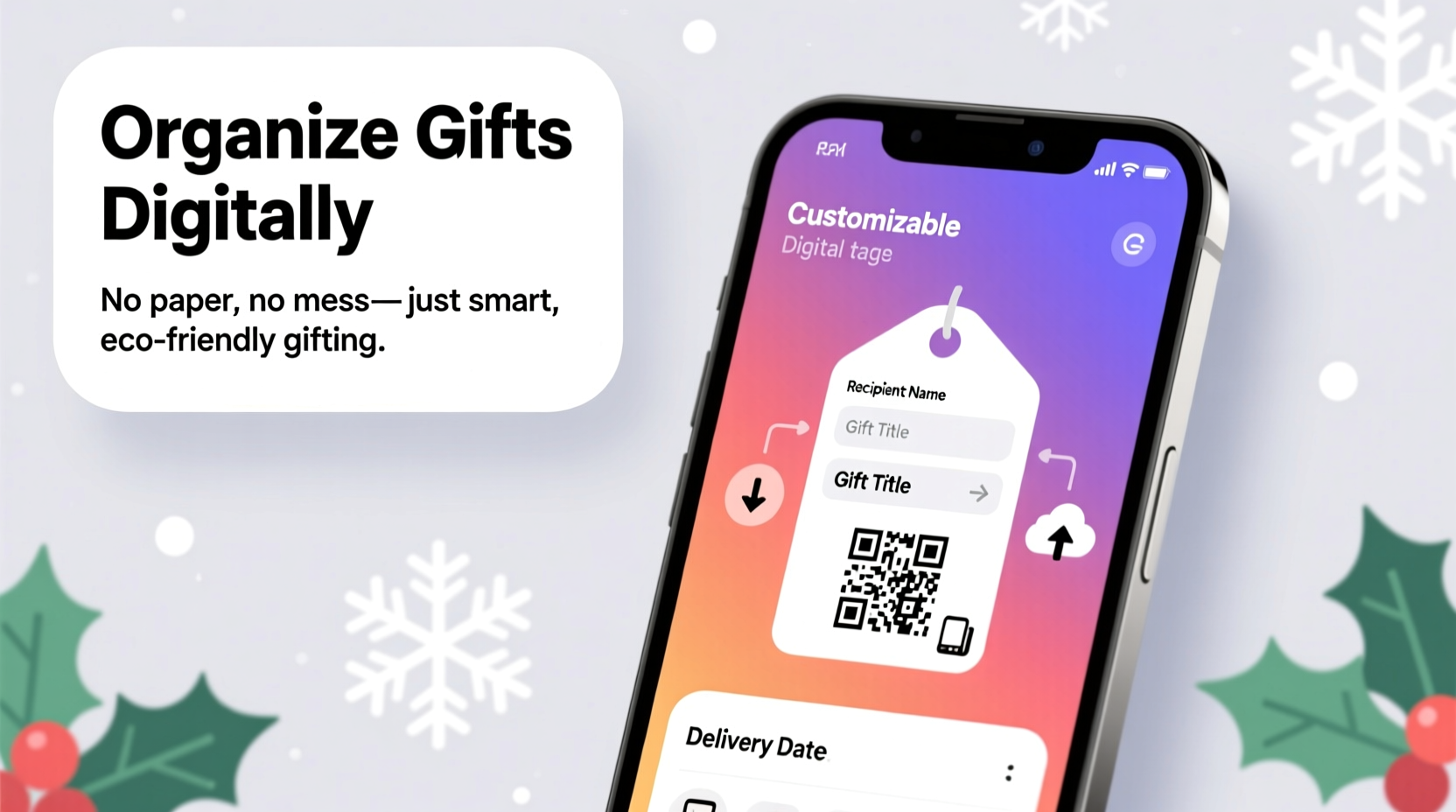
Paper gift tags may seem harmless, but they come with hidden drawbacks. They’re easily lost, difficult to update, and create clutter both during and after the holidays. Once unwrapped, they often end up crumpled at the bottom of a gift bag or swept into the trash—along with any useful notes they might have contained.
Digital gift tags solve these problems by centralizing information. Instead of relying on physical scraps, you store all gifting details—recipient names, gift ideas, purchase status, budget tracking, and personal messages—in a single, searchable location. This shift not only reduces environmental impact but also improves accuracy and collaboration.
“Digital organization tools allow families to plan more thoughtfully and execute more efficiently during high-pressure seasons like Christmas.” — Dr. Lydia Tran, Behavioral Scientist specializing in household productivity
Moreover, digital systems integrate seamlessly with other planning tools. You can link your gift list to shopping apps, set reminders for wrapping deadlines, or sync data across devices so everyone involved stays informed.
Top apps for digital gift tag management
Not all apps are created equal when it comes to organizing holiday gifts. The best ones combine simplicity with powerful features like tagging, status tracking, shared access, and integration with calendars or e-commerce platforms. Below is a comparison of leading options tailored for digital gift tagging.
| App Name | Best For | Key Features | Platform | Cost |
|---|---|---|---|---|
| Google Keep | Simple, fast note-taking | Color-coded labels, voice notes, image uploads, sharing | Web, Android, iOS | Free |
| Notion | Customizable databases | Templates, relational databases, collaborative editing | All major platforms | Free (Pro: $8/user/month) |
| Trello | Visual project-style tracking | Kanban boards, due dates, attachments, team sharing | All platforms | Free (Premium: $5/user/month) |
| Microsoft OneNote | Detailed note organization | Note sections, handwriting support, file embedding | Windows, macOS, mobile | Free with Microsoft account |
| AnyList | Shopping-integrated lists | Shared shopping lists, recipe importing, voice input | iOS, Android | Free (Plus: $1.99/month) |
Each app serves different needs. Google Keep excels in speed and accessibility, making it ideal for quick tagging and reminders. Notion offers unparalleled customization—you can build a full gift-tracking database with fields for recipient, idea, price, purchased status, wrapped, and delivered. Trello mimics physical sticky notes on a board, perfect for visual planners who like moving items from “To Buy” to “Wrapped.”
A step-by-step guide to setting up your digital gift tags
Moving from paper to digital doesn’t require a tech overhaul. With a clear process, you can transition smoothly and start benefiting immediately. Follow this timeline to get organized before the shopping rush begins.
- 3–4 weeks before Christmas: Choose your preferred app and create a new workspace or notebook titled “Christmas Gifts [Year].”
- Create categories: Set up sections or columns such as “To Buy,” “Purchased,” “Wrapped,” “Shipped,” and “Delivered.” In Notion or Trello, use a kanban view to drag items across stages.
- Add recipients: List every person receiving a gift. Include notes like age, interests, or past gifts to avoid repeats.
- Assign gift ideas: Brainstorm one or more ideas per person. Link to online product pages if available.
- Set budgets: Add estimated prices next to each gift. Use formulas (in Notion) or manual tracking to monitor total spending.
- Share access: If collaborating with a partner or family member, invite them to edit or view the list. Ensure permissions are set correctly.
- Update in real time: As you shop, mark items as purchased. When wrapping is done, move them to the next stage.
- Post-holiday review: After Christmas, archive the list and note which ideas were hits or misses for future reference.
This system transforms chaotic gifting into a streamlined workflow. Unlike paper tags, digital entries can be edited without scribbling over mistakes, duplicated effortlessly for similar gifts, and searched instantly if you forget who was getting what.
Real-world example: How the Reynolds family simplified their holiday chaos
The Reynolds family of six used to spend every December surrounded by stacks of paper lists, sticky notes, and half-written gift tags. “We’d buy duplicates because one parent didn’t know the other already got the Lego set,” says Sarah Reynolds, a teacher from Portland. “And after the kids opened presents, we had no idea who gave what.”
Last year, they switched to a shared Trello board. Each child got a card with their name, and under it, gift ideas were listed with links to Amazon products. Columns tracked progress: “Wishlist,” “Bought,” “Wrapped,” and “Given.” Sarah and her husband synced their phones, and even the older kids could check off items they helped wrap.
The biggest win came on Christmas morning. Using the “Given” column, they snapped photos of each gift and uploaded them to the corresponding card. Later, they reviewed the board together to thank relatives properly. “We finally knew Aunt Lisa gave the sweater and Uncle Mark sent the board game,” Sarah said. “No more guessing, no more forgotten thanks.”
Common pitfalls and how to avoid them
Even with the right tools, digital gift tagging can go wrong without proper habits. Here are frequent missteps and how to prevent them:
- Overcomplicating the system: Don’t build a 10-field database if a simple checklist suffices. Start minimal and expand only if needed.
- Forgetting to sync across devices: Always log into your chosen app on all devices you’ll use. Enable cloud backup to avoid data loss.
- Ignoring privacy: Avoid sharing sensitive info (like exact prices or personal messages) on unsecured shared lists. Use private notes within apps when necessary.
- Waiting too long to start: Begin organizing at least three weeks before shopping. Last-minute setups lead to incomplete tracking.
- Not reviewing post-holiday: Failing to archive or reflect means losing valuable insights for next year.
Checklist: Your digital gift tag setup in 7 steps
Use this concise checklist to ensure nothing falls through the cracks:
- ✅ Choose a digital tool (e.g., Notion, Trello, Google Keep).
- ✅ Create a master gift list with all recipients.
- ✅ Add at least one gift idea per person, with links if possible.
- ✅ Assign budgets and track totals to stay within limits.
- ✅ Set up status columns (e.g., To Buy → Purchased → Wrapped).
- ✅ Share the list with co-planners and confirm access.
- ✅ Update daily during peak shopping and wrapping periods.
This checklist ensures you cover every critical phase—from planning to post-holiday reflection—without relying on memory or scattered notes.
Frequently asked questions
Can I still include personal messages with digital gift tags?
Absolutely. Most apps let you add detailed notes to each gift entry. When wrapping, you can either print a small tag with the message or handwrite it based on the digital reminder. Some people even record short voice memos in apps like Google Keep to capture tone and emotion.
What if I’m not tech-savvy? Is this realistic for me?
Yes. Apps like Google Keep and AnyList are designed for everyday users. Start with a basic list, add names and ideas, and use checkboxes. You don’t need advanced features to benefit. Many users find digital systems easier than managing paper once they overcome the initial setup.
How do I handle secret gifts or surprises without spoiling them?
Use private notes or password-protected sections. In Notion, toggle visibility so only certain members see specific entries. Alternatively, use code names (e.g., “Project Reindeer” for a surprise trip) known only to organizers.
Make this Christmas smoother, greener, and smarter
Switching from paper gift tags to digital alternatives isn’t just a modern twist—it’s a practical upgrade. You gain clarity, reduce waste, improve collaboration, and preserve memories in a way paper never could. The time invested in setting up a digital system pays dividends in reduced stress, fewer mistakes, and more meaningful gifting.
Start today. Pick an app, add your first few recipients, and take the first step toward a more organized holiday. Whether you're managing five gifts or fifty, digital tagging puts you in control. And next year, you’ll already have a template ready to go—no starting from scratch.




 浙公网安备
33010002000092号
浙公网安备
33010002000092号 浙B2-20120091-4
Comments
No comments yet. Why don't you start the discussion?