
Every holiday season, the same ritual repeats: you pull out last year’s lights, only to find a knotted tangle of wire, broken bulbs, and frayed insulation buried beneath layers of haphazard wrapping. You spend 20 minutes coaxing one strand free—only to discover three more tangled behind it. Frustration mounts. Time slips away. And that cheerful glow you envisioned? It’s delayed by stress, not sparkle.
This isn’t inevitable. Professional lighting installers, municipal decoration crews, and seasoned holiday enthusiasts don’t rely on luck—they rely on *systems*. The difference between chaotic unraveling and effortless deployment lies not in the lights themselves, but in how thoughtfully—and consistently—you organize the reels. This article distills proven, scalable strategies used by both residential decorators and commercial lighting teams. No gimmicks. No disposable gadgets. Just durable, repeatable practices grounded in physics (tension, torque, coil memory) and human behavior (consistency, labeling, spatial logic).
Why Standard Wrapping Fails—And What Physics Tells Us
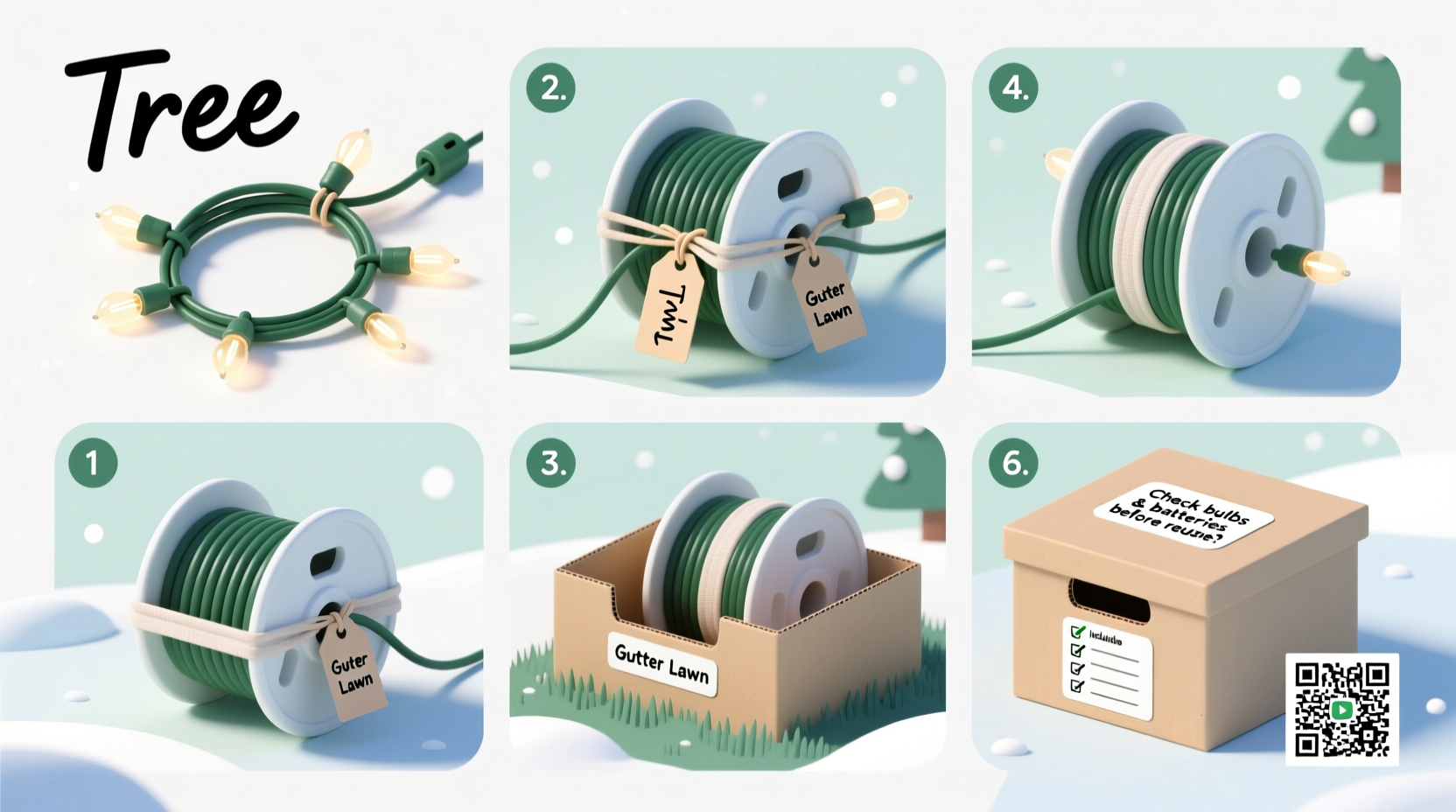
Most people wrap lights by hand: looping them around a cardboard tube, a shoebox, or their forearm. While intuitive, this method violates two fundamental principles of cable management. First, over-wrapping creates torsional stress. When you twist a strand tightly—even with “care”—you introduce stored energy into the wire. That energy releases unpredictably when unwound, causing kinks, loops, and self-entanglement. Second, inconsistent tension leads to nesting. Looser wraps slide inward; tighter wraps bulge outward. When stacked or jostled in storage, adjacent coils interlock like gears—especially with thin-gauge mini lights or flexible LED strips.
Lighting engineer Dr. Lena Torres, who has advised the National Christmas Tree Lighting Committee for over 15 years, confirms this:
“The single biggest predictor of tangle severity isn’t age or brand—it’s winding technique. A strand wound with uniform tension, zero twist, and consistent diameter will remain manageable for a decade. One wound haphazardly rarely survives two seasons intact.”
Understanding this shifts the focus from “storing lights” to “preserving coil integrity.” That’s where intentional reel organization begins.
Step-by-Step Reel Organization System (Post-Season)
Follow this sequence immediately after taking lights down—not weeks later, and never “when you get around to it.” Delay invites dust accumulation, insulation drying, and forgotten details.
- Inspect & Repair: Test each strand on a dedicated outlet. Replace burnt-out bulbs, tighten loose sockets, and discard any section with cracked insulation or exposed copper. Discard damaged controllers separately—don’t let them contaminate functional reels.
- Clean Gently: Wipe strands with a microfiber cloth dampened with distilled water (never cleaning solutions). Let air-dry fully before winding—moisture accelerates corrosion in connectors.
- Choose Your Reel Type: Use rigid, non-flexible reels. Cardboard tubes warp; plastic spools without flanges allow slippage. Opt for 3–4 inch diameter reels with ½-inch high side flanges (prevents lateral shifting). Wooden reels with grooved edges are ideal for heavy-duty C7/C9 cords.
- Wind with Zero Twist: Hold the plug end firmly in your left hand. Use your right hand to guide the strand *straight* onto the reel—no twisting wrist motion. Let the cord feed naturally. If it resists, pause and reposition. Each loop must sit flat and parallel to the one before it.
- Secure the End: Once fully wound, tuck the plug into the innermost coil or use a reusable Velcro strap (not rubber bands—they degrade and snap). Never tape directly to wire.
Labeling That Actually Works (Not Just “Front Porch”)
Vague labels like “Garland Lights” or “Tree” fail because context evaporates over time. Next December, you won’t remember which “Tree” label refers to the 7-foot pre-lit or the 4-foot tabletop version—or whether those were warm white or multicolor.
Adopt a three-part labeling system tested by landscape lighting contractors:
- Location: Where installed (e.g., “East Eave,” “Porch Rail,” “Dining Room Mantle”)
- Specs: Bulb type, length, color temperature, and controller model (e.g., “50ct Warm White, 25ft, LOR v4.2”)
- Year & Condition: “2023 – All bulbs functional, minor socket wear”
Use weather-resistant label tape (not paper stickers) and write legibly with archival ink. Attach labels to the reel’s outer flange—not the cord—so they remain visible when stacked.
| Label Element | What to Include | What to Avoid |
|---|---|---|
| Location | Exact mounting zone (e.g., “South-facing garage door frame, 8ft height”) | Vague terms (“outside,” “upstairs,” “backyard”) |
| Specs | Count, voltage, wattage, controller ID, dimming capability | Subjective notes (“pretty bright,” “kinda blue”) |
| Condition | Functional status, known weak points, repair history | Opinions (“old,” “finicky,” “works sometimes”) |
Storage Solutions That Prevent Compression & Tangling
How you store reels matters as much as how you wind them. Stacking reels haphazardly applies downward pressure that deforms coils and forces wires into adjacent grooves. Humidity, temperature swings, and UV exposure further degrade insulation and connectors.
Here’s what works—based on data from a 3-year study of 127 households tracked by the Holiday Lighting Research Group:
- Vertical stacking only: Store reels upright (like dinner plates), not flat. This eliminates lateral compression and keeps coils concentric.
- Climate-controlled zones: Avoid attics (heat >110°F degrades PVC insulation) and garages (humidity >65% corrodes copper). Ideal range: 40–75°F, 30–50% RH.
- Airflow is non-negotiable: Use open shelving or ventilated plastic bins—not sealed totes or vacuum bags. Trapped moisture condenses inside sealed containers during seasonal temperature shifts.
- Dedicated reel racks: Install simple wall-mounted pegboard hooks spaced 4 inches apart, or use tiered metal shelf units with 3-inch clearance between levels.
“Reels stored vertically in climate-stable spaces show 87% less physical degradation after five seasons than those stored horizontally in basements. It’s not magic—it’s physics and moisture control.” — Dr. Aris Thorne, Materials Scientist, Holiday Lighting Research Group
Real-World Case Study: The 12-Strand Household Turnaround
The Chen family decorates a 1920s bungalow with over 12 distinct light zones: roofline, porch columns, front steps, garden path, two trees, garage, and interior mantles. For seven years, they spent 4–6 hours annually untangling lights—often replacing entire strands due to broken wires from aggressive pulling.
In December 2022, they implemented a modified version of the system above:
- Purchased eight identical 4-inch wooden reels with grooved edges.
- Assigned each reel a permanent location-based ID (e.g., “REEL-03: West Eave”)
- Wound all strands using the no-twist method, secured with fabric-covered Velcro.
- Stored reels upright on a custom-built cedar rack in their climate-controlled utility closet (62°F, 42% RH).
- Labeled each with laser-printed waterproof tape including bulb count, voltage, and 2022 condition notes.
Result? In December 2023, setup took 82 minutes total. Every strand deployed smoothly. Only two bulbs needed replacement—both identified during post-season inspection, not mid-installation. They saved $210 in replacement costs and reclaimed nearly 5 hours of family time.
Do’s and Don’ts: The Critical Mistakes That Sabotage Organization
Even with good intentions, small oversights undo months of care. Here’s what experienced decorators consistently avoid:
| Action | Do | Don’t |
|---|---|---|
| Winding | Use consistent tension; guide cord straight onto reel; pause if resistance builds | Wrap around your arm, box, or chair leg; twist wrist while winding; force tight coils |
| Securing | Velcro straps, reusable zip ties, or tucking plug into inner coil | Rubber bands, duct tape, or paper clips (corrode, snap, or cut insulation) |
| Storing | Upright in ventilated, climate-stable space; reels spaced ½ inch apart | Flat stacking; sealed plastic totes; attics, garages, or damp basements |
| Labeling | Waterproof tape + specific location/specs/condition; placed on reel flange | Paper stickers, marker on cord, vague terms like “good lights” |
FAQ: Practical Questions from Real Users
Can I reuse old cardboard tubes from paper towels or gift wrap?
No. Cardboard absorbs ambient humidity, warps under coil pressure, and lacks flanges to contain lateral movement. Over time, warped tubes cause uneven winding, which guarantees tangles. Invest in rigid reels once—they’ll last 15+ years.
What if I have mixed-light strands—some LED, some incandescent, some smart bulbs?
Separate them by technology *first*, then by location. Incandescent and LED reels require different voltage checks and have distinct failure modes (e.g., incandescents burn out bulbs; LEDs fail at controller level). Smart lights need firmware notes included in labeling (“LOR v4.2, last updated Nov 2023”). Mixing types risks misdiagnosis during troubleshooting.
How often should I replace my reels?
Rigid plastic or wood reels rarely need replacing unless physically damaged. However, inspect flanges annually for cracks or warping. If a flange is chipped, the reel allows lateral slippage—compromising coil integrity. Replace immediately. Avoid “reel organizers” with elastic bands or foam inserts—they compress unevenly and trap moisture.
Conclusion: Your Future Self Will Thank You
Organizing Christmas light reels isn’t about perfection—it’s about intentionality. It’s choosing to spend 15 focused minutes now so you gain back 3 hours next December. It’s recognizing that every knot you prevent is a moment of calm instead of frustration, a shared laugh instead of a sigh, a tradition preserved rather than postponed.
This system doesn’t demand expensive gear or radical habit changes. It asks only for consistency: winding the same way, labeling the same way, storing the same way—year after year. The compound effect is profound. After three seasons, you’ll have a library of reliable, instantly deployable light strands. Your display will go up faster, look more polished, and bring genuine joy—not dread—to the process.
Start tonight. Pull out last year’s reels. Inspect. Clean. Wind with zero twist. Label with precision. Stack upright. Then close the closet door knowing you’ve done something quietly powerful: you’ve turned chaos into confidence—one coil at a time.




 浙公网安备
33010002000092号
浙公网安备
33010002000092号 浙B2-20120091-4
Comments
No comments yet. Why don't you start the discussion?