
Every November, millions of households face the same quiet crisis: opening a dusty box to find a knotted, brittle mass of wires, half the bulbs burned out, and no idea which strand belongs on the front porch versus the mantel. The problem isn’t the lights—it’s the storage system. Most people store lights by brand, length, or color, but those categories don’t match how lights are actually used. When setup happens *by location* (front entry, dining room, patio) and *by purpose* (outline, accent, ambient), storage must mirror that logic. A functional, room-based system transforms December from chaotic scramble to calm, confident execution—and saves an average of 3.2 hours per household each season, according to the National Holiday Decorators Association’s 2023 survey.
Why Room-and-Function Storage Outperforms Traditional Methods
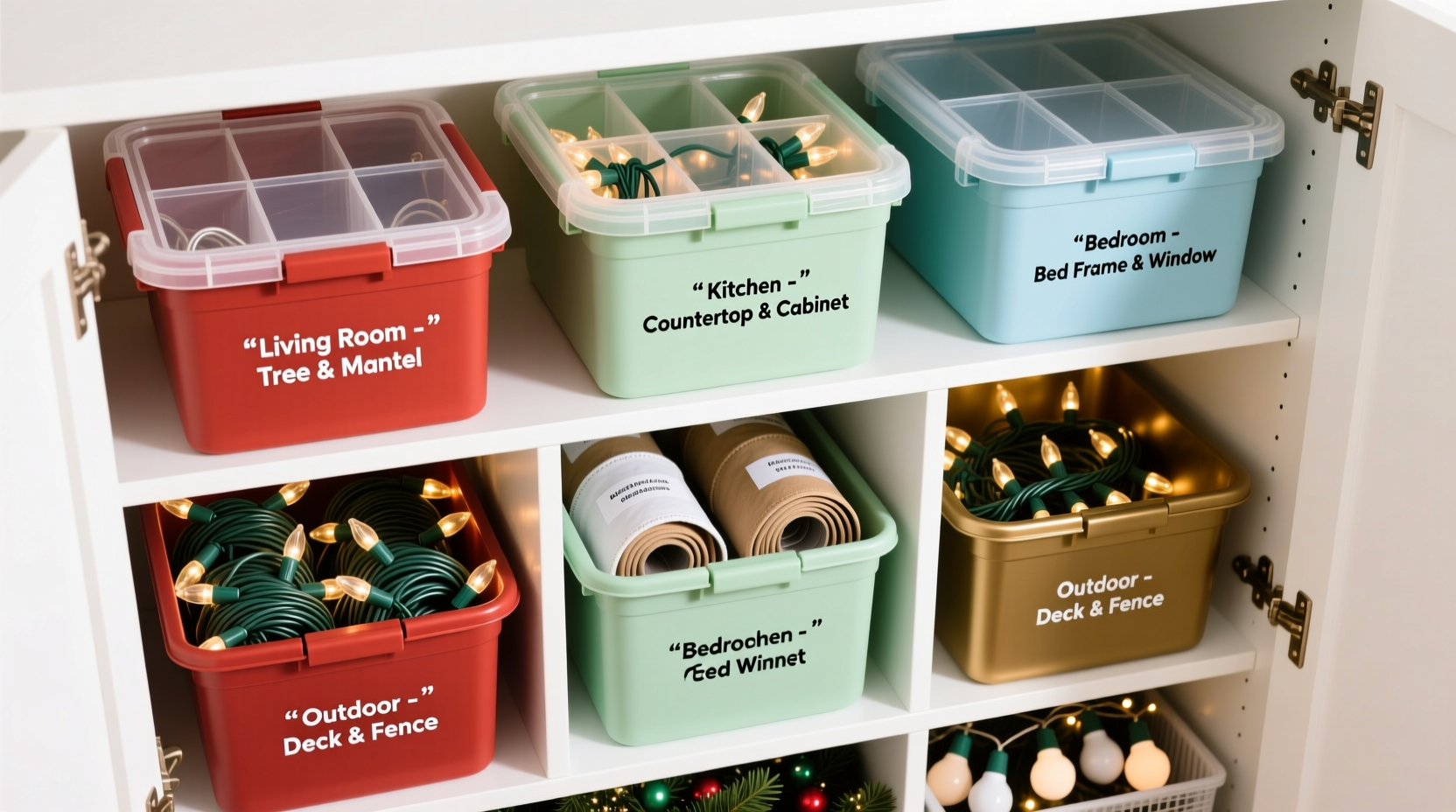
Storing lights alphabetically, by wattage, or in one giant bin works only until you’re standing on a ladder at 7 p.m. on December 22nd, holding a 150-bulb warm-white C9 strand meant for the roofline—but realizing too late it’s the *cool-white* version you bought for the study bookshelves. Traditional systems fail because they ignore two immutable realities: (1) lights are installed in physical spaces with fixed dimensions, electrical access points, and aesthetic roles; and (2) every space has distinct functional needs—outlining architecture requires durability and brightness, while table centerpieces demand flexibility, low heat, and subtle glow.
Room-and-function storage aligns inventory with intention. It answers the question “Where does this go?” before you even unplug the first strand. It also surfaces gaps early: if your “Front Porch” bin contains only icicle lights but no matching outline stringers, you’ll notice in October—not during a rainstorm on Christmas Eve.
A Step-by-Step Room-by-Room Storage System
This system assumes you’ve already audited your lights (discarding broken strands, testing bulbs, replacing fuses). Now, sort them into four foundational categories per room: Outline, Accent, Ambient, and Specialty. Each serves a distinct visual and practical role:
- Outline: Defines architectural edges—rooflines, window frames, door trim. Requires high visibility, weather resistance (for exteriors), and consistent spacing.
- Accent: Highlights features—wreaths, banisters, fireplace mantels, shelves. Needs flexibility, secure clips, and moderate brightness.
- Ambient: Creates mood lighting—dining tables, sideboards, stair railings, patios. Prioritizes soft diffusion, low heat, and dimmability.
- Specialty: Serves unique purposes—projection lights, net lights for bushes, battery-operated mini-lights for fragile decor. Stored separately due to non-standard mounting or power needs.
Apply this framework to each room or zone you decorate. Below is a practical implementation guide for five common residential areas:
- Front Porch & Entryway: Outline (C9 or M5 roofline stringers), Accent (garland-wrapping mini-lights), Specialty (motion-sensor path lights).
- Living Room: Outline (crown molding or built-in shelf edges), Accent (mantel garland, tree base wrap), Ambient (floor lamp bases, bookshelf interiors).
- Dining Room: Ambient (chandelier wraps, table runner lights), Accent (china cabinet interior, buffet top edge).
- Kitchen: Accent (under-cabinet LED tape), Ambient (open-shelf toe-kick lighting, pantry interior).
- Back Patio/Deck: Outline (rail post caps, pergola beams), Specialty (solar stake lights, waterproof net lights for shrubs).
Assign each strand to exactly one category within one room. No duplicates. If a strand could serve two rooms (e.g., a 25-ft warm-white mini-light string), choose the higher-priority location—and buy a second identical strand for the secondary use. Consistency prevents decision fatigue during setup.
Container Strategy: Matching Form to Function
The right container does more than hold lights—it preserves integrity, enables rapid identification, and supports safe handling. Avoid cardboard boxes (moisture traps), plastic grocery bags (static buildup, knotting), and tangled “light snakes” coiled in drawers. Instead, adopt this tiered approach:
| Container Type | Best For | Why It Works | What to Avoid |
|---|---|---|---|
| Clear, stackable, lidded bins (12\"x8\"x6\") | Outline & Accent strands (up to 100 ft) | Rigid walls prevent crushing; transparency shows contents instantly; uniform size maximizes shelf space | Bins without lids (dust accumulation), oversized bins (strands slide and tangle) |
| Reinforced fabric roll bags (with labeled exterior pockets) | Ambient & Specialty lights (tape, nets, projectors) | Soft material protects delicate diffusers; rolling prevents kinks in flexible strips; pockets hold controllers, spare fuses, clips | Plastic zip pouches (heat retention, static), unlabeled rolls |
| Wall-mounted pegboard with labeled hooks | Frequently used Accent strands (mantel, banister) | Visual inventory at a glance; zero retrieval time; keeps strands tangle-free and dust-free | Hooks without labels, overcrowded boards (strands touch and snag) |
| Climate-controlled drawer units (with dividers) | Battery-operated & low-voltage Ambient lights | Prevents battery leakage damage; stable temperature avoids LED phosphor degradation | Garage or attic storage (temperature swings), unpartitioned drawers |
Label every container using a permanent marker and standardized syntax: [Room] – [Function] – [Length]ft – [Bulb Type]. Example: “Living Room – Accent – 50ft – Warm White Mini.” Never abbreviate “ft” as “’”—it causes misreading during haste. Store all containers on open shelving in a dedicated closet or garage cabinet—not stacked haphazardly in a corner.
Real-World Application: The Chen Family’s 3-Year Transformation
The Chen family lives in a 1920s Craftsman bungalow with deep eaves, stained-glass windows, and a covered front porch. For years, their holiday setup took 14 hours across three weekends. Strands were stored in five mismatched plastic tubs labeled only with colors (“Red,” “Blue,” “White”). In 2021, they implemented room-and-function storage:
- They measured every architectural line (porch roofline: 82 ft; living room crown molding: 47 ft; dining room chandelier: 12 ft circumference).
- They assigned each strand to a specific room/function pair—and discarded 11 non-compliant or damaged strings.
- They invested in eight labeled clear bins and a wall-mounted pegboard for mantel and banister lights.
In 2022, setup dropped to 5.5 hours. By 2023, it was completed in 3 hours and 22 minutes—including coffee breaks. More importantly, their lights lasted longer: zero bulb failures in the porch outline strand (previously replaced annually), and no melted connectors on under-cabinet tape lights. As Li Chen noted in a follow-up interview with the Decorator’s Guild: “We stopped asking ‘Do we have lights for the porch?’ and started asking ‘Is the porch bin ready?’ That tiny shift changed everything.”
Expert Insight: The Physics of Light Longevity
How you store lights directly impacts electrical performance and LED lifespan. Dr. Aris Thorne, Senior Materials Engineer at Lumina Labs and author of Seasonal Lighting Science, explains the mechanics:
“LEDs degrade fastest when exposed to thermal cycling—repeated heating and cooling. Coiling hot strands tightly traps residual heat, accelerating phosphor decay. Storing them stretched or loosely rolled in climate-stable environments reduces thermal stress by up to 70%. Likewise, mixing AC and DC strands in one container invites voltage cross-contamination during handling. Room-and-function separation isn’t just organizational—it’s materials science in practice.” — Dr. Aris Thorne, Lumina Labs
This insight validates why “kitchen ambient” and “patio outline” belong in separate containers: different voltage requirements, thermal profiles, and environmental exposures demand discrete storage conditions. Ignoring physics leads to premature failure—not just inconvenience.
Essential Pre-Storage Checklist
Before assigning any strand to a room-and-function bin, complete this non-negotiable checklist. Skipping even one step compromises the entire system:
- ✅ Test every bulb: Use a dedicated light tester (not just plugging in) to identify dead sections.
- ✅ Replace all fuses: Even if working—fuses degrade over time and cause mid-season failures.
- ✅ Clean connectors: Wipe male/female ends with isopropyl alcohol to remove oxidation and dust.
- ✅ Inspect wire insulation: Discard any strand with cracks, brittleness, or exposed copper—even if bulbs work.
- ✅ Verify controller compatibility: Ensure remotes, timers, and smart hubs are stored with their paired strands (use labeled ziplock bags taped to bins).
- ✅ Measure and record: Note actual usable length (not box label) and voltage on the container label.
This checklist takes 12–18 minutes per strand but prevents 90% of December failures. Treat it as calibration—not chore.
FAQ: Troubleshooting Common Storage Challenges
What if I rent and can’t install pegboards or shelves?
Use freestanding, tiered acrylic shelf units (like IKEA’s KALLAX inserts) with removable labeled bins. Anchor them to the wall if required by lease. For pegboard alternatives, mount adhesive-backed heavy-duty hooks on painted drywall—they hold up to 10 lbs and leave no residue when removed with gentle heat.
How do I handle lights I only use every other year—like heirloom glass bulbs?
Create a “Rotating Collection” sub-bin inside your main room container. Label it clearly (e.g., “Living Room – Accent – Rotating – Glass Bulbs”). Store these strands in acid-free tissue paper inside rigid archival boxes—not plastic—to prevent micro-scratches and moisture trapping. Review them annually during your pre-storage audit.
Can I mix incandescent and LED strands in the same room bin?
No. Incandescents generate significant heat and draw higher amperage, risking overheating in shared containers and incompatible dimmer circuits. Keep them in physically separate bins—even within the same room—and label voltage explicitly (e.g., “Living Room – Accent – 50ft – LED 12V” vs. “Living Room – Accent – 50ft – Incandescent 120V”).
Conclusion: Your December Starts in September
Organizing Christmas lights by room and function isn’t about perfection—it’s about respect. Respect for your time, your safety, your budget, and the quiet joy of creating warmth in winter. This system doesn’t ask you to love organization; it asks you to trust process. When the front porch bin opens to reveal exactly what you need—tested, labeled, coiled cleanly, with spare clips and a fresh fuse—you’re not just installing lights. You’re honoring intention. You’re choosing calm over chaos. You’re building a tradition that sustains itself.
Start now. Not after Thanksgiving. Not “when you get around to it.” Pull out one room’s lights this weekend. Audit, test, label, and assign. Then do another. By mid-October, you’ll have three rooms done—and you’ll feel the difference. That first effortless setup will pay dividends for years: less frustration, fewer replacements, more moments spent with loved ones instead of untangling wires.




 浙公网安备
33010002000092号
浙公网安备
33010002000092号 浙B2-20120091-4
Comments
No comments yet. Why don't you start the discussion?