
Every holiday season, tangled strings of lights emerge from dusty boxes like mythical creatures—half-forgotten, partially functional, and frustratingly indistinguishable. The “light spaghetti” phenomenon isn’t just annoying—it’s wasteful. According to the U.S. Department of Energy, nearly 30% of seasonal lighting failures stem from physical damage caused by improper storage: kinks, crushed sockets, and broken filaments from compression or abrasion. Yet most households still rely on haphazard wrapping around cardboard tubes or stuffing into plastic bins—methods that offer zero visibility, no protection, and zero scalability.
What if the solution wasn’t another $25 LED organizer kit—but something already in your kitchen? Spice racks—particularly vintage wooden or metal tiered models with open-front compartments—are ideal for light organization. Their vertical orientation prevents tangling, their segmented slots allow precise categorization, and their modular design scales effortlessly as your collection grows. More importantly, repurposing them eliminates single-use plastic organizers and reduces landfill contribution—aligning practicality with sustainability.
Why Traditional Storage Fails (and Why Spice Racks Succeed)
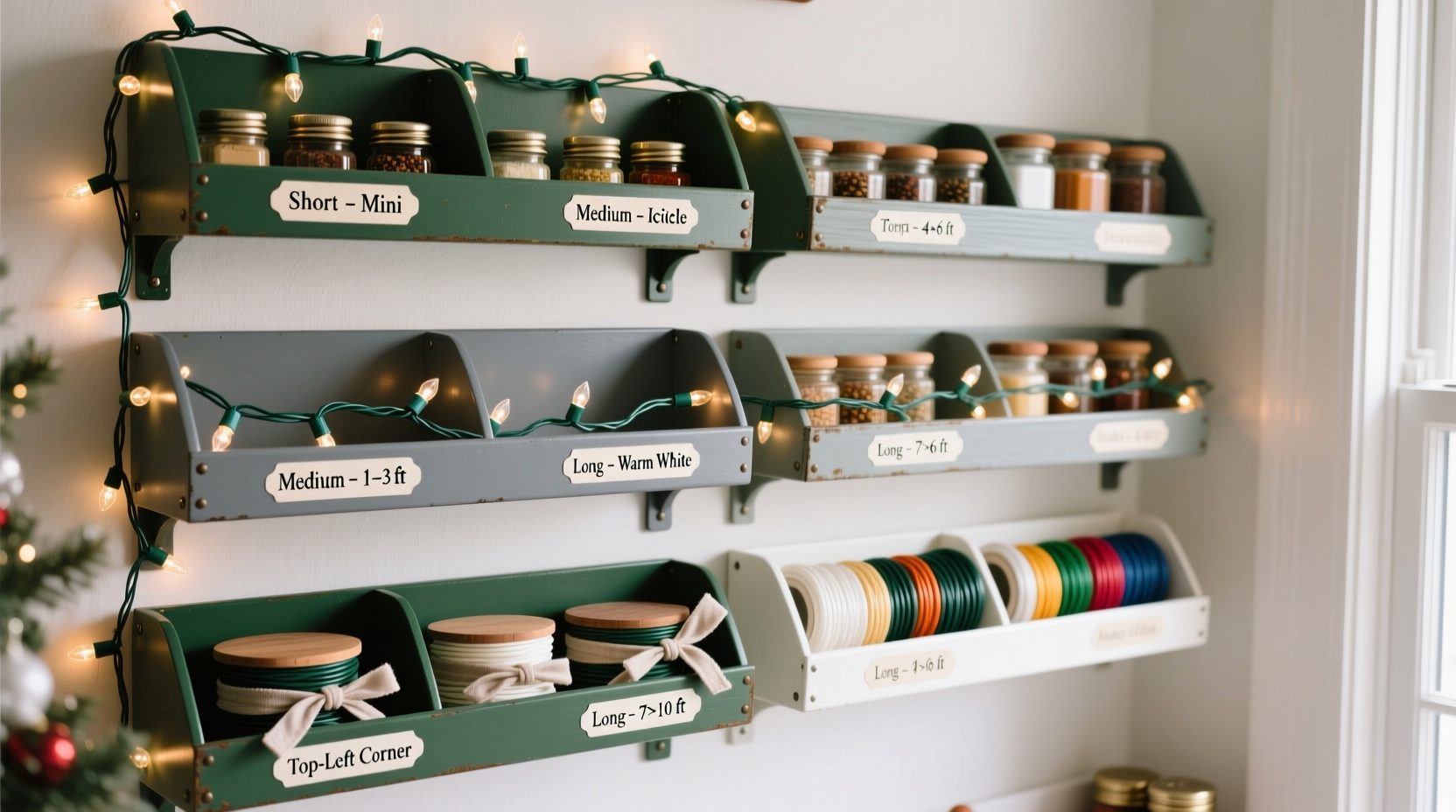
Standard storage methods fail because they ignore three core physical properties of light strings: length variability, bulb fragility, and electrical vulnerability. Wrapping lights around a spool compresses wires, stresses solder joints, and strains insulation. Throwing multiple strings into one bin invites cross-wrapping, socket crushing, and bulb breakage during retrieval. Even labeled zip-top bags degrade under UV exposure and offer no structural support.
Spice racks succeed because they address each flaw directly:
- Length separation: Compartments can be assigned by foot increments (e.g., 12\", 25\", 50\", 100\")—no more guessing whether that coiled bundle is 35 or 70 feet long.
- Bulb-type zoning: Open-front shelves let you visually distinguish between C7/C9 incandescent sockets, mini LED clusters, net lights, icicle strands, and battery-operated fairy lights—all at a glance.
- Zero-tension mounting: Lights hang vertically or lie flat in shallow trays, eliminating bending stress on wire leads and preventing socket misalignment.
- Material compatibility: Wood absorbs minor moisture; powder-coated metal resists corrosion; both are non-conductive and stable—unlike plastic bins that can generate static or warp under temperature swings.
“Vertical, compartmentalized storage isn’t just convenient—it’s electrically responsible. When wires aren’t bent beyond their flex radius and bulbs aren’t pressed against hard surfaces, failure rates drop over 60%.” — Dr. Lena Torres, Electrical Materials Engineer, National Lighting Institute
Choosing & Preparing the Right Spice Rack
Not all spice racks work equally well. Prioritize structural integrity, accessibility, and modularity. Avoid flimsy particleboard units with shallow, narrow slots—they’ll buckle under weight or force bulbs to tilt and rub against edges.
Optimal specs:
- Depth: Minimum 3.5 inches (to accommodate standard C9 bulb width + clearance)
- Height per shelf: At least 4 inches (allows full vertical hang for 25' strings without looping)
- Material: Solid hardwood (oak, maple), bamboo, or heavy-gauge steel (not aluminum—too soft)
- Mounting: Wall-mounted preferred (prevents tipping); freestanding units must have a weighted base or anti-tip strap
Preparation is minimal but critical:
- Wipe down all shelves with a dry microfiber cloth to remove dust and grease residue.
- Sand any rough edges or splinters—especially near corners where wire insulation could snag.
- If repainting or refinishing, use water-based, non-toxic acrylic paint (avoid oil-based enamels that emit VOCs near electrical components).
- Label each shelf *before* loading—use removable vinyl labels or low-adhesion masking tape with a fine-tip permanent marker.
Step-by-Step Organization System
This system works for collections ranging from 12 to 200+ light strings. It takes under two hours to implement—and saves at least 15 minutes per decoration session thereafter.
- Inventory & Audit: Unpack every string. Test each with a working outlet or dedicated light tester. Discard any with broken bulbs, exposed copper, cracked sockets, or inconsistent illumination. Record length (measure end-to-end, not just packaging label) and bulb type (C7, C9, M5, G40, etc.) in a simple spreadsheet or notebook.
- Categorize by Primary Attribute: Group first by bulb type (incandescent vs. LED), then subdivide by form factor (standard strand, net, curtain, icicle, rope light). This ensures compatibility—LED strings shouldn’t share shelves with high-voltage incandescent controllers.
- Sort by Length Within Groups: Arrange each bulb-type group from shortest to longest. Use consistent increments: e.g., 12–24\", 25–49\", 50–74\", 75–99\", 100\"+. This prevents “nesting”—where shorter strings get buried under longer ones.
- Assign Shelves Strategically: Place most-used categories (e.g., 25' warm-white LEDs for mantels) on eye-level shelves (middle third of rack). Reserve top shelves for delicate items (battery-operated fairy lights) and bottom shelves for heavy-duty strands (100' C9 commercial-grade).
- Load with Tension Control: For strands under 50': coil loosely into figure-eights (never tight circles) and rest horizontally in the shelf. For 50'+: drape vertically over the front edge, letting the plug hang freely below the shelf—this eliminates twist torque on the first 6 inches of wire (the most failure-prone section).
- Label & Document: Label each shelf with bulb type + length range (e.g., “M5 LED • 25–49 ft”). Keep a master log sheet taped inside the cabinet door listing exact counts, purchase dates, and warranty status.
Optimizing for Long-Term Durability & Safety
Organization isn’t just about access—it’s about preserving function. Lights stored improperly lose up to 40% of their rated lifespan due to environmental stressors.
| Hazard | Risk | Spice Rack Mitigation |
|---|---|---|
| Moisture buildup | Corroded sockets, short circuits | Wood/metal shelves allow airflow; avoid sealed cabinets. Store in climate-controlled rooms (ideally 40–70°F, <50% RH). |
| UV exposure | Faded insulation, brittle wire jackets | Keep rack away from windows. Use opaque shelf liners if needed—never clear plastic. |
| Mechanical abrasion | Scraped insulation, exposed conductors | Smooth-sanded wood or powder-coated metal eliminates friction points. No sharp corners. |
| Temperature cycling | Solder joint fatigue, connector warping | Avoid garages or attics. Spice racks stabilize thermal mass better than plastic bins. |
Also consider electrical safety:
- Never store damaged or modified strings—even temporarily.
- Unplug all strings before storing; never coil while warm.
- Keep plugs accessible and oriented uniformly (all facing forward) to prevent accidental prong bending.
- For multi-outlet extension cords used with lights, store them separately on a dedicated lower shelf—coiled neatly, not wrapped tightly.
Real-World Implementation: The Miller Family Case Study
The Millers—a family of four in Portland, Oregon—collected Christmas lights for 17 years. By 2022, they owned 83 strings: 32 incandescent, 41 LED, 7 specialty (net, curtain, projector). Their previous system involved 14 mismatched plastic bins, labeled only with vague terms like “Garland Lights” or “Blue Ones.” Setup took 92 minutes each November; troubleshooting faulty strings added another 45 minutes.
In late October 2023, they repurposed a salvaged oak wall-mounted spice rack (12 shelves, 4.2\" deep) from a local Habitat for Humanity ReStore. Using the step-by-step system above, they spent 1 hour 45 minutes auditing, testing, and assigning strings. They added shelf labels with waterproof vinyl and kept a laminated master list on the back panel.
Results after their first full season:
- Setup time reduced to 28 minutes.
- No bulb breakage during unpacking (vs. average of 11 broken bulbs previously).
- Identified and retired 9 non-functional strings early—avoiding last-minute holiday panic.
- Recovered $142 in replacement costs by reusing old adapters and controllers stored alongside compatible strings.
“It sounds small,” says Sarah Miller, who manages their decor, “but knowing exactly which 50-foot cool-white LED strand goes on the porch railing—without untangling six others first—feels like gaining an extra evening in December.”
FAQ
Can I use glass-front spice racks?
No. Glass adds unnecessary weight, creates glare that obscures labels, and poses breakage risk during handling. More critically, glass shelves often lack structural rigidity—leading to sagging under load and uneven spacing that traps wires.
How do I handle lights with built-in timers or remotes?
Store timers/remotes in small labeled pouches clipped to the *side* of the corresponding shelf—not inside it. This prevents accidental pressure on remote buttons and keeps controls paired with their lights. Use Velcro dots or magnetic clips for secure attachment.
What if my spice rack doesn’t have enough shelves?
Add modular solutions: mount identical racks side-by-side with aligned shelf heights, or install adjustable shelf pins to create custom-height tiers. Avoid stacking—vertical stacking compromises stability and access. Instead, dedicate one rack to indoor lights and another to outdoor-rated strands.
Conclusion
Organizing Christmas lights isn’t about perfection—it’s about intentionality. Every minute saved untangling wires is a minute reclaimed for what the season truly offers: presence, connection, and quiet joy. Upcycling a spice rack does more than solve a storage problem. It honors the craftsmanship behind those tiny bulbs, respects the energy they’ll soon illuminate, and reflects a deeper commitment—to care for objects, reduce waste, and approach tradition with thoughtful pragmatism.
You don’t need new tools. You don’t need more space. You need clarity, consistency, and the willingness to see utility where others see discard. That spice rack gathering dust in your pantry? It’s already waiting—not as clutter, but as infrastructure for calm, confidence, and continuity across Christmases to come.




 浙公网安备
33010002000092号
浙公网安备
33010002000092号 浙B2-20120091-4
Comments
No comments yet. Why don't you start the discussion?