
Every November, millions of households open a storage bin only to confront the same seasonal riddle: a knotted, indecipherable mass of wires, bulbs, and frayed ends—Christmas lights that defy logic and patience. What begins as festive anticipation often devolves into 45 minutes of cursing, broken bulbs, and abandoned strands. The root cause isn’t poor lighting design—it’s unstructured storage. Without intentional organization by both color *and* function, even high-quality LED strings become disposable clutter by year three. This isn’t about aesthetics alone; it’s about efficiency, safety, longevity, and sanity. Lights stored haphazardly suffer from insulation stress, connector corrosion, and voltage mismatch risks when misused. But with a repeatable, low-effort system rooted in how lights are actually used—not just how they’re sold—you can transform chaotic bins into intuitive, reliable toolkits for holiday setup.
Why color + function matters more than brand or length
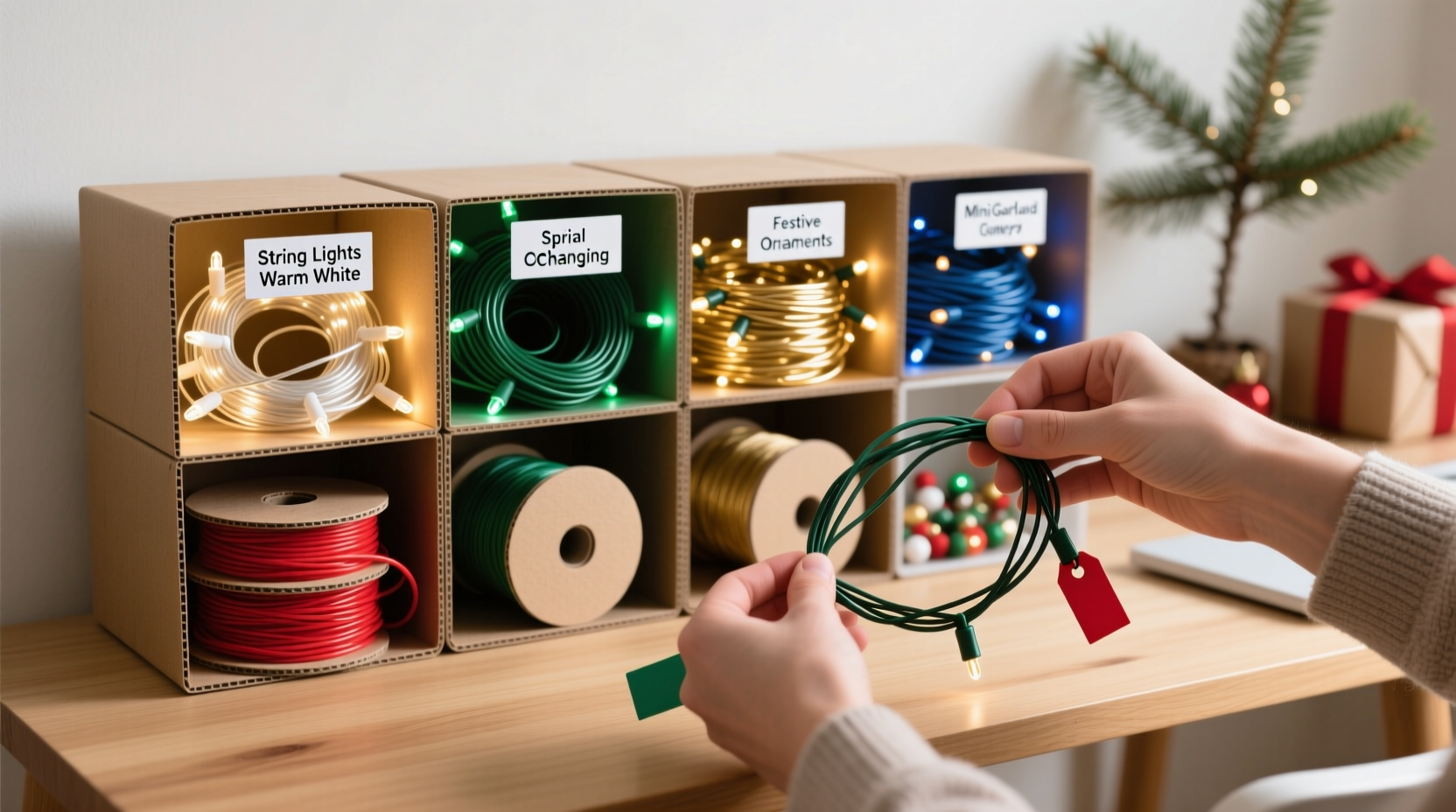
Most people sort lights by box label, brand, or wire length. That approach fails because it ignores two critical real-world variables: visual harmony and electrical compatibility. A 100-bulb warm-white mini string and a 100-bulb cool-white mini string may share identical packaging—but they belong on different trees, different eaves, and different circuits. Likewise, a 35-foot commercial-grade C9 string designed for outdoor rooflines has no business sharing a drawer with delicate battery-operated fairy lights meant for indoor mantels. Function dictates voltage (120V AC vs. 3–6V DC), weather resistance (IP44 vs. IP65), dimmability, and controller compatibility. Color determines emotional tone, architectural contrast, and layering logic. When you conflate the two—storing all “white” lights together regardless of function—you invite mismatches: using non-dimmable LEDs on a smart hub, overloading an outlet with unbalanced loads, or hanging indoor-only lights on a rain-exposed porch.
Professional lighting designers follow this dual-axis principle instinctively. As lighting consultant Marcus Bell explains:
“Color is your palette; function is your architecture. You wouldn’t hang museum-grade track lighting in a shower—and you shouldn’t plug a 20-watt rope light into the same circuit as ten 5-watt micro-LEDs. Sorting by both eliminates guesswork, prevents damage, and lets you visualize combinations before unwrapping a single strand.” — Marcus Bell, Founder of LuminaEdge Design Group
This dual sorting method also accelerates troubleshooting. If your blue accent lights flicker only on the front porch, you instantly know to check the outdoor-rated blue section—not dig through every white and multicolor box in your garage.
A step-by-step system: From tangle to taxonomy
Follow this seven-stage process to rebuild your light collection with intention. It takes 90–120 minutes for a typical household collection (15–25 boxes) and pays dividends every season thereafter.
- Empty & inspect: Remove all lights from boxes. Discard any with cracked sockets, exposed copper, or bulbs that won’t light after testing (use a simple outlet tester or multimeter).
- Test under load: Plug each strand into a power source *for 5 full minutes*. Many LEDs fail only when heated—don’t trust a 10-second flash test.
- Identify function first: Classify each working strand into one of five functional categories: Indoor Decorative (battery or low-voltage, non-weatherproof), Outdoor Accent (IP44+, rated for covered porches), Outdoor Structural (IP65+, for roofs, gutters, railings), Commercial/High-Density (24+ watts, heavy-gauge wire), or Smart/Controller-Ready (compatible with LOR, Light-O-Rama, or Wi-Fi hubs).
- Assign color codes: Use standard industry color groups: Warm White (2700K–3000K), Cool White (4000K–4500K), Daylight (5000K–6500K), Red, Green, Blue, Purple, Amber, Multicolor (fixed sequence), and RGB (addressable). Avoid subjective terms like “icy” or “rose”—stick to Kelvin ratings or Pantone-verified swatches if uncertain.
- Label physically: Use waterproof label tape (not paper stickers) on *both ends* of each strand and its box. Format: [Function]-[Color]-[Bulb Count] (e.g., “OUTDOOR-STRUCTURAL-WARM-WHITE-300”).
- Wind methodically: Never wrap around your hand or a cardboard tube. Use the over-under coil technique: hold the plug in your left hand, loop wire over your right thumb, then under your fingers—repeating until fully coiled. Secure with Velcro straps (never rubber bands—they degrade and cut insulation).
- Store vertically in labeled bins: Use clear, stackable plastic totes with dividers. Assign one bin per functional category, then subdivide by color using colored index tabs or removable sticky labels on bin interiors.
The color-function matrix: Your organizational blueprint
Below is the functional-color matrix used by professional installers and municipal holiday teams. It reflects actual usage patterns—not marketing categories. Note how function determines placement priority, while color governs visual hierarchy.
| Functional Category | Typical Colors Used | Where It’s Installed | Max Strands Per Circuit |
|---|---|---|---|
| Indoor Decorative | Warm White, Amber, Purple, RGB | Mantels, stair railings, tabletops, wreaths | 8 (120V) / 20 (battery) |
| Outdoor Accent | Cool White, Green, Blue, Multicolor | Deck railings, patio umbrellas, shrub outlines | 6 (requires GFCI) |
| Outdoor Structural | Warm White, Daylight, Red, Green | Gutters, rooflines, fence tops, pergolas | 4 (dedicated 15A circuit) |
| Commercial/High-Density | Daylight, Warm White, RGB | Building facades, large trees, archways | 2 (20A circuit + surge protection) |
| Smart/Controller-Ready | All colors (RGB dominant) | Zoned displays with synchronized effects | Depends on controller specs (e.g., 50 channels) |
This matrix prevents common errors: using Indoor Decorative lights on a roofline (safety hazard), mixing Warm White and Daylight on the same tree (visual dissonance), or overloading a single outlet with Outdoor Structural strands (trip hazards). It also informs purchasing decisions—if your Outdoor Structural bin lacks blue, you’ll buy blue *only* in that functional category next season—not grab whatever’s discounted.
Real-world application: The Thompson family’s transformation
The Thompsons of Portland, Oregon, stored 32 light boxes in a single 36-gallon plastic tub. Each November, they spent 3–4 hours untangling, testing, and discarding 20–30% of their inventory. Their turning point came after a $280 electrician call to fix a short caused by a damaged Indoor Decorative strand mistakenly wired into their gutter circuit.
In late January, they implemented the color-function system. They began by testing every strand, retiring 11 non-functional units. They grouped the remaining 21 into functional bins, then subdivided by color using colored file folders taped inside clear totes. They labeled every plug end and added a master spreadsheet tracking purchase date, warranty status, and voltage rating.
By November, setup time dropped from 8 hours to 2.5 hours. More importantly, they noticed subtle improvements: their tree had cohesive color layers (Warm White inner branches, Cool White mid-level, RGB tips); their porch railing used only Outdoor Accent green—no more mismatched yellowish tones; and they identified two strands nearing end-of-life (flickering at 3-minute mark) before installation. “We stopped seeing lights as ‘stuff’ and started seeing them as tools,” says Sarah Thompson. “Now I know exactly which blue goes where—and why.”
Do’s and don’ts of long-term light preservation
Proper organization extends bulb life—but only if paired with sound preservation habits. Here’s what seasoned decorators consistently do (and avoid):
| Action | Do | Don’t |
|---|---|---|
| Storage Environment | Climate-controlled, dry space below 77°F (25°C); silica gel packs in bins | Attics (heat >120°F degrades LEDs), garages (humidity >60%), or basements (condensation risk) |
| Coiling Technique | Over-under coil with 6–8 inch diameter; secured with fabric Velcro | Figure-eight wraps, rubber bands, or tight spools that create memory kinks |
| Connector Care | Plug ends capped with dust covers; metal contacts wiped with isopropyl alcohol annually | Leaving plugs exposed or cleaning contacts with vinegar (corrosive) |
| Voltage Management | Use dedicated circuits for Outdoor Structural; never daisy-chain >3 strands unless rated for it | Plugging 10 strands into one outlet tap—even if “under wattage”—causing thermal buildup |
| Seasonal Review | Test and log performance every March (off-season); replace aging strands proactively | Waiting until Thanksgiving Eve to discover half your warm whites are dead |
Frequently asked questions
Can I mix LED and incandescent lights on the same circuit?
No. Incandescent strings draw significantly higher current and generate heat that can damage LED drivers and controllers. Even if voltage matches, the differing electrical profiles cause inconsistent dimming, premature failure, and potential fire risk. Keep them in separate functional categories and circuits.
What’s the best way to identify unknown lights without packaging?
Start with the plug: UL-listed outdoor lights have “UL 2585” stamped on the housing; indoor lights show “UL 588”. Check bulb base size (E12 candelabra vs. E17 intermediate) and measure wire gauge (18 AWG = indoor; 16 AWG or thicker = outdoor). Use a multimeter to test voltage drop across 10 bulbs—if it’s ~12V total, it’s likely 120V AC; if ~3V, it’s low-voltage DC.
How often should I replace my light strands?
Quality LEDs last 25,000–50,000 hours—but real-world storage degrades them faster than use. Replace strands showing consistent flickering after 3 minutes, discoloration near sockets, or brittle wire jackets. Most professionals retire strands after 7–8 seasons, even if functional—electrical components fatigue invisibly.
Conclusion: Your lights deserve intention—not inertia
Tangled lights aren’t a seasonal inconvenience—they’re a symptom of deferred intention. Every knot represents a decision not made: which color belongs where, which function serves which purpose, which strand earns continued use. Organizing by color and function isn’t about perfectionism; it’s about respect—for your time, your safety, your electricity bill, and the quiet joy of effortless holiday magic. When you know precisely which warm-white outdoor structural strand fits your north-facing eaves, you reclaim hours. When you can grab three coordinated blues for the kids’ bedroom without digging, you reclaim calm. And when your lights last two, three, or four seasons longer because they were stored with care—not crammed and forgotten—you reclaim value.
This system doesn’t require expensive gear, special training, or a weekend overhaul. Start tonight: pull one box, test its strand, label it with function and color, coil it properly, and place it in a designated spot. Do that for three boxes a week, and by July, your storage will feel less like a junk drawer and more like a well-curated workshop. Your future self—standing in the cold, holding a single plug while snow falls—will thank you.




 浙公网安备
33010002000092号
浙公网安备
33010002000092号 浙B2-20120091-4
Comments
No comments yet. Why don't you start the discussion?