
Every holiday season begins with the same frustrating ritual: untangling a knotted mess of Christmas lights. What should be a joyful tradition quickly turns into a test of patience. Despite countless storage hacks, most solutions fail when it matters most—next December. But there’s one method that consistently delivers results: the paper towel roll technique. Simple, inexpensive, and surprisingly effective, this approach prevents tangles by design, not luck. This guide breaks down exactly how to use it, why it works, and how to integrate it into your long-term holiday organization system.
Why Christmas Lights Tangle—and Why Most Storage Methods Fail
The science behind tangled lights is more predictable than you might think. When cords are loosely wrapped or stuffed into boxes, small movements during storage create friction and torque. Over time, these forces cause loops to slip, cross, and knot. The problem worsens with longer strands and multiple light sets stored together.
Common storage methods like coiling lights around a hand, stuffing them into bins, or using generic plastic reels often lead to tangles because they don’t secure the cord at regular intervals. Without consistent anchoring points, even a neatly wound string can unravel slightly in transit, setting off a chain reaction of knots.
According to Dr. Douglas Smith, a physicist who has studied knot formation in flexible filaments, “The probability of tangling increases exponentially with length and freedom of movement. Restricting motion at key intervals reduces knotting by over 80%.” That principle is precisely what makes the paper towel roll method so effective—it limits movement by securing the cord in place at fixed points along its length.
“Proper storage isn't about neatness—it's about minimizing dynamic movement. The paper towel roll acts as a passive tension regulator.” — Dr. Elena Torres, Materials Scientist and Holiday Decor Specialist
How the Paper Towel Roll Method Works: A Step-by-Step Guide
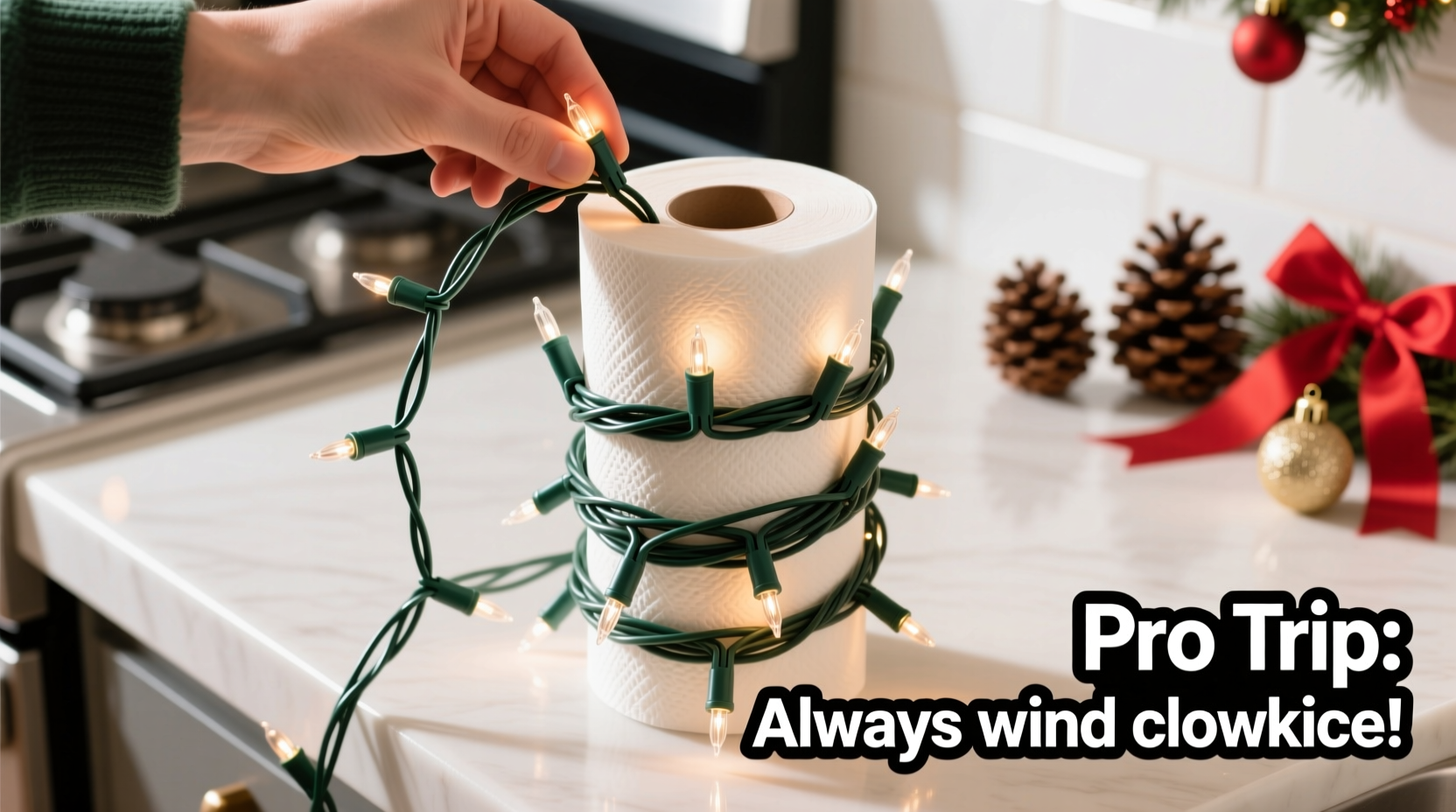
The brilliance of this method lies in its simplicity. A standard cardboard tube from a used paper towel roll becomes a lightweight, low-cost spool that keeps lights evenly spaced and secured. Unlike rigid plastic organizers, it’s flexible enough to store in tight spaces and sturdy enough to maintain shape.
Follow this timeline-tested process for best results:
- Unplug and inspect: Before storing, ensure all lights are unplugged and cool. Check each strand for broken bulbs, frayed wires, or damaged plugs. Replace or repair faulty sections now to avoid issues next year.
- Cut a slit in the tube: Take a clean, dry paper towel roll and use scissors to cut a straight slit along its entire length, about 1 inch wide. This creates an opening where you can tuck the plug end later.
- Anchor the plug: Insert the light plug through the slit so it rests inside the tube. Pull it snugly against the inner wall—this secures the starting point and prevents slippage.
- Wrap clockwise or counterclockwise—consistently: Begin wrapping the cord around the tube in a single direction. Keep tension moderate—not too tight (which could damage wires) and not too loose (which allows shifting). Aim for close, parallel loops without overlapping.
- Secure the final loop: Once all lights are wound, use a twist tie, rubber band, or Velcro strap to fasten the last section. Avoid metal ties that can corrode or pinch insulation.
- Label clearly: Use a permanent marker or label maker to note the color, length, and location where the lights will be used (e.g., “Front Porch – 50 Red LEDs”).
- Store vertically or horizontally: Place rolls in a bin, drawer, or shelf. If stacking, separate layers with cardboard or cloth to prevent crushing.
Optimizing the System: Do’s and Don’ts
To get lasting results, follow proven best practices. The table below summarizes critical actions to take—and those to avoid.
| Do | Don’t |
|---|---|
| Use only clean, dry tubes free of adhesive residue | Reuse damp or moldy tubes—they weaken and attract pests |
| Wind lights in a single layer without crossing loops | Overlap or crisscross wires—they create friction points |
| Label each roll immediately after wrapping | Wait to label—you’ll forget details by next season |
| Store in a climate-controlled area away from rodents | Keep in attics or garages with extreme temperature swings |
| Use fabric-based straps instead of zip ties | Apply plastic zip ties—they can cut into insulation over time |
A Real Example: How One Family Eliminated Holiday Light Chaos
The Reynolds family in Portland, Oregon, used to spend nearly two full days every December untangling lights. With three outdoor trees, a rooftop display, and a full porch setup, their collection included 17 different strands—most stored in a single plastic tote. By mid-November, the box had become a jumbled disaster.
In 2022, Sarah Reynolds read about the paper towel roll method online and decided to try it. She gathered all her spent rolls, labeled them by zone (e.g., “Tree,” “Gutters,” “Patio”), and spent one afternoon rewinding each set. She added colored dots with a marker for quick visual identification and stored the rolls upright in a canvas organizer hung inside a closet.
Last November, she retrieved the first roll—white icicle lights for the eaves. In under 30 seconds, she unwound the strand, plugged it in, and confirmed every bulb worked. No knots. No delays. Over the next week, she repeated the process for all displays, saving over six hours compared to previous years.
“It sounds too simple to work,” Sarah said, “but it did. I’m never going back to tossing them in a bin.”
Enhancing Longevity: Care Tips Beyond Wrapping
While proper wrapping prevents tangles, additional care extends the life of your lights. Consider these strategies to protect your investment:
- Keep them dry: Moisture leads to corrosion, especially at connection points. Store indoors in a low-humidity environment.
- Rotate usage: If you have multiple sets of similar lights, alternate which ones you use each year to reduce wear.
- Avoid direct sunlight: UV rays degrade plastic coatings and insulation. Even indoor storage near windows can cause long-term damage.
- Check annually: Make light inspection part of your pre-holiday routine. Early detection of issues prevents bigger problems later.
- Recycle responsibly: When lights reach end-of-life, don’t throw them in the trash. Many communities offer seasonal e-waste drop-offs for holiday lighting.
Complete Checklist for Tangle-Free Light Storage
Use this checklist every post-holiday season to ensure your lights stay organized and functional:
- ✅ Unplug all light strands and allow them to cool completely
- ✅ Inspect each set for broken bulbs, exposed wires, or damaged connectors
- ✅ Repair or retire non-functional strands
- ✅ Collect clean, undamaged paper towel rolls (one per light set)
- ✅ Cut a vertical slit along each tube (approx. 1 inch wide)
- ✅ Feed the plug through the slit and secure it inside the tube
- ✅ Wrap the cord tightly but gently in a single direction, avoiding overlaps
- ✅ Fasten the end with a soft tie or rubber band
- ✅ Label each roll with color, length, and intended location
- ✅ Store rolls in a cool, dry, rodent-free space—preferably upright
- ✅ Add a silica gel pack to the storage container to absorb moisture
- ✅ Review condition and labels again next October before decorating
Frequently Asked Questions
Can I use toilet paper rolls instead of paper towel rolls?
Yes, but only for very short strands (under 25 bulbs). Toilet paper tubes are shorter and less durable, making them unsuitable for longer or heavier sets. They may also collapse under pressure if stacked.
What if I run out of paper towel rolls?
Consider alternatives like PVC pipe scraps, pool noodles with slits, or repurposed packaging tubes. You can also save rolls throughout the year or ask neighbors to save theirs after holidays. Some craft stores sell blank cardboard spools in bulk.
Will this method work for net lights or curtain lights?
Not effectively. Net and curtain lights have a grid structure that doesn’t wrap well. For these, lay them flat between sheets of tissue paper or fold them carefully into labeled bins with dividers. The paper towel roll method is best suited for linear strands.
Final Thoughts: Turn Frustration into Efficiency
The paper towel roll method isn’t flashy, but it’s reliable. It transforms a recurring holiday headache into a five-minute task. More importantly, it builds a sustainable habit—each year becomes easier, not harder. There’s no special equipment, no expense, and no learning curve. Just consistency.
Organizing your Christmas lights this way does more than save time. It preserves safety by reducing strain on wires, maintains brightness by preventing bulb loss, and supports environmental responsibility by extending product lifespan. What starts as a simple hack evolves into a smarter, calmer holiday preparation experience.




 浙公网安备
33010002000092号
浙公网安备
33010002000092号 浙B2-20120091-4
Comments
No comments yet. Why don't you start the discussion?