
Organizing your closet by color can transform your daily routine. It makes outfit selection faster, highlights gaps in your wardrobe, and turns your closet into a personal showroom. But there’s a common pitfall: when done carelessly, a color-sorted closet can look overly coordinated—like a Pantone swatch board rather than a lived-in wardrobe. The key isn’t just sorting by hue, but curating with intention. With the right balance of structure and texture, you can enjoy the benefits of color coordination while preserving individuality and style.
The Psychology Behind Color-Based Organization
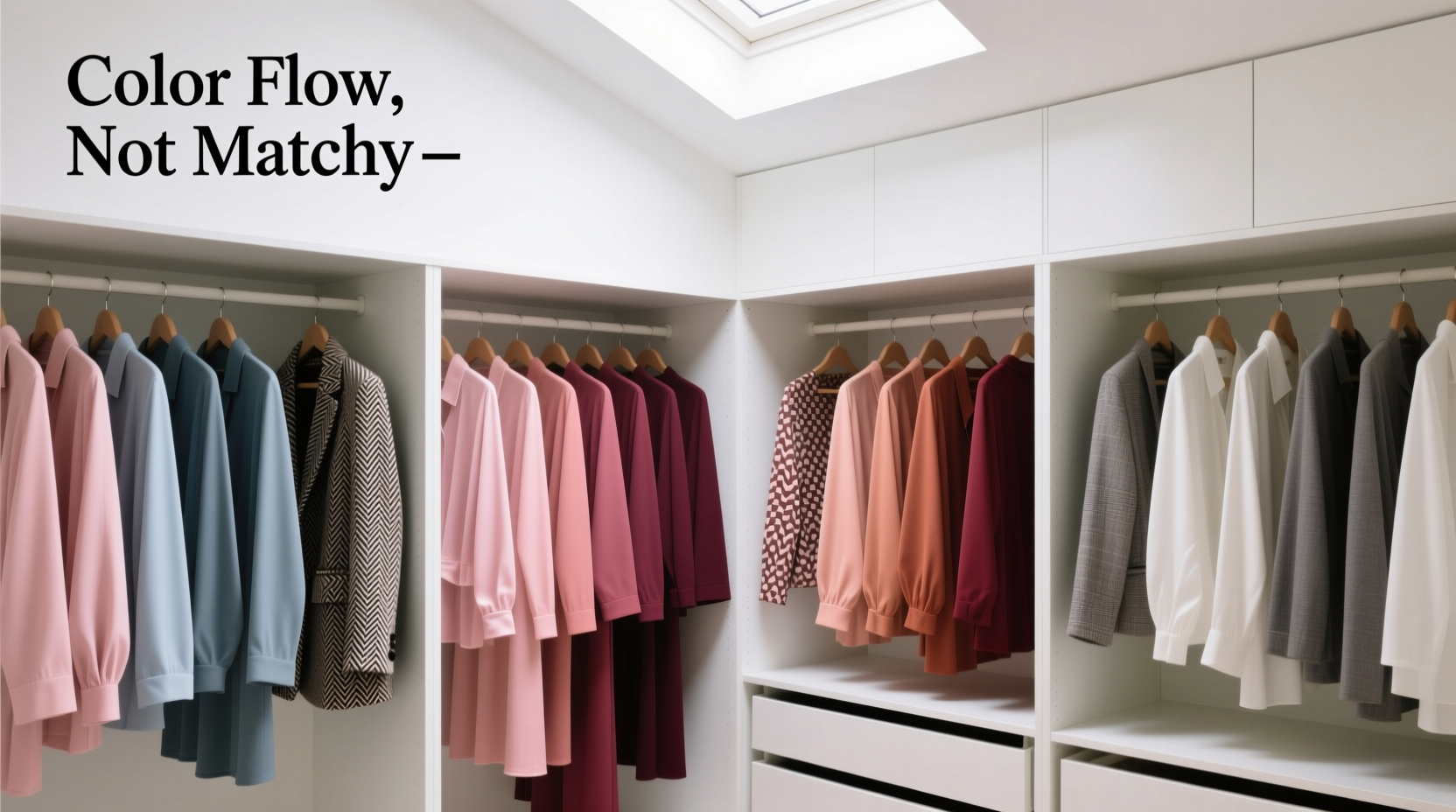
Color impacts mood, perception, and even decision-making. When applied to wardrobe organization, grouping items by color leverages visual memory and spatial recognition. Studies in cognitive psychology suggest that humans recall information more efficiently when it’s visually categorized. In practical terms, seeing all your blues together helps you quickly assess what you own and identify combinations.
However, over-reliance on color uniformity risks creating a flat aesthetic. A closet where every navy sweater aligns perfectly with navy shirts and pants may look impressive at first glance—but it lacks depth. Real style emerges from contrast, layering, and subtle imperfections. The goal is not to eliminate color order, but to use it as a framework—not a rulebook.
“Color organization should serve function without sacrificing personality. Think of it as a backstage system for an elegant performance.” — Lila Chen, Wardrobe Stylist & Author of *Closet Logic*
Step-by-Step Guide to a Balanced Color-Sorted Closet
Creating a color-organized closet that feels natural requires planning and editing. Follow this sequence to build a system that works for real life.
- Empty and assess. Remove everything from your closet. This allows you to see your full inventory and evaluate each piece objectively.
- Categorize by garment type. Separate clothes into groups: tops, bottoms, dresses, outerwear, etc. This prevents overwhelming visual clutter later.
- Sort each category by color. Within each group, arrange items along the visible spectrum: red, orange, yellow, green, blue, indigo, violet. Use neutral tones (black, white, gray, beige) as anchors between sections.
- Introduce variation within hues. Don’t force identical shades together. Allow for tonal gradation—e.g., pair a burgundy blouse with a deeper wine skirt. Slight mismatches add dimension.
- Incorporate texture and pattern. Place textured fabrics like corduroy, knit, or silk next to smooth cotton or denim. Patterns should be grouped by dominant color but allowed to “break” monotony.
- Re-evaluate spacing. Leave breathing room between hangers. Overcrowding flattens visual interest, no matter how well-organized.
Avoiding the “Matchy” Trap: Design Principles That Work
The line between organized and overdone is thin. To keep your closet feeling dynamic, apply these design principles:
- Vary sleeve lengths and silhouettes. Hanging a cropped tee next to a longline shirt disrupts uniformity in a good way.
- Mix fabric weights. A lightweight linen shirt beside a structured denim jacket creates visual rhythm.
- Break up solids with prints. Even if a floral top is primarily pink, its secondary colors add complexity and prevent blockiness.
- Use accessories as accents. Store scarves or belts in a separate bin but pull one out occasionally and drape it over a hanger for movement.
- Rotate seasonal items. Store off-season pieces elsewhere. A summer-heavy palette in winter can skew perception and lead to over-correction.
Do’s and Don’ts of Color Coordination
| Do | Don't |
|---|---|
| Group by dominant color, not exact shade | Line up only identical tones |
| Allow space between garments | Crowd hangers to maximize storage |
| Include varied textures in each section | Store all knits together regardless of color |
| Use neutral zones as transitions | Jump abruptly from red to green |
| Update arrangement seasonally | Set it and forget it |
Real Example: From Matchy to Mindful
Sophie, a graphic designer in Portland, loved the idea of a rainbow-ordered closet but found her initial attempt felt “like a retail display.” She had arranged every top from coral to crimson, then matched her pants in parallel rows. While satisfying to look at, she rarely wore outfits from the same color family.
After reassessing, she restructured her system. She kept the general color flow but began mixing in earth-toned knits among the reds and introduced chambray shirts into her blue section. She also started folding select items—like slouchy sweaters—on shelves instead of hanging them. The result? Her closet still followed a color gradient, but now it reflected how she actually dressed: layered, tactile, and slightly imperfect.
“I realized I wasn’t dressing in monochrome,” she said. “So why should my closet pretend I do?”
Tips for Maintaining Visual Interest
Even the best-organized closet can become stale over time. Keep yours feeling fresh with these strategies:
- Layer in neutrals strategically. A black blazer doesn’t need to live only in the black section. Let it bridge deep blue and gray if that reflects your styling habits.
- Highlight statement pieces. If you own a bold emerald coat, give it space around it. Don’t bury it in a sea of green sweaters.
- Use lighting to your advantage. Natural light reveals true tones. Avoid warm bulbs that distort pinks into oranges or blues into grays.
- Add non-clothing elements. A small plant, a framed sketch, or a woven basket on a shelf softens the precision of color blocks.
Expert Insight: Why Imperfection Matters
Fashion psychologists note that environments perceived as “too perfect” can subconsciously stress users. A closet that looks like a showroom may discourage daily use because it feels fragile—like wearing something might ruin the arrangement.
“When a closet feels too curated, people avoid touching it. The ideal system supports spontaneity, not rigidity.” — Dr. Marcus Reed, Behavioral Designer & Co-Author of *The Organized Mind, Organized Life*
This insight underscores the importance of designing for usability, not just aesthetics. Your closet should invite interaction, not intimidate with perfection.
Checklist: Building a Non-Matchy Color System
Follow this checklist to ensure your closet stays organized yet expressive:
- ☐ Empty all clothing and sort by type (tops, bottoms, etc.)
- ☐ Identify dominant colors in each piece
- ☐ Arrange items in spectral order with neutral buffers
- ☐ Mix textures within each color zone (e.g., silk and cotton)
- ☐ Include at least one patterned item per major color group
- ☐ Leave 1–2 inches between hangers for airflow and visual ease
- ☐ Fold bulky or delicate items instead of overcrowding rods
- ☐ Reassess every 6–8 weeks and adjust based on wear patterns
- ☐ Add a non-clothing accent (e.g., box, mirror, artwork)
- ☐ Test the system: Can you grab three different outfits in under five minutes?
Frequently Asked Questions
Can I organize by color if I mostly wear neutrals?
Absolutely. Neutrals have undertones—warm (beige, camel), cool (charcoal, steel gray), or true (white, black). Sort them accordingly. For example, group warm browns with rust and terracotta, and cool grays with navy and lavender. This adds nuance and helps with pairing.
What if my clothes don’t fit neatly into one color category?
Assign each piece to its dominant color. A striped shirt with more blue than green goes in the blue section. If distribution feels uneven, create a “transition zone” between two main colors for multi-hue items.
Will this system work in a small closet?
Yes—and it may be even more beneficial. Limited space demands efficiency. Use vertical color gradients (light to dark from left to right) and double rods wisely. Prioritize frequently worn items at eye level, arranged by color for quick access.
Conclusion: Style Is in the Details
Organizing your closet by color doesn’t mean surrendering your sense of style to a rigid spectrum. Done thoughtfully, it enhances both functionality and inspiration. The secret lies in embracing variation—within color families, across textures, and through intentional imperfection. When your closet reflects how you actually dress, not how a magazine says you should, getting ready becomes less chore and more joy.




 浙公网安备
33010002000092号
浙公网安备
33010002000092号 浙B2-20120091-4
Comments
No comments yet. Why don't you start the discussion?