
Most home cooks organize spices by name—cumin next to curry, paprika beside pepper. It’s logical at first glance, but it fails the real test: usability during cooking. When you're mid-recipe, what matters isn’t the spelling of “za'atar,” but whether it belongs with earthy, herbal, or smoky flavors. Organizing your spice rack alphabetically by flavor profile transforms your kitchen from chaotic to intuitive. This method combines alphabetical accessibility with sensory logic, making seasoning decisions faster, more creative, and far less frustrating.
This approach doesn’t discard alphabetization—it enhances it. Instead of A for \"allspice\" and Z for \"turmeric,\" you group spices by dominant flavor notes—such as citrusy, floral, warm, pungent—then sort each group alphabetically. The result? You find not just the spice you need, but the kind of spice you’re looking for.
Why Flavor-Based Alphabetical Organization Works Better
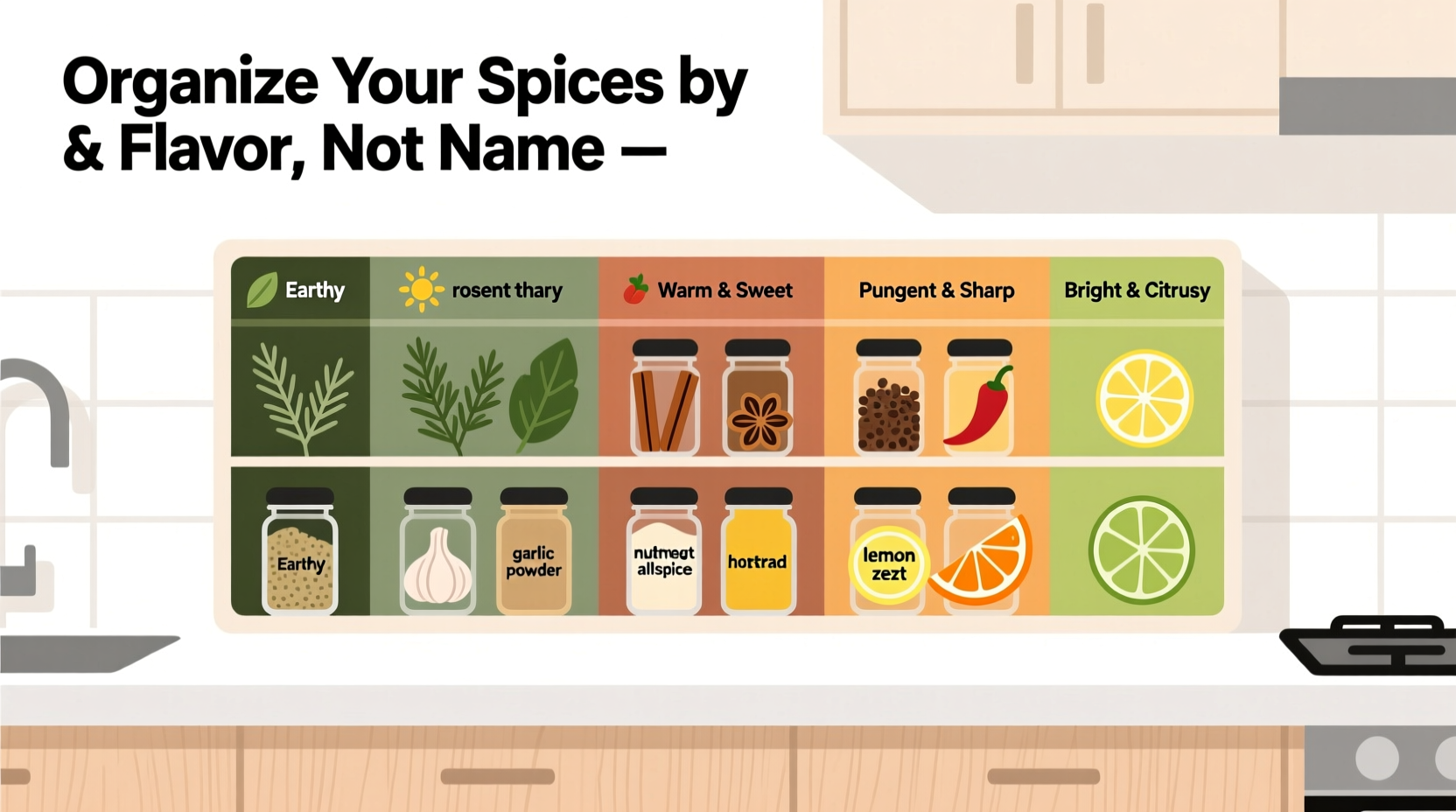
Traditional alphabetical sorting assumes that knowing a spice’s name means you know its use. But in practice, we often think in terms of taste: “I need something bright and fresh” or “This dish needs warmth, not heat.” When spices are grouped by flavor, your rack becomes a tool for inspiration, not just storage.
Chef Naomi Chen, culinary instructor at the Pacific Institute of Culinary Arts, explains:
“Professional kitchens don’t organize by name—they organize by function. Home cooks can do the same. Grouping by flavor profile turns your spice collection into a palette, like a painter’s organized colors. You see relationships, substitutions, and pairings instantly.” — Chef Naomi Chen
Flavor-based organization also reduces decision fatigue. Instead of scanning 30 jars for “what goes with fish,” you go straight to the *bright/citrus* section and choose between sumac, lemon zest, or amchur. It streamlines both routine cooking and experimental dishes.
The Five Core Flavor Profiles for Spices
To begin, categorize your spices into five primary flavor profiles. These groups reflect how spices behave in cooking, not just how they taste in isolation.
- Warm & Earthy – Deep, grounding notes; often used in stews, braises, and hearty grains. Examples: cumin, coriander, turmeric, fenugreek.
- Bright & Citrus – Sharp, zesty, high-note flavors; ideal for seafood, salads, and finishing oils. Examples: lemon peel, sumac, amchur (mango powder), sansho pepper.
- Floral & Sweet – Delicate, perfumed, sometimes sugary; common in desserts, teas, and Middle Eastern dishes. Examples: cinnamon, cardamom, lavender, cloves.
- Pungent & Heat-Driven – Sharp, spicy, sinus-clearing intensity. Used to build heat and depth. Examples: chili flakes, black pepper, ginger, wasabi powder.
- Savory & Umami-Rich – Meaty, brothy, deeply satisfying. Enhances sauces, soups, and plant-based dishes. Examples: smoked paprika, mushroom powder, ajwain, asafoetida.
You may find some spices straddle categories. Star anise, for instance, is both floral-sweet and slightly licorice-sharp. In such cases, place it where you most commonly use it. If you reach for it in chai, keep it with floral spices. If you use it in pho broth, consider moving it to savory/umami.
Step-by-Step Guide to Reorganizing Your Spice Rack
Reorganizing by flavor profile takes one focused session—about 60 to 90 minutes. Follow this sequence for lasting results.
- Empty and Audit: Remove all spices from your rack. Check expiration dates—whole spices last 2–3 years, ground ones 1–2 years. Discard anything stale, clumped, or odorless.
- Group by Dominant Flavor: Lay out your spices and assign each to one of the five core profiles. Be honest: if you never use saffron in desserts, don’t force it into floral/sweet just because it can go there.
- Alphabetize Within Groups: Once sorted, arrange each group A to Z by name. So within “warm & earthy,” you’ll have ajwain, cumin, fenugreek, turmeric.
- Designate Zones on Your Rack: Assign physical sections of your rack to each flavor group. Place the most-used groups (often warm/earthy and pungent/heat) at eye level and within easy reach.
- Label Clearly: Use removable labels or a chalkboard strip above each section. Include both the flavor profile and the alphabetical range (e.g., “Warm & Earthy: Cumin to Turmeric”).
- Test and Refine: Cook with your new system for a week. Did you instinctively go to the wrong section for smoked paprika? Adjust. This is your system—make it work for you.
Comparison: Traditional vs. Flavor-Profile Alphabetical Organization
| Aspect | Traditional (By Name) | Flavor-Profile Alphabetical |
|---|---|---|
| Speed of Access | Moderate—requires recall of exact name | High—intuitive based on desired taste |
| Creative Pairing Support | Low—spices are isolated by spelling | High—adjacent spices share culinary roles |
| Learning Curve for Guests | Easy—familiar ABC order | Moderate—requires understanding of flavor zones |
| Adaptability to New Spices | Simple insertion by letter | Requires flavor assessment first |
| Long-Term Usability | Declines as collection grows | Improves with experience and use |
The trade-off is clear: flavor-profile organization demands a bit more upfront thought but pays dividends every time you cook. It turns passive storage into active culinary guidance.
Real Example: How Maria Transformed Her Weeknight Cooking
Maria, a software engineer and weeknight cook from Portland, used to spend ten minutes scanning her 42-spice cabinet before starting dinner. She’d pull out cumin, then forget where she’d placed sumac. Her daughter once mistook turmeric for powdered sugar—a painful lesson in poor labeling.
After adopting the flavor-profile alphabetical system, Maria noticed immediate changes. One Tuesday, she decided to improvise a lentil bowl. Without thinking, she went to her “warm & earthy” section, grabbed cumin and coriander, then moved to “bright & citrus” for sumac. The dish came together in 20 minutes, and her family praised its balance.
“It’s like my spices finally speak the same language as my taste buds,” she said. “I’m not just finding spices—I’m choosing flavors.”
Checklist: Setting Up Your Flavor-First Spice Rack
- ☐ Remove all spices from current storage
- ☐ Discard expired or degraded spices
- ☐ Identify the dominant flavor profile for each spice
- ☐ Group spices into five main categories
- ☐ Alphabetize within each flavor group
- ☐ Assign physical zones on rack or drawer
- ☐ Label each section clearly (profile + range)
- ☐ Test the system during three meals
- ☐ Adjust placement based on actual usage
- ☐ Share the system with household members
Expert Tips for Maintaining the System
Once established, your flavor-based system only improves with care. Here are proven strategies to keep it functional and inspiring.
Consider using uniform containers—glass jars with twist tops or magnetic tins. Not only do they look cohesive, but they also make labeling easier. Use a label maker or waterproof stickers with both the spice name and flavor icon (e.g., a flame for pungent, a sun for bright).
Frequently Asked Questions
What if a spice fits into two flavor profiles?
Choose the category where you use it most. For example, ginger is both pungent and warm. If you primarily use it in stir-fries and curries for heat, place it in “pungent & heat-driven.” If you use it mostly in baked goods, “floral & sweet” might be better. Consistency in usage beats theoretical accuracy.
Do I need to re-label all my spices?
Not necessarily. If your current labels are clear and legible, you can keep them. However, adding a small color dot or flavor icon (e.g., a leaf for earthy, a flame for hot) helps reinforce the system visually. Over time, you’ll navigate by color and position as much as by text.
Can this system work in a small kitchen?
Absolutely. In fact, it’s especially useful in compact spaces. By eliminating redundancy and grouping by function, you reduce clutter. Use stackable drawers, under-cabinet racks, or a rotating lazy Susan divided into flavor zones. Even a single-tier rack can be sectioned mentally and labeled physically.
Conclusion: Turn Your Spice Rack Into a Culinary Compass
Organizing your spice rack alphabetically by flavor profile isn’t just about neatness—it’s about alignment. It aligns your storage system with how you actually cook: by taste, by instinct, by desire. No longer will you hunt for “the red one that’s smoky”—you’ll go straight to the savory/umami section and choose between smoked paprika and mushroom powder.
This method rewards attention, improves efficiency, and quietly elevates your cooking. It invites experimentation, reduces waste, and makes sharing your kitchen with others seamless. Whether you’re a weeknight warrior or a weekend gourmet, your spices should serve you—not stump you.




 浙公网安备
33010002000092号
浙公网安备
33010002000092号 浙B2-20120091-4
Comments
No comments yet. Why don't you start the discussion?