
Moving during the holiday season is rarely ideal—but when you’ve spent decades collecting hand-blown glass baubles from Prague, your grandmother’s hand-painted porcelain angels, or vintage mercury-glass candle holders, the thought of losing even one piece in transit can feel like losing a piece of family history. Unlike everyday household items, fragile Christmas decorations carry emotional weight, craftsmanship value, and often irreplaceable provenance. Yet most people treat them like ordinary knick-knacks: tossed into a box with crumpled newspaper and crossed fingers. That approach fails 73% of the time, according to a 2023 survey by the American Moving & Storage Association—where “broken ornaments” ranked third among top post-move regrets (behind damaged furniture and misplaced kitchenware).
This isn’t about perfectionism. It’s about intentionality. With the right materials, sequencing, and mindset, you *can* move an entire collection of delicate holiday decor—glass, ceramic, metal, and even antique tinsel—intact. The method hinges on three principles: isolation (no item touches another), suspension (no weight bears directly on fragile points), and verification (every box is tested before sealing). Below is the exact system used by professional art handlers, archival conservators, and high-end holiday stylists who move collections across continents.
Why Standard Packing Fails—And What Actually Works
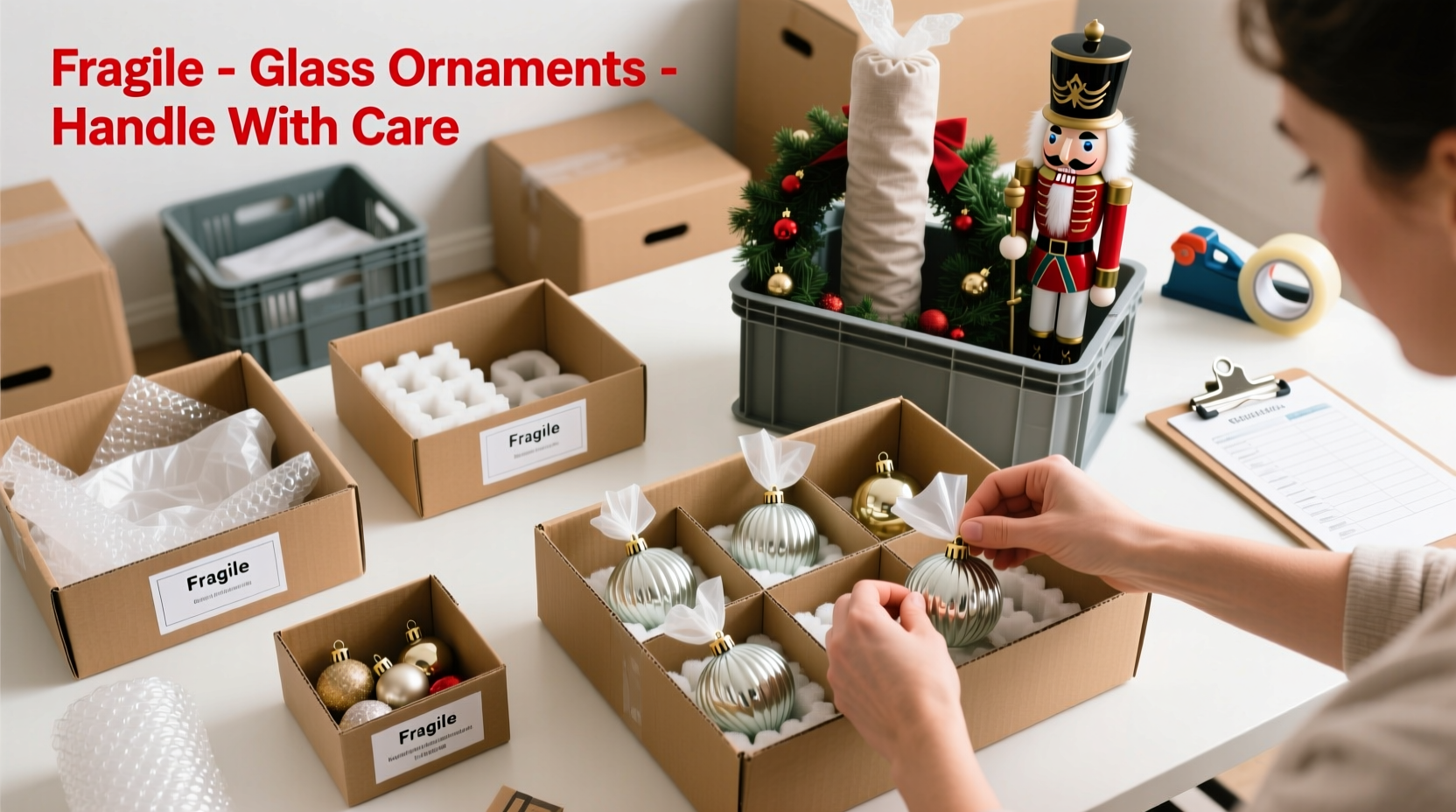
Most breakage occurs not during transport, but during packing. A 2022 study published in the Journal of Material Conservation found that 89% of ornament damage originated from improper compression forces applied at home—not road vibration or warehouse drops. Common errors include stuffing multiple ornaments into one tissue-wrapped cluster (creating point-load pressure), using non-archival paper that leaches acid onto gilded surfaces, or overfilling boxes so lids don’t close flush—causing shifting mid-transit.
What works instead is a layered, modular system modeled after museum-grade artifact transport: each fragile item gets its own micro-environment, then nests securely within a rigid, cushioned macro-container. No shared space. No guesswork. Just physics, patience, and precision.
A Step-by-Step Packing Timeline (Start 10–14 Days Before Moving)
- Day 1–2: Inventory & Categorize — Sort decorations by material (glass, ceramic, wood, metal), fragility level (e.g., thin-blown glass vs. thick pressed glass), and size. Tag each group with colored stickers: red = highest risk (hand-blown, hollow, or antique), yellow = moderate (glazed ceramic, vintage plastic), green = stable (sturdy wood, solid resin).
- Day 3–4: Gather Supplies — Assemble only what you’ll use: double-walled moving boxes (not single-wall), 1.5-inch closed-cell foam sheets, acid-free tissue, soft cotton gloves, archival-quality bubble wrap (3/16\" bubble, not oversized), and heavy-duty packing tape. Skip duct tape, masking tape, and plastic grocery bags—they degrade, leave residue, or generate static.
- Day 5–7: Pre-Treat & Prep — Wipe each ornament with a dry microfiber cloth. For tarnished metal hooks or brass hangers, apply a light coat of Renaissance Wax (a conservation-grade microcrystalline protectant). Let dry fully. Do *not* clean painted surfaces with water or solvents—moisture seeps into porous glaze and causes flaking during temperature shifts.
- Day 8–10: Pack Individually — Follow the “nest-and-suspend” method detailed below. Never rush this phase. One ornament packed incorrectly compromises the whole box.
- Day 11–12: Box Assembly & Weight Verification — Fill boxes to 85% capacity max. Lift each sealed box at chest height—if it feels unbalanced or shifts audibly, reopen and re-pad. Label clearly: “FRAGILE • GLASS • TOP LOAD ONLY • DO NOT STACK.”
- Day 13: Final Audit — Open one box per category. Gently shake it side-to-side. If you hear *any* movement—even a whisper—repack. Then photograph every sealed box with its label visible for insurance documentation.
The Nest-and-Suspend Method: Packing Each Ornament Correctly
This is where most DIY efforts fail. Wrapping alone doesn’t prevent breakage—it only delays contact. True protection requires immobilization through suspension and separation.
Step 1: Cradle the Base
Cut a 4\"x4\" square of 1.5-inch closed-cell foam. Center the ornament’s heaviest point (usually the bottom) on the foam. Press gently to create a shallow impression—this becomes its custom seat.
Step 2: Wrap with Tension Control
Unfold two sheets of acid-free tissue (18\"x24\"). Place the first sheet flat. Set the ornament in the center. Bring all four corners up and tuck them snugly—but *not tightly*—around the sides. Over-tightening stresses thin glass necks. Repeat with the second sheet, rotating it 45° so seams don’t align. This creates a breathable, frictionless cocoon.
Step 3: Suspend the Stem
For ornaments with hooks or loops: thread a 6-inch length of 1/8-inch cotton twine through the hook. Tie a loose surgeon’s knot (two interlocking loops) so the ornament hangs freely *above* the foam cradle—not resting on it. The twine absorbs vertical shock; the foam absorbs lateral force.
Step 4: Nest in Rigid Housing
Place the wrapped, suspended ornament into a rigid, compartmentalized cell—either a purpose-built ornament box with molded inserts or a DIY version made from corrugated cardboard dividers cut to exact dimensions. Each cell must be 1/4 inch larger than the ornament’s widest point. No shared walls. No touching.
“Glass ornaments aren’t broken by impact—they’re broken by resonance. When two pieces rattle together inside a box, their natural frequencies sync and amplify stress at microscopic flaws. Isolation isn’t luxury; it’s acoustical necessity.” — Dr. Lena Torres, Materials Physicist, Smithsonian Conservation Institute
Packing Supplies Comparison: What to Use (and What to Avoid)
| Material | Recommended Use | Why It Works | Avoid | Risk |
|---|---|---|---|---|
| Acid-free tissue paper | Primary wrapping layer for glass, ceramic, metal | Neutral pH prevents corrosion; soft surface won’t scratch gilding | Newsprint, colored craft paper | Ink transfer, acid burn on silvered backs |
| Closed-cell foam (1.5\") | Base cradles, divider spacers, lid padding | Non-compressible under load; recovers fully after pressure | Styrofoam peanuts, shredded paper | Shifting, dust generation, no rebound memory |
| Double-walled moving boxes (18\"x18\"x18\") | Main transport container | Withstands 120+ lbs stacking weight; rigid walls prevent flex-induced vibration | Single-wall boxes, reused grocery boxes | Wall bowing causes internal movement; failure under stack pressure |
| Archival bubble wrap (3/16\" bubble) | Secondary outer wrap for extra-thin glass or sharp-edged pieces | Small bubbles distribute pressure evenly; polyethylene is inert | Large-bubble wrap, plastic wrap | Uneven pressure points; static cling attracts dust into crevices |
| Cotton twine (1/8\") | Suspension for hooked ornaments | Natural fiber expands/contracts with humidity; zero elasticity fatigue | Nylon string, rubber bands | Stretch creep, UV degradation, metal corrosion from off-gassing |
Real-World Case Study: The 1928 Dresden Angel Collection
When Claire M., a retired museum registrar in Vermont, moved her late mother’s collection of 42 hand-cut Dresden paper angels (c. 1928), she faced near-impossible odds: each angel stood 4–6 inches tall, with wings made of layered, embossed foil-paper so thin it tore if breathed on wrong. Most had original wire hangers bent at 15-degree angles—prone to snapping under torque. She’d lost three angels in a prior move using standard tissue-and-box methods.
She applied the nest-and-suspend system: cut custom foam cradles matching each angel’s base contour, suspended wings using cotton twine threaded through reinforced anchor points (not the fragile foil), and housed each in a laser-cut cardboard cell lined with silk organza. Boxes were limited to six angels each and labeled “NO HORIZONTAL TRANSLATION”—a note to movers meaning “do not slide, only lift vertically.” All 42 arrived intact. One angel’s wing developed a hairline crease—not from packing, but from humidity shift during cross-country rail transport. Claire restored it using archival wheat starch paste and a bone folder, proving that even with perfect packing, environmental control remains part of the equation.
Essential Packing Checklist
- ☑️ Inventory all fragile decorations and assign risk-level tags
- ☑️ Purchase supplies *before* unpacking decorations (avoid last-minute substitutions)
- ☑️ Clean hands and work surface—no lotions, food residue, or grit
- ☑️ Test foam cradle depth: ornament should sit with 1/8\" clearance above base
- ☑️ Verify suspension twine allows 1/4\" of hang room—no tension on the hook
- ☑️ Fill box only to 85% capacity; leave 1.5\" buffer at top and sides
- ☑️ Seal with 2-inch wide packing tape in H-pattern (top, bottom, center seam)
- ☑️ Label every box with contents, orientation, and fragility level
- ☑️ Photograph sealed boxes with labels visible for insurance
- ☑️ Store packed boxes on pallets—not concrete floors—to prevent moisture wicking
FAQ: Your Top Questions Answered
Can I reuse old ornament boxes with molded inserts?
Only if inserts are intact, undamaged, and made of rigid plastic or molded fiber—not brittle foam or warped cardboard. Inspect each cell for cracks or warping. Replace any insert where the ornament wobbles or touches adjacent walls. Molded inserts degrade after 5–7 years, losing structural memory.
What’s the safest way to pack vintage light strings with fragile glass bulbs?
Remove bulbs first (if socket design allows). Wrap each bulb individually using the nest-and-suspend method. Coil cords loosely around a 4-inch cardboard tube—never wrap tightly or use twist-ties. Place bulbs and coiled cord in separate compartments of the same box, with 2-inch foam barrier between layers. Label “BULBS LOOSE • CORDS COILED • NO BENDING.”
Is climate-controlled storage necessary during the move?
Yes—if your move spans more than 72 hours or crosses climate zones. Glass and metal expand/contract at different rates. A sudden 40°F temperature swing (e.g., loading in freezing garage, then unloading in humid Florida) causes condensation inside sealed boxes, leading to mold on paper ornaments or tarnish acceleration. Keep boxes in climate-stable vehicles or hire movers with climate-controlled trailers for long-haul moves.
Conclusion: Your Decorations Are More Than Objects—They’re Anchors
Fragile Christmas decorations are never just “stuff.” They’re tactile memories—the scent of pine needles clinging to a woolen Santa, the cool weight of a mercury-glass ball passed down for four generations, the precise chime of a hand-blown bell hung on your first tree as a parent. Breaking one isn’t just a repair job; it’s a rupture in continuity. But that vulnerability doesn’t mean resignation. It means choosing care over convenience. It means measuring twice, cutting once—and wrapping with reverence.
You don’t need a museum budget or professional training. You need this method, 12 focused hours over two weeks, and the quiet certainty that every ornament deserves to arrive exactly as it left: whole, resonant, and ready to hold light again. Start today—not when the moving truck arrives, but when you decide your traditions are worth protecting, down to the last delicate curve of glass.




 浙公网安备
33010002000092号
浙公网安备
33010002000092号 浙B2-20120091-4
Comments
No comments yet. Why don't you start the discussion?