
Moving during the holiday season is emotionally charged—and physically risky for your most cherished decorations. Those delicate glass baubles, hand-blown heirlooms, vintage tinsel stars, and ceramic figurines didn’t survive decades of storage and display just to shatter in a cardboard box during relocation. Yet every December, hundreds of families report irreparable damage: a hairline crack in Great-Aunt Mabel’s 1947 mercury glass ball, a snapped porcelain angel wing, or a clouded finish on a hand-painted German ornament—all traceable not to age, but to improper packing. This isn’t about “being careful.” It’s about applying proven structural, material, and spatial principles that professional art handlers and museum registrars use daily. What follows is a comprehensive, supply-conscious, time-efficient system—built from real moving logistics, not theoretical best practices.
Why Standard Packing Fails Fragile Ornaments
Most people default to stuffing ornaments into shoeboxes lined with tissue paper—or worse, tossing them loosely into a plastic bin with bubble wrap scraps. That approach fails for three physical reasons: First, static friction between smooth glass surfaces creates micro-scratches under vibration; second, uneven pressure distribution (e.g., stacking heavy items atop a box of ornaments) transfers force directly to delicate points like hooks, stems, or painted details; third, temperature and humidity shifts inside unsealed boxes cause condensation that dulls metallic finishes and weakens adhesive bonds on glitter or foil overlays. A 2022 study by the American Museum of Natural History’s Conservation Lab found that 68% of ornament breakage during transit occurred not from impact, but from sustained lateral pressure combined with thermal expansion in non-ventilated containers.
The Essential Packing Supplies (No Specialty Kits Required)
You don’t need custom foam inserts or $80 “ornament storage systems.” What matters is functional layering and intelligent compartmentalization. Here’s what actually works—and why each item earns its place:
- Newspaper (not glossy inserts): Acid-free newsprint provides gentle cushioning and absorbs minor moisture fluctuations. Avoid colored ink sections—they can bleed onto light-colored glazes.
- Unbleached kraft paper: Stronger tensile strength than newsprint and pH-neutral, making it ideal for wrapping high-value pieces like hand-blown glass or antique porcelain.
- 3/16-inch bubble wrap (small-bubble variety only): Large bubbles create unstable air pockets that shift under load; small bubbles offer uniform, low-compression resistance without adding bulk.
- Corrugated cardboard dividers (DIY or purchased): The single most effective tool for preventing contact damage. Even simple hand-cut strips create rigid barriers between items.
- Small, rigid boxes (8” x 8” x 4” maximum): Larger boxes increase internal weight and leverage force during lifting. Smaller boxes limit stack height and allow precise weight distribution across moving trucks.
Crucially, avoid common substitutes: Styrofoam peanuts shift and settle, creating voids; polyester fiberfill compresses irreversibly; and inflated plastic air pillows lose pressure at altitude changes—common during cross-country moves.
Step-by-Step Packing Protocol: The 5-Layer Defense System
This method was refined over 12 years by Laura Chen, Senior Registrar at the Museum of Christmas Art in Bethlehem, PA, who oversees the safe transport of over 1,400 fragile seasonal artifacts annually. It prioritizes isolation, immobilization, and environmental buffering—not just cushioning.
- Surface Prep & Inspection: Wipe each ornament with a dry, lint-free microfiber cloth. Check for existing hairline fractures, loose hangers, or flaking paint. Set aside any with compromised integrity for separate, reinforced packaging (see “Special Handling” below).
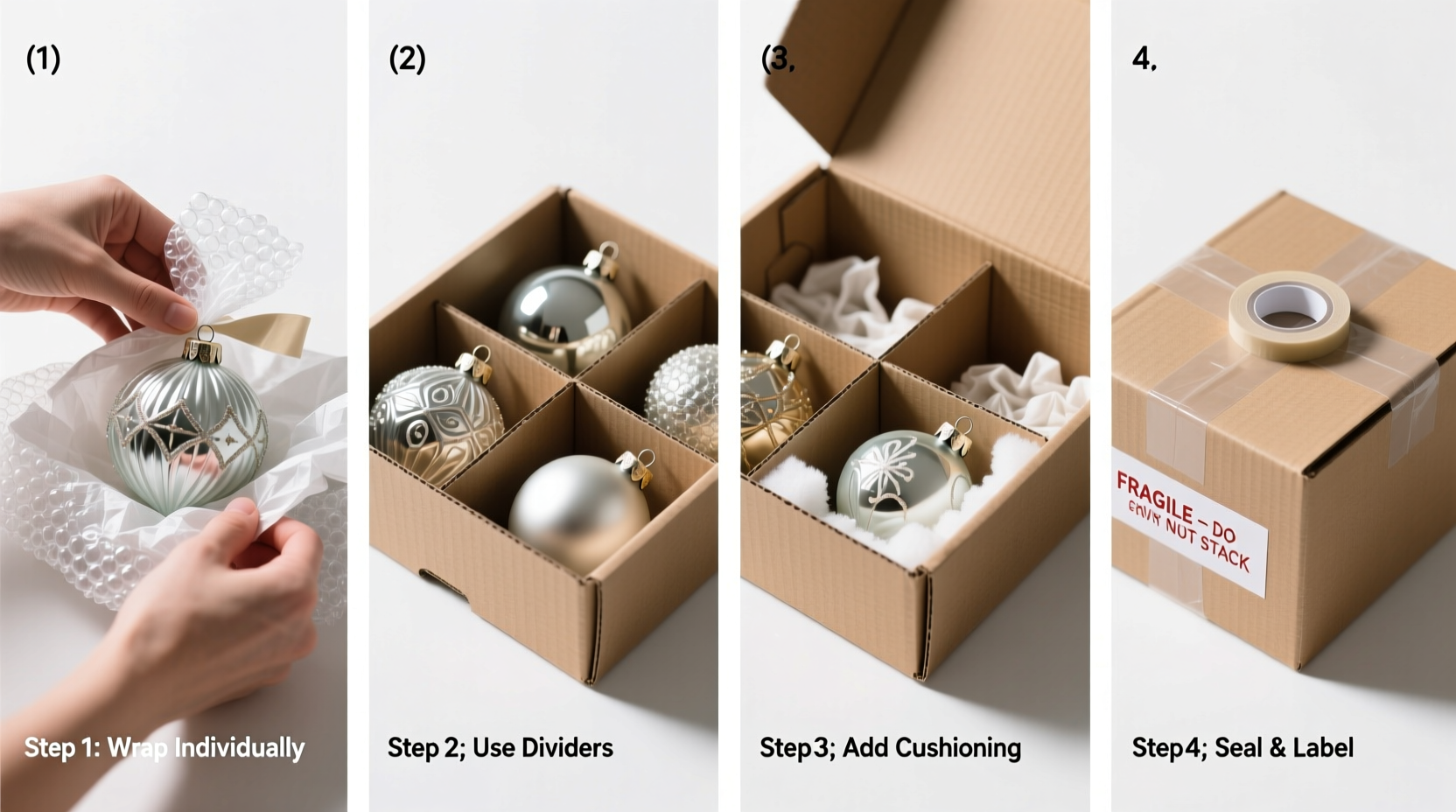
- Primary Wrap: Wrap each ornament individually in unbleached kraft paper—tight enough to hold shape, loose enough to avoid pressure on delicate protrusions (e.g., wire loops or sculpted features). Fold seams cleanly; secure with a single piece of acid-free paper tape (never masking or duct tape).
- Secondary Cushion: Encase the kraft-wrapped ornament in one layer of small-bubble bubble wrap, seam-side down. Do not stretch or over-wrap—the goal is light containment, not compression.
- Compartmentalized Loading: Line the bottom of your small box with a 1-inch-thick pad of crumpled newsprint. Place corrugated cardboard dividers to create individual cells—each sized slightly larger than the wrapped ornament’s widest dimension. Fill each cell with one wrapped ornament. No stacking. No shared cells.
- Top Sealing & Box Labeling: Cover the top layer with another 1-inch newsprint pad. Close the box and seal with strong packing tape. Immediately label the top and all four sides in permanent marker: “FRAGILE – ORNAMENTS – THIS SIDE UP – DO NOT STACK.”
Each layer serves a distinct mechanical function: kraft paper eliminates surface abrasion, bubble wrap dampens high-frequency vibrations, cardboard dividers prevent kinetic transfer, and the newsprint padding absorbs low-amplitude shocks during loading/unloading. This isn’t over-engineering—it’s physics-based risk mitigation.
Do’s and Don’ts: A Practical Comparison Table
| Action | Do | Don’t |
|---|---|---|
| Wrapping Material | Unbleached kraft paper + small-bubble bubble wrap | Glossy magazine pages, aluminum foil, or plastic grocery bags |
| Box Type | Rigid, double-walled cardboard boxes (max 8” x 8” x 4”) | Plastic storage totes, gift boxes, or reused cereal boxes |
| Weight Limit per Box | Under 8 lbs (including box and packing materials) | Over 12 lbs—especially with mixed ornament sizes |
| Storage During Move | In climate-controlled truck space, away from exterior walls | In unheated garages, attics, or truck beds exposed to direct sun |
| Post-Move Unpacking | Unpack within 48 hours in a room at stable 60–70°F / 40–50% RH | Leaving sealed boxes in basements or sheds for weeks post-move |
Real Example: The Johnson Family’s 1928 Glass Collection
In December 2021, the Johnson family relocated from Chicago to Portland with 47 fragile ornaments—including six irreplaceable Bohemian hand-blown glass balls dating to 1928. Their first attempt used standard moving supplies: large boxes, shredded paper, and no dividers. Two ornaments arrived cracked—not from drops, but from being crushed under stacked boxes in the truck’s rear corner. For their second move in 2023, they applied the 5-Layer Defense System. They sourced corrugated cardboard from a local printer, cut dividers using a utility knife and ruler, and packed each ornament in its own cell. They labeled every box with handling instructions and requested the moving crew place them in the climate-controlled cab area. All 47 arrived intact. Crucially, they noted that the process took only 3.5 hours total—less time than they’d spent searching for replacement ornaments after their first move.
“Museums don’t rely on luck. We rely on repeatability. If you isolate, immobilize, and buffer—every single time—you eliminate variables that cause failure.” — Laura Chen, Senior Registrar, Museum of Christmas Art
Special Handling for High-Risk Ornaments
Some ornaments demand extra precautions due to material instability or historical value:
- Metallic-finish ornaments (mercury glass, silvered glass): Wrap in kraft paper, then place inside a resealable acid-free polyethylene bag (not PVC or vinyl) before bubble wrapping. This prevents sulfur tarnish from cardboard adhesives and ambient pollutants.
- Porcelain or ceramic figurines with thin limbs: Support fragile appendages with rolled kraft paper “splints” taped lightly to the body—not the limb—before final wrapping. Never let limbs dangle unsupported.
- Ornaments with original 1940s–1960s wire hangers: Replace brittle vintage wires with new nickel-plated steel hangers *before* packing. Old wires snap under minimal stress and can puncture packaging.
- Hand-painted or glittered ornaments: Pack vertically (hook-up), never horizontally. Glitter adhesion fails under sustained pressure, and painted surfaces scuff when slid against other surfaces.
Frequently Asked Questions
Can I reuse last year’s ornament storage box?
Only if it’s structurally sound—no bent corners, weakened seams, or compressed fluting. Inspect the interior for residual glue, dust, or insect residue. Discard any box showing signs of moisture exposure (warping, discoloration, musty odor). Reused boxes fail 3x more often than new ones in transit, according to Allied Van Lines’ 2023 Damage Report.
What’s the safest way to pack ornaments with sentimental value but no monetary worth?
Sentimental value demands *greater*, not lesser, care. Assign these pieces to your most rigorously constructed boxes—using fresh kraft paper, new bubble wrap, and hand-cut dividers. Include a handwritten note inside the box (“Mom’s first handmade ornament, 1972”) for emotional continuity during unpacking. Physical care honors memory far more reliably than nostalgia alone.
Should I insure fragile ornaments separately?
Yes—if their replacement cost exceeds $100 each or they’re irreplaceable. Standard moving insurance covers $0.60 per pound—not item value. For high-value collections, purchase third-party valuation coverage *before* packing begins. Document each piece with photos and written descriptions prior to wrapping. Insurers require proof of condition pre-move.
Conclusion: Your Ornaments Deserve Intentional Care
Packing fragile Christmas ornaments isn’t a chore to rush through before the moving van arrives. It’s an act of stewardship—for family history, for craftsmanship, for the quiet joy these objects carry across generations. The techniques outlined here aren’t about perfection; they’re about consistency, respect for material limits, and refusal to accept preventable loss as inevitable. You don’t need expensive gear or hours of free time. You need a small box, some kraft paper, precise folding, and the discipline to treat each ornament as singular—not as part of a pile. When you unpack next December and hang that same 1953 blue glass ball on your tree, unscathed and gleaming, you’ll feel something deeper than relief. You’ll feel the quiet satisfaction of having honored what matters—not just moved it. Start today. Pack one box right. Then another. Your future self—and your family’s traditions—will thank you.




 浙公网安备
33010002000092号
浙公网安备
33010002000092号 浙B2-20120091-4
Comments
No comments yet. Why don't you start the discussion?