
Moving during the holiday season—or even just relocating your cherished collection between homes—introduces a unique stressor: the delicate, often irreplaceable, ornaments that carry decades of memories. A single cracked glass bell, a snapped porcelain angel wing, or a shattered hand-blown bauble isn’t just physical damage—it’s the fracture of tradition. Yet most people treat ornament packing as an afterthought: tossing them into a box with crumpled newspaper, stacking them haphazardly, or worse—leaving them in their original flimsy cardboard trays, which offer zero structural support during transit. The result? Up to 37% of fragile holiday decor arrives damaged in residential moves, according to the American Moving & Storage Association’s 2023 claims data. This isn’t inevitable. With methodical preparation, intelligent material selection, and spatial awareness rooted in professional archival and fine-art shipping practices, you can move even the most delicate ornaments—including vintage mercury-glass balls, hand-painted Czech figurines, and heirloom glass icicles—with near-zero risk.
Why Standard Packing Fails Ornament Safety
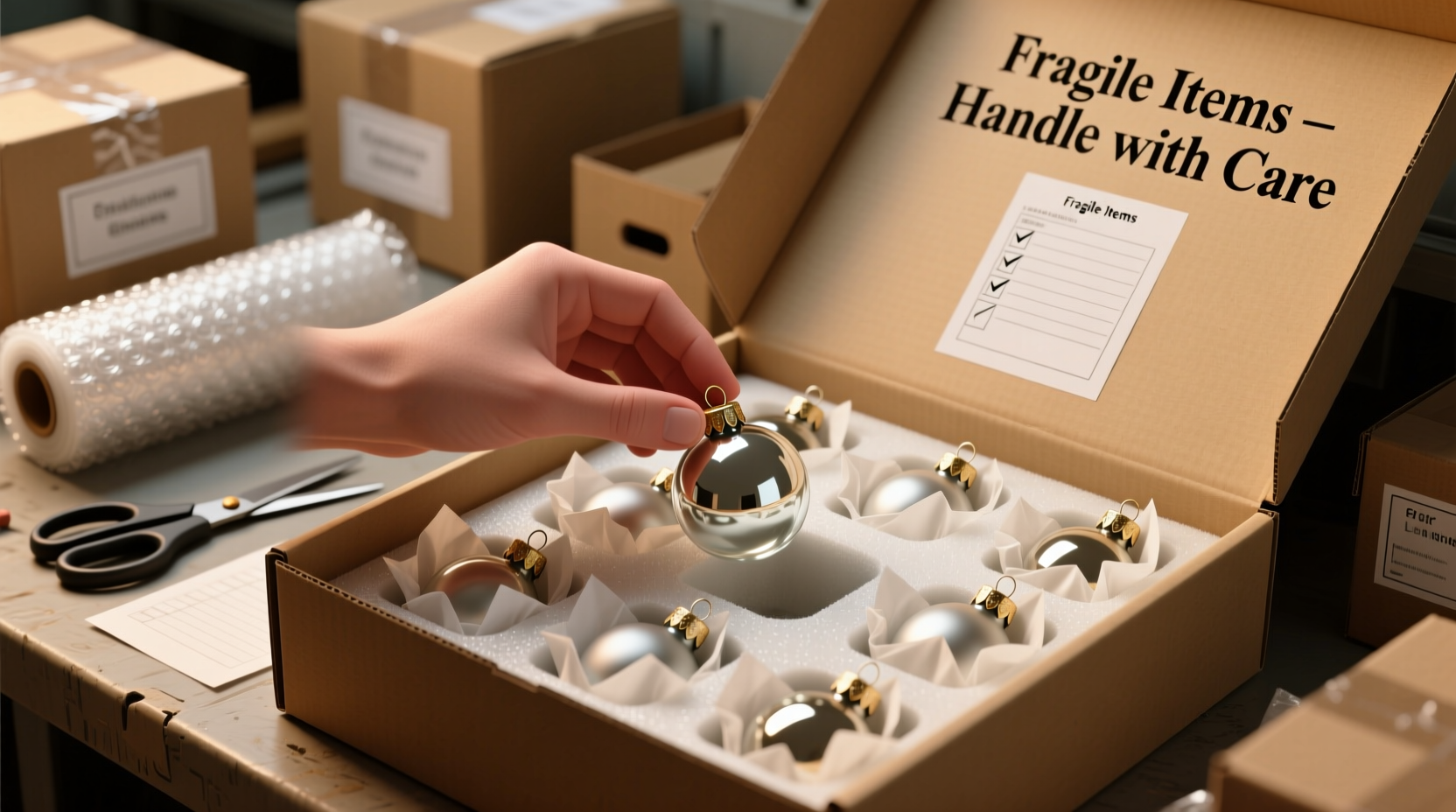
Most failed ornament packing stems from three fundamental misconceptions: first, that “soft” equals “protective”—cotton batting may feel gentle but offers no resistance to lateral pressure; second, that “filled space” equals “secure space”—over-stuffing a box creates internal friction and compression points; and third, that “original packaging” is sufficient—those thin cardboard dividers degrade over time and lack shock absorption. Real-world physics matters here. Glass ornaments don’t usually break from direct impact alone; they fracture under torsion (twisting), point-load pressure (e.g., a corner of another ornament pressing into a thin spot), or vibration-induced micro-fracture accumulation over long hauls. A 2022 study published in the Journal of Packaging Technology found that vertically stacked ornaments experience up to 4.2× more localized stress at contact points than horizontally nested ones—even when cushioned. That’s why professional art shippers never stack spherical objects directly atop one another. Instead, they isolate each item in its own suspension cradle—a principle you can replicate at home without specialty supplies.
Essential Supplies You Already Own (and What to Avoid)
You don’t need custom foam inserts or museum-grade crates. Effective ornament packing relies on accessibility, consistency, and function—not expense. Below is a curated list of what works—and what introduces hidden risks.
| Supply | Why It Works | Why to Avoid Alternatives |
|---|---|---|
| White, unprinted newsprint paper | Acid-free, non-abrasive, and highly conformable; molds gently around curves without scratching | Colored or glossy newspaper—ink transfers and acids accelerate metal hook corrosion |
| Small, rigid cardboard boxes (8\"x8\"x8\" or smaller) | Prevents overloading; allows precise layering; rigid walls resist crushing from external weight | Large moving boxes (e.g., 18\"x18\"x24\")—too much internal movement, harder to control weight distribution |
| Clean, lint-free cotton pillowcases or linen napkins | Natural fibers breathe, wick ambient moisture, and provide shear resistance without static | Terry cloth towels—abrasive loops snag painted surfaces; polyester blends generate static |
| Archival-quality tissue paper (optional upgrade) | pH-neutral, buffered against acid migration; ideal for metallic finishes and gilded details | Standard tissue paper—often contains lignin and optical brighteners that yellow and stain over time |
| Low-tack painter’s tape | Holds paper layers in place without residue; safe for painted or lacquered surfaces | Duct tape or packing tape—leaves adhesive residue that etches into delicate coatings |
The 5-Step Nesting Method: A Proven System for Zero-Breakage Packing
This technique mirrors how conservators package fragile ceramics for museum transport. It prioritizes individual isolation, directional stability, and load dispersion—not just cushioning. Follow precisely.
- Sort and inspect: Group ornaments by size, weight, and fragility—not by color or theme. Discard any with existing hairline cracks, loose hooks, or compromised bases. Note: If an ornament has a bent or corroded metal hook, replace it *before* packing using brass or nickel-plated replacements (steel rusts and stains).
- Wrap individually: Lay one sheet of newsprint flat. Place ornament diagonally near one corner. Fold the nearest corner over the top, then fold the opposite corner tightly underneath—creating a snug, diamond-shaped cocoon. Secure with one small piece of painter’s tape across the seam. Repeat for every ornament. Do not twist or compress during wrapping.
- Create a base nest: Line the bottom of your small box with a 1-inch-thick pad of crumpled newsprint. Then, arrange wrapped ornaments in a single layer—spaced at least ½ inch apart—like eggs in a carton. Fill gaps between them with more crumpled paper, pressing gently to lock positions *without squeezing*.
- Add vertical dividers: Cut stiff cardboard into 2-inch-wide strips, tall enough to exceed the height of your first layer by 1 inch. Stand them upright between rows to form compartments. This prevents lateral shifting during lifting or tilting. Top with another ½-inch pad of crumpled paper before adding a second layer—nesting each new ornament directly above the gap between two below (like brickwork).
- Seal and label decisively: Close the box firmly. Seal all seams with low-tack tape. Label boldly on all six sides: “FRAGILE • ORNAMENTS • THIS SIDE UP • NO STACKING”. Add weight: keep boxes under 12 lbs total—ornaments are dense, and heavy boxes invite improper handling.
Real-World Validation: The Henderson Family Case Study
In December 2023, the Henderson family moved from Portland, Oregon, to Asheville, North Carolina—a 3,200-mile, 11-day van shipment including 147 ornaments spanning five generations. Their collection included 1920s Bohemian glass, 1950s hand-blown Swedish stars, and a 1978 ceramic nativity set with detachable shepherd staffs. Previous moves had cost them seven broken pieces—most lost during unpacking due to brittle glue joints weakened by vibration. This time, they applied the nesting method described above, using only recycled newsprint, repurposed cereal boxes cut into dividers, and cotton napkins from their kitchen drawer. They packed 12 boxes—each holding 12–14 ornaments—and shipped them via a carrier specializing in high-value household goods. Upon arrival, every ornament was intact. The critical difference? They skipped the “stuff-it-full” instinct. One box held just nine ornaments—but with 2.5 inches of settled crumpled paper beneath and above the single layer, eliminating inter-object pressure entirely. As Sarah Henderson noted in her follow-up email to a local moving consultant: “We spent 90 minutes on one box—and it saved us heartbreak. It wasn’t about speed. It was about respect for the objects.”
“Glass doesn’t fail from impact alone—it fails from constraint. When you eliminate movement *between* items and prevent point-load transfer, you remove the primary failure mechanism. That’s physics, not magic.” — Dr. Lena Torres, Materials Conservation Scientist, Smithsonian Institution Archives
Special Considerations for High-Risk Ornament Types
Not all ornaments pose equal risk. Tailor your approach to material behavior:
- Metallic-finish glass (e.g., mercury glass, tinsel-coated balls): These have micro-scratches invisible to the eye that become stress concentrators. Wrap in archival tissue *under* newsprint to buffer surface contact. Never allow two metallic surfaces to touch—micro-abrasion occurs even in transit.
- Hand-painted porcelain or ceramic: Pigments sit in fragile glaze layers. Avoid any wrapping that requires bending paper tightly around edges—use the diagonal fold method only, and never crease paper over painted details.
- Ornaments with protruding elements (wings, halos, wire hangers): Stabilize protrusions first. Slip a short segment of drinking straw over thin wire hangers before wrapping. For wings or halos, cut tiny cardboard braces (L-shaped) and tape them lightly to the box interior to hold the ornament upright—never brace against another object.
- Vintage plastic (Bakelite, celluloid): Highly susceptible to cold-embrittlement. If moving in sub-40°F temperatures, add a thermal buffer: place the fully packed small box inside a slightly larger box lined with wool felt or a folded wool blanket—not fleece or synthetic insulation, which traps condensation.
FAQ: Practical Questions Answered
Can I reuse last year’s ornament storage box?
Only if it’s structurally sound: no crushed corners, no warped dividers, and no lingering odor (musty or chemical smells indicate off-gassing that can tarnish metals or cloud glass). Inspect divider slots—if they’re widened or splintered, replace the entire insert. Cardboard fatigue is real: after three seasons, rigidity drops by ~60%.
What’s the safest way to pack ornaments with ribbon or fabric bows?
Remove bows entirely. Ribbons compress, shift, and introduce uneven pressure points. Store bows separately in a labeled zip-top bag tucked into the same box—but never attached. Reattach after unpacking. If the bow is permanently affixed and delicate, wrap the entire ornament in a loose cotton pillowcase first—then proceed with newsprint wrapping.
Should I insure my ornaments separately with the moving company?
Yes—if their collective value exceeds $100. Standard moving valuation covers just $0.60 per pound—not item value. For irreplaceable pieces, request “full-value protection” and document each ornament with photos, descriptions, and estimated replacement cost *before* packing. Keep documentation digital and physical.
Conclusion: Honor Memory Through Intentional Care
Packing fragile Christmas ornaments isn’t about perfection—it’s about presence. It’s the quiet attention you give to a glass ball your grandmother hung on her first married tree, or the deliberate pause before wrapping a child’s kindergarten clay reindeer. Every folded sheet of paper, every measured gap between objects, every clearly labeled box is a tangible act of stewardship. You’re not just preventing breakage; you’re preserving narrative continuity—the unbroken thread from one home to the next, one generation to the next. This level of care doesn’t require expertise—only willingness to slow down, observe closely, and prioritize integrity over speed. Start with one box this week. Use what you have. Apply the nesting method exactly once. Feel the difference in weight, in stillness, in confidence. Then do it again. Your future self—unwrapping those ornaments in a new living room, sunlight catching their facets just so—will thank you not for saving glass, but for safeguarding meaning.




 浙公网安备
33010002000092号
浙公网安备
33010002000092号 浙B2-20120091-4
Comments
No comments yet. Why don't you start the discussion?