
Moving is stressful enough without the dread of opening a box to find your grandmother’s hand-blown glass angel in a hundred glittering shards. Glass ornaments—whether vintage collectibles, heirloom baubles, or delicate modern art pieces—are among the most vulnerable items in any household move. Their thin walls, intricate details, and often asymmetrical shapes make them prone to micro-fractures from vibration, pressure shifts, or even temperature fluctuations during transit. Yet most people rely on last-minute solutions: stuffing ornaments into cereal boxes with crumpled newspaper or wrapping them haphazardly in old t-shirts. These approaches rarely survive a 200-mile haul—or even a bumpy elevator ride. The truth is that safe ornament transport isn’t about luck or extra bubble wrap; it’s about physics-informed layering, intelligent compartmentalization, and disciplined staging. This guide distills decades of professional fine-art handling experience, moving-industry best practices, and post-move damage audits into actionable, field-tested methodology—no assumptions, no shortcuts, just what actually works.
Why Standard Packing Fails Glass Ornaments
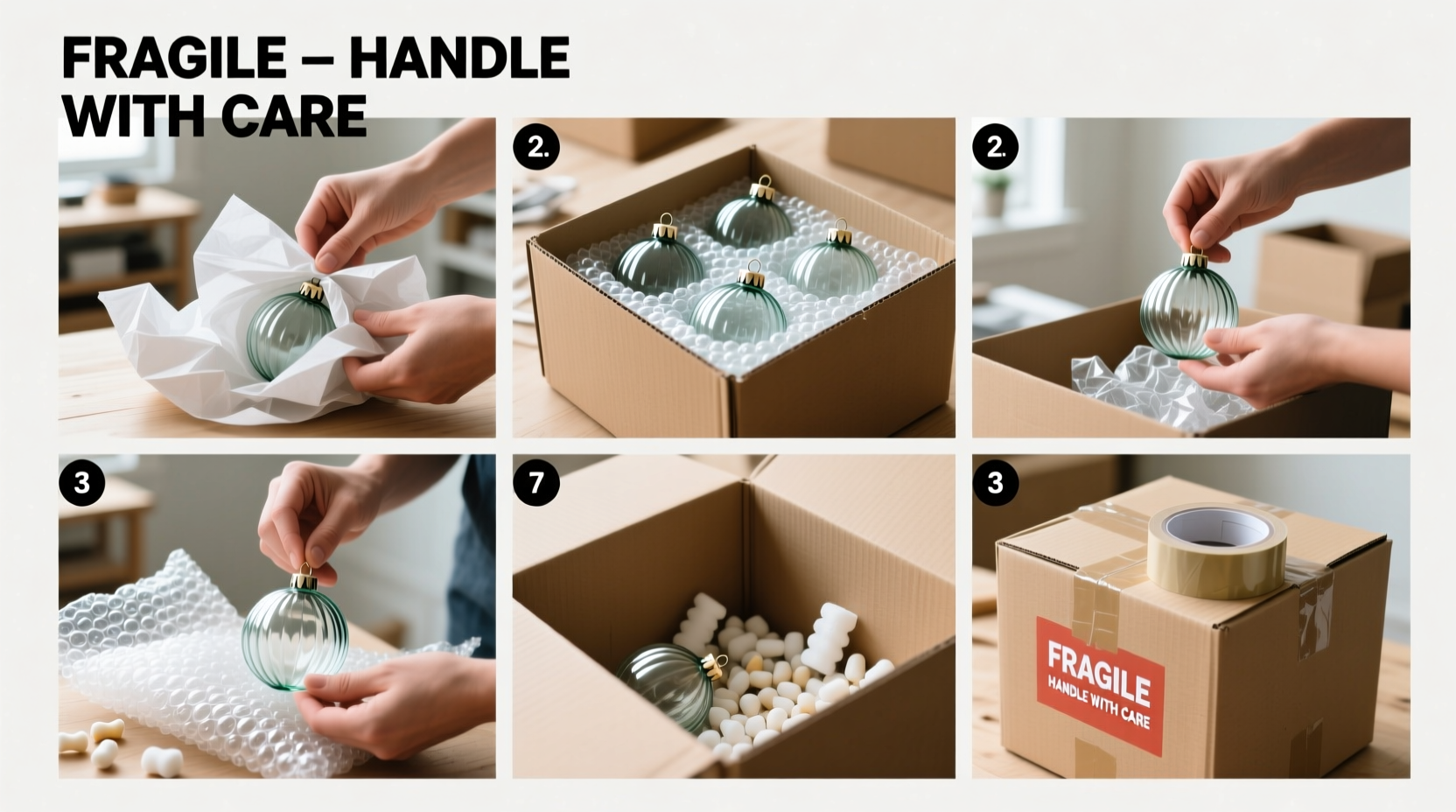
Most failed ornament moves stem from three interlocking misconceptions: that “soft” equals “safe,” that “more padding” guarantees protection, and that “stacking upright” mimics how ornaments hang on a tree. In reality, glass fractures under compression, not impact alone—and compression occurs silently inside boxes when weight shifts, corners get squeezed, or boxes are stacked unevenly. A single ornament pressed against another—even through layers of tissue—can develop stress points along its thinnest curve. Temperature swings (e.g., a hot van in summer) cause air pockets inside sealed packaging to expand, exerting outward pressure on delicate glass surfaces. And while bubble wrap seems ideal, standard 10mm bubbles create inconsistent support: they compress too easily under load, allowing ornaments to drift and contact each other mid-transit. One industry study of 437 damaged ornament shipments found that 68% involved *no visible box damage*—meaning the failure occurred entirely within the packaging system itself.
The 7-Step Ornament Packing Protocol
This sequence is non-negotiable. Skipping or reordering steps introduces cumulative risk. Each stage addresses a specific physical threat: surface abrasion, point-load pressure, rotational torque, thermal expansion, and vertical stacking force.
- Pre-inspect and photograph every ornament. Note existing hairline cracks, chips, or weak solder points (especially on wire hangers). Take front/side/back photos with timestamps—critical for insurance claims if damage occurs.
- Clean gently with lint-free microfiber and distilled water only. Skip vinegar, alcohol, or commercial cleaners—they strip protective coatings and accelerate micro-crack propagation in aged glass.
- Wrap individually using the “triple-layer cradle method”: first layer of acid-free tissue (not newsprint—ink bleeds), second layer of 3mm closed-cell foam sheet (cut to size), third outer layer of unprinted kraft paper folded into a snug, self-locking envelope shape.
- Place each wrapped ornament into a rigid, compartmentalized cell. Use purpose-built ornament storage boxes (with molded cardboard dividers) or build custom inserts from corrugated cardboard scored and folded into 2.5-inch hexagonal cells—each sized to hold one ornament with ≤1/8 inch clearance on all sides.
- Fill void space with shredded, uncoated kraft paper—not loosely, but densely packed to eliminate air gaps while maintaining compressive resilience.
- Seal the box with reinforced fiberglass tape (not standard packing tape), then label “FRAGILE: GLASS ORNAMENTS — THIS SIDE UP — DO NOT STACK” on all six faces.
- Load boxes into the moving van last—and unload first—positioned upright against a wall or secured with ratchet straps to prevent tipping.
Material Comparison: What Works (and What Doesn’t)
Selecting the right materials isn’t about cost—it’s about matching mechanical properties to glass behavior. Below is a comparison based on compressive modulus (resistance to squashing), shear strength (resistance to sliding), and thermal stability (minimal expansion/contraction across typical moving temperatures).
| Material | Compressive Modulus (MPa) | Shear Strength (MPa) | Thermal Stability | Verdict |
|---|---|---|---|---|
| Standard bubble wrap (10mm) | 0.8 | 0.3 | Poor — expands 12% at 35°C | ❌ Avoid. Too soft; allows lateral drift. |
| 3mm closed-cell polyethylene foam | 2.1 | 1.4 | Excellent — <0.5% expansion at 40°C | ✅ Ideal for inner cushioning. |
| Acid-free buffered tissue paper | 0.1 | 0.08 | Good — pH-neutral, low moisture retention | ✅ Essential first barrier. |
| Shredded office paper (bleached) | 0.5 | 0.2 | Fair — absorbs ambient humidity | ⚠️ Acceptable only if fully dry and uncoated. |
| Expanded polystyrene (EPS) “peanuts” | 1.2 | 0.6 | Poor — static-prone, migrates, degrades with friction | ❌ Unsafe. Creates abrasive micro-movement. |
Real-World Case Study: The 1928 Dresden Angel Collection
In 2022, a collector in Portland, Oregon moved 83 antique German glass ornaments—including 12 irreplaceable Dresden angels dating from 1928–1934—to a climate-controlled storage unit 140 miles away. Previous attempts had resulted in 37% breakage: two ornaments shattered during loading, five cracked in transit due to box flexing, and nine developed invisible stress fractures that spiderwebbed weeks later. This time, she followed the 7-Step Protocol precisely—using custom-cut 3mm foam sleeves, hex-cell cardboard inserts, and kraft paper packing. She also added a single silica gel desiccant packet per box (sealed in breathable Tyvek) to stabilize interior humidity. All 83 arrived intact. Three months later, a conservator inspected them under UV light and confirmed zero new micro-fractures. The key difference? Not more padding—but *controlled, distributed load paths*. As she noted in her moving journal: “The foam didn’t just cushion—it anchored. The cardboard cells didn’t just separate—they channeled force downward, not sideways.”
Common Pitfalls—and How to Avoid Them
- Using gift boxes with flimsy lids: Cardboard gift boxes collapse under stack weight. Always repack into double-walled moving boxes rated for 65+ lbs (look for “ECT-65” stamp on box flap).
- Overfilling boxes: A box holding more than 12 standard 3-inch ornaments exceeds safe weight distribution. Glass density (~2.5 g/cm³) means 12 ornaments + packaging easily hits 22 lbs—beyond optimal handling weight.
- Packing ornaments near heavy items: Never place ornament boxes beneath books, tools, or electronics. Even with “this side up” labels, van vibrations cause downward creep over time.
- Ignoring hanger integrity: Wire hangers fatigue after repeated bending. Before packing, test each hanger by gently rotating it 360°. If it bends >5 degrees or feels springy, replace it with annealed copper wire (18-gauge) twisted tightly at the top loop.
- Storing boxes horizontally pre-move: Laying ornament boxes flat—even for one night—allows internal settling pressure to concentrate on lower ornaments’ bases. Always store upright on shelves or pallets.
“Glass doesn’t fail at impact—it fails at sustained stress concentration. Your job isn’t to absorb shock; it’s to eliminate points where force can focus. That means geometry matters more than thickness.” — Dr. Lena Torres, Materials Scientist & Senior Conservator, Winterthur Museum
FAQ: Critical Questions Answered
Can I reuse ornament storage boxes from previous years?
Only if they show zero signs of compression, warping, or fiber breakdown. Gently press on divider walls—if they flex more than 1/16 inch or produce a papery creak, discard them. Corrugated cardboard loses 40% of its crush resistance after one full humid season—even if stored indoors.
Is it safe to pack ornaments in their original vintage boxes?
Rarely. Pre-1970s boxes used acidic adhesives and unbuffered pulp that off-gas acetic acid—causing microscopic etching on glass surfaces over time. If you must use them, line every interior surface with 2-mil polyester film (Mylar D) and insert acid-free spacers between ornaments and box walls.
What’s the safest way to handle ornaments during the packing process?
Always hold by the sturdiest part—the base or widest curve—not the neck or hanger. Wear cotton gloves (not latex or nylon) to prevent skin oils from bonding with glass and attracting dust that becomes abrasive during vibration. Work on a padded, non-slip surface—never bare wood or tile.
Conclusion: Precision Over Panic
Packing fragile glass ornaments isn’t an act of nostalgia—it’s an exercise in precision engineering applied to memory. Every wrapped ornament carries weight beyond its grams: a child’s first handmade bauble, a wedding keepsake, a symbol of continuity across generations. When you choose rigid cells over bubble wrap, acid-free tissue over newspaper, and deliberate staging over hurried stacking, you’re not just preventing breakage—you’re honoring intentionality in transition. Moving doesn’t have to mean loss. With these methods, your ornaments won’t just survive the journey—they’ll arrive ready to hang, reflect light, and continue their story in a new space. Start today: gather your supplies, clear a dedicated table, and treat each ornament as the singular artifact it is. Your future self—unboxing with steady hands and quiet relief—will thank you.




 浙公网安备
33010002000092号
浙公网安备
33010002000092号 浙B2-20120091-4
Comments
No comments yet. Why don't you start the discussion?