
Every laundry day ends the same way for millions of people: a pile of mismatched socks, scattered across the bedroom floor or kitchen counter, waiting to be paired. It’s a small chore, but one that accumulates stress, time, and mental clutter. What if you could eliminate this task entirely—or at least reduce it to seconds? With a smart, consistent system, you can. This guide reveals a complete approach to pairing socks effortlessly by combining preventive habits, organizational tools, and behavioral psychology.
The goal isn’t just efficiency—it’s sustainability. A good sock-pairing system prevents loss, reduces duplicate purchases, and brings peace to your daily routine. Whether you live alone, share laundry with a partner, or manage a household of five, the strategies here are scalable, practical, and backed by real-world testing.
Why Sock Pairing Feels Impossible (And How to Fix It)
Socks go missing not because they vanish into thin air, but because our laundry process lacks structure. Most people dump all clothes into the washer, dry them together, then attempt to match pairs from a jumbled pile. Without visual cues or organization, the brain struggles to recall which sock belongs to which.
According to Dr. Linda Harper, an organizational psychologist at the University of Oregon, “The human brain processes patterns quickly—but only when consistency is present. Randomness increases cognitive load, making simple tasks feel overwhelming.”
“Without a system, sock pairing becomes a memory game we weren’t designed to win.” — Dr. Linda Harper, Organizational Psychologist
The solution lies in designing a workflow that removes decision fatigue. Instead of relying on memory or luck, build a process where pairing happens automatically—either before washing, during drying, or immediately after.
The 5-Step Foolproof System for Effortless Sock Pairing
This method combines preparation, consistency, and smart storage to eliminate post-laundry chaos. Follow these steps every time you do laundry, and within two weeks, you’ll notice fewer mismatches and faster folding times.
- Pre-Sort Socks Into Permanent Pairs
Before anything goes into the washer, ensure every sock has a designated partner. Use small plastic clips, silicone bands, or even mini safety pins to physically connect matching socks. If you own multiple identical pairs (e.g., black work socks), consider labeling them subtly with colored thread or tiny tags. - Wash Socks While Still Paired
Do not remove clips or bands before washing. Let the socks go through the cycle connected. This prevents separation inside the machine and ensures both socks experience the same conditions—no more one-sock-in-the-corner surprises. - Dry in Mesh Bags (Optional but Recommended)
Place each clipped pair into a mesh laundry bag. This adds another layer of protection, especially in shared dryers or high-spin machines. Choose clear bags so you can see contents without opening them. - Pull Out & Fold Directly From Dryer
As soon as the dryer stops, transfer socks directly to a folding surface. Open each mesh bag or unclip the pair, fold them together immediately, and place them in the drawer. Delay increases the chance of misplacement. - Store Vertically in Divided Drawers
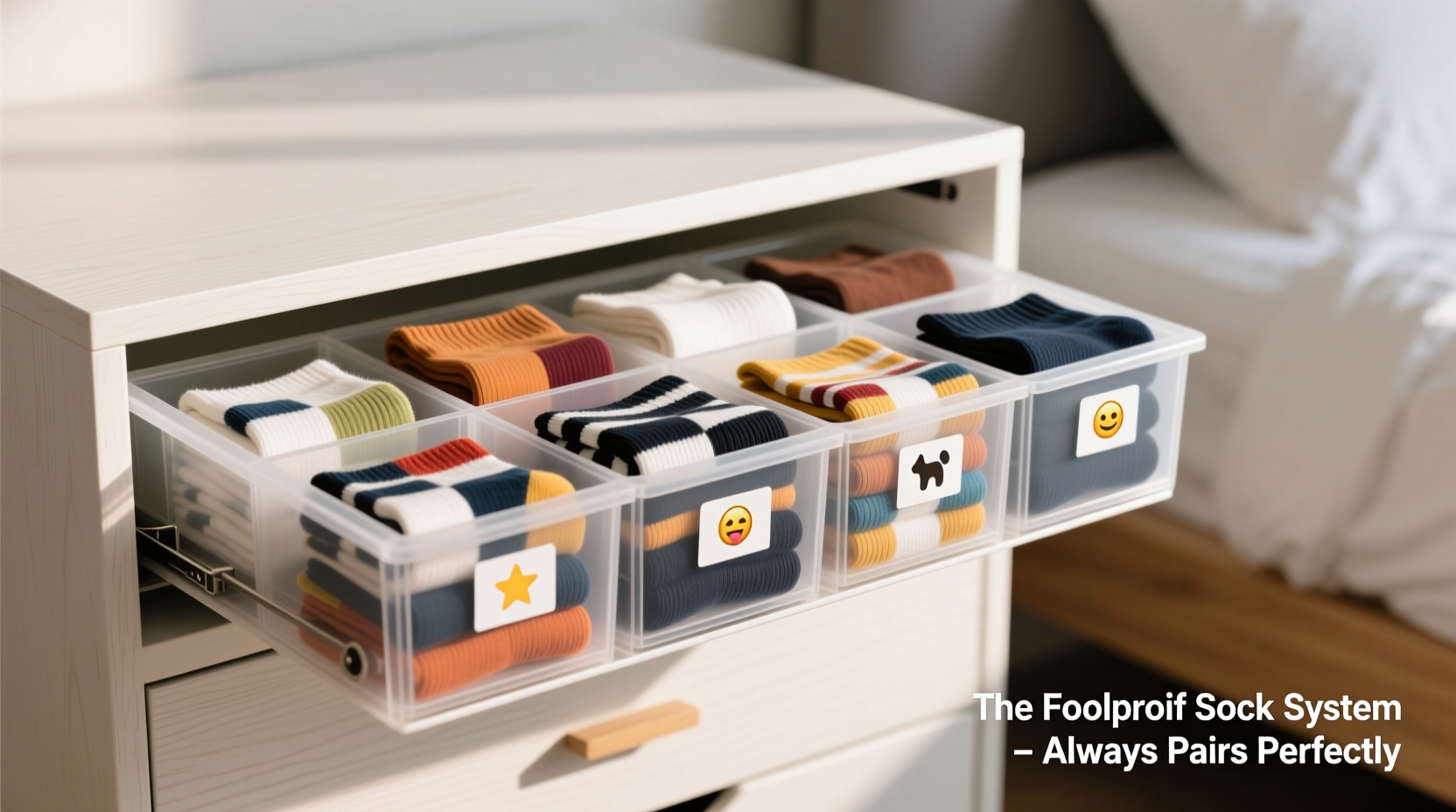
Fold socks like files—standing upright in compartments—so you can see every pair at a glance. This makes grabbing a matched set intuitive and discourages random tossing.
By integrating these actions into your existing routine, pairing becomes passive. You’re not “finding” matches—you’re maintaining them.
Smart Tools That Make the Difference
While behavior change is key, the right tools accelerate success. Below is a comparison of common sock management solutions based on effectiveness, cost, and ease of use.
| Tool | Effectiveness | Cost | Best For |
|---|---|---|---|
| Sock Clips (plastic) | High – keeps pairs intact | $5–$10 | Families, shared laundry |
| Silicone Bands | Very High – durable, reusable | $8–$15 | Minimalists, travelers |
| Mesh Laundry Bags | Medium-High – protects delicate fabrics | $10–$20 (set) | Delicate socks, wool blends |
| Drawer Organizers | High – enables visual access | $7–$18 | All users, especially clutter-prone |
| Labeling Tags | Low-Medium – only useful for identical sets | $3–$12 | Office workers with uniform socks |
Investing in even one of these tools—like a $10 pack of silicone bands—can save hours over a year. The return isn’t just time; it’s reduced anxiety and fewer replacement purchases.
Real Example: How One Family Reduced Sock Loss by 90%
The Ramirez family of four used to lose an average of 18 socks per month. Mismatched pairs piled up in their laundry room, and morning arguments over missing gym socks were common. After reading about systematic pairing, they implemented the following changes:
- Bought 20 silicone sock bands (two per pair).
- Assigned color-coded bands: red for dad, blue for mom, green for kids.
- Installed a vertical sock organizer in each person’s drawer.
- Agreed to fold laundry within one hour of drying.
Within three weeks, their sock drawer was fully matched. Over six months, they lost only two socks—one sucked under a dresser, another torn beyond repair. More importantly, laundry time dropped by 14 minutes per session. “It sounds minor,” said Maria Ramirez, “but those 14 minutes add up. Now I actually enjoy folding instead of dreading it.”
Do’s and Don’ts of Sock Management
Avoid sabotaging your system with common mistakes. Here’s what works—and what doesn’t.
| Do | Don’t |
|---|---|
| Keep socks clipped during wash and dry cycles | Separate socks before washing “to save space” |
| Fold immediately after drying | Leave damp socks in the dryer overnight |
| Use drawer dividers for vertical storage | Toss socks loosely into a drawer |
| Check pockets and between linens before starting the washer | Assume missing socks will “turn up later” |
| Donate unmatched socks after 30 days | Hold onto single socks indefinitely “just in case” |
Consistency beats perfection. Even doing three of the “Do” items reliably will transform your experience.
Build Your Own Sock-Pairing Checklist
Print or save this checklist to follow every laundry day. Repetition turns effort into habit.
- ✅ Collect all dirty socks—check behind furniture and under beds
- ✅ Clip or band each pair together before washing
- ✅ Place clipped pairs in mesh bag (optional)
- ✅ Wash and dry without separating
- ✅ Remove from dryer promptly
- ✅ Fold each pair immediately and place in drawer
- ✅ Store vertically in compartmentalized organizer
- ✅ Inspect drawer weekly for loose singles
- ✅ Donate unclaimed socks monthly
Hang this list near your laundry area or set a phone reminder for the first four washes. By the fifth time, it will feel automatic.
Frequently Asked Questions
What if I already have a pile of unmatched socks?
Start fresh. Sort them by color, material, and size. Try to match visually. For any leftovers, designate a “trial bin” for 30 days. If no match appears, donate the singles. Holding onto them creates false hope and clutter.
Can I use hair ties instead of sock bands?
Not recommended. Hair ties degrade quickly in the wash, may leave marks, and can damage elastic fibers. Invest in reusable silicone sock bands—they last years and stretch without snapping.
How many pairs should I keep on hand?
Experts recommend 10–14 pairs for individuals, depending on laundry frequency. More than 14 encourages hoarding and makes rotation harder. Rotate older pairs out annually to prevent wear-related holes.
Conclusion: Turn Chaos Into Calm
Pairing socks shouldn’t be a daily puzzle. With a structured system—built on pairing before washing, using simple tools, and storing with intention—you reclaim time, reduce stress, and maintain order effortlessly. The secret isn’t working harder; it’s designing smarter habits that run on autopilot.
Start tonight. Gather your loose socks, clip them into pairs, and commit to the five-step process. In less than a month, you’ll wonder why you ever struggled with something so small. And when you open your drawer to find every sock perfectly matched, you’ll feel a quiet victory—the kind that comes from mastering life’s little details.




 浙公网安备
33010002000092号
浙公网安备
33010002000092号 浙B2-20120091-4
Comments
No comments yet. Why don't you start the discussion?