
In an age where digital privacy is increasingly important, securing sensitive files has become essential. Whether it's personal photos, financial records, or confidential work documents, keeping your data away from unauthorized eyes should be a top priority. While many turn to third-party encryption tools, few realize that their operating system already includes everything needed to password-protect a folder—no downloads required.
This guide walks through practical, reliable methods available natively in Windows, macOS, and Linux. These approaches use built-in features like compression utilities, disk image creation, and command-line tools to lock folders with passwords, ensuring your data stays private without cluttering your system with additional software.
Create a Password-Protected ZIP File (Windows & macOS)
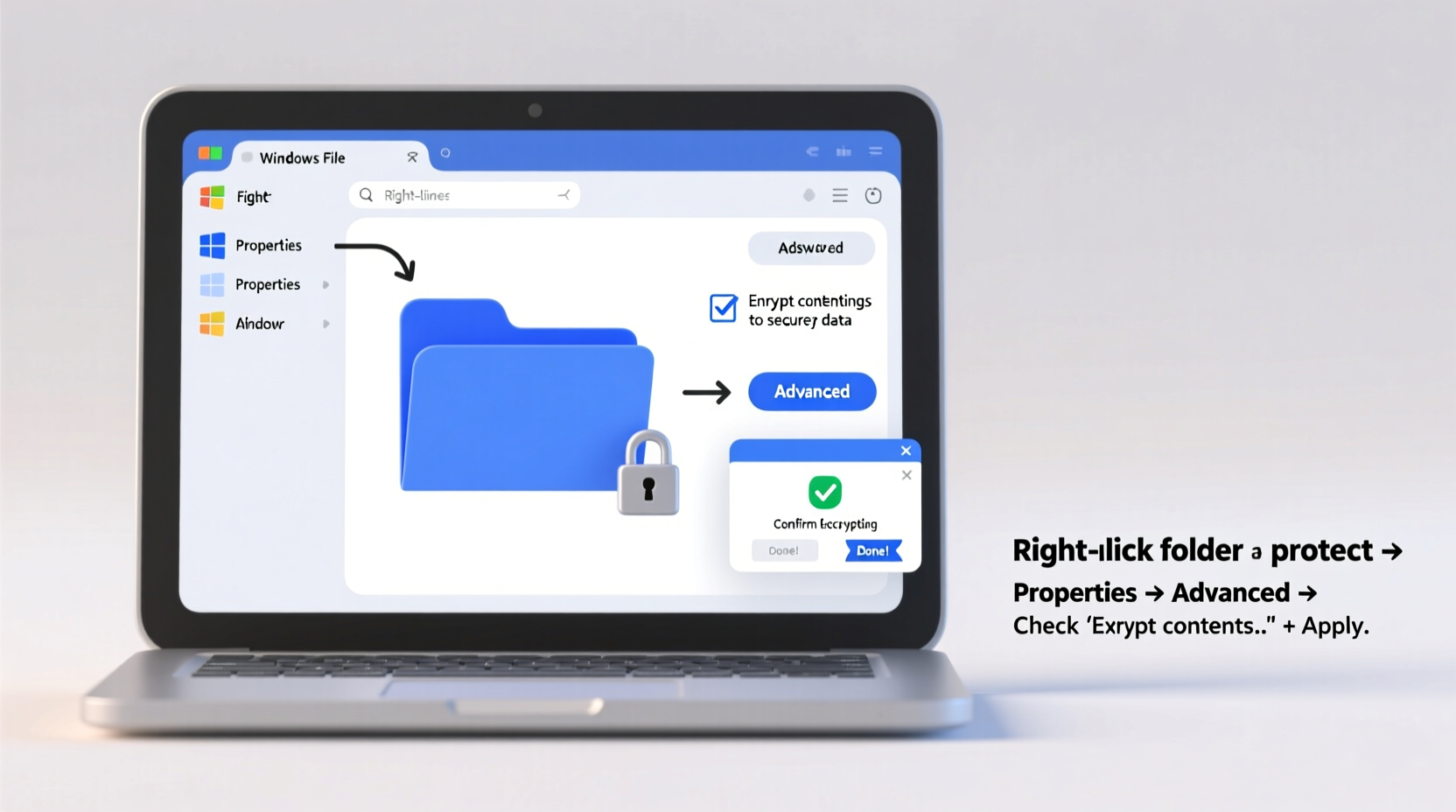
One of the simplest ways to secure a folder without installing new software is by compressing it into a password-protected archive. Both Windows and macOS support ZIP file creation, though only macOS natively allows setting a password during compression. However, you can work around this limitation on Windows using built-in Command Prompt tools.
On macOS, right-click the folder, select “Compress,” then use Terminal to encrypt the resulting .zip file:
- Right-click the folder and choose \"Compress [Folder Name]\"
- Open Terminal
- Type:
zip -er archive_name.zip /path/to/folder/* - Enter and confirm your password when prompted
The -e flag enables encryption; the -r ensures all contents are included recursively. This creates a secure, portable archive accessible only with the correct password.
For Windows users, native ZIP support doesn’t include encryption—but there’s a workaround using PowerShell and the .NET Framework:
- Ensure your folder is ready for archiving
- Open PowerShell as Administrator
- Run this script:
Add-Type -AssemblyName System.IO.Compression.FileSystem
$password = Read-Host \"Enter password\" -AsSecureString
$marshal = [Runtime.InteropServices.Marshal]
$bstr = $marshal::SecureStringToBSTR($password)
$plainPassword = $marshal::PtrToStringBSTR($bstr)
$marshal::ZeroFreeBSTR($bstr)

[IO.Compression.ZipFile]::CreateFromDirectory(
    \"C:\\Path\\To\\Your\\Folder\",
    \"C:\\Path\\To\\Output\\SecureArchive.zip\",
    [IO.Compression.CompressionLevel]::Optimal,
    $false
)

# Note: True ZIP encryption isn't supported here — use 7-Zip alternative below if strong security is critical.
Use Encrypted Disk Images on macOS
macOS offers one of the most robust native solutions: creating encrypted disk images via Disk Utility. This method turns any folder into a secure container that mounts as a virtual drive when opened with the correct password.
Here’s how to do it:
- Open Disk Utility (found in Applications > Utilities)
- Go to File > New Image > Image from Folder
- Select the folder you want to protect
- Choose a name and save location for the disk image (.dmg file)
- Set Encryption to 128-bit AES or 256-bit AES
- Select Read-only or Read/Write depending on future edit needs
- Click Save and enter a strong password
Once created, double-clicking the .dmg file prompts for a password before mounting it as a drive on your desktop. When finished, eject it just like a USB stick.
This approach is especially useful for backing up sensitive data or transferring files securely across devices. The encryption uses Apple’s trusted Common Crypto library, making it resistant to brute-force attacks when paired with a strong password.
“Encrypted disk images are among the most underused yet effective security tools built into macOS.” — Sarah Lin, Cybersecurity Analyst at OpenGate Labs
Password Protection Using Batch Scripts (Windows Only)
Windows users can leverage batch scripting and folder attribute manipulation to create a pseudo-password-protected folder. While not true encryption, this method hides and locks access to a folder using native CMD commands.
Important: This technique relies on hiding and renaming the folder rather than encrypting its contents. It deters casual snooping but isn’t suitable for high-security scenarios.
To set it up:
- Create a new text file in the parent directory where you want the protected folder
- Name it
Locker.bat - Edit it with Notepad and paste the following script:
cls
@echo off
if exist \"ControlPanel.{21EC2020-3AEA-1069-A2DD-08002B30309D}\" goto UNLOCK
if NOT exist Locker goto MDLOCKER
:CONFIRM
echo Are you sure you want to lock the folder? (Y/N)
set/p \"cho=>\"
if %cho%==Y goto LOCK
if %cho%==y goto LOCK
if %cho%==n goto END
if %cho%==N goto END
goto CONFIRM
:LOCK
ren Locker \"ControlPanel.{21EC2020-3AEA-1069-A2DD-08002B30309D}\"
attrib +h +s \"ControlPanel.{21EC2020-3AEA-1069-A2DD-08002B30309D}\"
echo Folder locked
goto End
:UNLOCK
echo Enter password to unlock:
set/p \"pass=>\"
if NOT %pass%==yourpasswordhere goto FAIL
attrib -h -s \"ControlPanel.{21EC2020-3AEA-1069-A2DD-08002B30309D}\"
ren \"ControlPanel.{21EC2020-3AEA-1069-A2DD-08002B30309D}\" Locker
echo Folder unlocked successfully
goto End
:FAIL
echo Invalid password.
goto end
:MDLOCKER
md Locker
echo Locker created successfully
goto End
:End
- Replace
yourpasswordherewith your desired password - Save the file
- Double-click
Locker.batto create a folder named “Locker” - Move sensitive files into the Locker folder
- Run the script again and confirm locking
After locking, the folder disappears from view unless you enable viewing of hidden and system files. To unlock, run the script and enter the password.
Linux: Create an Encrypted Archive with Tar and GPG
Linux users have powerful command-line tools at their disposal. Combining tar for archiving and gpg (GNU Privacy Guard), which comes preinstalled on most distributions, allows full encryption of any folder.
Follow these steps:
- Open Terminal
- Navigate to the directory containing your target folder:
cd /path/to/directory- Create and encrypt the archive in one step:
tar -czf - sensitive_folder/ | gpg --cipher-algo AES256 -c > folder_backup.tar.gz.gpg- Enter and confirm a strong passphrase when prompted
To decrypt later:
gpg -o folder_backup.tar.gz -d folder_backup.tar.gz.gpg
Then extract:
tar -xzf folder_backup.tar.gz
This method provides military-grade encryption using AES-256, making it nearly impossible to crack without the passphrase. Since GPG is part of most Linux systems’ core toolset, no installation is necessary.
| Method | Security Level | Best For | Reversibility |
|---|---|---|---|
| Password-Protected ZIP (macOS Terminal) | Moderate | Simple sharing, light protection | High – standard extraction |
| Encrypted DMG (macOS) | High | Backups, long-term storage | High – mounts as drive |
| Batch Script (Windows) | Low to Moderate | Hiding from casual users | Medium – requires script execution |
| Tar + GPG (Linux) | Very High | Secure archival, compliance-sensitive data | High – decrypt & extract |
Real-World Example: Protecting Family Tax Documents
Consider Maria, a freelance accountant who stores years of client tax returns on her laptop. She works from home and shares internet access with family members. While she trusts them, she wants to ensure no one accidentally opens or deletes sensitive files.
Maria decides to use the encrypted disk image method on her MacBook. She gathers all tax folders into one directory called “Client Records 2020–2024,” then follows the Disk Utility process outlined earlier. She sets a strong 14-character password stored only in her password manager.
Now, whenever she needs to access the files, she double-clicks the .dmg file, enters her password, and works normally. When done, she ejects the virtual drive. Even if someone gains physical access to her computer while it’s off, the data remains encrypted and inaccessible without the password.
This solution gives her peace of mind without slowing down her workflow or requiring subscriptions to external tools.
Frequently Asked Questions
Can I password-protect a folder directly in Windows Explorer?
No, Windows does not allow direct password protection of folders through Explorer. However, you can use NTFS permissions to restrict user access or employ workarounds like batch scripts or encrypted ZIPs via third-party tools. For zero-installation options, the batch method described above is the closest native equivalent.
Is a password-protected ZIP file truly secure?
It depends on the method used. ZIP files created via macOS Terminal with zip -e use PKWARE encryption, which is vulnerable to known weaknesses. For better security, use 7-Zip (if allowed) or opt for stronger formats like encrypted DMG or GPG-encrypted tarballs. If maximum security is required, avoid standard ZIP encryption.
What happens if I forget my password?
You will permanently lose access to the contents. None of the methods described here include password recovery mechanisms. Always store your passwords securely in a trusted password manager and consider writing down backups in a physically secure location (e.g., locked safe).
Final Checklist: Securing Your Folder Without Extra Software
- ✅ Identify the folder and files you need to protect
- ✅ Choose the appropriate method based on your OS (DMG for macOS, GPG for Linux, batch script or ZIP for Windows)
- ✅ Use a strong, unique password (at least 12 characters, mix of letters, numbers, symbols)
- ✅ Test unlocking the archive or container before deleting originals
- ✅ Store the password separately and securely
- ✅ Back up the encrypted file if needed
- ✅ Delete original unsecured files after successful encryption (use secure deletion if highly sensitive)
Conclusion: Take Control of Your Digital Privacy Today
Protecting your private data doesn’t require expensive software or complex configurations. With just a few clicks or commands, you can leverage the powerful tools already built into your operating system to safeguard sensitive information. Whether you're a Mac user creating encrypted disk images, a Linux enthusiast using GPG, or a Windows user scripting folder locks, the ability to maintain control over your files is within reach.
Start small—secure one folder today. Build the habit. Over time, organizing and protecting your digital life becomes second nature. In a world where data breaches and accidental exposures are common, taking proactive steps now can prevent serious consequences later.




 浙公网安备
33010002000092号
浙公网安备
33010002000092号 浙B2-20120091-4
Comments
No comments yet. Why don't you start the discussion?